Rod Bantjes, “Genus_Indoor_Cosmorama.html,” created 26 August, 2026; last modified, 26 August, 2026(https://people.stfx.ca/rbantjes/).
Indoor-Cosmorama Genus (ca. - )
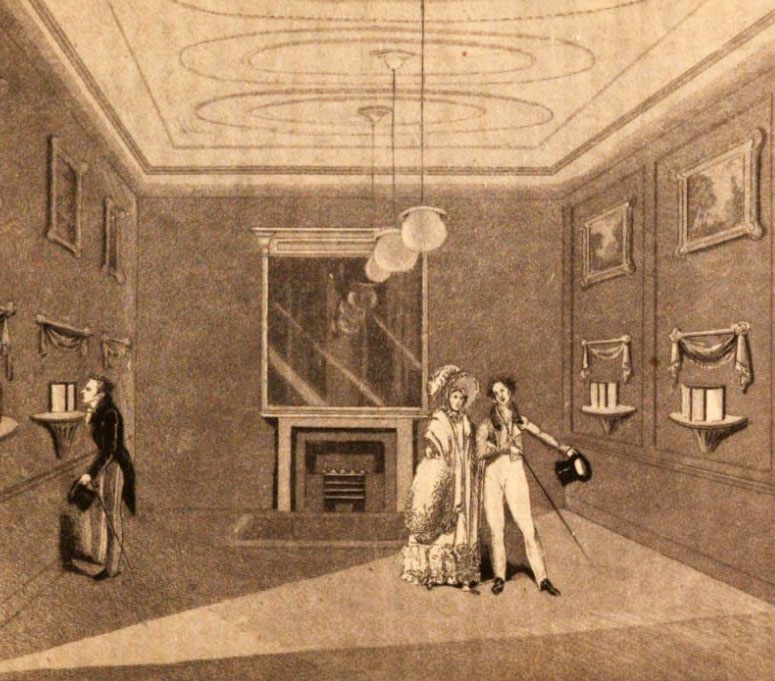 |
Figure BA-24.1 –Cosmorama, St. James's Street, London |
| Source: Blunt, C. “Popular Description of the Cosmorama.” La Belle Assemblée 24, no. 155 (1821): 233. |
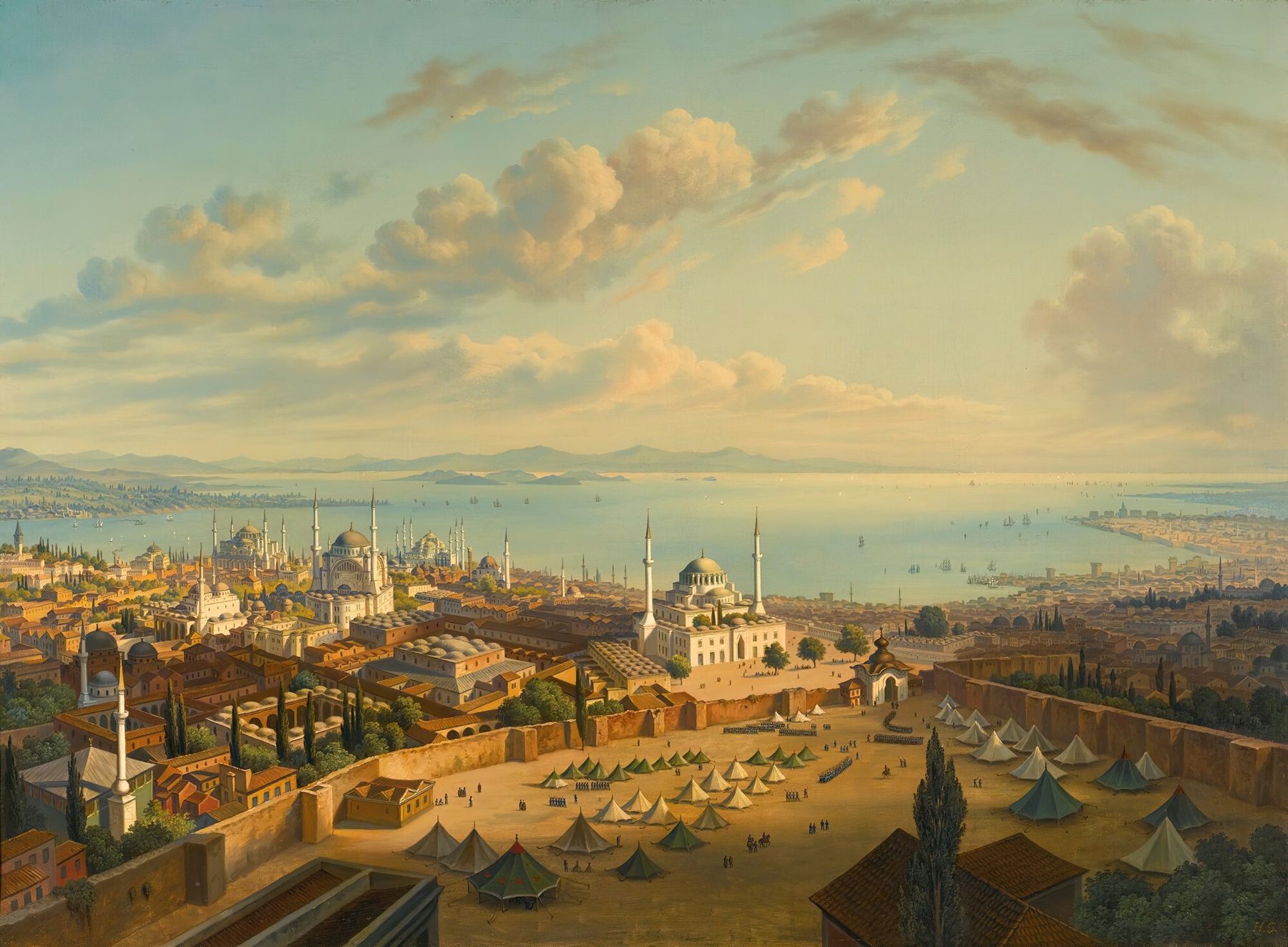 |
Figure BA-24.2 – Cosmorama Painting |
| Hubert Sattler, Constantinople From The Fire Tower Of Beyazit, oil on canvas, 74 x 101.5 cm. . |
The Indoor Cosmorama was a public picture gallery with lensed viewing stations that enhanced the spatial illusion of paintings erected behind them. It is an example of an “optical machine ” and is included in the Optical Machine Taxonomy as one of five genuses of the cosmorama family.
The genus is distinguished from Outdoor Cosmoramas by being housed (if only temporarily) in permanent buildings.
It was an inter-media hybrid between the lowly raree show and the high-art salon or picture gallery.
We are tentatively defining three species of indoor cosmorama: painted cosmoramas; print cosmoramas and touring cosmoramas. Within these categories
2.0 Tentative Species:
2.1 Grand Cosmoramas:
Grand cosmoramas are indoor cosmoramas with paintings over a meter wide viewed from behind clusters of multiple lenses per viewing station.
The size of the image, or rather the corresponding distance from the viewing-lens, made a difference to the viewing effect. For this reason it is a fitting characteristic to distinguish species. We have chosen a cut-off size of a meter in width to define the Grand Cosmorama. There were no prints of that size in the 19th century, so these are all painted cosmoramas. Raree Shows sometimes had paintings of up to 61 cm, well below our cutoff. So far there are no records of indoor cosmoramas with paintings less than 1 meter in width.
We know that some of these cosmoramas had multiple lenses per viewing-station (e.g. the Regent Street Cosmorama). We also know of cosmoramas with single lenses (e.g. the Girona Cosmorama). Single-lens painted cosmoramas would be a separate species.
| • 1808-1832, Gazzera Cosmorama Palais Royal, Paris, 200 paintings, 203 x 121 cm. | ||
| • 1821-1823, Cosmorama Rooms, St. James Street, London. | ||
| • 1823-1851, Cosmorama Rooms, Regent Street, London. | ||
| • 1841, P.T. Barnum’s American Museum Cosmorama, New York. | ||
| • ca.1870-1937, Sattler’s Panorama and Cosmorama, Salzburg, H=100 x W=130 cm.[xxx] |
2.2 Print Cosmoramas:
These are indoor cosmoramas that exhibit prints rather than paintings.
The use of prints reduces the scale of the exhibition and takes a step away from the cosmorama’s original high-art pretensions.
| • 1857, Grand Cosmorama and Neorama, Porto, Portugal, chromolithographs, 40.5 x 55.7 cm. |
2.3 Touring Cosmoramas:
These are cosmoramas that are transported from city to city and are temporarily housed in permanent buildings.
The logistics of touring would have affected the design of these cosmoramas, making the components easier to take down, package in crates and set up in unfamiliar locations.
| • 1828-1858, Andorfer’s Grand Optical Gallery, touring. |
Endnotes:
[xxx] Victor Flores ( "Hubert Sattler's Cosmorama." In Cosmorama: The Forgotten Medium, edited by Victor Flores and Susana S.Martins. Lisbon: CICANT, 2025, p. 75) gives a period depiction of the panorama and cosmorama building in Saltzburg, but no indication when it was active.