Rod Bantjes, “Genus_Mondo_Niovo.html,” created 27 November, 2025; last modified, 27 November, 2025 (https://people.stfx.ca/rbantjes/).
Mondo Niovo Genus (ca. 1750-1830)
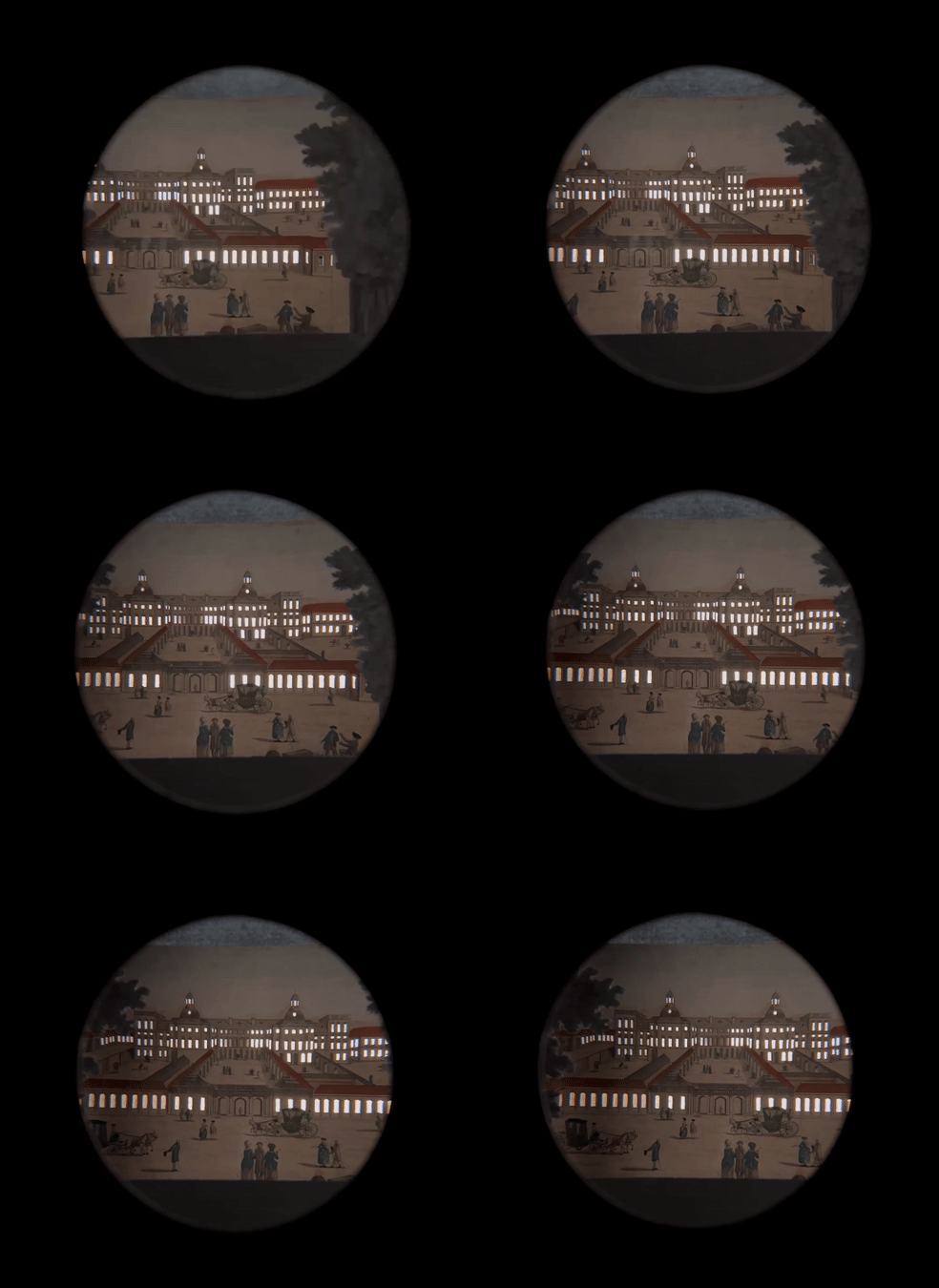 | ||||
Figure 69056.3 –Illuminated Vue d'Optique | ||||
| This is a view through the lens of an optical theatre I built.
Gif image © Rod Bantjes, 2025. |
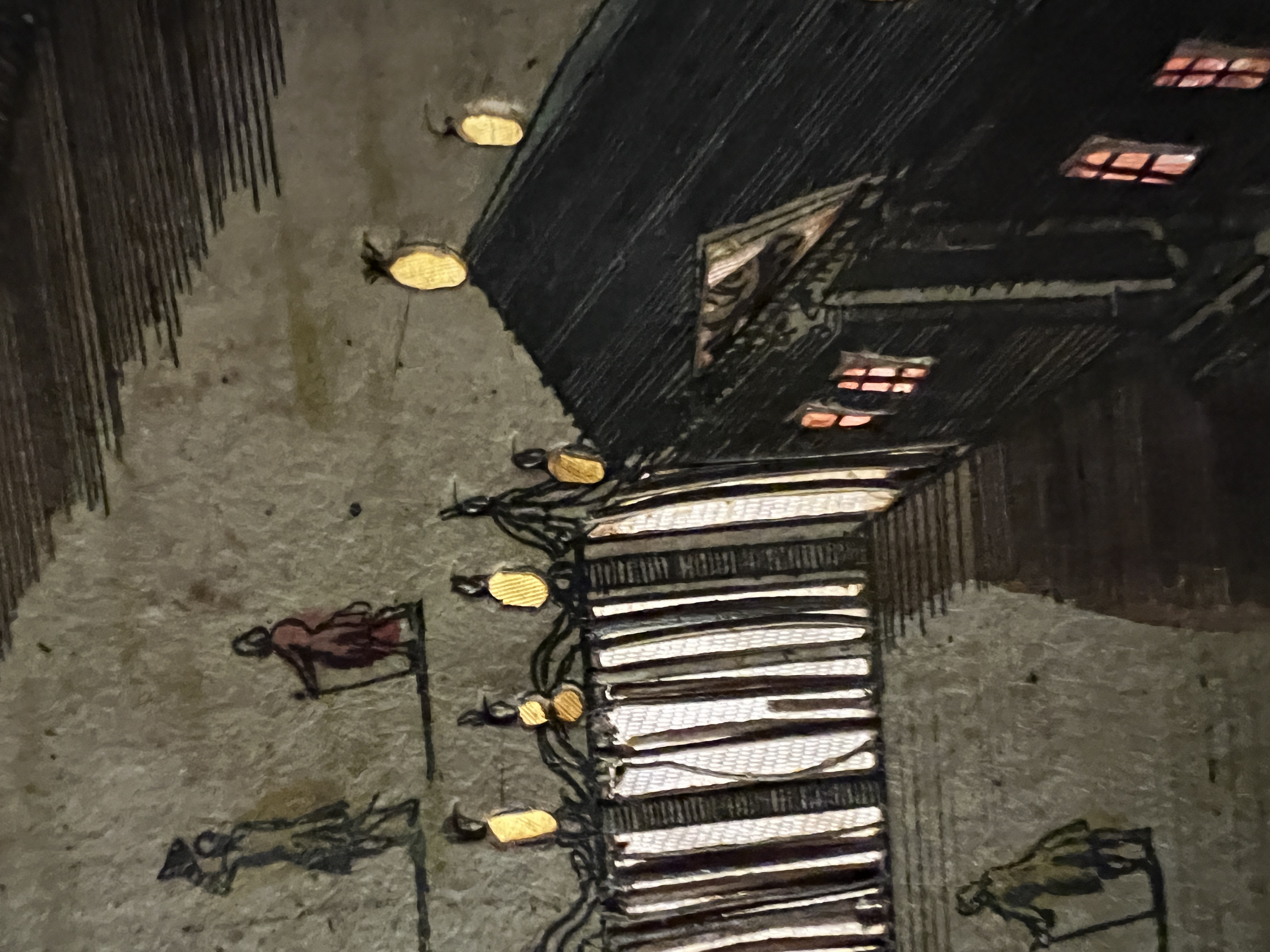 |
Figure DFF-88-A-724.5 – Back-Illumination |
| Detail of back-illuminated vue d'optique with coloured filters made of cloth. Photo © Ana Mendes. |
The Mondo Niovo[xxx] is an Italian style of show-box for pierced and back-illuminated vues d'optique. It is a genus of "optical machines" within the Optical Machine Taxonomy.
Travelling Shows: Like all show-boxes the Mondo Niovo was designed to be carried from place to place by itinerant showmen. However, it may not have moved much beyond the city limits of Venice, in contrast to the way that Raree Shows were toured to towns and villages in the countryside.[xxx] We know of at least two Mondo Niovos that were carried on the back (AP-19-3347 and MNC-M01035). However their size and weight, and the fact that they had to be accompanied by a wooden stand, meant that some (like the massive MNC-M01034) may have been conveyed in some form of hand-cart.[xxx]
Public performance: Show-boxes were designed and used for public performance. Performances took place in public spaces: on the street, or un-housed, and mostly for strangers in exchange for money or gifts (e.g. in some places in India bioscope wallahs could be paid in kind, or in the form of alms). Consequently multiple lenses are a central design feature, as more lenses allow for more paying customers in a given period of time.
Taxonomy: Show-boxes, like the Mondo Niovo, with pull-string mechanisms for raising and lowering images are part of the family of Pull-String Show-Boxes. These include the following genuses: Raree Show, Raek (Russia), Xihu jing jing (China and Japan) and Mondo Niovo (Italy). There are two known genuses of show-boxes with roll-mechanisms instead of flytowers or rigging: Bioscope (India) and Shahr-E Farang (Iran). All of these travelling shows for public performance are part of the taxonomic order "Show-box."
Translucent Vues d'Optique: The main thing that distinguishes the Mondo Niovo from other Raree Shows is the provision for front and back illumination using both artificial light (candles) and daylight. The experience of the back-illuminated night view (Figure DFF-88-A-724.5) was central to the Mondo Niovo performance. The building-in of artificial light-sources suggests that these boxes were commonly used in the evening or at night.
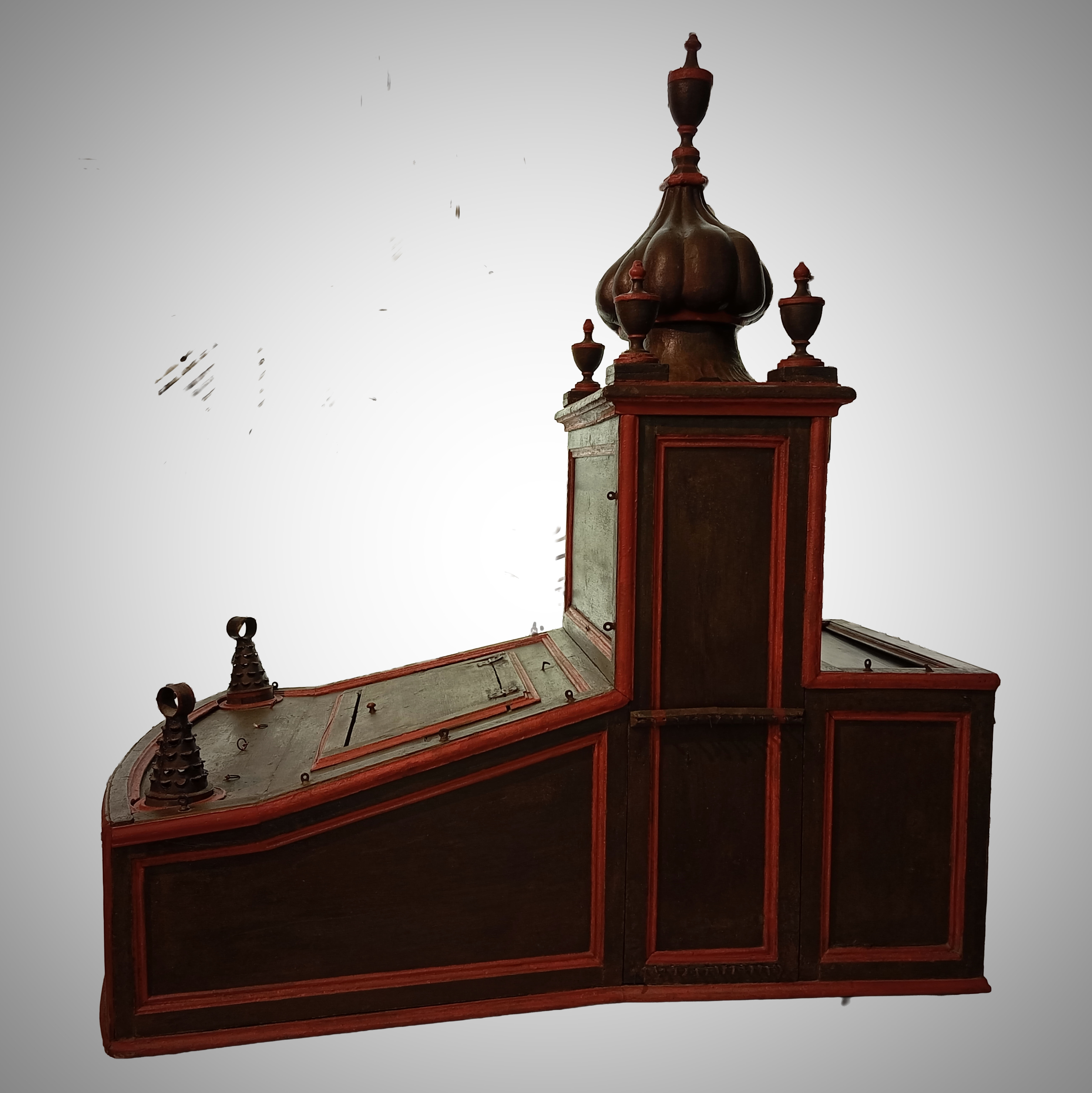 |
Figure MNC-M01033.2 – Profile |
| Typical profile of a Mondo Niovo. Photo © Ana Mendes. |
Structure: Mondo Niovos all have two artificial/natural light-boxes: one at the front and, very distinctively, one at the back (see Figure MNC-M01033.2). The back-extension places distance between the candle-flames and the paper images. The front candles are positioned behind the lens-array and are exhausted through characteristic chimneys. The Mondo Niovo pull-string mechanism takes the form of a flytower so that the unused vues d'optique hang above (rather than below) the exhibition stage. These three features give the box its characteristic profile (Figure MNC-M01033.2).
The defining features of the Mondo Niovo are:
| • Multiple lenses in a curved lens-array; | ||
| • a "stage" situated below a flytower; | ||
| • a front-section fanning out towards the lens-array; | ||
| • a downward-sloping cover from the top of the stage towards the lens-plate, and containing a hinged flap for front-illumination; | ||
| • A backstage area, lower than the flytower, and containing candle illumination and a top-flap that can be raised for back-illumination with natural light; | ||
| • candle-holders with chimneys behind the viewing-lenses for front-illumination. |
A curious feature shared by all of them (but not definitive of the genus) is the colour. All were originally green, including MNC-M01023 which was later over-painted brown. The only colour-illustration we have of one depicts it too as green (Figure MN.5 below). Why this uniformity? What was the meaning of green? Coincidentally, perhaps, Henri Lefort's boxes of the mid 19th century were also papered, with few exceptions, in green. Could Lefort have fallen in love with the lighting effects of a Mondo Niovo and modelled his hand-held "boîtes dioramique" after them?
While the basics of Mondo Niovo design followed a clear standard, each box appears to have been a one-off construction, built perhaps by the show-person him/herself, and exhibits peculiarities of style and decoration. So far we have identified three species grouped by row in the following tables.
| Binocular | 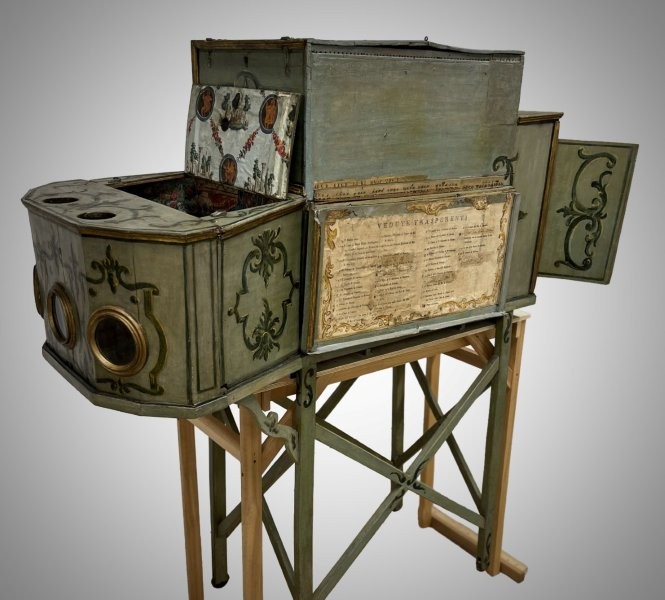 |
| Mondo Niovo Binocular |
This is a large, highly-ornate box with three lenses large enough to look into with both eyes. The other examples in this list have lenses slightly smaller than 6 cm – difficult to see through with both eyes and therefore lacking the more plausible 18th-century 3D effect.
| Three-Lens: | 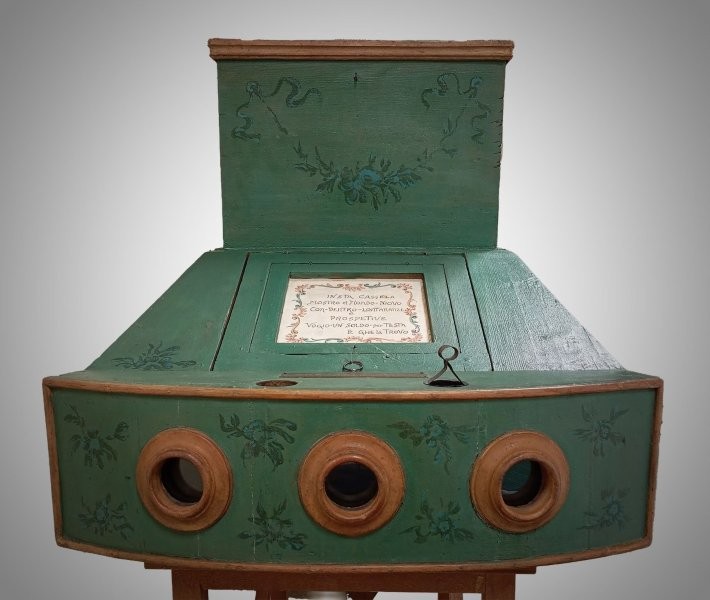 |
| 3-Lens |
This 3-lens viewer has small lenses, more suited to peeping with a single eye. It has the same inscription as the one in Zompini's print (Figure MN.8, below): "insta cassela monstro el mondo niovo con-dentro-lontananze e prospetive vogio-un soldo-per testa e ghela trovo," which translates roughly as "In this box I show the New World inside with depth and perspective; I want a penny per person; and I will get it."
Beneath that inscription, under a small trap-door is another, secret inscription, revealed by back-lighting.
| Four to five Lenses: | 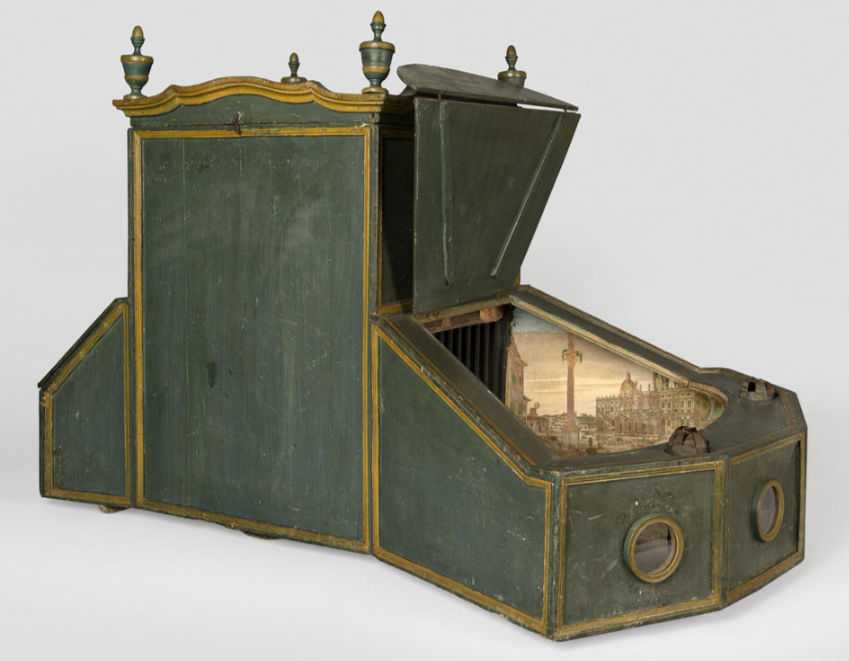 |
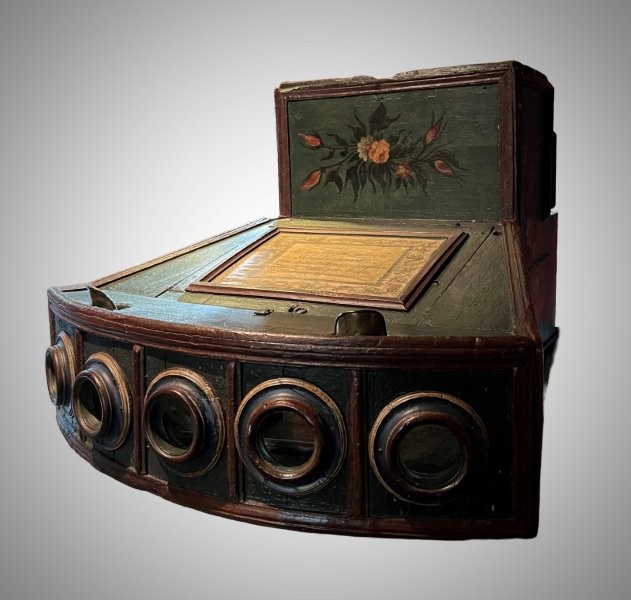 |
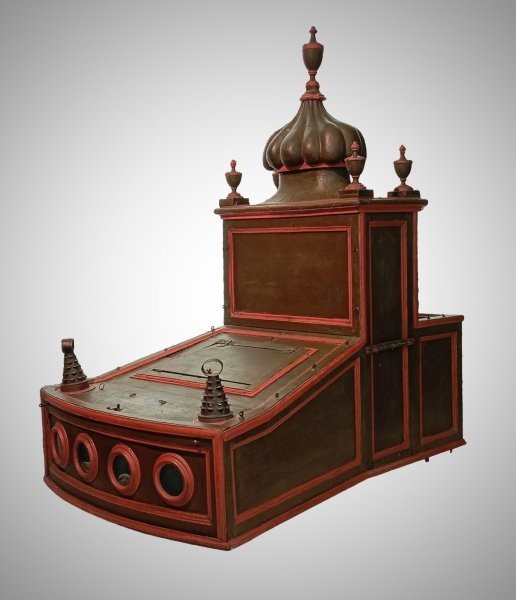 |
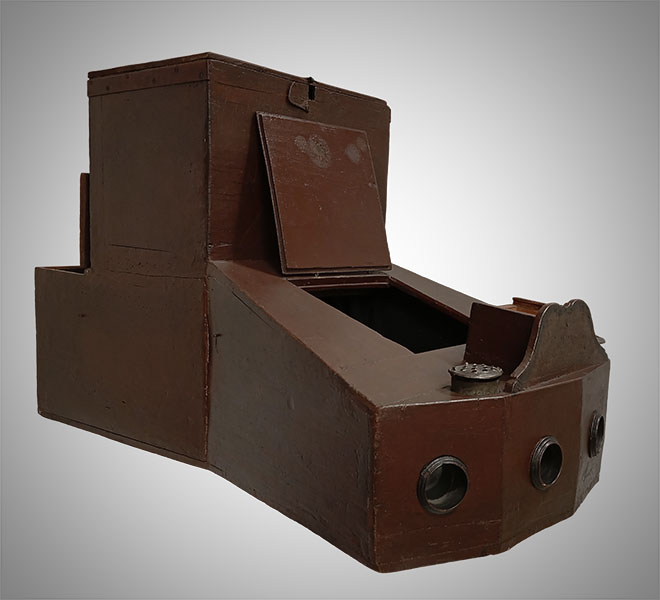 |
| Binétruy Mondo Novo | With Shoulder Straps | St. Marco Dome | Mondo Niovo (Brown) |
Italian Show-Box Images
There are six surviving examples of Italian show-boxes – all of them take the very particular form of the mondo niovo as we have described it here. However, of the period images that we have of Italian show-boxes, some of which are labelled "mondo niovo," none of them take that form. So, we have an anomaly that demands some explanation.
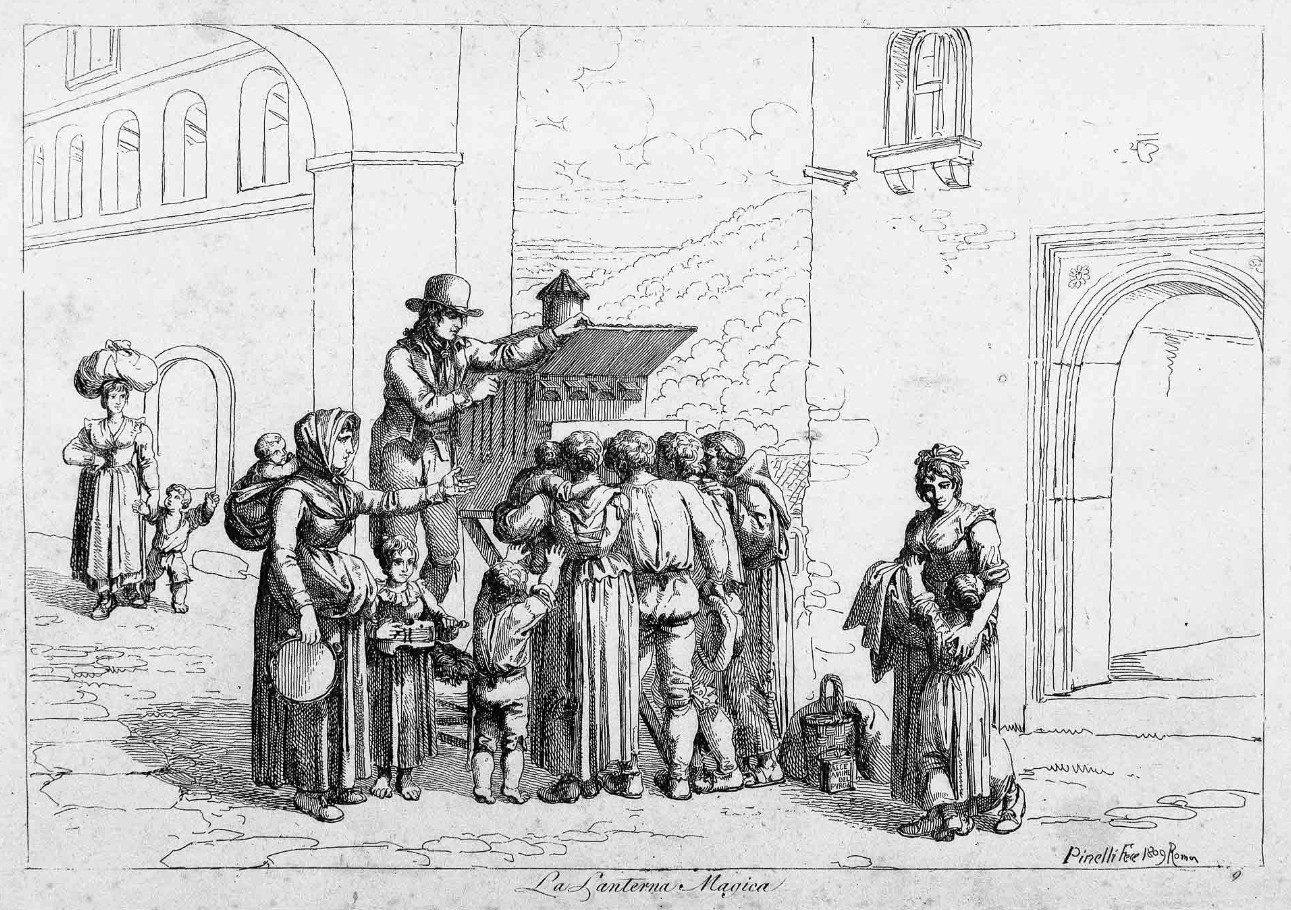 |
Figure MN.4 – Pinelli, 1809 |
Barolomeo Pinelli (1781-1835), La Lanterna Magica (The Magic Lantern), 1809. Etching. Graphic Arts Theater Collection, Princeton University Library. |
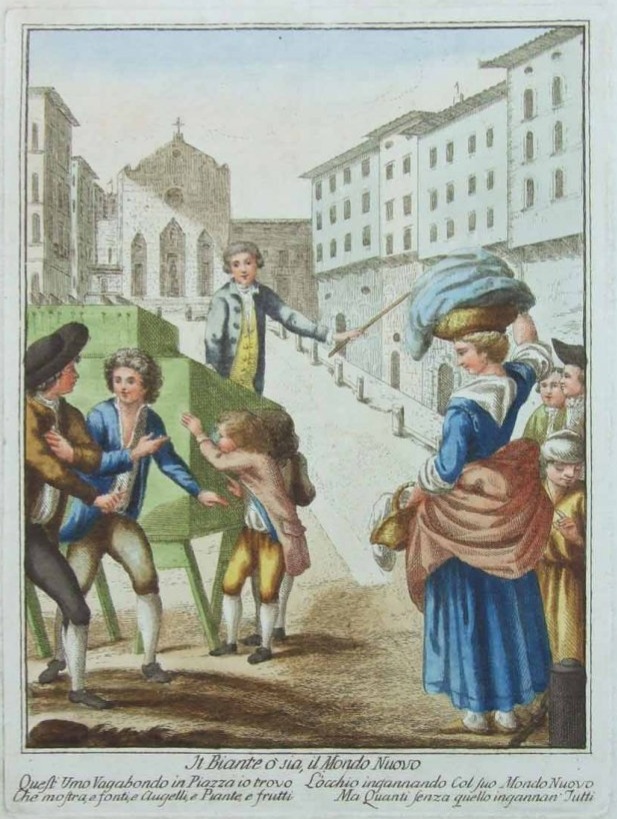 |
Figure MN.5 – Mondo Niovo |
Il Biante o sia Mondon Nuovo Quest umo vagabondo in piazza io trovo che mostra e fonti e augelli e piante frutti l'occhio ingannando col suo mondo nuovo ma quandti senza quello ingannan tutti[xxx] |
Visual Inaccuracies: The two depictions that I have reproduced first (Figures MN.4 and MN.5) are the closest approximations to the actual known artifacts. Both boxes have flytowers with the strings correctly located on the sides of them. However, the strings are on the left side [facing forward] while all surviving boxes have them on the right side. True, the position would have been correct on the copper plate used to print the images, but all print-makers would have been aware of this reversal and their failure to correct for it indicates that accuracy of such detail was not important to them.
Like surviving mondo niovos, both boxes have front-extensions for the lens-array. However, the lenses are not far enough away from the stage where the images will descend (a common error with contemporary representations). These front-sections are also too tall relative to the flytower. With this configuration, the viewer would be able to see the vues d'optique that were supposed to be hidden, dangling as they waited to descend.
Neither artist seems to be quite sure what is happening at the top of the box. The author of figure MN.5 has depicted the vues d'optique with the top edges their wooden frames protruding out of the top of the box. In all the known boxes they are lifted and lowered by strings attached to their top edge. These strings go up and over a bar that serves as a pulley, then out to the side of the box where they exit through little holes (Figure MN.6). There needs to be room above the tops of the vues d'optique to accommodate this assembly.
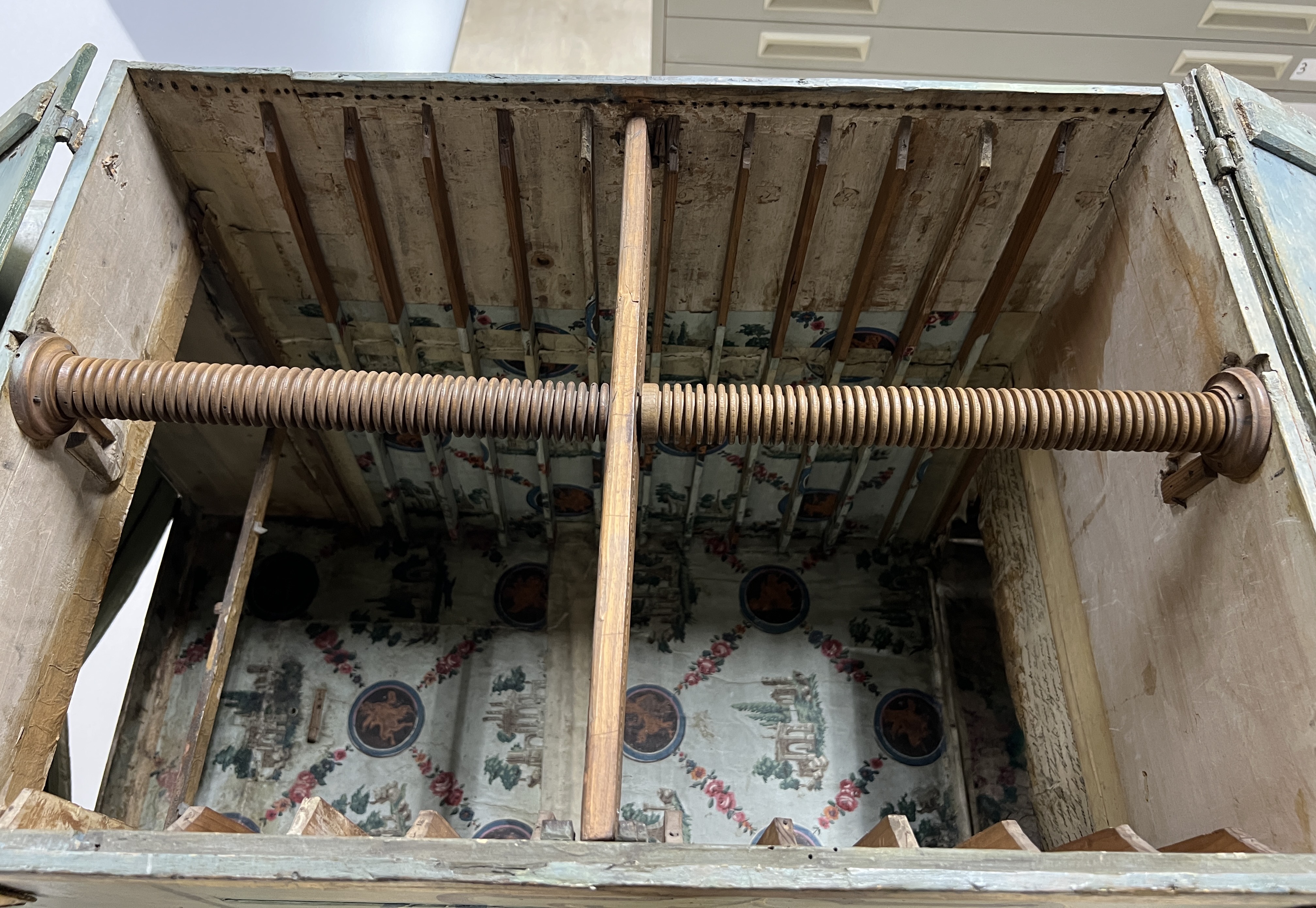 |
Figure MN.6 – Inside Flytower of MNC-M01034 |
Note the stringer-bar (the grooved dowel) and the hinged flaps (top left and right). The channels on the sides are meant to guide the vue-frames as they descend and ascend. This area would normally be stacked with vues d'optique on their frames.
Photo © Ana Mendes. |
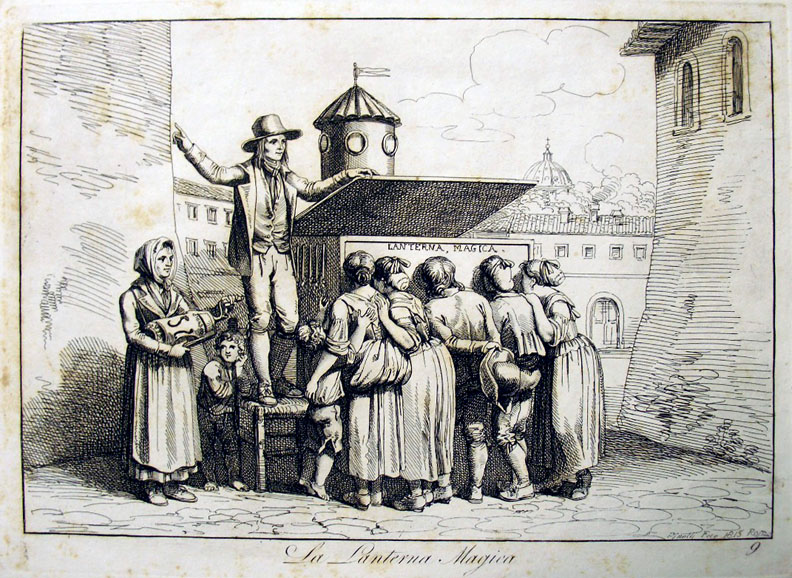 |
Figure MN.7 – Pinelli, 1815 |
| This is a fanciful, non-functional show-box. |
The most odd feature of Pinelli's depiction is the front-flap: it should open over the front-section to admit light towards the front of the images. His is oddly disconnected from the front-section – it is almost as if it is opening backwards, over the flytower. The flytower would be full of hanging vues d'optique which would obstruct illumination of the stage.
Some mondo niovos did have top-flaps that hinged like Pinelli's (see Figure MN.6). Their purpose was to allow the operator access to the interior of the flytower. The stringer bar is removable so that vue-frames can be taken out or new ones added. The operator would never have reason to open it when in the middle of a performance. A further problem for Pinelli is that he has depicted a box with a dome or turret on top like the one I am calling "St. Marco Dome" (above). The dome is incompatible with top-flaps – instead, to access the flytower, the operator must lift off the whole top-section including the dome.
Under the front-flap, Pinelli has depicted 4 semi-circles that might be windows over top of which are little awnings. They make no sense functionally. As illumination, they could only shed light on vues d'optique that were hidden from view in the flytower.
All mondo niovos have light-boxes behind the flytower. These are not visible in either depiction, but the showman is positioned in such a way that he might be obscuring them from view.
In 1815 Pinelli produced a second version of this print with a different composition (Figure MN.7). Here he has exaggerated the impossibilities of the box design. There is no longer a front section, so the people peer directly into the flytower. The top-flap now hinges from the back of the flytower. Not only would this offer poor illumination, but there is now no means of support for the improbably enlarged turret.
Finally, the fact that Pinelli calls his object a Lanterna Magica (Magic Lantern), an image-making device that works on entirely different principles from an optical machine, is further evidence that he had only a vague idea of how contemporary optical devices worked.
First Conclusion: These images (MN.4, 5 and 7) are not convincing evidence that a different style of Italian show-box existed alongside the surviving examples. Pinelli and the other artist probably observed mondo niovos without fully understanding what they were seeing and then drew them from memory, making numerous errors.
Zompini's Print, 1785
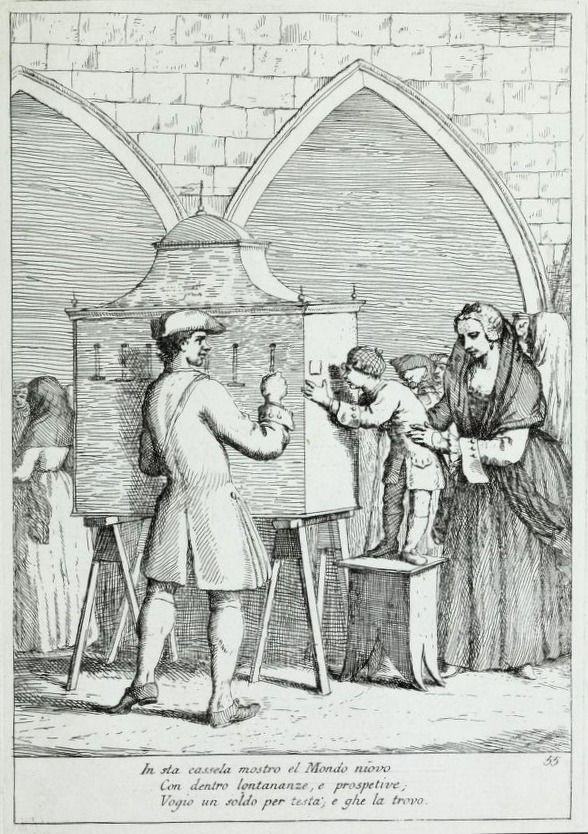 |
Figure MN.8 – Zompini, 1785 |
Zompini, Gaetano. Le Arti Che Vanno Per Via Nella Citta Di Venezia. Venezia, 1785. |
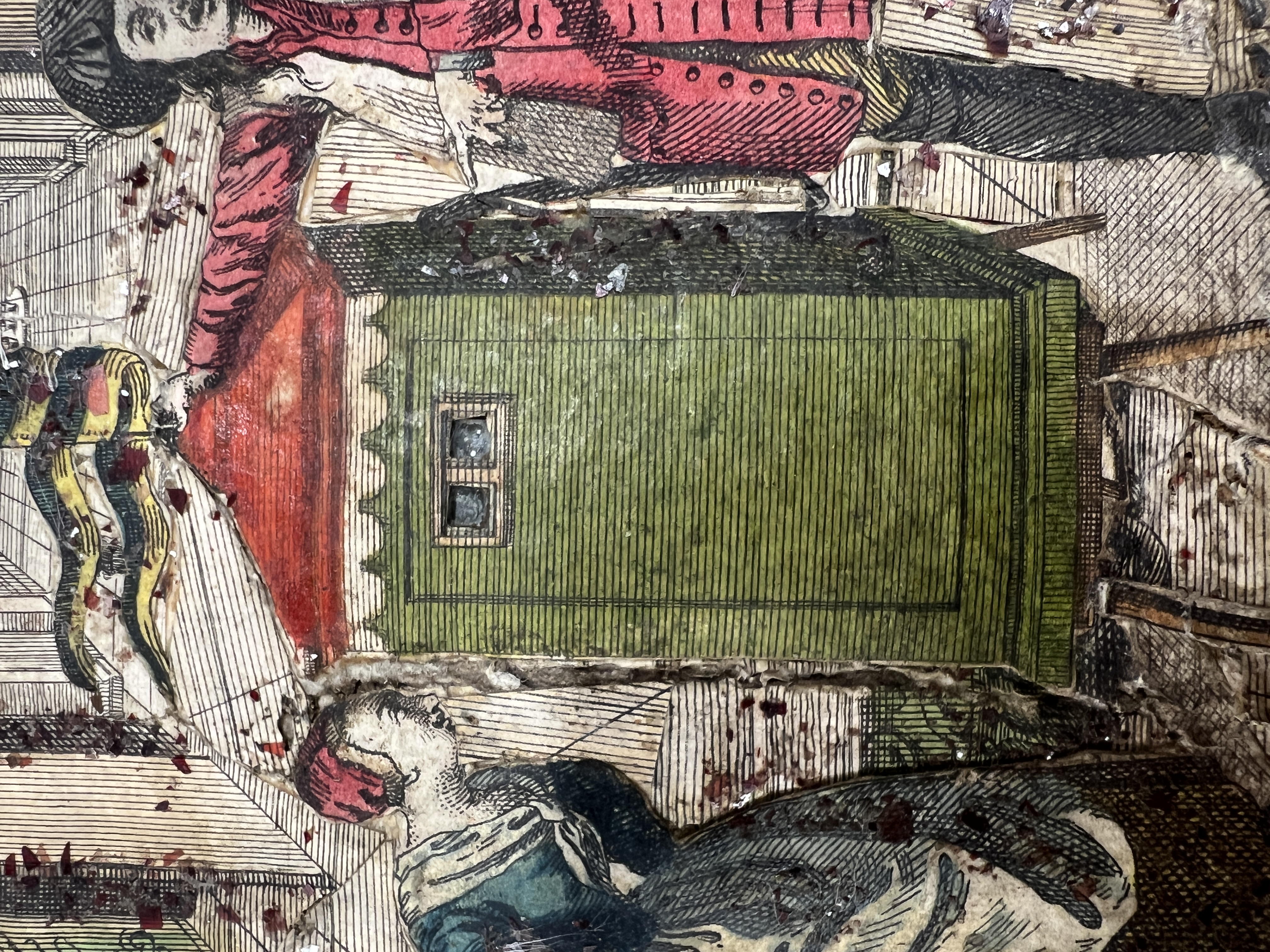 |
Figure MN.9 – Vue d'Optique Detail |
Vedutta della Piazza del Gambaro in Brescia
Museo del Cinema Collection, #M00106. |
The case is different with the 1785 print by Gaetano Zompini (1700 – 1778). It has some impossibilities. The first image (judging by the position of the drawstrings) is too close. There is no front-flap or other opening to admit light, so patrons would be unable to see the prints in the dark interior.
The box has no flytower, but does have room below the viewing-area for a lower fly. While I think the lower fly had some problems as a design choice, they did exist. In fact there are two known Italian examples (GCCH-1000219483 and AP-95-1630) neither of which are show-boxes.
Second Conclusion: There probably was another genus of Italian show-box, closer in design to the Raree Show than the Mondo Niovo as we are defining it.
Zompini's Inscription: Zompini has included lines, presumably spoken by the showman: "In sta cassela monstro el Mondo niovo Con dentro lontananze, e prospetive; Vogio un soldo per testa; e ghe la trovo" which translates roughly "In this box I show the New World inside with depth and perspective; I want a penny per person; and I will get it." The same inscription can be found on a surviving box from the 18th century (MNC-M01032). The reference to depth or distance of the interior view may be acknowledgement that the operators understood the 3D promise of the biconvex lens technology.
Exhibition Practices: Zompini and Pinelli's uncertainty about technical features of these boxes is not evidence of uncertainty about the social context of use. Pinelli reveals something of the life and style of showmanship. His show-people are a family group: the showman perhaps narrating the scenes and the wife and daughter providing musical accompaniment. In the first print, the wife, with an infant on her back, is playing a tambourine and the daughter a hurdy-gurdy. In the second, the wife is on the hurdy-gurdy while the daughter looks on appreciatively. The family enrich the performance. Their presence also indicates that, at least in the early 19th century, a small family could be supported by this kind of work in Italy. In other contexts, it is a visibly impoverished man who is depicted running the show alone.
Viewers - Age and Gender: These depictions of the viewers are also interesting. In other times and places (e.g. India), this type of amusement was seen as fit only for children or rural women, naive about visual culture. In Pinelli's prints, the box is attracting adults of both genders. The height at which the lenses are set is a physical indicator of the expected clientele. In Zompini's print, the default height is for adults; a special bench has to be provided to raise children up to the lens level. Adult-height was also a feature of the ornate Italian boxes for private performance, the Dolfini Teatro Rotondo and the Friggeri Tower.
Viewers - Social Class: Judging from their dress, the viewers in Pinelli's prints are probably working-class. However the boy in Zompini's print is attired like a little gentleman. Italian aristocrats and nobles enjoyed these optical machines in private. At least some of the upper classes – this boy and his mother might be from a bourgeois household – enjoyed them in public as well.
Endnotes:
[xxx] The name means "new world" in Italian, perhaps because it introduced people to new worlds, including the distant Americas. The spelling with an "i" is Venetian and we use it (as opposed to Mondo nuovo or mondo novo) because this style seems to be uniquely Venetian.
[xxx] It is possible that in Venice that each Mondo Niovo may have had a customary location to which the showman brought it each day &along the lines of modern street entertainers like buskers.
[xxx] We know little about the showmanship practices for the Mondo Niovo. However, in images of Raree Shows and Bioscopes there is typically a single showman. There is one image of a wife assisting, and it is possible that they might be family affairs. The limit on numbers might be the meagre takings of this type of employment.
[xxx] Rough translation: "The Mondo Nuovo: One finds this man wandering in the square displaying fountains and birds and plants and fruits, deceiving the eye with his new world, yet even without it everyone deceives."