Rod Bantjes, “EXBD-69027_Pillar_Box.html,” created 23 July, 2026; last modified, 23 July, 2026. (https://people.stfx.ca/rbantjes/).
Pillar Box
Bill Douglas Cinema Museum[1] #EXBD-69027
English, late 18th century
Dimensions: H=67.1 cm; W=32.5 cm; D=26 cm
Lens: missing, ƒ= cm
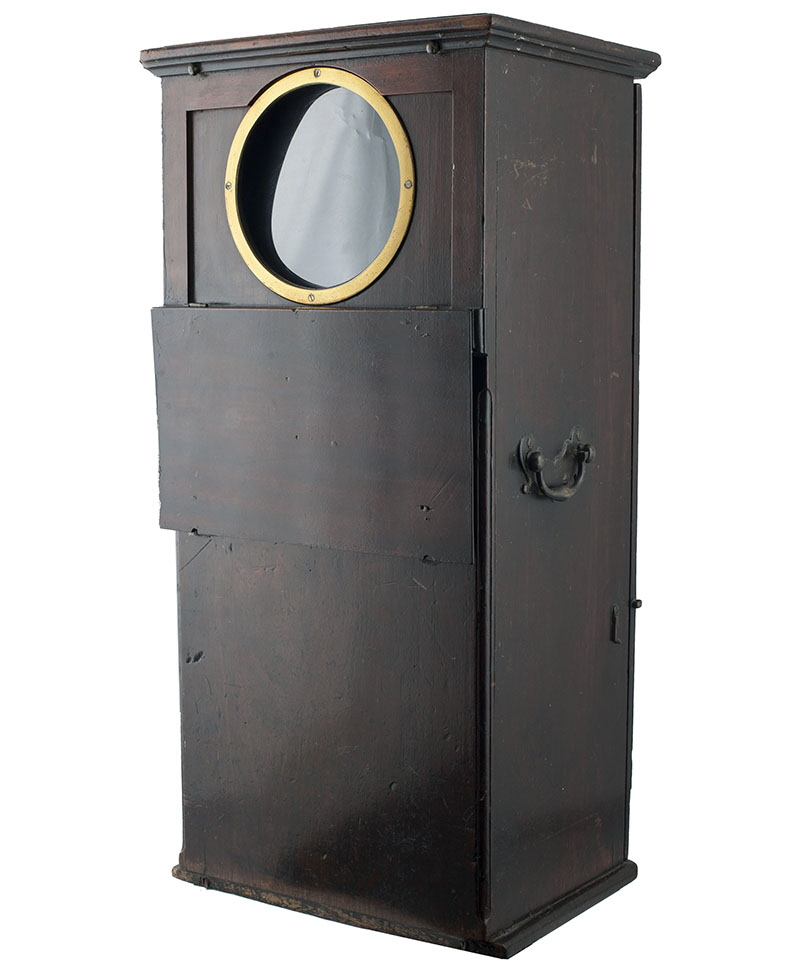 |
Figure EXBD-69027.1 –Pillar Box |
| Photo © Bill Douglas Cinema Museum |
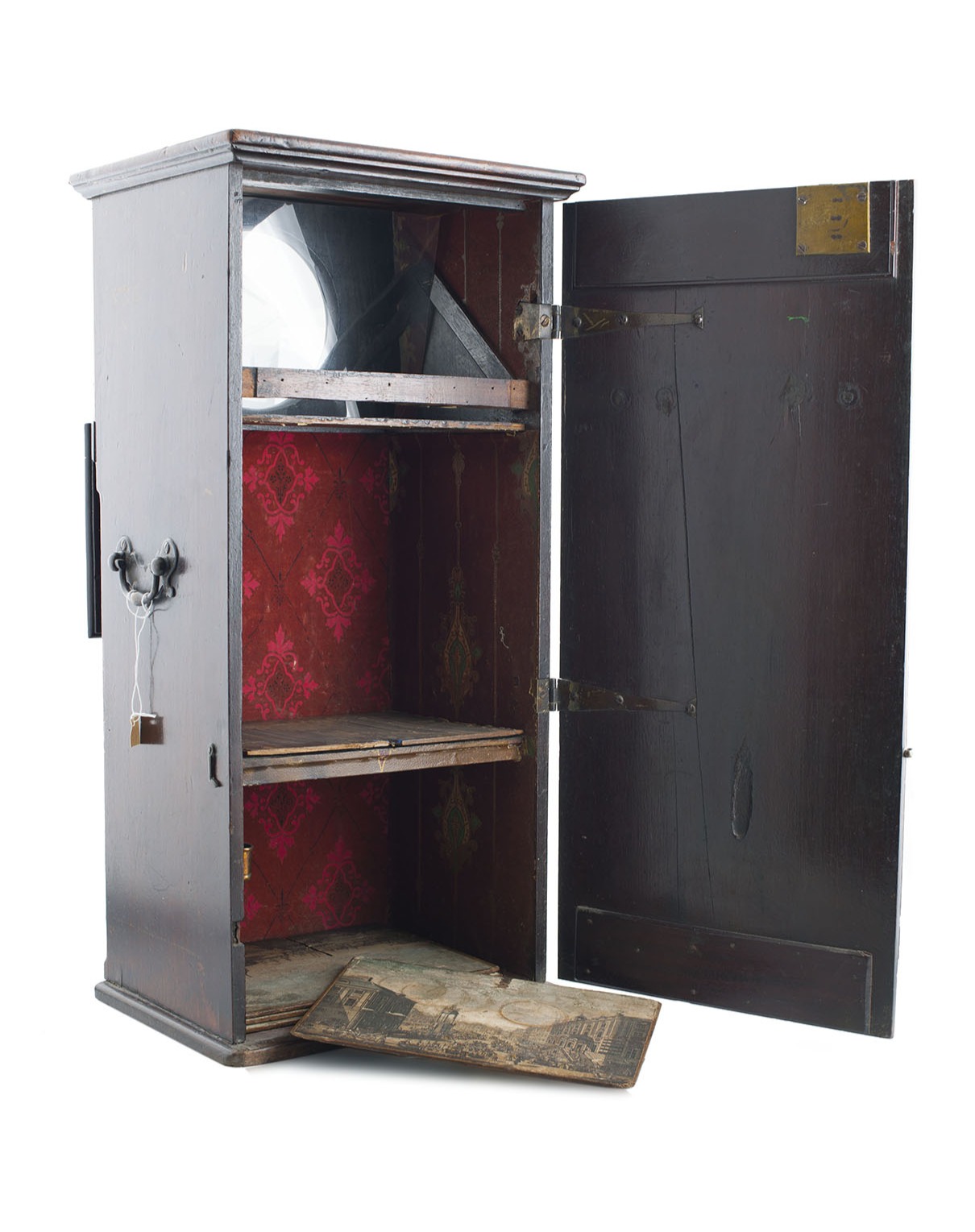 |
Figure EXBD-69027.2 –Rear View |
| Photo © Bill Douglas Cinema Museum. |
This is a vertical optical box for a single lens and a diagonal mirror. Both the lens (14.8 cm diameter) and the mirror are missing. The focal length of the lens would have been around 44 cm. It is an example of an “optical machine ” and is included in the Optical Machine Taxonomy.
The function of the lens was to make the objects in the views appear more distant, just as they would appear when viewing the actual scene. This effect was achieved by the lens changing the path of light to the two eyes so that they converged as though fixing on a distant, rather than a near point.[xxx]
The box comes with five two-sided views – copper-plate engravings on laid paper glued to wood panels. Two of them depict the battle of the Plains of Abraham, Quebec, in 1759 from which the English emerged victorious and wrested control of Canada from the French. A French viewer would not likely have wanted to relive this humiliation again and again in immersive 3D so the views, and probably the box with which they are associated, are no doubt English.
William Hooper, in his Rational Recreations in 1774 advises his readers on how to select, prepare and modify prints for use in their optical boxes.[xxx] You can see that do-it-yourself spirit here as some of the images have been cut from much larger prints. In one case a print, perhaps of a rural scene, has been pasted over with a military scene. The user here seems to have been drawn to views of grand edifices and great events.
Eighteenth-century prints typically came with titles and identifying text. All that has been cropped from these prints, perhaps to eliminate distractions and make the scenes feel more immersive. The size of these views, 18.3 x 25.3 cm, is unusual. Eighteenth-century vues d'optique for optical boxes and zograscopes were more typically in the range of 22-25 x 32-35 cm. The two views of Venice come from a series of etchings, based on Canaletto paintings, called Prospects of the Great Canal of Venice, perhaps sold as a folio of prints. The dimensions of these prints, cropped to their decorative borders, may have defined the particular standard around which the box was built.
The image-boards have cut-marks indicating that a piece of triangular hardware was once screwed or bolted to the top at the centre of each one. In one case the bolt hole has an ancient piece of string through it. In many optical boxes strings were used to raise and lower the views into the viewing area. The views were stiffened with cardboard or wooden board like these ones, but the style of attachment here is unique. The odd thing about these fixtures is that they would not work in this box. Here views are inserted from the back of the box, lying flat with the top facing forward (so that it appears upright in the mirror) – you have to grip them and pull them from the bottom, not the top of the image. They may have been made for a box in which the images stood upright and vertical and were viewed directly without a mirror. Boxes with this horizontal axis of viewing often had flytowers from which to raise and lower scenes onto the “stage” below.
That sort of box, with a flytower and plates hoisted by strings, was typically for public performances where a showman manipulated the views for an audience. The vertical type, with the diagonal mirror, was more common for domestic or private use where the viewer was more apt to be the one choosing and changing the views. Are these views wrongly associated with this box? Or did someone perhaps purchase a set of views originally from a showbox and have a new viewer purpose-built for them? In this case the viewer would be more recent than the most recent engraving (1794).
The design and construction of the box is simple and of modest quality. It is made from stained and varnished hardwood, with only simple moldings and no inlaid or turned elements or fine dovetailing. With its flap up to conceal the lens, it is quite austere in appearance. The back of the cabinet that holds the views was secured with a lock, which suggests that people either valued these prints highly or distrusted their servants (owners of such a box certainly would have had servants) or both. The carelessness with which they were later handled – resting coffee cups on them and allowing children to scribble on them – indicates how their value diminished over time.
Two handles on either side of the box, set forward to counterbalance the weight of the large lens, indicate that it was meant to be semi-portable. Some optical boxes were intended to be fixed in place like a piece of furniture, but this one could perhaps be set aside and then taken out and set on a table when in use.
A final and mysterious feature of this box is the little brass fixture attached below the image support on the left-hand side when you open the back. Showboxes often had candleholders for lighted candles to illuminate the front or, more typically, the back of semi-transparent views (with piercings and coloured tissue to create varied lighting effects). This fixture looks like a candle holder, but if you placed a lighted candle in it, it would certainly burn the wooden support directly above it. There is no evidence of soot or charring.
List of Views:
- 1a. MALTA "A Perspective View Of the Town and Fortifications of Malta" published, 27th May, 1794, hand-coloured engraving. Original dimensions: 26 x 40 cm, 40 x 52 cm overall
- 1b. A prospect of the Moro Castle taken within the entrance of the harbour / drawn upon the spot by an officer ; P.C. Canot, sculp., Canot, Pierre Charles, 1710-1777, engraver, London: Published 24th June 1818 by Jas. Whittle and R.H. Laurie, no. 53, Fleet Street, [1818]. Original dimensions: plate mark 26 x 43 cm, on sheet 35 x 49 cm. The engraving has been cropped to fit the viewer.
- 2a. A view of the Piazza del Popolo in the city of Rome (published by John Bowles of London, 20 x 24.5 cm)
- 2b. Fish market at the Hoher Markt in the Inner City of Vienna, view from east. Etching by J. A. Delsenbach after a drawing from J. E. Fischer v. Erlach, around 1715, Wien Museum. 22.3 × 32.6 cm (this measure includes border material including title). Acquired in 1883 by Prince Johann II von Liechtenstein. The box includes the full image.
- 3a. A View of the Taking of Quebec, September 13, 1759, Bowles & Carver [ca. 1760] reissued ca. 1793 Robert Wilkinson, plate: 36.2 x 47.9 cm, sheet: (37 x 49.1 cm). This is part of a much larger engraving cut to fit the box.
- 3b. An interior view of York Minster looking towards the choir (details of particular engraving not located)
- 4a. Battle of the Plains of Abraham. This is part of a much larger engraving cut to fit the box. It was pasted over a previous engraving then later torn off.
- 4b. Unidentified British Naval Battle
- 5a. Ex Aede Salutis, usque ad Caput Canalis, a view of Venice copied from an etching of a painting by Canaletto. This engraving is reduced in size (to fit a particular box format?) and given a decorative border.
- 5b. The Entrance of the Canal Regio from the Church of St Jeremiah, from the series Prospects of the Great Canal of Venice, (British Library calls it an etching), 1735-1779, 19.7 cm (trimmed) x 25.5 cm. These two views, 5 a and b are taken from the same series of etchings of Venice. Their size, with decorative border, fits the box.
Endnotes:
[1] I would like to thank the Bill Douglas Museum for a stipend that supported my research there and the staff of the museum for their generous assistance..
[xxx] Harris, Joseph, A Treatise on Optics (London: B. White, 1775); for an animation of the effect, see Rod Bantjes, “Binocular Convergence and the Spatial Deception of the Optical Machine,”.
[xxx] Hooper, William, Rational Recreations (London: L. Davis etc., 1774).