Rod Bantjes, “Genus_Raree Show.html,” created 31 January, 2026; last modified, 31 January, 2026 (https://people.stfx.ca/rbantjes/).
Raree-Show Genus (1700 - 1890)
The Raree Show, "peepshow," or "show-box"[1] was a travelling optical machine with multiple lenses and a draw-string mechanism for multiple scene changes. Itinerant showmen toured these to fairs and markets around Europe until the late 19th century. They were the most wide-spread and well-known of the optical machines, but the ones for which we have the least physical evidence. They were well-loved by millions who flocked to view their marvels. But the devices lacked cultural prestige and were rarely preserved. To understand their physical characteristics we rely on the visual evidence of numerous prints and paintings from the period.
During the 19th century, variants of the Raree Show migrated to other countries where their form and aesthetics changed while their social function remained remarkably similar. The Indian bioscope and the Iranian shahr-e farang have the same multiple lenses, but differ from the raree show by having a roll-mechanism for changing views rather than a draw-string mechanism.
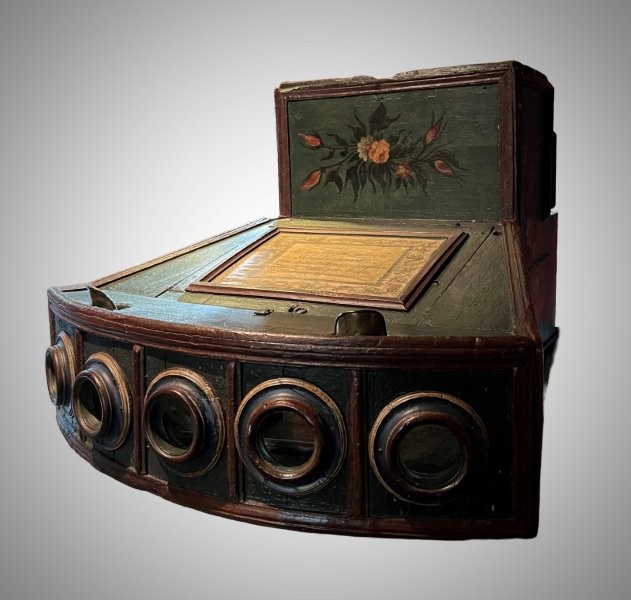
The Mondo Niovo is the Italian version of the raree show. It's form is more uniform and it always has three related features that are rarely seen in the raree show: a flytower between a low front that flares out to the lens-array and a rear extension that has a flap and holds candles for back-illumination. It is unclear from the depictions whether any of the raree shows support back-illumination.
Draw-String Mechanism: The operator pulls strings, usually visible at the side of the box, to lift and lower different scenes into a viewing area. On a flytower model, the string rides over a rail above the views and down to where it is attached to a frame that supports an image.
As portable devices, the raree show had to have a means of being transported: as a backpack; by hand-rails (necessitating two people); or by hand-cart.
Image Formats: Prior to ca. 1820, the images used in raree shows would have been vues d'optique stiffened, usually with cardboard, so that they did not buckle and jam in the guide rails of the flytower. If the vue was to be back-illuminated, it might be reinforced mostly around the edges or given a light wooden frame (although this approach seems to have been rare).
Sometime in the early 19th century there was pressure to increase the size of images. Some showmen extended their vues d'optique with hand-drawn margins (see for example Figure 69056.4). Some began to commission larger-sized paintings (ca. 61 cm wide) often with more topical and sensational subjects than the 18th-century images.
| Lower Fly: | 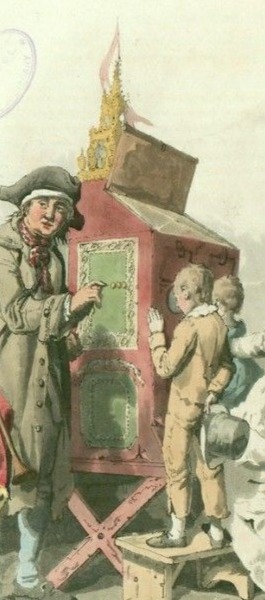 |
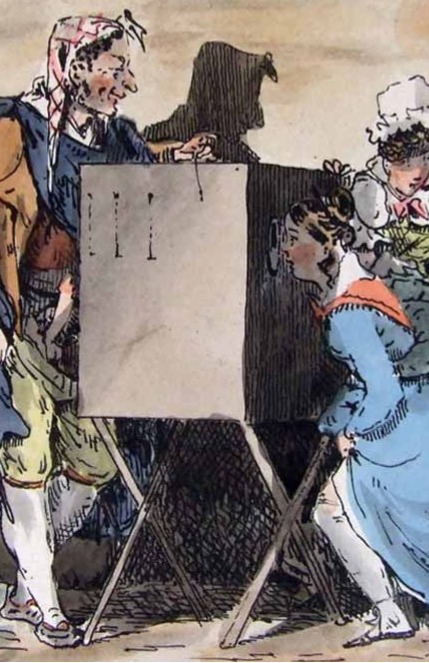 |
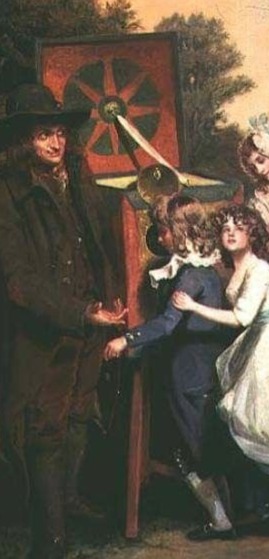 |
| RR-LF-02 | RR-LF-01 | RR-LF-03 |
Raree-show boxes require space either above or below the viewing-area where the collection of prints is suspended. Suspension from above in a flytower is how theatres do it. I am surprised by the frequent choice of a lower fly: if the image-flats are raised from below, the pull-string is likely to be visible to the viewer. Perhaps the idea was that a lower storage area would help raise the lenses to viewer height while minimizing the size and weight of the stand needed to support the box.
| Lower Fly Double: | 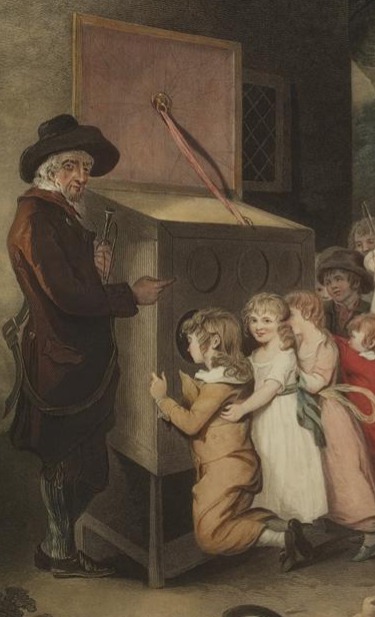 |
 |
| RR-LF-D-01 | RR-LF-D-02 |
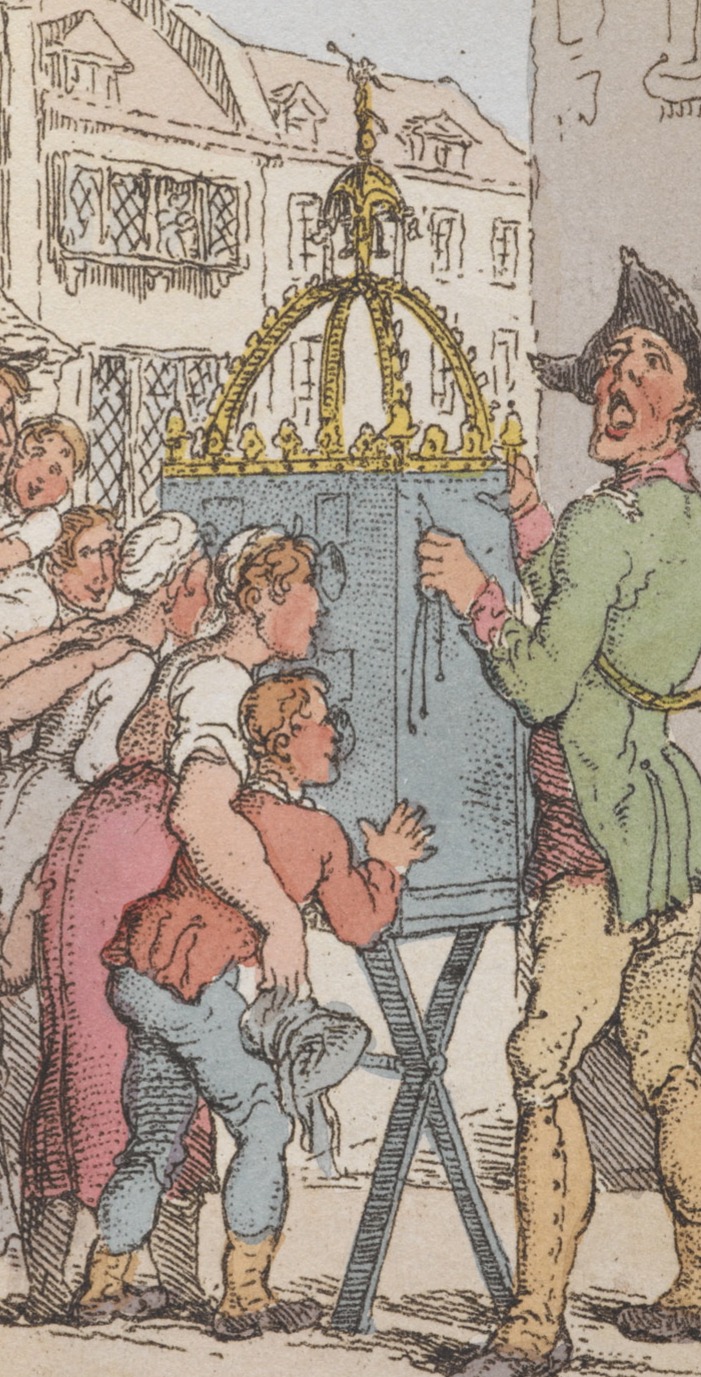
This box has two horizontal rows of lenses: the lower one best suited for children.
There are two surviving boxes with lower flys but none that I have seen with this double horizontal row of lenses.
| Lower Fly - Hand Rails: | 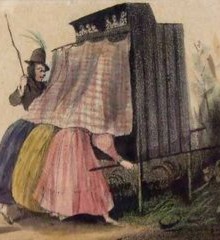 |
 |
| RR-LF-R-01 | RR-LF-L-01 |
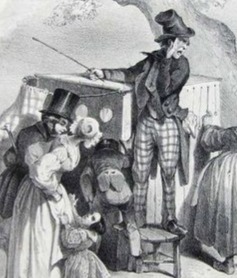
These boxes are large enough for a two-person carry. In the first case (RR-LF-R-01) you can see the hand-rails; in the second, the box is huge and the showman has his wife to assist him in pulling the strings and, presumably, in carrying the box from place to place.
These are more examples of the lower fly-storage, which appears to have been at least as common, if not more common than the flytower.
| Flytower: | 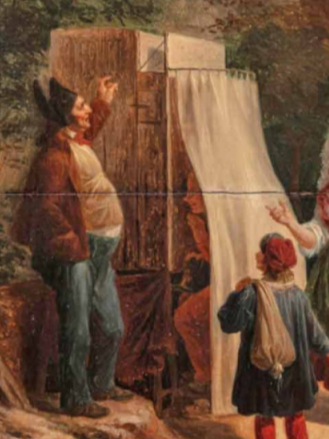 |
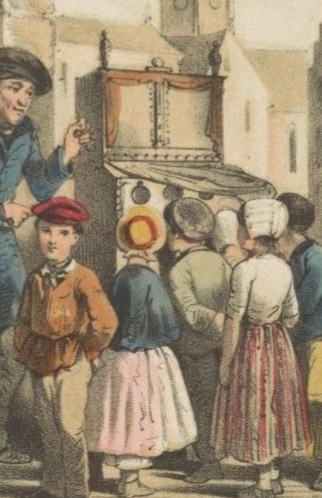 |
| RR-FT-01 | RR-FT-02 |
These boxes, like the Italian Mondo Niovo, have flytowers.
| Sergeant Bell: | 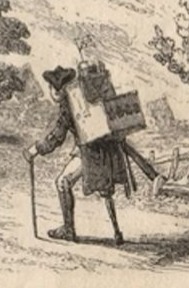 |
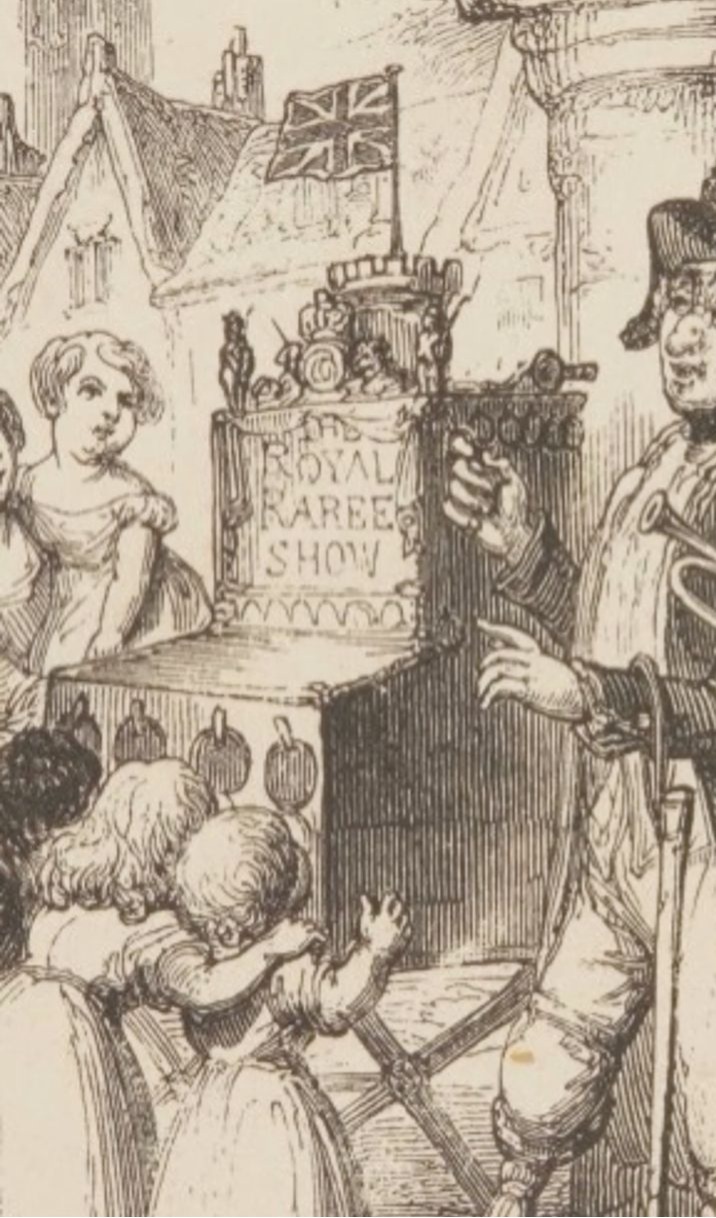 |
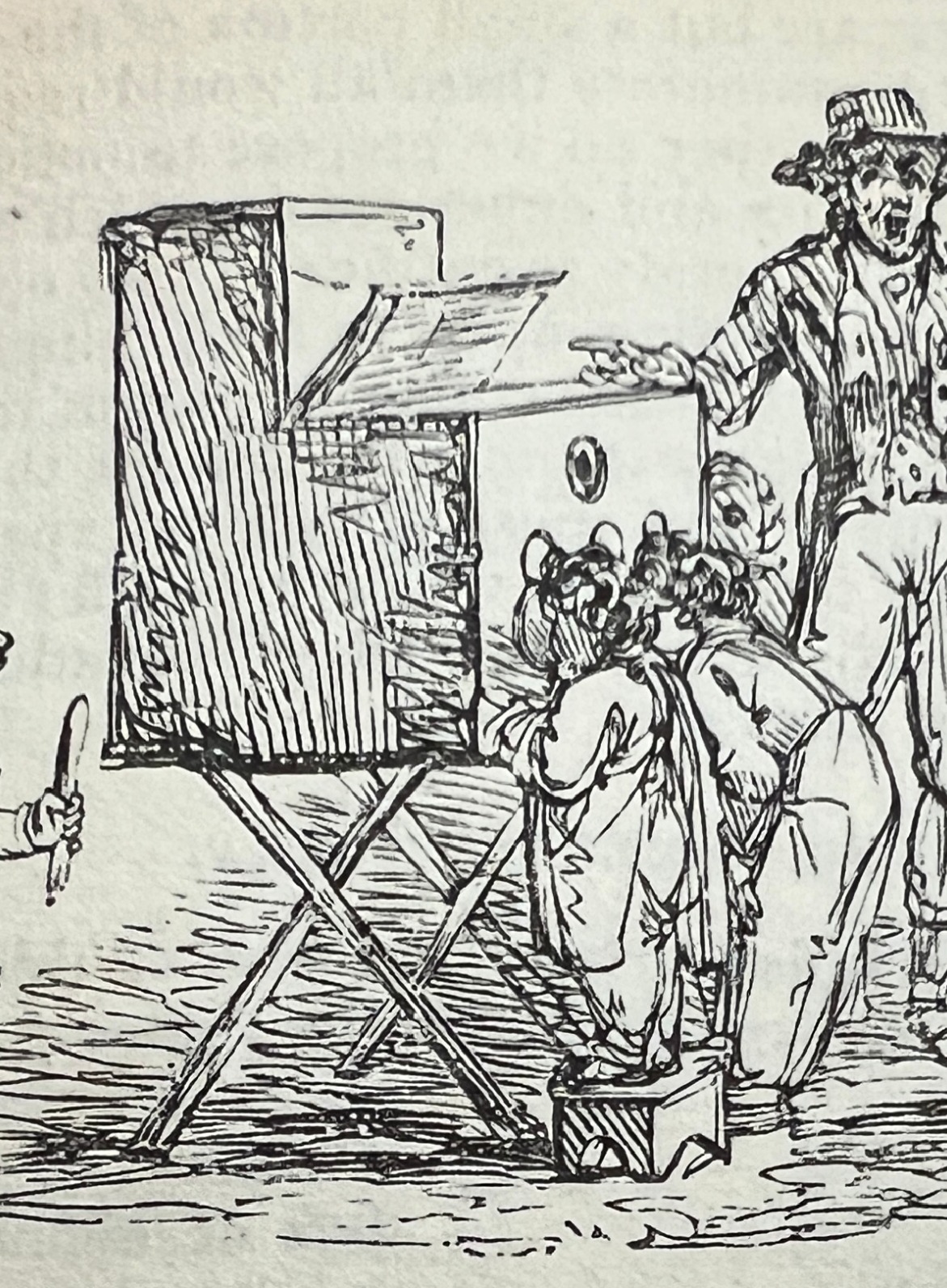 |
| RR-SB-01 | RR-SB-02 | RR-SB-03 |
This is a small flytower box fitted with shoulder straps so it can be carried on the showman's back. I call it a "Sergeant Bell" because it is the one that Sergeant Bell is depicted carrying in the 1839 book Sergeant Bell and His Raree Show (Figure RR-SB-01).
The box is quite short, front to back, presumably to keep the weight close to the carrier's back. There is a long Mondo Niovo (MNC-M01035) with back straps, but these are at the bottom of the box, rather than the back so the long side is parallel to the person's back rather than sticking out so as to lever him backwards.
| Sergeant Bell 2: | 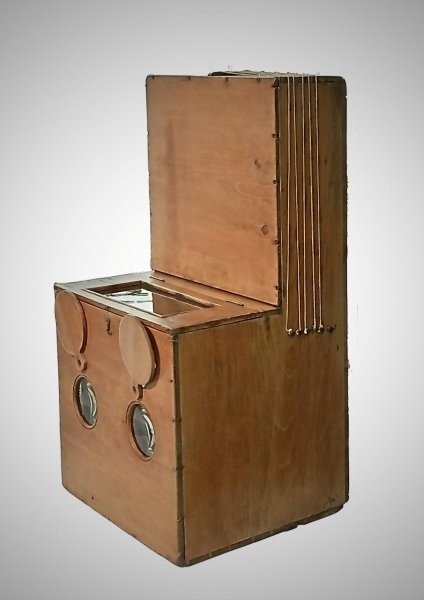 |
| MNC-M05753 |
This box with two lenses rather than four and a glass window in place of a front-flap is a separate species, but nonetheless very similar to the Sergeant Bell. It is the only known example of a Raree Show to have survived.
| Wheeled Double: | 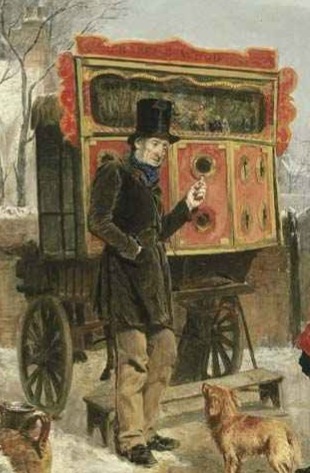 |
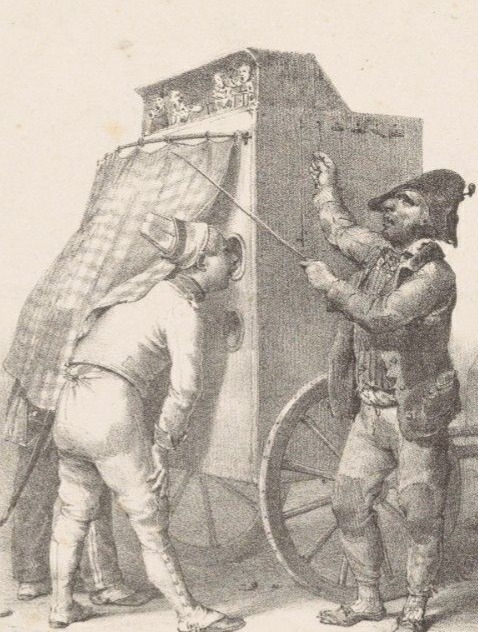 |
| RR-W-D-01 | RR-W-DC-01 |
These boxes both have integrated wheels for transporting them. This feature was adopted by the Russian Raek.
They also have a stage with puppet-figures above the lenses. This stage-like opening was adopted by the shahr-e farang (Species 1)
They both have a double line of lenses. The first example (RR-W-D-01) has bottom-loaded images; it is unclear in the second example (RR-W-DC-01), but perhaps from the top.
RR-W-D-01 has a curved bank of lenses, like the Italian Mondo Niovo, the Iranian shahr-e farang, and to a limited degree the Indian bioscope.
| Curved Front: | 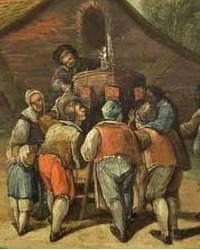 |
| RR-CF-01 |
Here is a very early box with a curved bank of lenses. This feature was adopted by the Italian Mondo Niovo, the Iranian shahr-e farang, and to a limited degree the Indian bioscope.
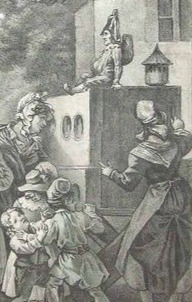
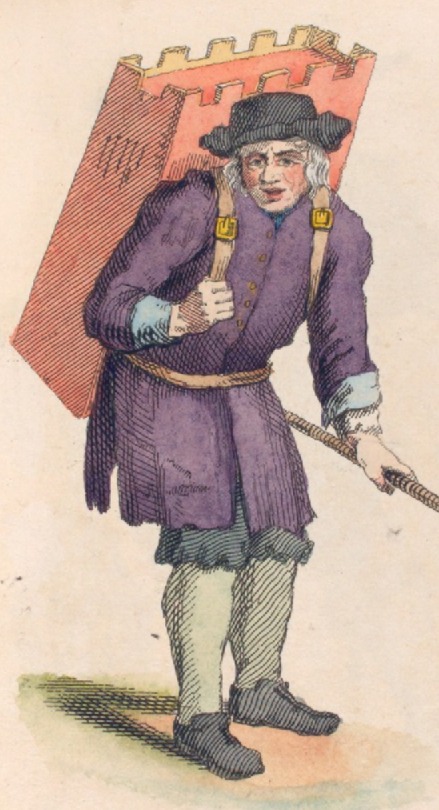
| Fanciful: | 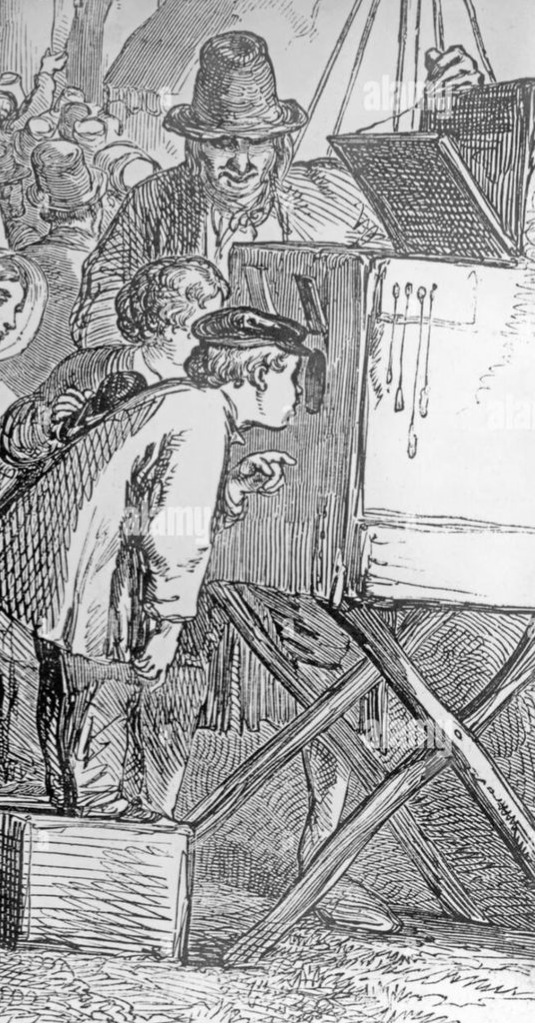 |
 |
 |
| RR-FF-01 | RR-FF-02 | RR-FF-03 |
These are instances in which the accuracy of the depiction is in doubt. People often had only a vague idea how these devices worked and fudged their descriptions or representations. The visual evidence should therefore be treated with caution. Click for a detailed discussion of other examples of visual misrepresentation.
There needs to be a flytower or lower storage equal in height to the viewing area. Neither RR-FF-01 nor RR-FF-02 have that.
The viewing area has to be set back a foot (30 cm) or more from the lenses. In RR-FF-03 the first image would be almost touching the lens and you would not be able to see the full extent of it. In RR-FF-01 the pull-strings (above the image-frames) are also too close to the lenses, even though there is a correctly positioned flytower.
| Outliers: | 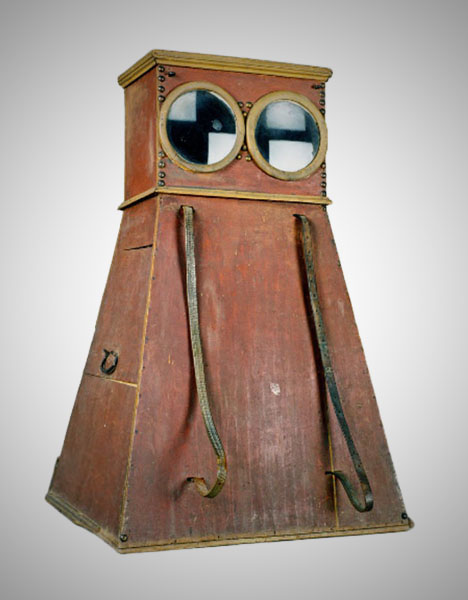 |
 |
 |
| AP-95-1615 | MNC-M01035 | MNC-M02470 |
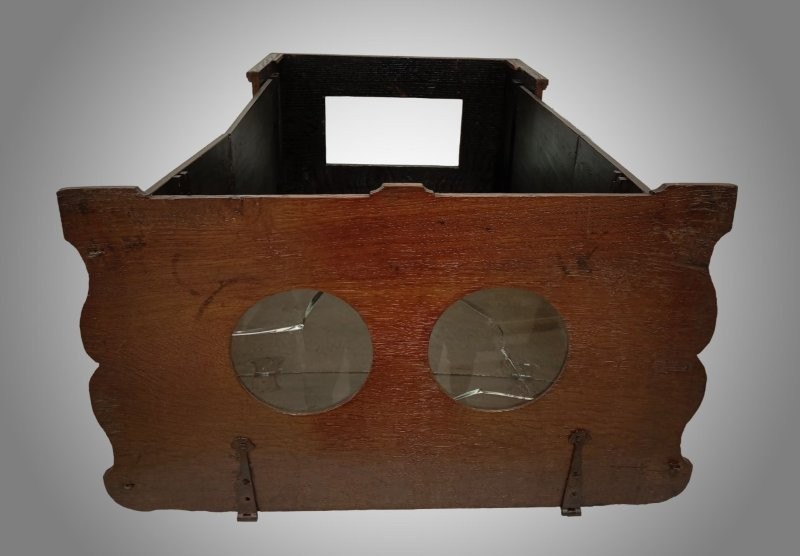
None of these are Raree Shows by our definition. The trapez-guckkasten (AP-95-1615) and Mondo Niovo (MNC-M01035) are "colporteur" boxes designed to be carried on the back, and the collapsible rarekiek would be easily put to that use.
However, neither the trapez-guckkasten (AP-95-1615) nor the rarekiek (MNC-M02470) have pull-strings for changing scenes.
The Mondo Niovo has a unique combination of flytower, flared and curved lens-array and rear extension for back-illumination not found together in Raree Shows.
Endnotes:
[1] I have chosen the word "Raree Show" because it applies only to this type of device. "peepshow" is probably the more common term, but over time it has become promiscuous and ambiguous in meaning. In gets applied to single-lens devices, non-travelling devices, slot machines, and any device that allows one to peep at erotic or taboo content.