Rod Bantjes, “Genus_Folding_Book.html,” created 15 December, 2025; last modified, 10 February, 2026 (https://people.stfx.ca/rbantjes/).
Folding-Book Diagonal-Mirror Genus (1750 - 1800)
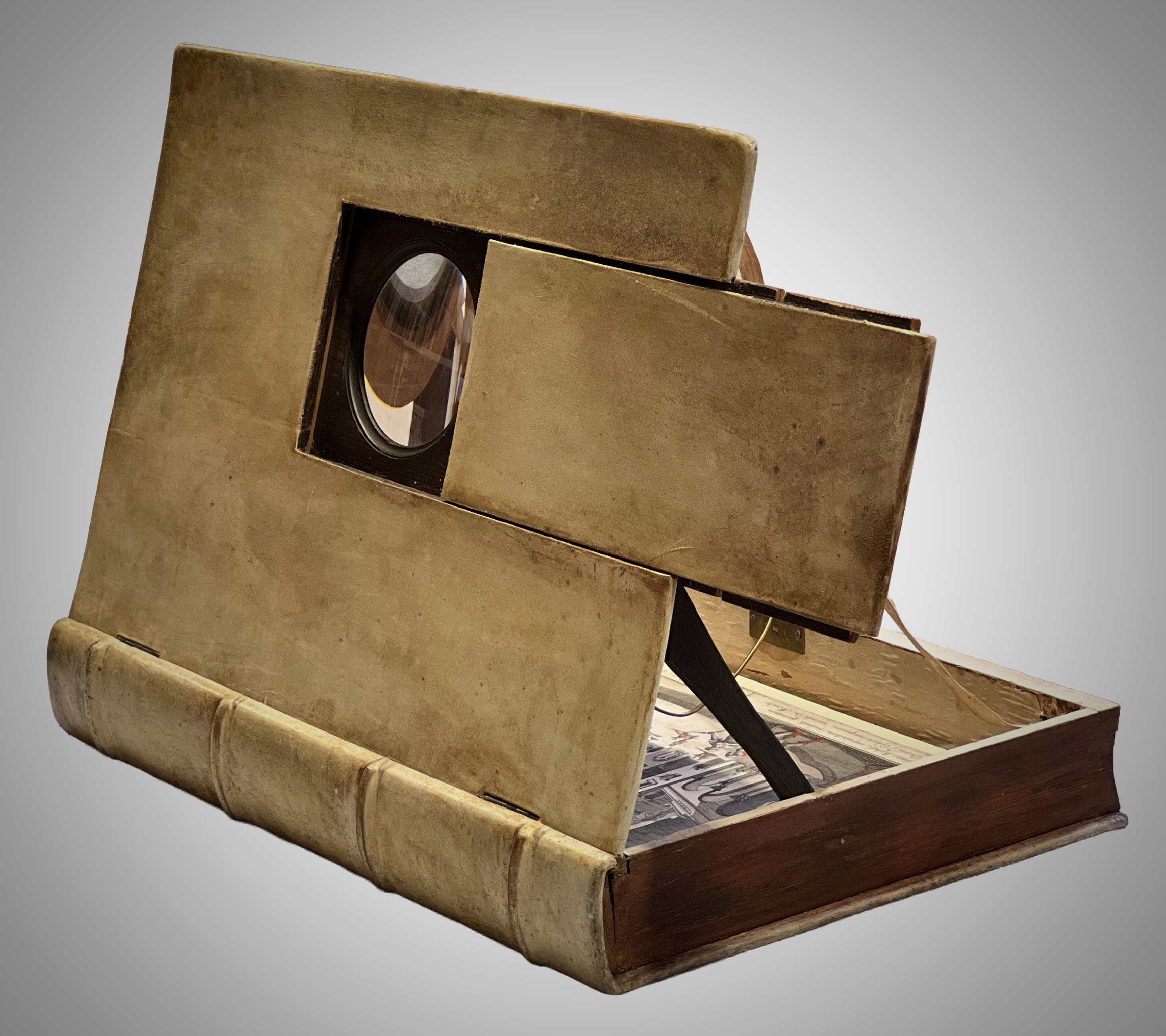 |
Figure GFB.1 – Egerton's Folding-Book Viewer |
| Photo © Rod Bantjes. |
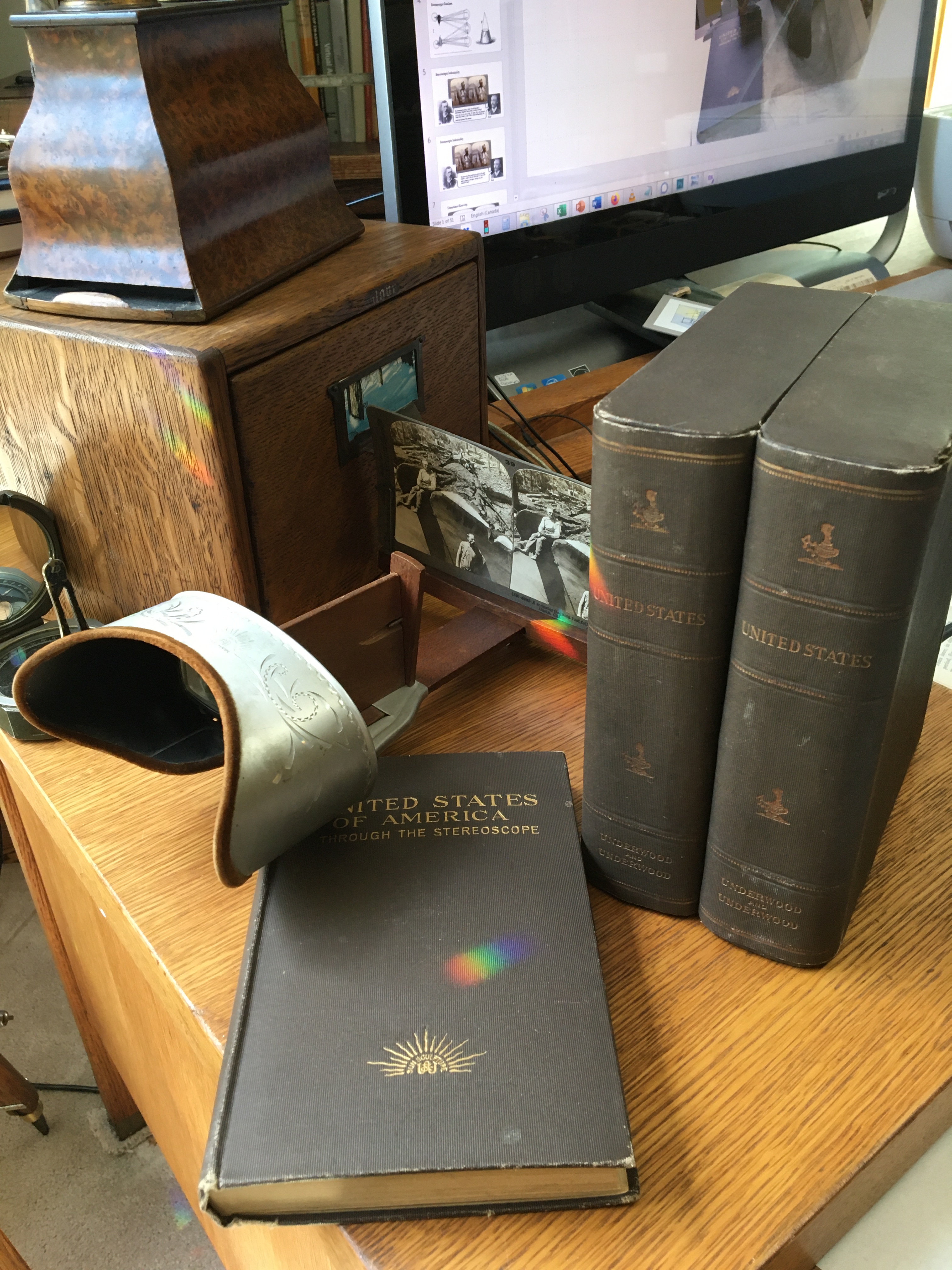 |
Figure GFB.2 – Underwood Boxed Set[xxx] |
| Photo © Rod Bantjes. |
This is a diagonal-mirror viewer disguised as a book. It is an example of an "optical machine " and is included in the Optical Machine Taxonomy.
The book-form optical device persisted to the 20th century when makers of mass-produced stereoviews packaged them in "boxed sets" in the shape of learned tomes (see Figure GFB.1).
Of the two objects conjoined here, the book had more prestige than the optical machine and its collection of pictures or vues d'optique. Prints were down-market works of art, which could not make claim to the status of "truth" that painting aspired to. A print transformed by the mysterious mechanism of the optical machine was doubly suspect. The optical machine, particularity the street variety known as the Raree Show became the definitive metaphor for visual deception. Most forms of optical machine were understood to be proper to children and their female charges – much less so for learned men who had private libraries at their disposal.
The pairing of the learned tome and the deceptive optical machine makes more sense in this context. Could it have been an attempt to elevate the optical machine, to suggest that it was really like a form of educative text? Or was the book-disguise meant to hide the guilty pleasure of picture-viewing? Egerton's folding-book viewer with its hidden lens and tooled leather binding could be hidden very convincingly on a library shelf.
There are many satirical prints depicting the optical machine being used for bawdy erotica. While I have only see one actual erotic vue d'optique there may have been many that have not survived – consigned to the flames by relatives of deceased collectors. It is possible that boxes like these were used to hide secret 18th-century porn stashes.[xxx]
Each row in the following table represents a different species of folding-book diagonal-mirror:
| Egerton's Folding-Book Viewer: | 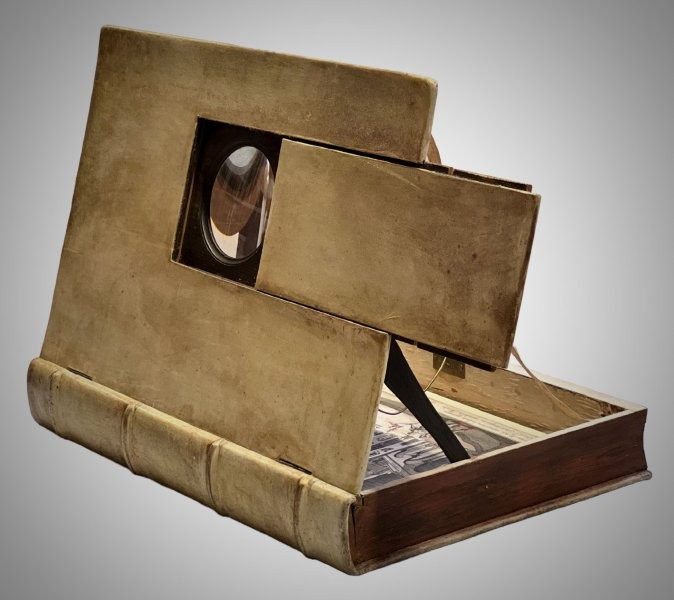 |
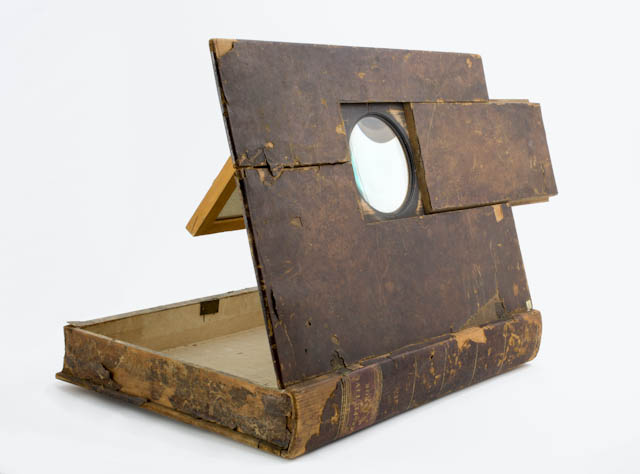 |
| WN-2396 | MH_SK-2006.1957.1 |
The Werner Nekes variant (WN-2396) is very convincing as a slender volume bound in velum. It has no title on the spine; The second variant, from the Joseph Allen Skinner Museum, Mount Holyoke College, is bound in paper with the title "Perspective Mirror" tooled into the spine in gold leaf.
They are both from the workshop of Egerton and William Smith, Liverpool.
| Fat Book: | 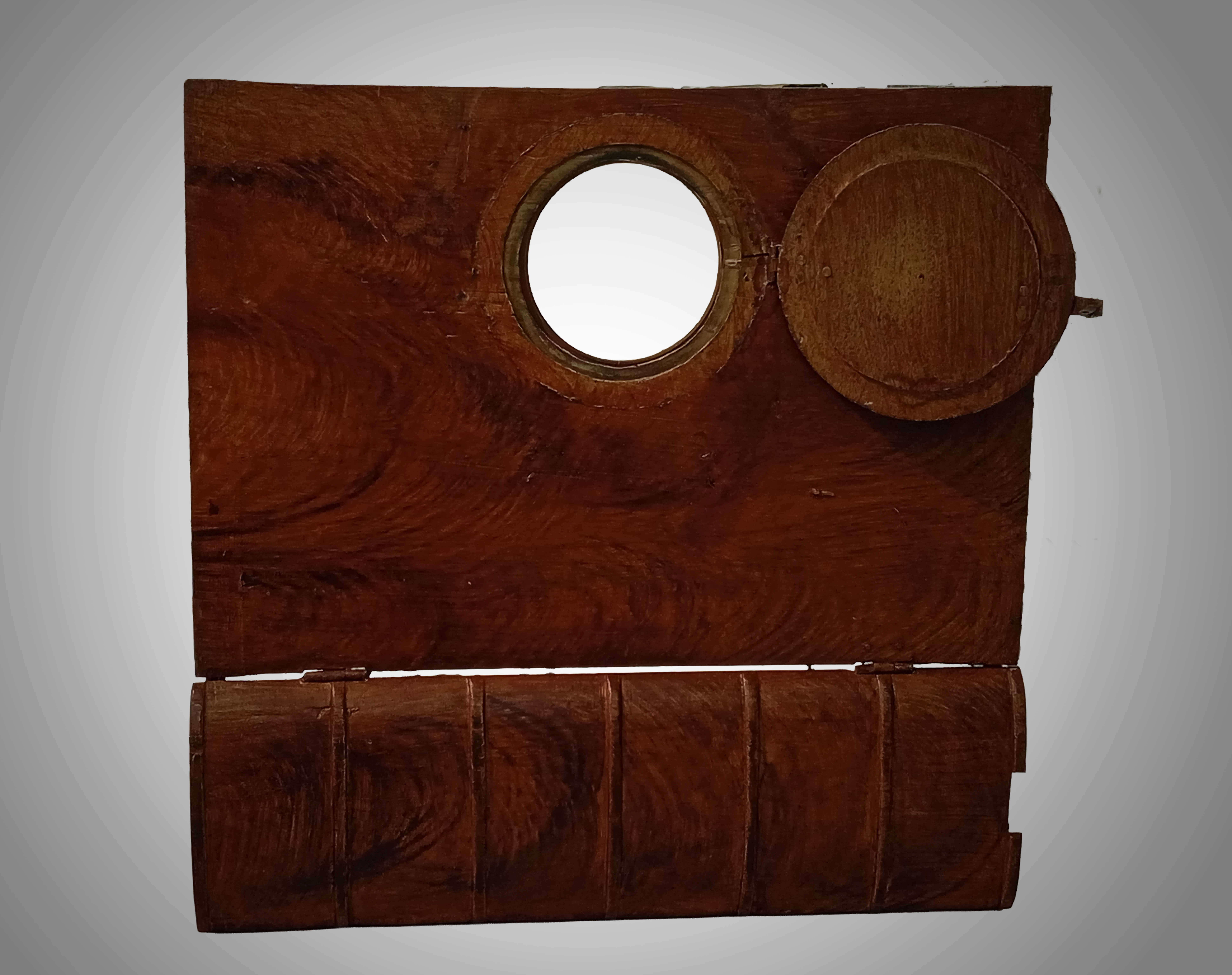 |
| MNC-M01026 |
This is a thicker, cruder book than Egerton's. It has a raised image-plate that allows for the storage of more prints below it. The round lens-cap is not as unobtrusive as Egerton's sliding cover.
| Trapez Book I: | 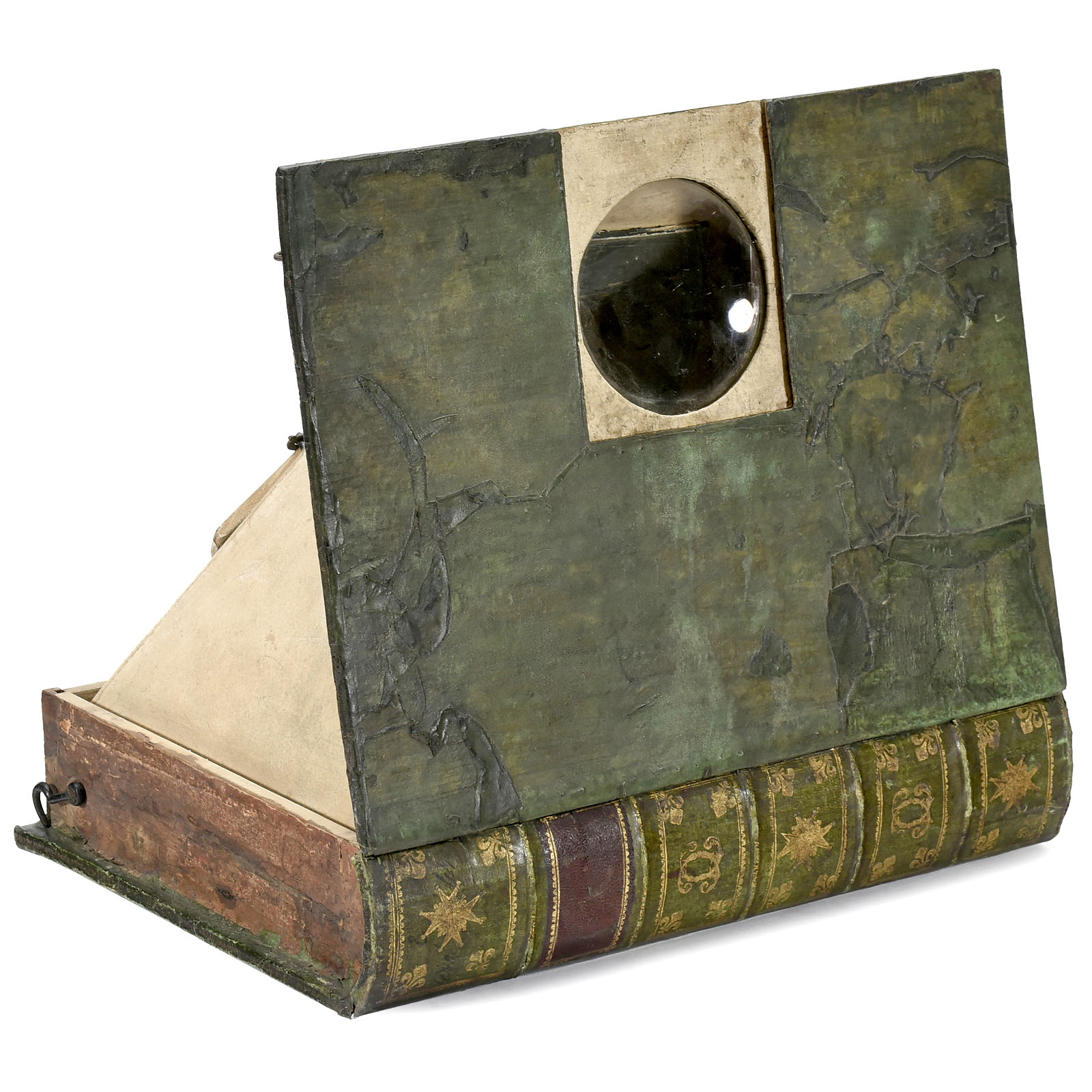 |
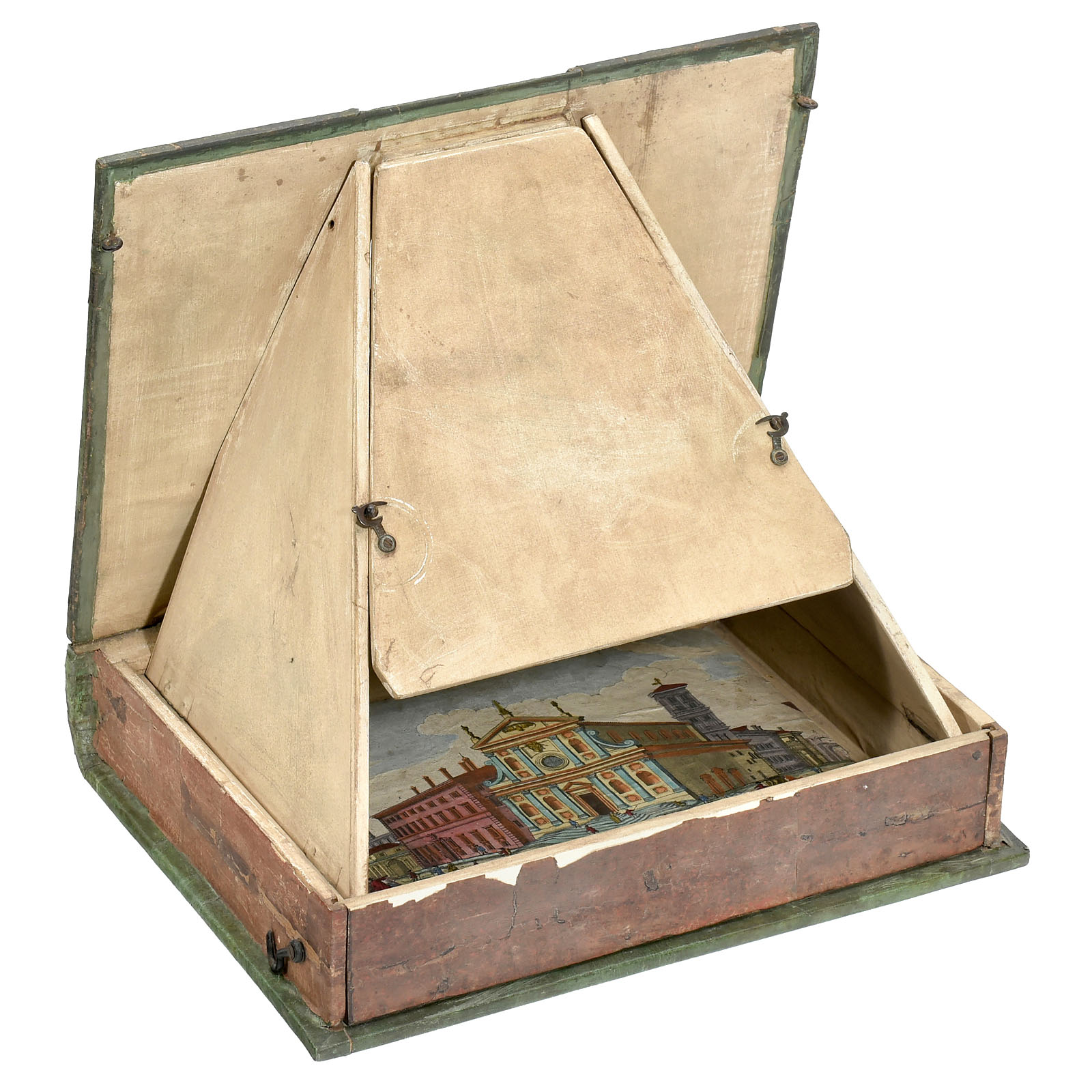 |
| laoxiangji_2026 | laoxiangji_2026 |
This species, on a Chinese auction site in 2026, shows an arrangement for propping up the lens/mirror assembly that is doubtless inspired by the structure of the Trapez-Guckkasten. Perhaps the steps of inspiration were: Trapez-Guckkasten – Folding Diagonal Mirror – Trapez Book – Egerton's Folding-Book.
This box was being sold with a set of six vues d'optique of Italian sights, with Italian and German legends and hand-written French translations. Perhaps an Italian design; certainly not English.
| Trapez Book II: | 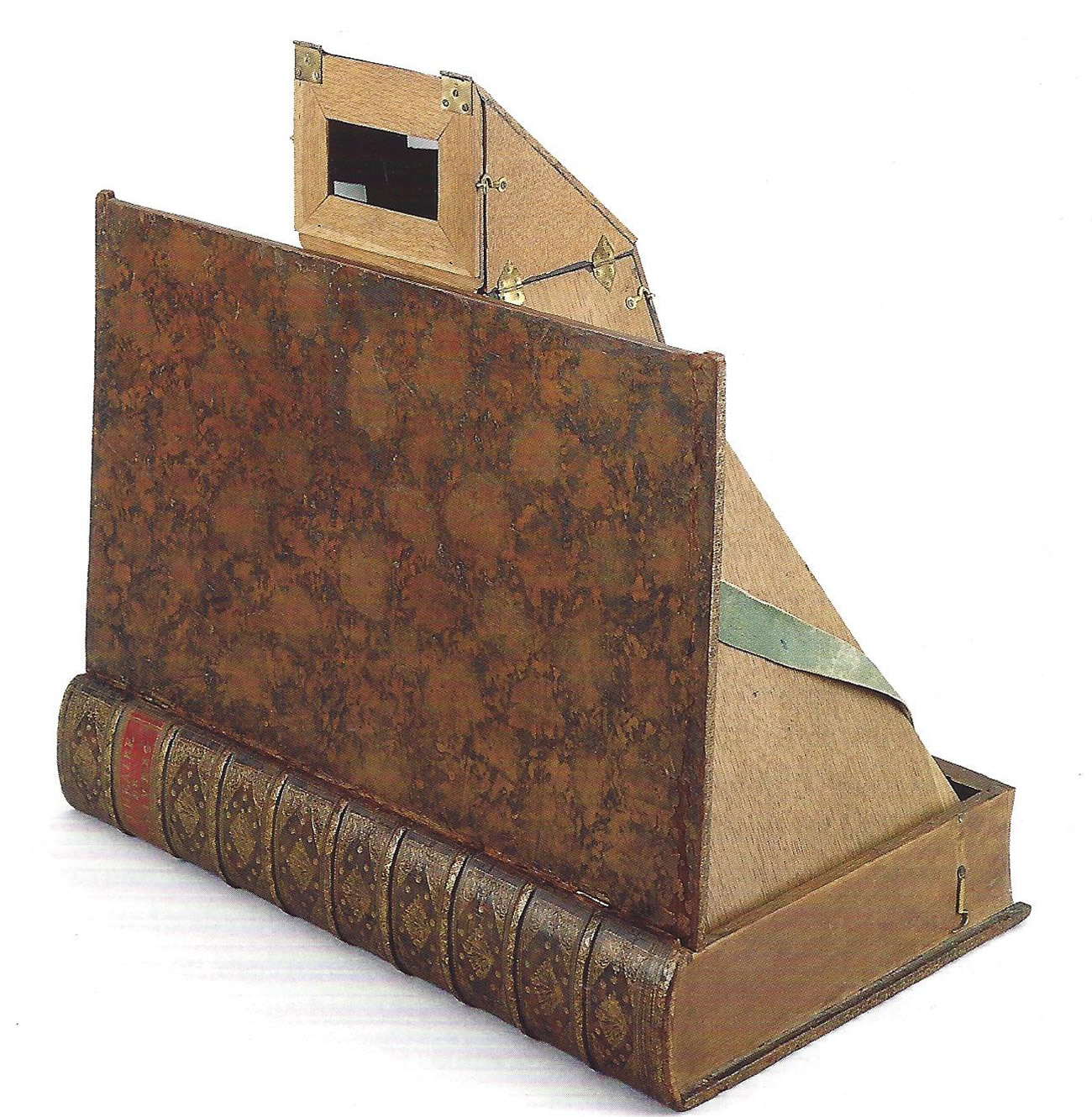 |
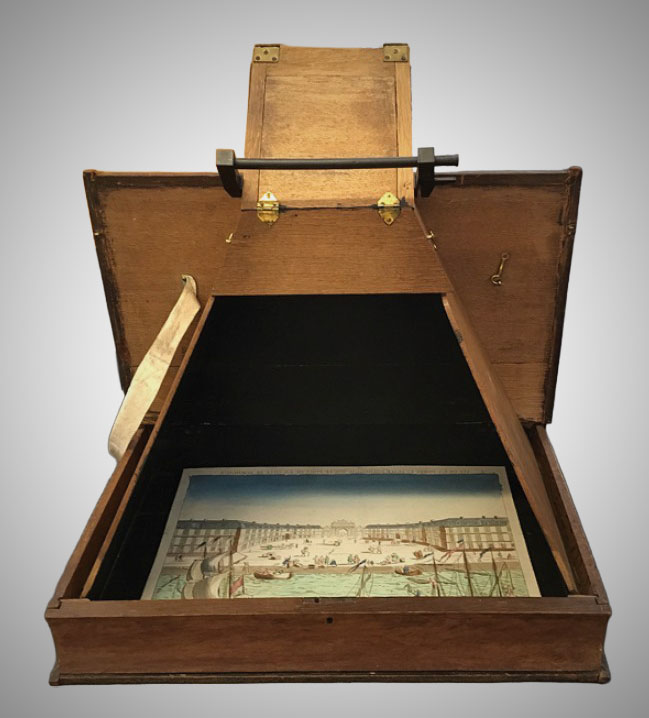 |
| WN-GTTY_01 | WN-GTTY_01 |
This is a French mashup between a Trapez-Guckkasten and a book (ca. 1750). The author of the website on which it is depicted assumes that it is a camera obscura. An optical machine can be designed so that it functions also as a camera obscura. These are Camera-Optique hybrids. However, the sloping sides and closed back of the box (see by contrast SML-1875-28 below) leave little room for the draughts-person to get her hands into the drawing-space wielding a pencil.
Like the camera obscura (SML-1875-28 below) the lens folds up to hide it completely in its book form. This box is also unique in having a square lens-opening. The title on the spine is Théâtre de l’univers, apt if it refers to the vue d'optique views of the world it contains.
It is described as being made of "wood, metal and glass, 56,2 x 55,2 x 36,5 cm ([as]shown unfolded)" and being in the Werner Nekes Collection of the Getty Research Institute, Los Angeles.
| Outlier: | 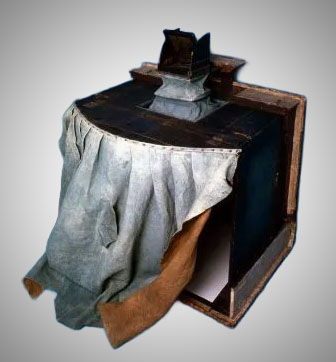 |
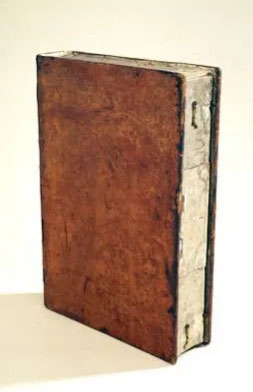 |
| Camera-Obscura Book (SML-1875-28) | Closed (SML-1875-28) |
This is one of Sir Joshua Reynolds's (1723 - 1792) camera obscuras used for drawing. Like the optical machines on this page it folds up into a book (perhaps Reynolds wanted to preserve the myth for critics and collectors who visited his studio that no "mechanical" means were used in his work). However it is not another folding-book diagonal-mirror.
It could be "hacked" as a viewer for prints, but is not suited to that purpose. The lens is small and would be even further diminished by looking through the mirror first (the print viewers all have the lens first, looking through to the mirror). The solid sides and heavy curtain are designed to exclude light, whereas print-viewing benefits from even lighting over the print surface. Note how, unlike the other examples on this page, the lower edge of the box is removed to allow level access for the artist's hands and wrists.
Its dimensions when closed are: 12.5 cm x 46.5 cm x 65 cm.
Endnotes:
[xxx] This two-volume "book" appeals to the realism of stereo-photography and the authority of the book to make dubious ideological claims about the character of America.
[xxx] For more thoughts on book-form objects, see Dubansky, Mindell. Blooks—The Art of Books that Aren’t. Book Objects from the Collection of Mindell Dubansky. New York: Mindell Dubansky, 2016.