Rod Bantjes, “Genus_Mono-Graphoscope.html,” created 19 April, 2026; last modified, 20 April, 2026 (https://people.stfx.ca/rbantjes/).
Mono-Graphoscope Genus (ca. 1880-1900)
The Mono-Graphoscope is a large-lens, short-focal-length viewer that is supposed to enhance the depth-effect of 19th-century photographic formats such as the carte de visite. It is a genus of "optical machine" within the Optical Machine Taxonomy.
The original graphoscope, patented by Charles John Rowsell in 1864, integrated a pair of Stereoscope lenses with the graphoscope lens. At what point manufacturers decided that the graphoscope lens could be marketed as a stand-alone is uncertain. However, judging by the number that have survived, people must have appreciated the graphoscope effect on its own merits, or for whatever reason thought it useful for their growing collections of non-stereo photographs.
Defining Features: The defining features of the Mono-Graphoscope are:
| • A single, large lens (⌀>8 cm, ƒ<40 cm) with the unique features described under the Graphoscope Family | ||
| • A rectangular base from which a rectangular lens-plate folds up for viewing. | ||
| • An image-plate which is typically adjustable up and down and forward and back along the base and can be folded down when not in use. |
| Cigar-Box: | 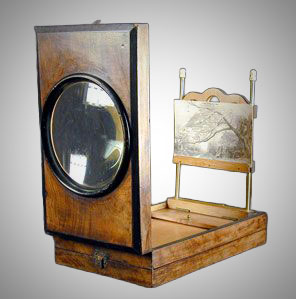 |
| GMR-01 |
This is likely the standard version where there are two hinged platforms, plus the lens-plate. The platform atop the base hinges up and can be supported at different viewing-angles by a hinged prop beneath it.
When folded flat the unit looks a bit like a cigar case, hence the name I have given it.
| Souvenir de Paris: | 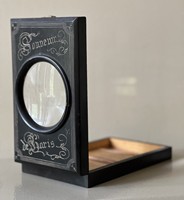 |
| RB-03 |
This is a cheap model which lacks the second platform and therefore cannot be tilted up for a more convenient viewing angle.
You can read a more complete description here.
| Billon Viewer: | 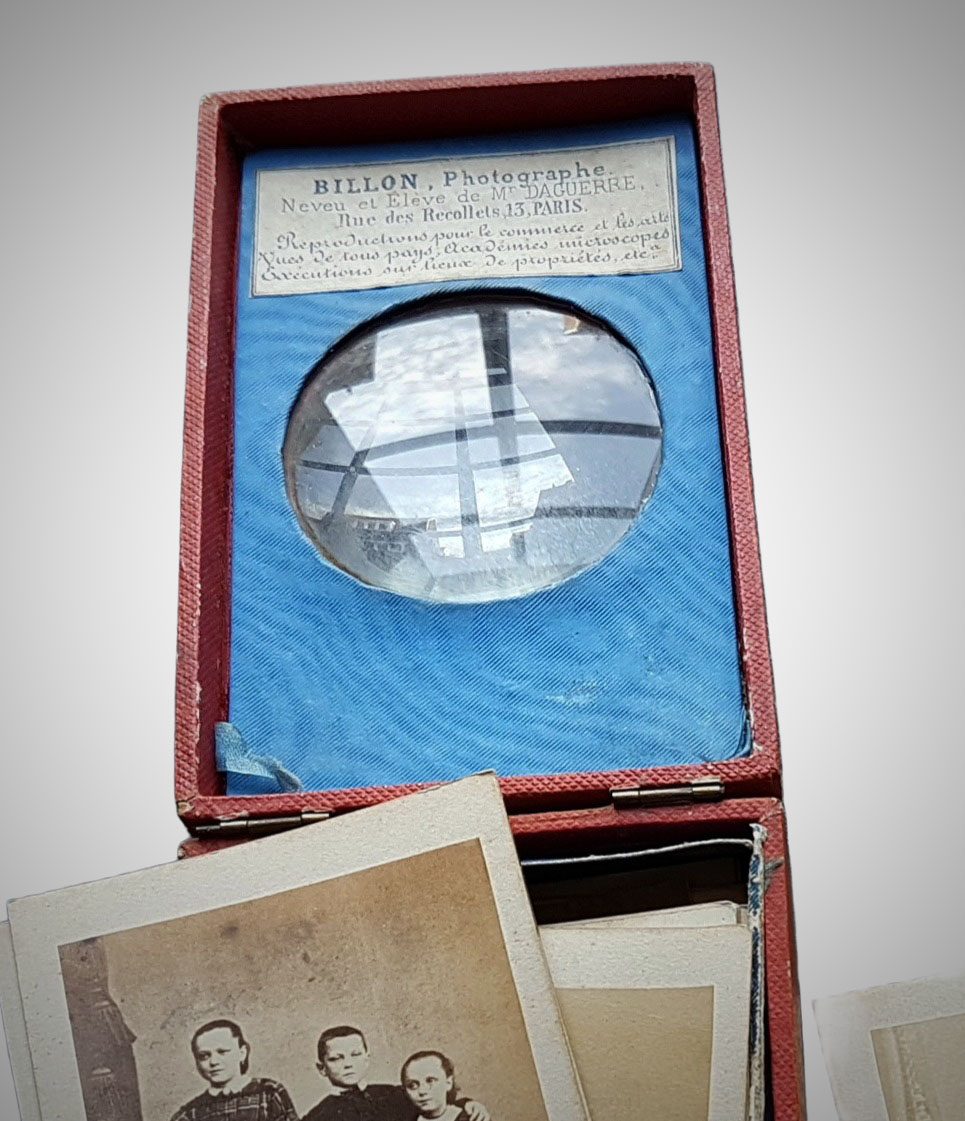 |
| Billon |
This is a viewer exclusively for cartes de visite sold by French photographer Armand(?) Billon, student and nephew of Louis Daguerre. It is cheaply constructed with paper-covered softwood.
The box functions as a storage case and base for the erected lens and image. Like a Reflectoscope, the image-card probably slots in between an inner cardboard layer and outer edge of the box. Unlike most Mono-Graphoscopes, the image-plate's height and distance from the lens is therefore not adjustable.
Judging from its curvature, evident in the photo, the lens has a short focal length (perhaps equivalent to the length of the box) typical of graphoscopes. The images are ca. 1869, which makes this quite an early graphoscope.
Photo © Regout family archive at the Regional Historical Centre Limburg in Maastricht.