Rod Bantjes, “Family_Graphoscope.html,” created 19 April, 2026; last modified, 19 April, 2026 (https://people.stfx.ca/rbantjes/).
Graphoscope Family (ca. 1861 - 1930)
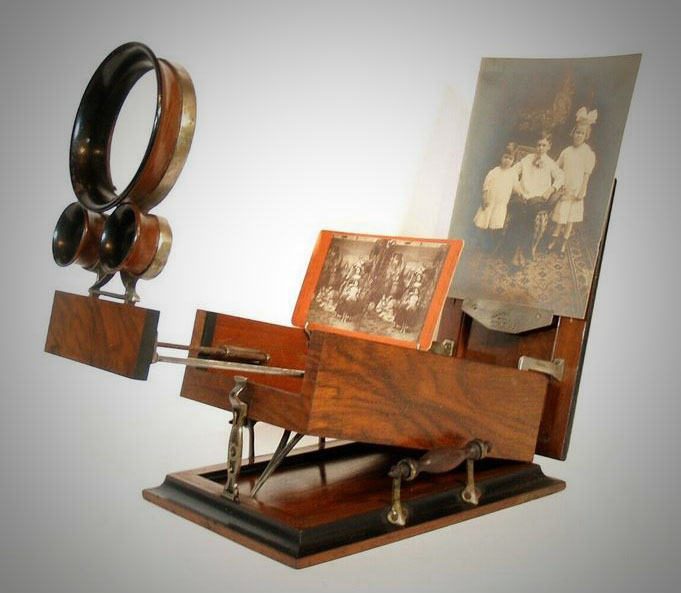 |
Figure GF.1 – Lewis Stereo-Graphoscope |
| Photo © WorthPoint. |
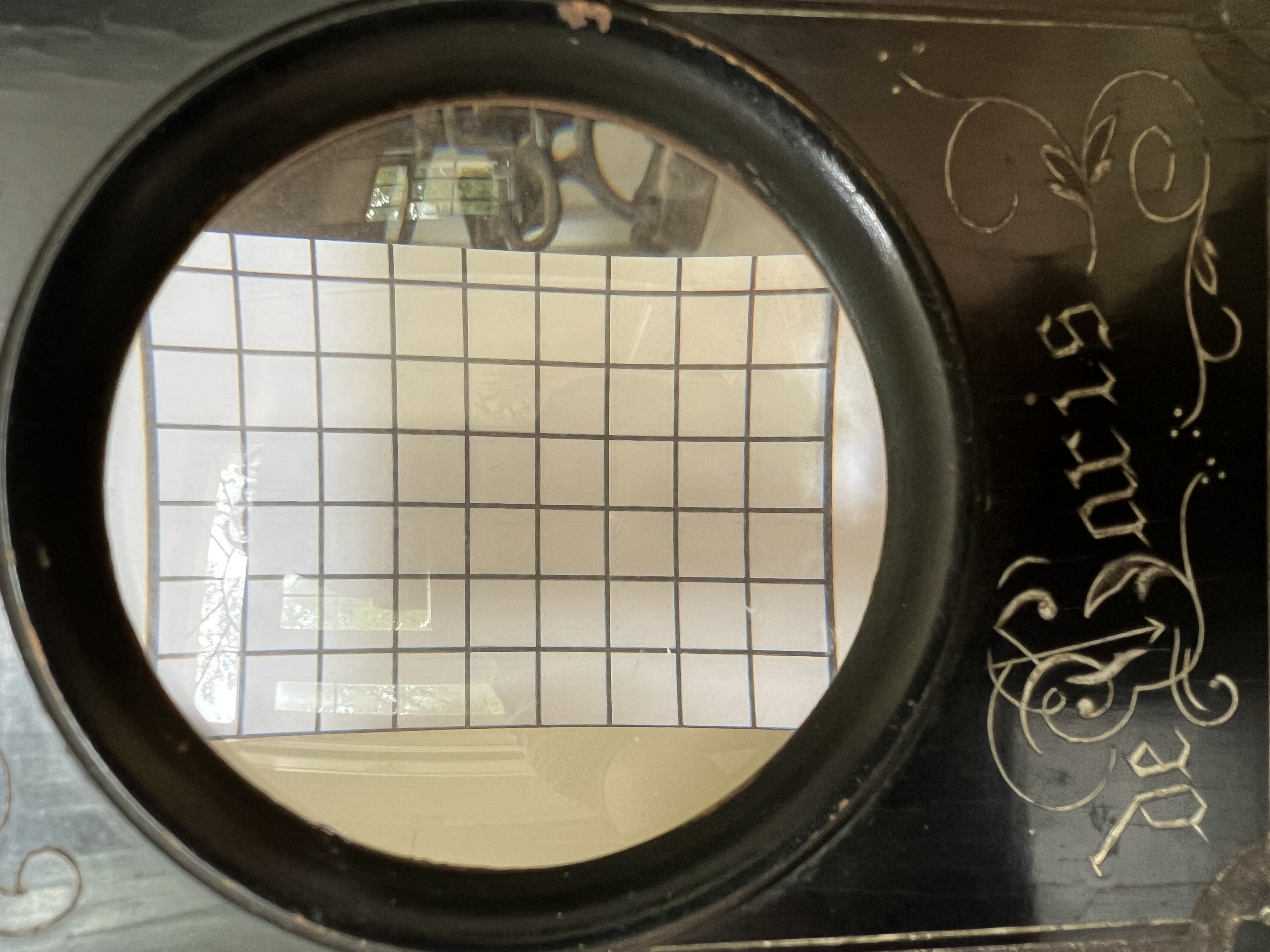 |
Figure RB-03.3 – Lens Distortion |
A square grid seen through graphoscope RB-03 with a lens focal-length of 33 cm. Photo © Rod Bantjes. |
1.0 Definition:
1.1: Graphoscopes are a family of optical machines all of the members of which have large-diameter (> 8 cm), short-focus (< 40 cm) convex lenses designed to enhance the 3D effect of standard photographic-format images such as the carte de visite.
1.1.1 Sub-Family – Miniature: There is a sub-family of miniature graphoscope that does not fit the above definition but is still more closely related by pedigree and morphology to the graphoscope family than to any other type of optical machine. It has one known species: the mini mono-graphoscope.
1.2 Photographic Optical Machine: Charles John Rowsell's original graphoscope, which he patented in 1864, was the third of five devices including Adolphe Beau's Neomonoscope (1860), Carlo Ponti's
2.0 Lenses:
2.1 Magnification and the Photograph: With the exception of Ponti's devices, these photo-viewers have shorter focal lengths (20 - 40 cm) which are more powerful than those in 18th-century optical machines (with typical focal lengths of around 60 cm). Since they magnify the images more, they highlight the imperfections of the surface, which may have been thought more acceptable for photographs with their crisp detail, than for the old copper-plate engravings or 19th-century lithographs.
2.2 Focal Length and Device Size: The graphoscope and neomonoscope have even shorter focal lengths than these other devices. Given how the binocular 3D effect is supposed to work in optical machines, a short focal length allows the image-plate to be closer to the lens and for the device to be smaller overall. Graphoscopes were part of a 19th-century trend towards miniaturization.
2.3 Lens Diameter and 3D Effect: All of the photograph-viewers have lenses wide enough to view through with both eyes. Magnification may have made these lenses even better for enhancing the 3D illusion than long-focus 18th-century lenses,[xxx] but the main advantage was still the way that a wide lens causes binocular deconvergence.
2.4 Lens Distortion: The editor of The British Journal of Photography complained in 1875 that the high magnification of the graphoscope lens made it unsatisfactory for architectural views where the linear grid revealed “a sadly-pincushioned shape” (see Figure RB-03.3).[1] He thought it more suited for subjects like flower arrangements (see below).
Given that this distortion is seen slightly differently by the left and right eyes, it may contribute to a pseudo-disparity effect that enhances the 3D illusion. The editor of Camera Craft recommended an experimental test of this hypothesis that I must try.[2]
2.5 Chromatic Aberration and 3D: :Most, perhaps all, optical machine lenses suffer from chromatic aberration. What this means is that they bend light at different angles depending on the colour of the light. Some people, including the editor of The British Journal of Photography, thought that this would make objects of different colours appear at different depths in a scene. I am skeptical of the idea that this phenomenon could enhance the 3D effect of an image. The editor was convinced that it could work, but only for specially-chosen scenes. He writes:
| If ...a group of flowers be photographed on a white ground, the most prominent centre flower being coloured a very strong red, some others farther from the centre, and of less importance as respects the composition, being respectively yellow, blue, or violet, the leaves being green, it will be found that, when viewed through a simple magnifying glass of the graphoscope order, in proportion as the colours are more or less frangible so will be the apparent distance from the eye of the objects thus coloured. The red central flower will stand out in bold relief, the green leaves will range farther back, while the blue or violet flowers will retire farthest back of all. Thus the very defect of the common graphoscope objective forms its chief merit when used in the examination of objects of the class of which we have spoken.[3] |
If the editor's opinion were widely shared by photographers for the graphoscope, then we would see many images with this sort of colour composition. It is not something that I have so far observed.
2.6 Conclusion: There is evidence here that the graphoscope lens may give a depth-effect superior to that of other optical machines. That is notwithstanding the distortions of architectural lines, and perhaps best with subjects such as the portraits typical of carte de visite photos. I have yet to verify this hypothesis, but if true it would help to explain the enormous popularity of this style of viewer in the late 19th through into the 20th century.
Sub-Family Mono-Graphoscope
| Mono-Graphoscope: |  |
| Genus Link |
This is a folding platform-style graphoscope with a rectangular base and only a single lens.
| Snap-Graphoscope: | 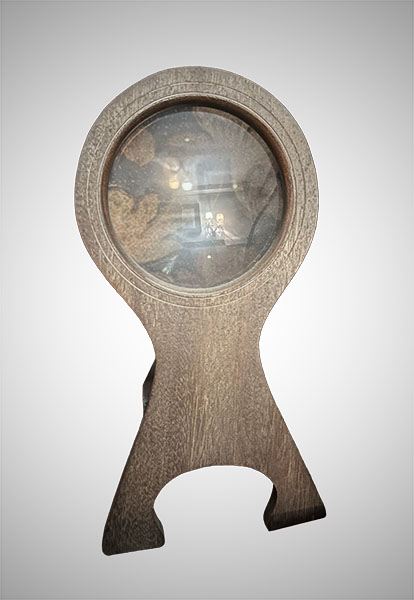 |
| [Future] Genus Link |
I call this device a Snap-Graphoscope because it is for the same type of image (a snapshot) and has the same scale and simplicity as the concave-mirror Snapscope.
| Pedestal-Graphoscope: | 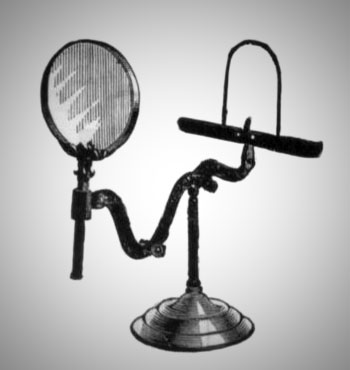 |
| Genus Link |
The pedestal graphoscope has a single lens and image-holder mounted on a round pedestal rather than a rectangular base. This is an Anderson Krum pedestal graphoscope from an advertisement in 1883. It has a 4 inch (10 cm) diameter lens.
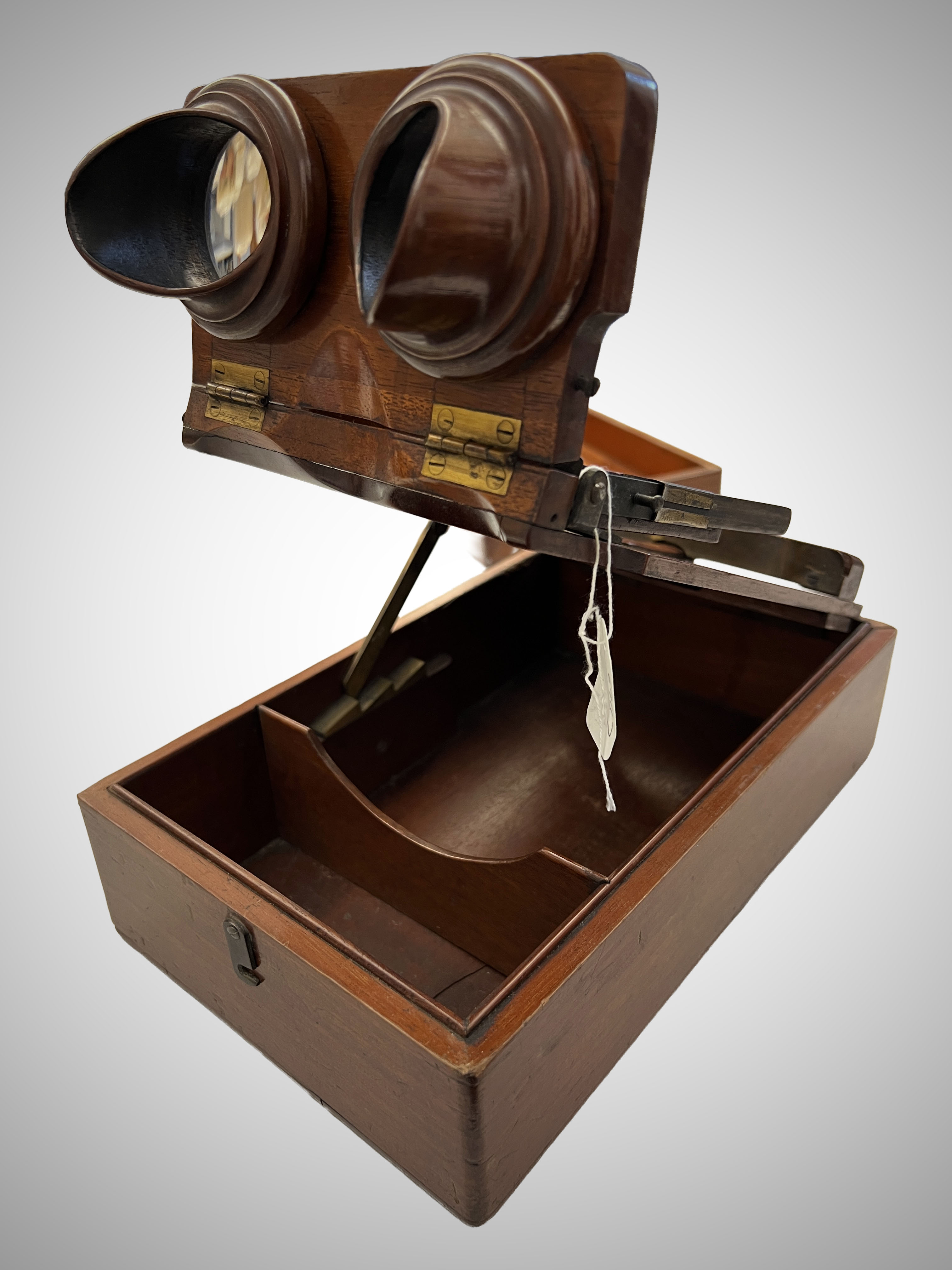 |
Figure GF.3 – Graphoscope |
Mashup of the graphoscope (EXBD-69117) and Brewster stereoscope. Photo © Rod Bantjes. |
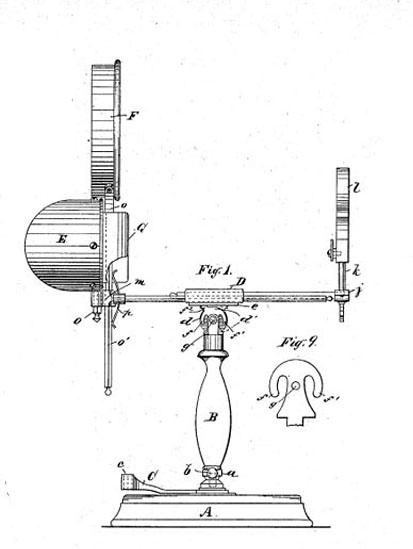 |
Figure GF.4 –Lewis Graphoscope-Stereoscope |
1881 patent application for a mashup design between an optical machine and Holmes stereoscope. Source: |
3.0 Intermedia Hybrids
Intermedia hybrids are “mashups” between optical machines and other devices like the magic lantern, the phonograph, animation devices and in the case of the Stereo-Graphoscope (below), the Stereoscope. The hybrid often borrows signature features of the component devices. The wooden lens hoods of the Rowsell Stereo-Graphoscope are typical of many Brewster stereoscopes.
The two Pedestal Stereo-Graphoscopes depicted here borrow instead from the Holmes stereoscope. Not only is the lens hood similar, but in the Lewis device (Figure GF.4) the handle and the oddly-shaped connector that is enlarged in the diagram are identical to ones on Holmes devices.
The 3D effect of the stereoscope is far superior to that of the graphoscope in my view. Others, closer to the period, agreed. Arthur Judge observes in 1926 that “Those who have viewed single prints with any of the devices mentioned [single-lens devices including the graphoscope], and have also observed stereoscopic pairs in the stereoscope will agree that there is no comparison between the results, the latter being infinitely better in relief, solidity and perspective.”[2]
However the popularity of the graphoscope, and the fact that so many designers insisted that it should not be “left behind” and must have a equal place with the stereoscope, suggests that others valued its capabilities more highly than Judge and I do.
In 1878 the instrument-makers Negretti & Zambra described the 3D effect of the graphoscope in terms that many people in that period would have found persuasive:
| Plain or Coloured Photographs, when viewed through the Large Lens, will be found to stand out with the roundness and reality of natural objects. ...In the beautiful Photographic “Nature Printing,” there is much that the unassisted eye cannot perceive, but which appears among the distincter portions portrayed, as a dark or light mass only. The Graphoscope, by a simple but effective arrangement, and a powerful Lens easily adapted to any focus, “brings out” and gives a Stereoscopic life-like effect to this, and to the whole subject in a very pleasing and beautiful manner.[xxx] |
Sub-Family Stereo-Graphoscope
| Rowsell Stereo-Graphoscope: | 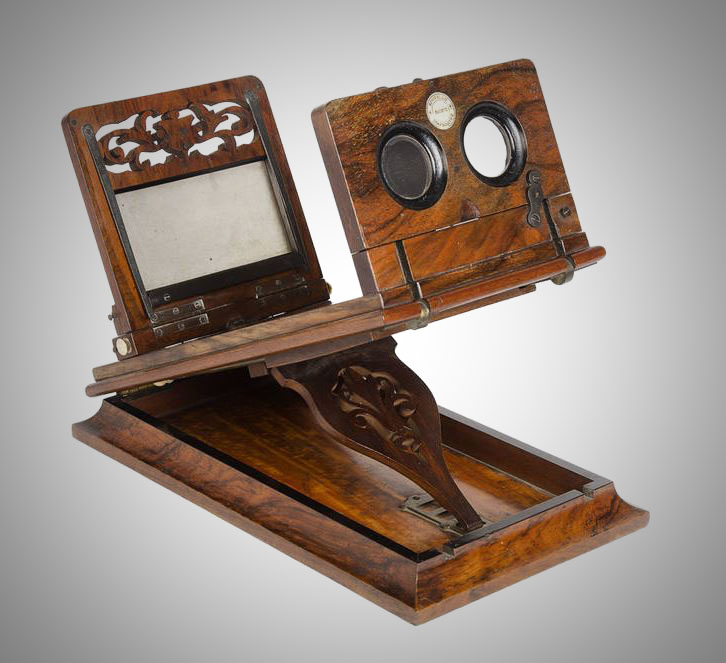 |
| Genus Link |
This is the inventor's original folding design with a tilting platform and rectangular base. The monoscopic and stereoscopic lenses interchange. The monoscopic lens folds either under or over the platform to make way for the stereoscopic lenses. When the monoscopic lens is in place, the stereoscopic lenses fold down.
| Stereo-Graphoscope-Integrated: | 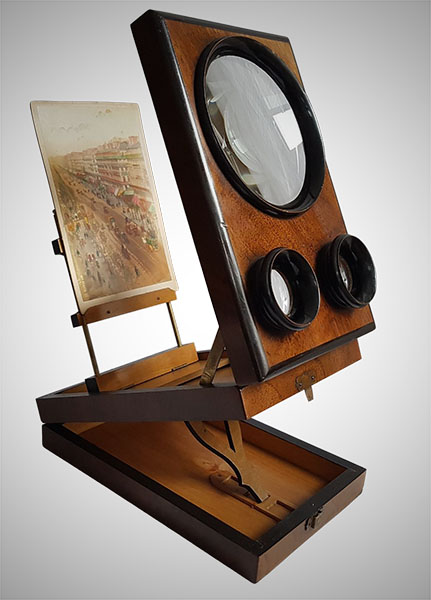 |
| Genus Link |
In these devices, the monoscopic and stereoscopic lenses are in the same lens-plate and do not interchange.
| Pedestal Stereo-Graphoscope: | 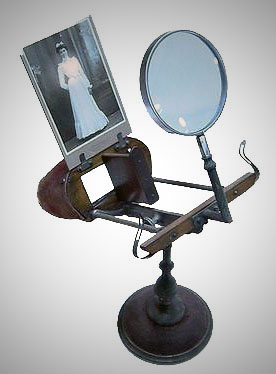 |
| Genus Link |
These devices are inspired by the skeletal design of the American Holmes stereoscope. The lenses are affixed to armatures supported by a turned pedestal and pillar rather than a rectangular plinth.
Endnotes:
[xxx] On the face of it, the magnifying lens should not enhance a 3D effect. A magnifying lens make things appear larger, and we know that a thing with a larger appearance to the eye is judged to be closer. The purported space of the image should in this way be contracted. The 3D-enhancement mechanism of a magnifier, if there is one, is therefore uncertain. It may be that the binocular-deconvergence effect prevails, so that the objects in the image appear both larger and more distant.
[1] “A Combination Graphoscope,” The British Journal of Photography XXII, no. 768 (1875), 37.
[2] “The Graphoscope,” Camera Craft 14 (1907).
[3] “A Combination Graphoscope,” 37.
[xxx] Negretti, Enrico Angelo Lodovico, and Joseph Warren Zambra, Negretti and Zambra's Encyclopædic Illustrated and Descriptive Catalogue of Optical, Mathematical ... Instruments, Etc (London: Hayman Brothers and Lilly, n.d., ca. 1884) 225.