Rod Bantjes, “Genus_Rowsell-Graphoscope.html,” created 19 April, 2026; last modified, 23 April, 2026 (https://people.stfx.ca/rbantjes/).
Rowsell-Graphoscope Genus (1864 - ca. 1890)
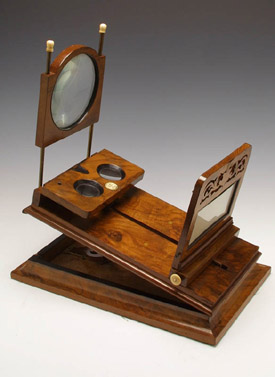 |
Figure RG.1 –Graphoscope |
| Negretti & Zambra, ca. 1875-84, with graphoscope lens up. Photo © George Glazer Gallery. |
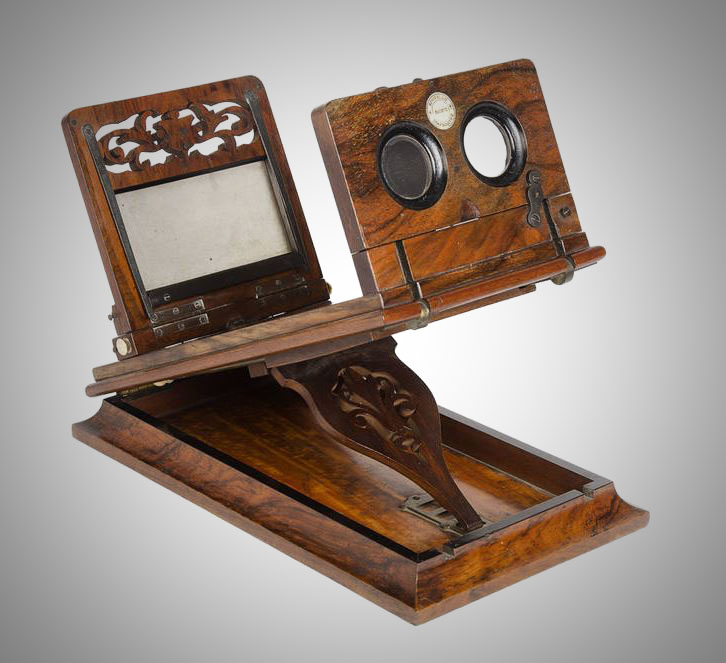 |
Figure RG.1 – Graphoscope |
| Rowsell, ca. 1864, with stereoscopic lenses up. The graphoscope lens is folded under the tilted platform. It has to loop over the prop to fold up fully. Photo © Leski Auctions. |
Charles John Rowsell patented the graphoscope in England in 1864 as a 3D-viewer for both stereographs and non-stereoscopic photographs of the carte de visite format. He may have been influenced by Carlo Ponti's Pontioscopio. However, while Ponti's lens has a focal length of 71 cm, Rowsell's device and the whole family of graphoscopes that it inspired had much shorter focal lengths (ca. 30 cm).
Graphoscope Lens Effects: The short focal length of the binocular graphoscope lens has two interesting consequences. First, it allows for the device to be smaller. Second, it creates visible distortion of straight lines and chromatic aberration. Paradoxically, these features may enhance the 3D illusion of photographs seen through the lens over and above the the binocular effect.
Inter-media Hybrid: Like all the Stereo-Graphoscopes, it is an inter-media hybrid that combines two types of 3D technology: the 18th-century biconvex lens and the 19th-century stereoscope Why designers from Rowsell onward insisted that the older (and to my mind inferiour) technology had to have a place on the same platform as the newer is curious and demands an explanation.
Rectangular Plinth and Platform: Like the Integrated Stereo-Graphoscope the Rowsell-Graphoscope has a rectangular plinth-style base with a hinged platform upon which the optics rest. The angle of this platform can be adjusted to suit the user. The platform can be held at different angles by a prop that folds out below the platform and lodges against stops in the base.
Interchangeable Optics: Unlike the Integrated Stereo-Graphoscope where the optics are all in the same lens-plate, the Rowsell-Graphoscope's optics are interchangeable: when the graphoscope lens is in place, the stereoscopic lenses fold away and vice-versa.
Summary: The defining features of the Rowsell-Graphoscope genus are:
| • a large-diameter (> 8 cm), short-focal length (< 40 cm) convex lens | ||
| • interchangeable graphoscope and stereoscope lenses. | ||
| • a rectangular plinth-style base with a hinged platform. | ||
Each row in the following table represents a different species of Rowsell-Graphoscope. Multiple entries in a single row represent slight variants of the same species.
| Rowsell-Original: | |
|
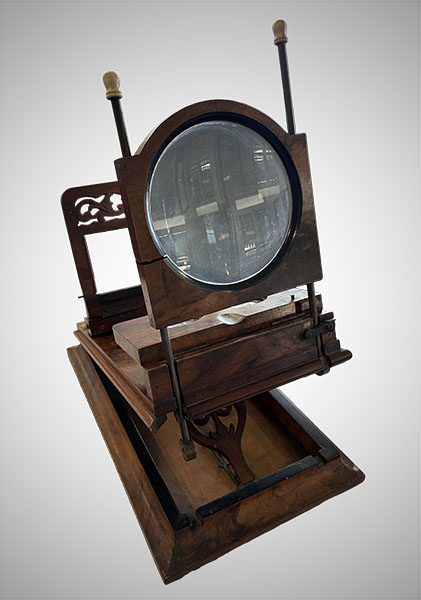 |
| Rowsell | Negretti & Zambra | SM-6939 |
The Negretti & Zambra and SM-6939 closely follow the Rowsell original in design and aesthetics. The graphoscope lens is on a kind of swivel-hinge that allows it to move in a wide arc and fold completely under the deck. The stereoscope lens-array folds forward to be out of the way when the graphoscope lens is up.
The George Glazer Gallery describes the Negretti & Zambra as "Burlwood with brass ...fittings, ...(24.1 x 40.6 x 11.4 cm) folded" with a 14 cm graphoscope lens. Photo © George Glazer Gallery.
| Long 42: | 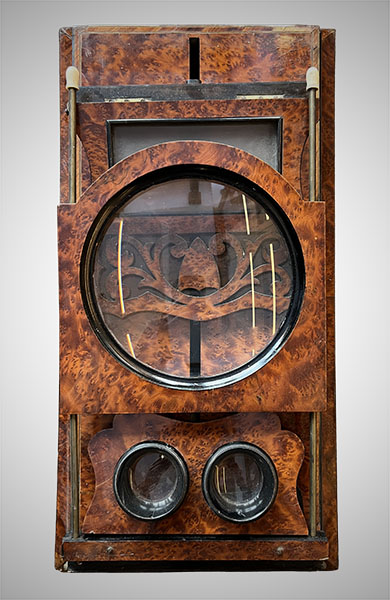 |
| SL-25-02 |
This graphoscope is shown folded flat. The stereoscopic lens-array and the graphoscope lens fold down separately, so that the graphoscope lens (secured upright by hooks) can be used with the stereoscope lenses out of the way. However, the graphoscope lens does not fold out of the way when the stereoscopic lenses are in place. It is long, with an unusually long focal-length (42 cm).
It was for sale in 2025 by Antiqu Photo, Paris.
| Brewster: | 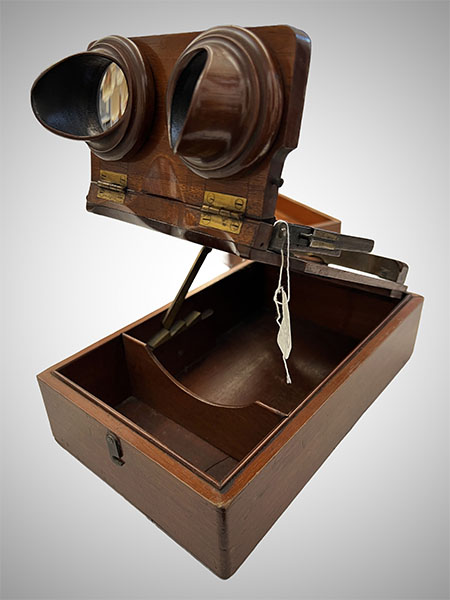 |
| EXBD-69117 |
This graphoscope has different design for interchanging lenses. The graphoscope lens folds down onto the top of the deck. The stereoscope lens-array folds forward and hangs down at right angles to the deck. It has a brass prop that lodges against serrated brass stops. The lens hoods for the stereoscopic element are reminiscent of those in some Brewster stereoscopes or Beckers' tabletop stereoscopes. It is short, with an unusually short focal-length (20 cm).