Rod Bantjes, “CM-2025-1_Pontioscopio.html,” created 24 April, 2026; last modified, 24 April, 2026. (https://people.stfx.ca/rbantjes/).
Pontioscopio
Carlo Montenero Collection,[xxx] Venice, Italy, #CM-2025-1
Italy ca. 1868
Dimensions Open: H=54.5 cm, W=34.2 cm, D=64, Closed: H=16.5 cm, W=34.2 cm, D=56
Lens: ⌀=20.5 cm, ƒ= 71 cm
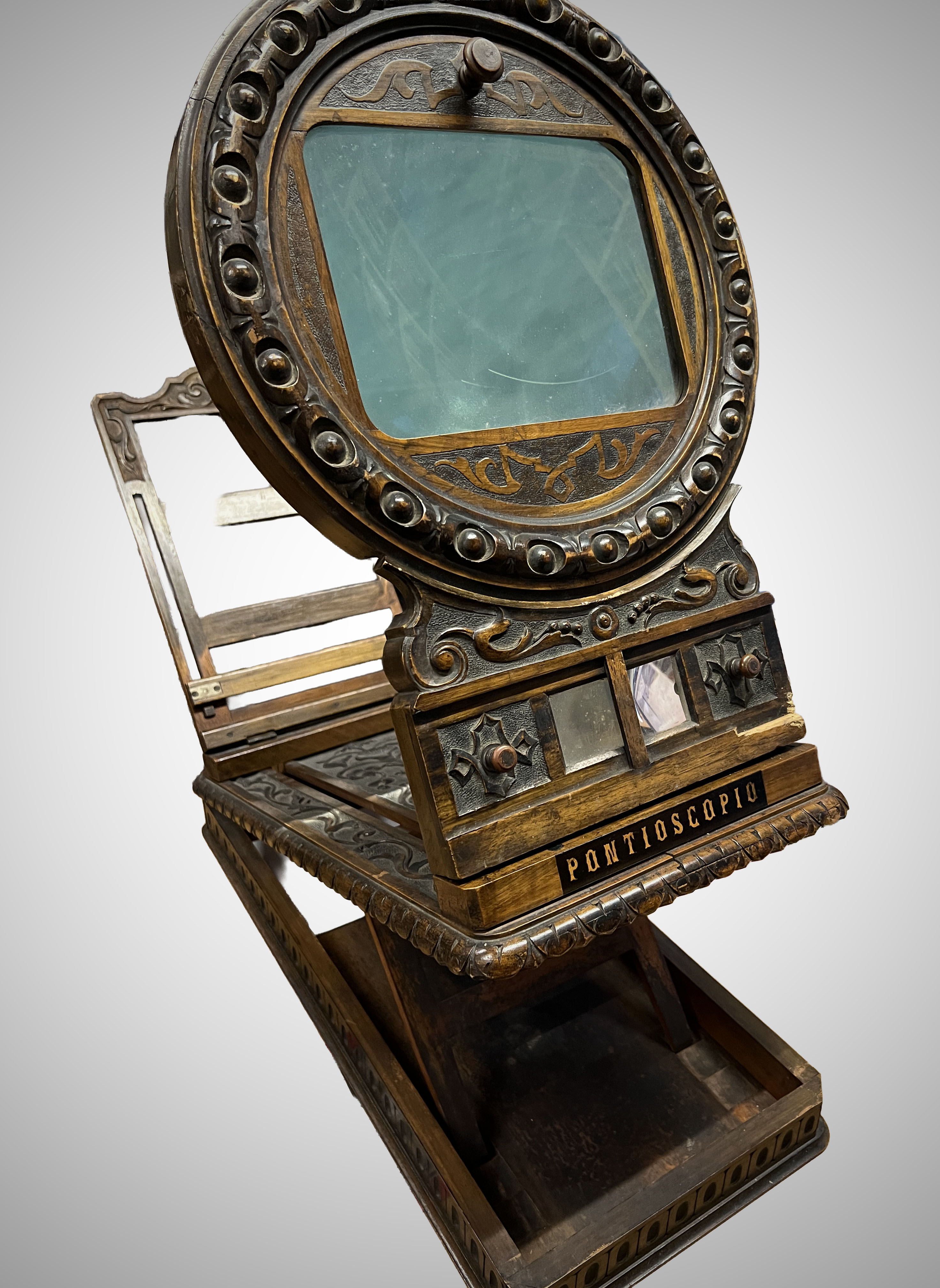 |
Figure CM-2025-1.1 –Pontioscopio |
| Photo © Rod Bantjes. |
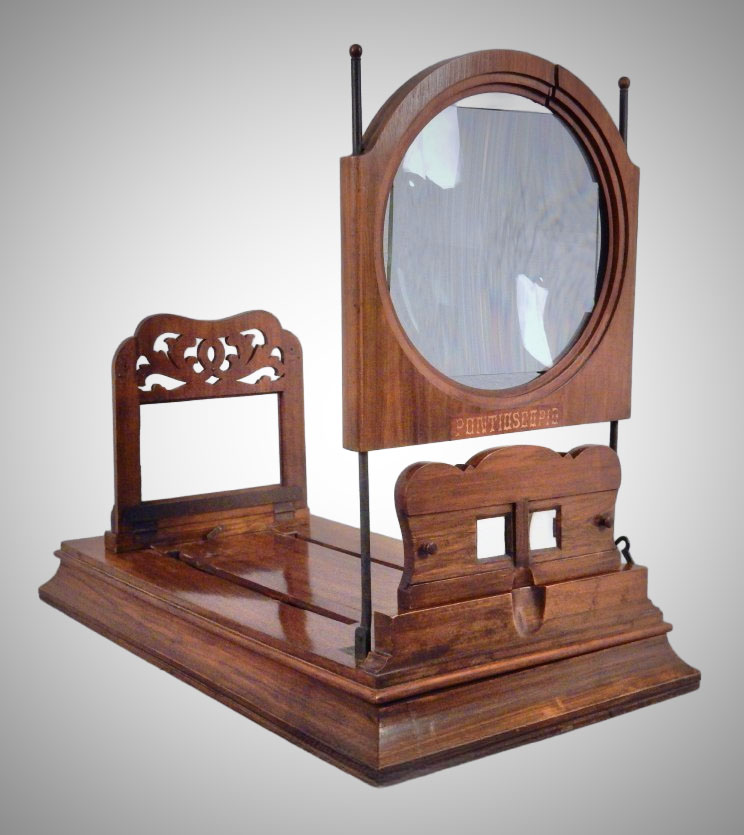 |
Figure CM-2025-1.2 –Pontioscopio |
Dimensions: H=63.8 W=42.2 D=79 cm Photo © History San Jose Collection . |
Carlo Ponti has a created here a grand quasi-graphoscope for enhancing the 3D effect of photographs. However, it is so large that it can no longer reasonably be called a graphoscope. It is an example of an "optical machine " and is included in the Optical Machine Taxonomy.
The morphology of the Pontioscopio is identical to that of the Integrated Stereo-Graphoscope. Like the Integrated Stereo-Graphoscope it unfolds in a three-part Z-shape: a rectangular plinth-style base; a hinged platform to set the angle of view; and a lens-plate containing both a large graphoscope lens and a pair of stereoscopic lenses.
Like all the stereo-graphoscopes, it is an inter-media hybrid between the 18th-century optical machine and the 19th-century stereoscope.
The Pontioscopio differs slightly from the Integrated Stereo-Graphoscope in having rectangular lenses (more like Frith's Cosmoscope) and a double-legged prop to more stably secure the great weight of the huge platform and lens.
The main difference that disqualifies the Pontioscopio from the category of graphoscope is the long focal length (71 cm) of the monocle biconvex lens. Graphoscopes average closer to 30 cm with an upper limit of about 40 cm). The greater magnification and distortion of the short-focus graphoscope lens had a unique effect that people seemed to find persuasively enhancing for photographs.
By the very name that he has given his device, Ponti seems to be making a claim of uniqueness, if not invention, for it. Its close similarity to the Integrated Stereo-Graphoscope suggests that one is little more than a scaled up (or down) version of the other. Sylvia Paoli writes that during the period between 1868 and 1876 when Ponti was fighting to regain exclusive rights to his Alethoscope from Carlo Naya, Ponti created many variants of his device with inventive names: Amfoteroscopio, Dioramoscopio, Cosmorama Fotografico and Pontioscopio, presumably with the aim of asserting exclusive rights over these. If so, the Pontioscopio was invented at least four years after the first graphoscope (1864).
It is possible that there was ongoing mutual inspiration between graphoscope and Pontioscopio as there often is during periods of design innovation. The Pontioscopio may have taken inspiration from the original Rowsell Graphoscope, and the Integrated Stereo-Graphoscope may in turn have been influenced by the Pontioscopio. Ponti's innovation may have been to do away with Rowsell's complex lens-interchange mechanism. The Alethoscope is his truly original creation that might better bear his name.
Typical of Ponti's work, the device is decorated on almost every surface with elaborate carving. It was clearly mean tto be a prestigious item worthy of display in a wealthy household.
A different species of Pontioscopio exists (Figure CM-2025-1.2). This one adheres more closely to the design of Integrated Stereo-Graphoscopes. It retains Ponti's square stereoscopic lens-frames which can be slid together or apart for different interlocutor distances. The square graphoscope lens in a round frame has been replaced by a round lens with a mostly square frame. This design, movable up and down on metal rods, was very common of graphoscopes. It retains the Pontiesque grand scale – this one is larger than the first, nearing a meter in length.
Endnotes:
[xxx] We are grateful to Mr. Montenero for allowing us to see his collection and for being so generous with his time.