Rod Bantjes, “WN-0202_Cloth_Box.html,” created 10 August, 2025; last modified, 21 September, 2025 (https://people.stfx.ca/rbantjes/).
Dutch Cloth Box
Werner Nekes Collection, Theatre Studies, University of Cologne[1] #WN-0202
Dutch c.1760
Dimensions: H=64 cm, W=54.7 cm, D=93 cm
Lens: ⌀=14 cm, ƒ=86 cm
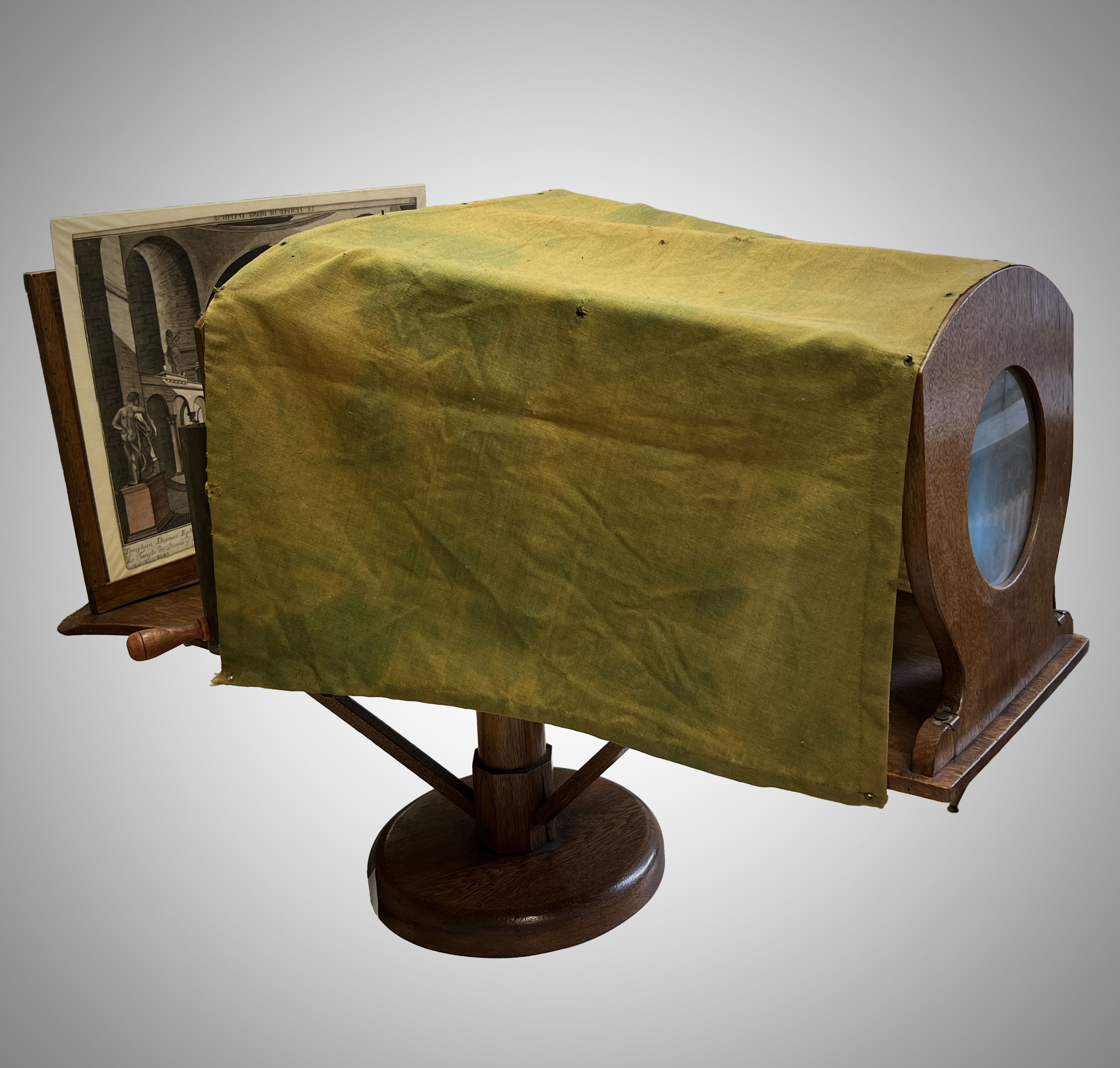 |
Figure WN-0202.1 –Cloth Box |
| Photo © Rod Bantjes. |
Figure WN-0202.2 –All-Round View |
| Video © Rod Bantjes. |
This is a large viewer for back-illuminated vues d'optique. It is an example of an "optical machine " and is included in the Optical Machine Taxonomy.
It can be considered as part of a family of large 18th-century Dutch boxes including the Rarekiek and the plain oak box in the collection of the Museo Nazionale del Cinema (MNC-M01025). They are all about a metre in length, well-built using quality materials – oak and brass. This one uses dovetail joints. The wide base (54.7 cm) is made of two solid pieces of oak glued on edge. These boxes are somewhat austere, with minimal ornament. The lens openings are simple circles cut out of the oak without the decorative turned frames typical of other boxes.
The maker of this box has opted for a very unusual cloth cover in place of a wooden enclosure (the closest thing to this in another optical machine, is the cardboard cover for Frith's Cosmoscope). That choice has limited the options for illumination. Instead of an adjustable top-flap for front-illumination the maker has designed special rotating candle-holders that can be turned away to dim the front lights (see these in action in video WN-0202_2). Similarly, the box lacks a back-flap and relies instead on three candles backed by a tin reflector (video WN-0202_2). These cannot be dimmed. However, they are cleverly designed to keep the flame in the same position even as it burns down and shortens the candle. The candle-holders are spring-loaded so that the bottom of the ever-shortening candle is gradually pushed up as it burns. The only other example of this innovation is in Gainsborough's Show-box.
At the back of the cloth cover there is a removable mask which you can see in the video. When removed, it leaves a slightly wider mask. The Cosmoscope also has interchangeable masks to frame different sized images. Perhaps this feature was designed for the same purpose in this device, although we do not have evidence of the appropriately-sized vues d'optique.
A final entirely unique feature of this box is the pedestal with diagonal supports. It lacks an integrated pivot, but nonetheless allows the device to be turned on the table more easily. Perhaps the intent was to turn it to share between seated users.
In one of Werner Nekes's exhibition catalogues, this device is depicted with the painted-glass images of a perspectiefkast placed in the viewing space. This is a Nekes innovation that would not likely have been seen in the 18th century. This box was designed for pierced vues d'optique.
Reliance on candle illumination would make the device best suited for use in the dark, probably indoors. This feature, the pedestal and the somewhat ungainly design all point to this being a one-off manufacture for home-use.
Endnotes:
[1] I would like to thank Dr. Peter W. Marx for permission to access the collection and Charlene Fündgens, Emma Gebbeken and Gerald Köhler for their generous assistance in the archive..