Rod Bantjes, “V_A_P.44.1-1955_Gainsboroughs_Show-box.html,” created 19 September, 2025; last modified, 18 October, 2025 (https://people.stfx.ca/rbantjes/).
Gainsborough's Show-box
Victoria & Albert Museum #V_A_P.44.1-1955
English, ca.1783
Dimensions: H=68.6 cm, W=38.1 cm, D=60 cm (95.6 cm with viewing tunnel)
Lens: ⌀=13.3 cm, ƒ= cm
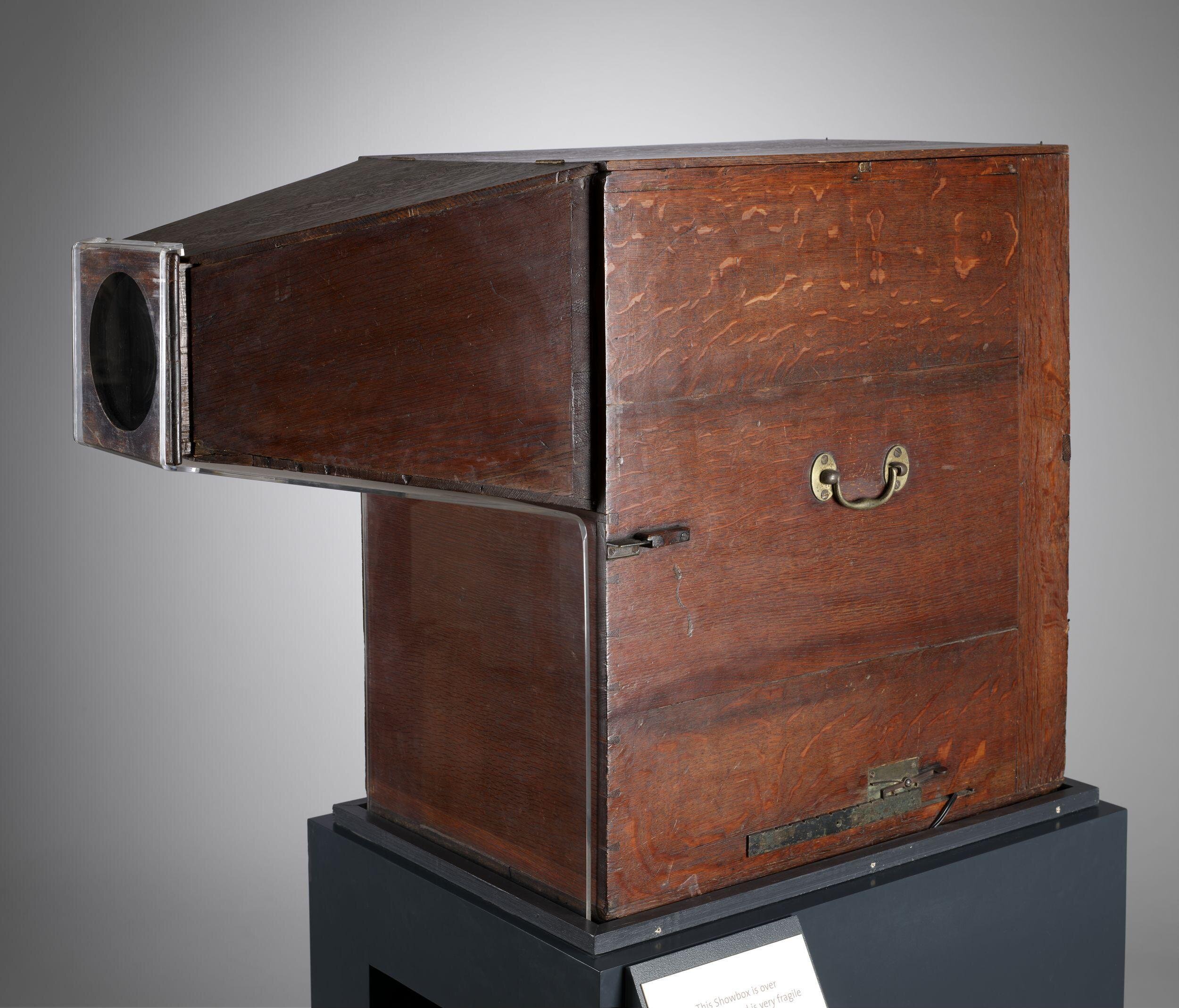 |
Figure P.44.1 –Gainsborough's Show-box |
| Photo © Victoria & Albert Museum |
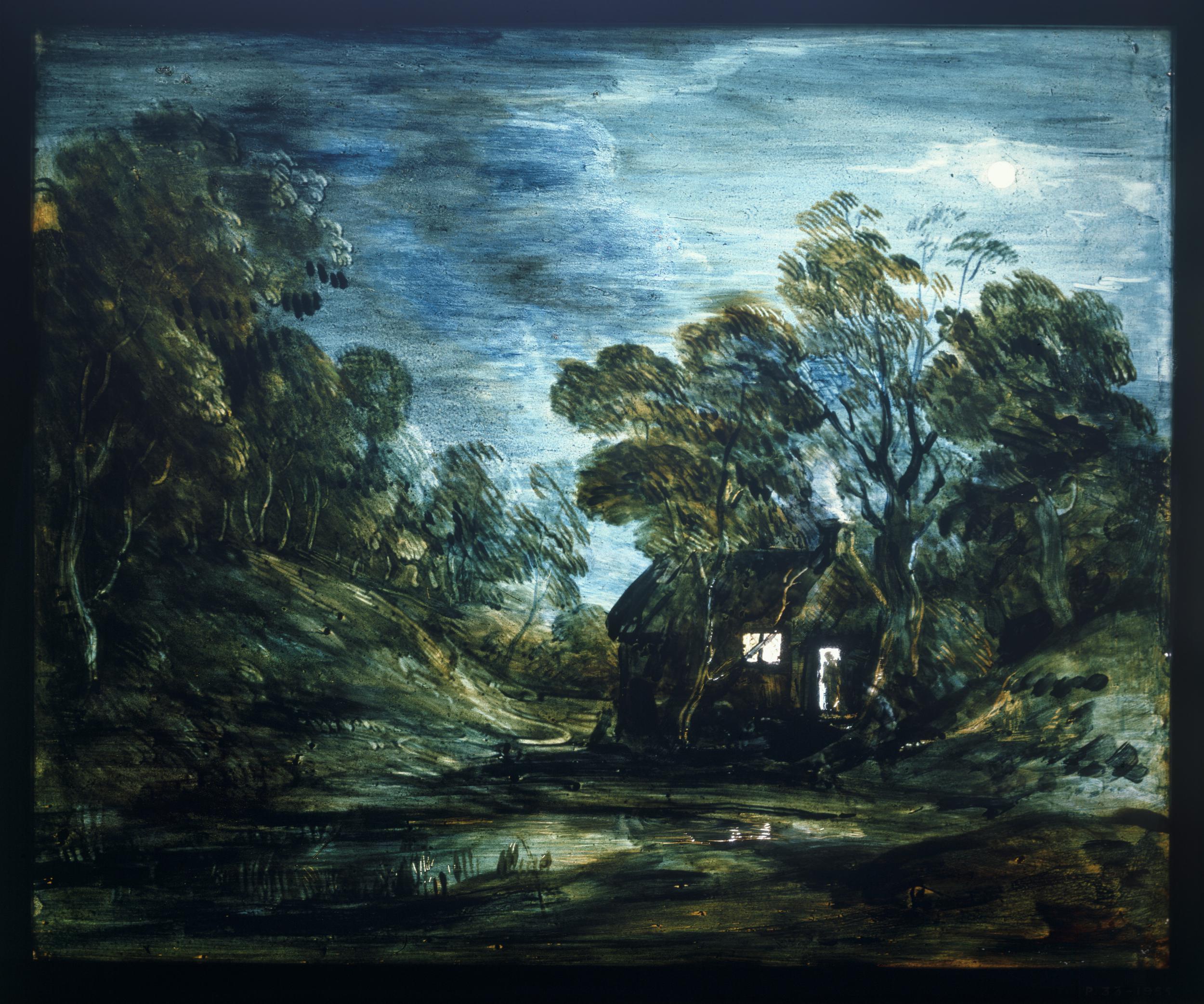 |
Figure P.44.2 –Moonlit Scene "The Cottage" |
| Oil on glass, 27.9cm x 33.7cm "Representing a most powerful effect of fire-light in the interior. The artist has given considerable interest to this subject by introducing the cottager opening the door: the contrast between the light of the cottage. and that of the moon, excite the most pleasing associations in the mind, and never fail to produce an instantaneous effect of pleasure and approbation." "Exhibition of Drawings, Soho-Square," Somerset House Gazette 2, no. #27, April 10 (1824). Photo © |
This is Thomas Gainsborough's (1727-1788) viewing-box for glass transparencies. It is an example of an "optical machine " and is included in the Optical Machine Taxonomy.
1. Box Design:
1.1 Paintings on Glass: The box holds 12 translucent paintings on glass. Like the touring show-boxes common at this time, scenes could be changed by raising plates into the viewing area or lowering them, by means of strings on pulleys, into the storage space below. Along with the Dutch perspectiefkast it was one of the very few optical machines to use paintings on glass.[2]
1.2 Illumination: The translucent images are back-lit by means of three candles in spring-loaded holders. The spring-loaded mechanism is designed to keep the flame at a constant height as the wax burns away – there is another, almost identical example in an 18th-century Dutch optical machine.
1.3 Movable Image-Tray: Gainsborough has solved one problem for showboxes with multiple views that are raised and lowered on rigging. Normally these slide up and down slots fixed to the sides of the box. For this reason, the distance between the lens and the image varies considerably between the first and the last plate in the series. Gainsborough's slots are affixed to the sides of a tray that is movable, forward and back, within the box.[3] A brass guide-rail, notched with 12 positions precisely registered with a spring-latch, can be seen on the outside of the box (Figure P.44.3). There is a threaded hole visible where a knob would have been attached. Grasping these knobs (there is probably a matching one on the other side) the user could advance the tray to the desired slide-position and then raise the indexed glass-plate into the viewing area – very like a 20th-century slide projector.
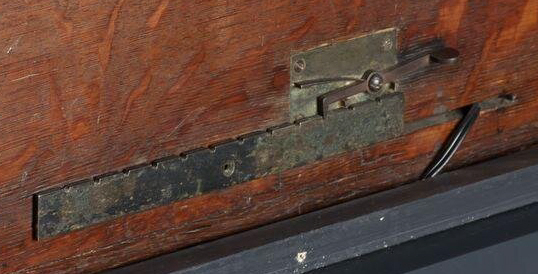 |
Figure P.44.3 –Guide-Rail |
| Photo © |
1.4 Lens-Image Relationship: Gainsborough must have had a reason for taking such pains to precisely locate the image in relation to the lens. Likely he was influenced by contemporary theories of how the optical machine worked, and prescriptions, such as Joseph Harris's, as to how to build one. Accordingly, the image-plate should be the focal-length's distance from the lens. I would guess that the focal length of Gainsborough's lens is about 87 cm. That is within range of many 18th-century optical machines and fits with some rather odd calculations made in the 1960s by Dr. F. A. B. Ward of the British Science Museum.[4]
2. Influence of de Loutherbourg's Eidophusikon:
2.1 Mechanical Art: Gainsborough was one of England's preeminent painters of the late 18th century, so his embrace of the humble show-box is unusual given that defenders of high culture typically despised it.[5] Biographer George Fulcher has proposed that Gainsborough conceived his box on the inspiration of set designer Philippe de Loutherbourg's Eidophusikon (1781). De Loutherbourg was able to bridge between the worlds of high art – he was an academic painter like Gainsborough – and "mechanical" art which relied upon optical devices and mechanical apparatuses. Both the theatre and the optical machine were understood to be mechanical in this sense. By his example, showing that the mechanical could enhance, and possibly even supersede, painting on canvas, de Loutherbourg influenced not only Gainsborough but also a number of other artists, particularly those connected with the Romantic movement.[6]
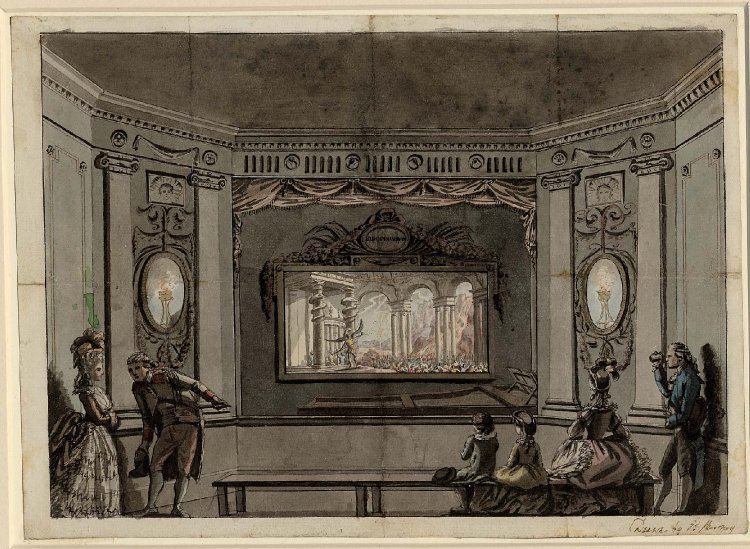 |
Figure P.44.4 – Eidophusikon |
| Edward Francis Burney, 1782, A View of Philip James de Loutherbourg's Eidophusikon, drawing on paper, 21.2 x 29.2 cm, British Museum. |
2.2 Admiration: "Gainsborough was so wrapped in delight with the Eidophusikon," wrote William Pyne, sometime after the fact, "that for a time he thought of nothing else, he talked of nothing else."[7] Other painters, including Pyne and Sir Joshua Reynolds were similarly taken with de Loutherbourg's work. He had done something new that had changed how people thought about representation and was to influence both painting and image-making for the optical machine. Precisely what effects were new and how, technically, he achieved them requires some piecing together.
2.3 Naturalistic Scenery: The coulisse was thought by many to evoke space in ways that painting was unable to. This was an old stage device; however, de Loutherbourg was regarded as having made coulisses more naturalistic by replacing a regular series of receding coulisse-flats with staggered or offset coulisses and free-standing elements or "bits, [such] as cottages or broken stiles before that flat." These "bits" included "miniature realistic objects" meant to appear continuous with painted objects in the manner of the "faux terrain" in 19th-century panoramas, or 20th-century museum dioramas.[8]
2.4 Gainsborough's Proscenium Arch: Gainsborough's box does not contain coulisses like the kulissentheater. Nor does it contain faux terrain, although some later optical machines did. It had a proscenium arch which, like a coulisse, exploits parallax and binocular convergence to define space. The proscenium acts to define space behind it – an opening out into the depicted scene. At the same time the proscenium, like a picture frame, serves to remind us that we are looking at a picture, that the depicted scene is a fiction.[9] Note how de Loutherbourg has included both a proscenium (which frames the piano) and also a frame around the Eidophusikon "picture" (figure P.44.4).
2.5 Theatre Machines: Nicola Sabbattini had in 1638 described machines to make waves appear to undulate and ships to pitch and roll at sea and clouds to move across the sky.[10] De Loutherbourg incorporated all of these old ideas into his Eidophusikon. They may have astonished people because they were rarely used on the English stage or because de Loutherbourg executed them with unequalled skill. His machine for clouds worked in a way that was likely unique.
2.6 Cloud Panorama: Pyne describes them as being expertly painted on linen, which "was stretched on frames of twenty times the surface of the stage, which rose diagonally by a winding machine."[11] The unwinding roll moved from the distant horizon towards the audience. Clouds were painted with different degrees of translucency depending on their purported density. Their colour changed as the day progressed from dawn through the various moods of daylight. Pyne implies that the changes in colour were painted onto the linen sheet as it unrolled overhead. Colour-change was certainly at least assisted by tinted front and back-illumination.
2.7 Illumination: De Loutherbourg's techniques of illumination were also improvements on old ideas. William Hooper in 1774 had described transparent flats with coloured illumination that changes with changes in daylight. It was one of his "rational recreations" for people to try at home with their home-made optical box.[12] The pierced vue d'optique was inspired by illuminated stage flats.[13] In both cases, apertures – of windows, candle flames, reflections on water and the like – are cut out of the flat, covered with a coloured, translucent film and back-illuminated. De Loutherbourg's idea of using filters to create a colour wash over other painted elements may have been new. He achieved this effect with glass filters on the new, more powerful Argand lamps. He also created new equipment for positioning and directing lights. He mounted them along battens which would have allowed them to be raised or lowered behind the proscenium arch.[14]
2.8 Variable Transparency and Depth:
The innovation that most inspired the passion among artists for transparencies was the layering of images using varying degrees of translucency. The density of paint for a cumulus cloud could be thinned towards the edges of the cloud and a "shadow layer" might be painted on the back surface where the cloud was thickest or had the blue-grey colour of impending rain.[15] Light shining through the cloud would show by its intensity the cloud's thickness and three-dimensional form.
Translucency freed artists from the constraints of conventional painting's limited scale of illumination – the brightest value it could offer was white, whose reflected light was orders of magnitude less than real sunlight.[16] Illumination through layers also gave more richness and depth of colour. Transparency may also have helped de Loutherbourg's coulisses invoke space to the extent to which one could see through them to the space behind. That is certainly the effect of the transparent coulisses in the Dutch perspectiefkast. Instead of the hard steps into the depths of the view like a kulissentheater there is a greater illusion of a transparent and unified space.
2.9 Sound Effects:
De Loutherbourg's sound effects were also innovative and persuasive. Pyne felt he had introduced a "new art–the picturesque of sound."[17] The Eidophusikon treats perception as multi-sensory – the visual effects confirmed by convincing sound become more visually believable.
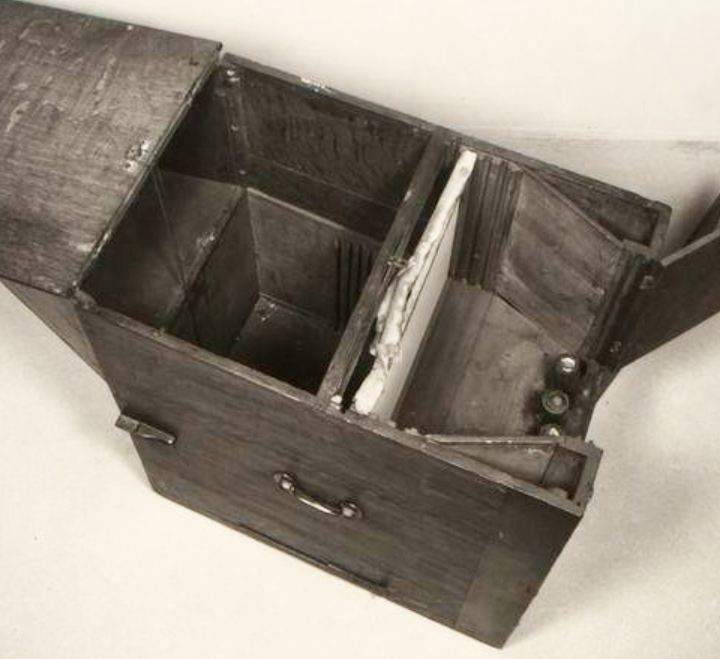 |
Figure P.44.5 –Show-box Interior |
There is a filter "originally [made] of watered silk" in one of the slots.
Source: Mayne, Jonathan. 1965. "Thomas Gainsborough's Exhibition Box." Victoria and Albert Museum Bulletin 1 (3):17-24. |
3. Gainsborough's Influences:
Johnathan Mayne is somewhat skeptical of the influence of the Eidophusikon and points instead to Thomas Jervais' (d.1799) paintings on glass as a more likely precedent.[18] Gainsborough attended Jervais's exhibitions of the 1770s and 1780s that included some "small works illustrating the effects of candlelight and moonlight."[19] Jervais also did stained glass for churches (a ubiquitous form of painting on glass that all would have been aware of). More importantly, the recent restoration of the Agher Parish Church in Ireland, which Jervais completed in 1770, shows that he used layers to create different degrees of opacity and colour depth. Painted magic lantern slides were another possible source of inspiration of techniques for painting on glass. There were probably many threads of innovation leading to the popularity of variable transparency in the Romantic era.
There is some overlooked evidence that the layered transparency of Jervais and de Loutherbourg may have been what Gainsborough was after. His box has three grooves behind the slot in which the main image is raised, as well as one behind the candles (Figure P.44.5). These were undoubtedly for coloured transparencies which, by filtering or by reflecting the candlelight altered its colour and mood. It is also possible that the additional grooves were meant for layering the image with colour and shadow (one slot would surely have sufficed if he were only interested in a coloured filter). Gainsborough's transparencies are somewhat monochromatic and partial as though an additional layer of colour was intended. Figure P.44.2 seems wanting some warm yellow/orange tones to produce the "powerful effect of fire-light in the interior" that either a coloured sheet or additional image-layer would give.
Gainsborough's main inspiration for the box was the travelling show-boxes that everyone in 18th century England would have been familiar with. It is also possible that during his trip to Holland in 1783, he may have seen a perspectiefkast that uses coulisses painted on glass with varying density and back-shading. It is also worth noting that the only other example of spring-loaded candles designed like Gainsborough's, comes from a Dutch optical machine. The date of Gainsborough's box is estimated to be 1781 because that is after the Eidophusikon; it could just as easily have been 1784 after the trip to Holland.
3. Gainsborough's Use of the Optical Machine:
Mayne has suggested that Gainsborough's purpose in having the box made was "as a conscious aid to the construction of pictures. In this way it falls into the same category as the model landscapes made up of moss, stones and sticks which Gainsborough used to stimulate his visual imagination."[20] His evidence for this claim is that Gainsborough's late landscapes share the same mood as the transparencies; however, he only has found one painting and transparency that are alike. Mayne's implication is that the optical machine was used to prepare for the superior image-format which was painting.
I think that the reverse is more likely. I think Gainsborough was one of a growing number of English painters who were dissatisfied with the limitations of perspective painting as a representation of how we see the world. Optical devices pointed to new ways to affect the physiology of perception: theatre coulisses and optical machines affected focus, parallax and binocular convergence to create more immersive spaces. Illuminated transparencies captured the scale of brightness of the world and introduced time and change into images. Panoramas reminded people that we experience a surround of space much greater than the 60° angle recommended for perspective painting.[21] These sorts of doubts were more openly discussed in the 1830s and led eventually to a crisis in perspective painting.[22]
We know that Gainsborough was infatuated by the Eidophusikon and its novel effects, and that he delighted in showing his optical-box views to his intimate friends, many of them artists. One of them later confirmed what I suspect was a shared opinion that "these extraordinary works by Gainsborough ...represent the effects of nature more powerfully than any picture or drawing can possibly do."[23] Gainsborough's optical machine was superior to painting, but it produced its effects through "mechanical" means that were stigmatized as "deceptive." It was also clearly a version of the lowly showbox. Gainsborough would have risked his reputation as a serious artist by publicly embracing the optical machine, so it remained a private pleasure for himself and a few like-minded friends.[24]
Endnotes:
[2] There is, in the Binétruy collection, a set of paintings on glass for an unknown optical machine..
[3] Mayne, "Exhibition Box," 17..
[4] Dr. Ward found that "whatever the position of the lens, the “angular” size of the transparency is unaffected, but there is a marked effect of distancing: i.e., with the lens in its closest position, the lens-holder being pushed fully in, the image appears to be magnified 21 times, but to be 21 times farther away (that is, 62 inches distant): with the lens pulled out as far as possible the image appears to be magnified 5 times, but to be 5 times farther away (that is, 172 inches)." From his description we can calculate probably accurate distances between lens and image-plate; his perception of apparent distance we can safely treat as fanciful. Mayne, "Exhibition Box," 17..
[5] On the disrepute of the optical machine, see Bantjes, Rod, "Hybrid Projection, Machinic Exhibition and the Eighteenth-Century Critique of Vision," Art History 37, no. 5 (2014).
[6] Füsslin, Georg, et al., Der Guckkasten : Einblick, Durchblick, Ausblick (Stuttgart: Füsslin, 1995) 74-88.
[7] Pyne, William Henry, "De Loutherbourg's Eidophusikon," Somerset House Gazette 1, no. #17, January 31 (1824) 266.
[8] "Loutherbourg," Somerset House Gazette 1, no. #11, December 20 (1823), 172.
[9] Stoichita, Victor Ieronim, The Self-Aware Image: An Insight into Early Modern Meta-Painting, Cambridge Studies in New Art History and Criticism, (Cambridge: Cambridge University Press, 1997).
[10] Sabbattini, Nicola. 1638. Pratica Di Fabricar Scene E Machine Ne' Teatri. Ravenna: stamp. de P. de' Paoli e G. B. Giovannelli. Contemporaries like John O'Keefe mistakenly believed that de Loutherbourg "invented transparent scenery – moonshine, sunshine, fire, volcanoes,..." O'Keefe, 1826 cited in Brockett, Oscar G., Margaret A. Mitchell, and Linda Hardberger, Making the Scene: A History of Stage Design and Technology in Europe and the United States (Austin, TX: University of Texas Press, 2010) 149.
[11] Pyne, "Eidophusikon," 266.
[12] Hooper, William, Rational Recreations (London,: L. Davis etc., 1774). Hooper's text derived very closely from Jacques Ozanam and Domenico Martinelli's, Récréations Mathématiques et Physiques (Paris: C.-A. Jombert, 1694).
[13] Brockett, Making the Scene 97.
[14] Ibid. 148.
[15] There is no surviving physical evidence to determine exactly how Eidophusikon transparencies were constructed. I think it is plausible to work backwards from transparencies that we know were descendants of the Eidophusikon and its successor the Diorama. Under-layers with shadows and colour washes were typical features of Lefort's paper dioramas. The Dutch perspectiefkast, contemporaneous with the Gainsborough box, also uses back-shading in its transparencies.
[16] Gombrich, E. H, Art and Illusion a Study in the Psychology of Pictorial Representation (Princeton, N.J: Princeton University Press, 2000) 33-49. The artist John Martin expressed this idea clearly: "by the transparency we have the means of bringing in real light and have the full scale of nature as to light and shadow, as well as to the richness of colour which we have not in oil-painting nor in water-colour." Martin ca. 1830 quoted in Altick, Richard Daniel, The Shows of London (Cambridge, Mass: Belknap Press, 1978) 414.
[17] Pyne, "Eidophusikon," 267.
[18] Mayne, "Exhibition Box," 19. On the popularity of painting on glass in this period, see Baylis, Sarah Frances. "Glass-Painting in Britain C.1760-C.1840: A Revolution in Taste." Apollo - University of Cambridge Repository. (1990).
[19] Altick, Shows 125.
[20] Mayne, "Exhibition Box," 23.
[21] Robert Barker (1739 – 1806) exhibited his first panorama in 1792.
[22] On the perspective crisis of the 1830s to 1850s see Bantjes, Rod, "“Vertical Perspective Does Not Exist:" The Scandal of Converging Verticals and the Final Crisis of Perspectiva Artificialis," Journal of the History of Ideas 75, no. 2 (2014) and Bantjes, Rod, “‘Perspectives Bâtardes’: Stereoscopy, Cézanne, and the Metapictoral Logic of Spatial Construction,” History of Photography 41, no. 3 (August 2017).
[23] "Exhibition of Drawings, Soho-Square," Somerset House Gazette 2, no. #27, April 10 (1824).
[24] Ibid.