Rod Bantjes, “WN-F138_Cosmoscope.html,” created 10 August, 2025; last modified, 10 August, 2025 (https://people.stfx.ca/rbantjes/).
Cosmoscope
Werner Nekes Collection, Theatre Studies, University of Cologne[1] #WN-F138[2]
English c.1880
Dimensions (closed): H=15.6 cm, W=42.8 cm, D=36.4 cm; (open): H=44.8 cm, W=42.6 cm, D=58.5 cm
Lens: H=5 cm W=10, ƒ=46.5 cm
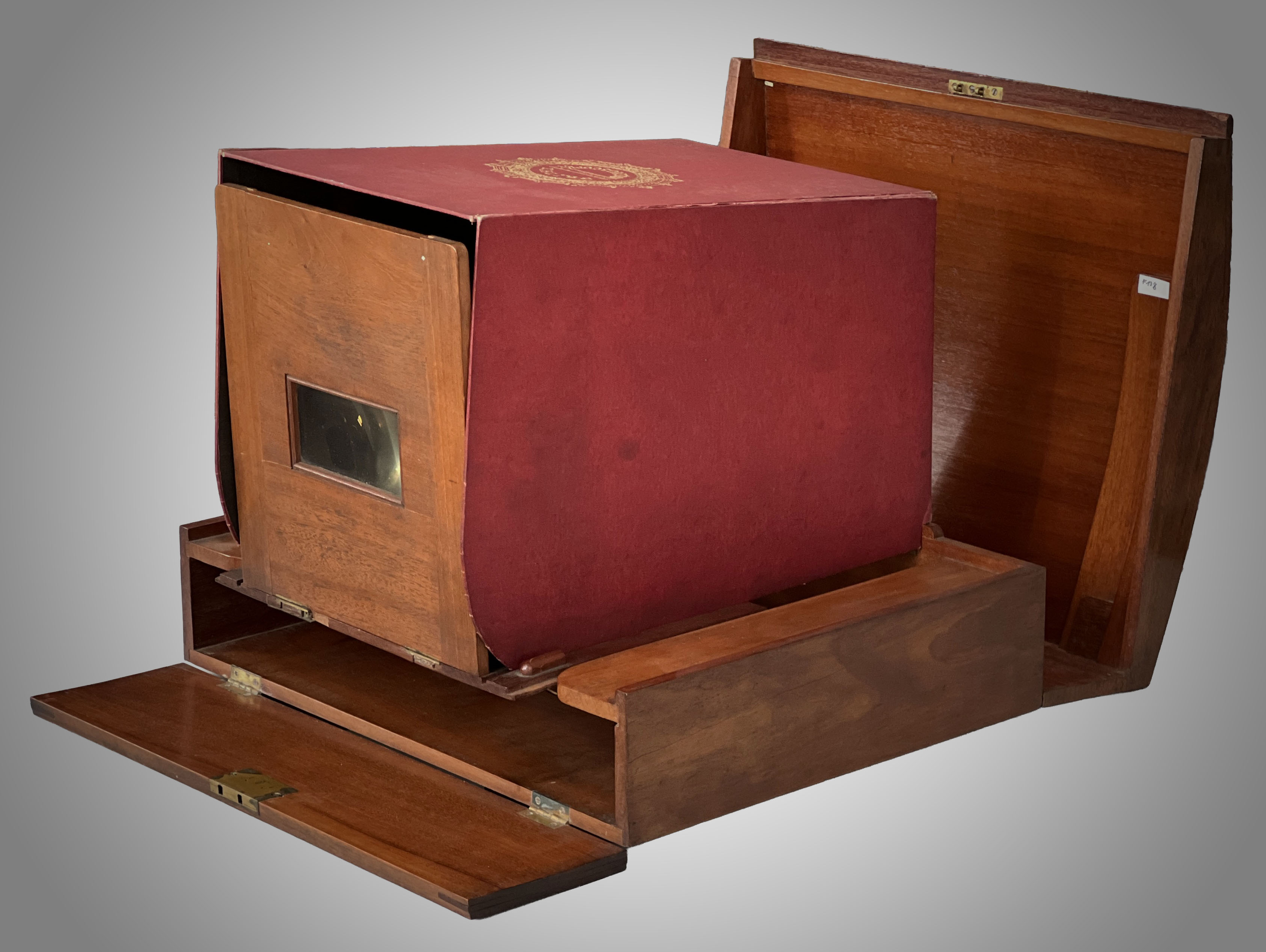 |
Figure GT49.1 –Cosmoscope |
| The hood masks out the surroundings. Photo © Rod Bantjes. |
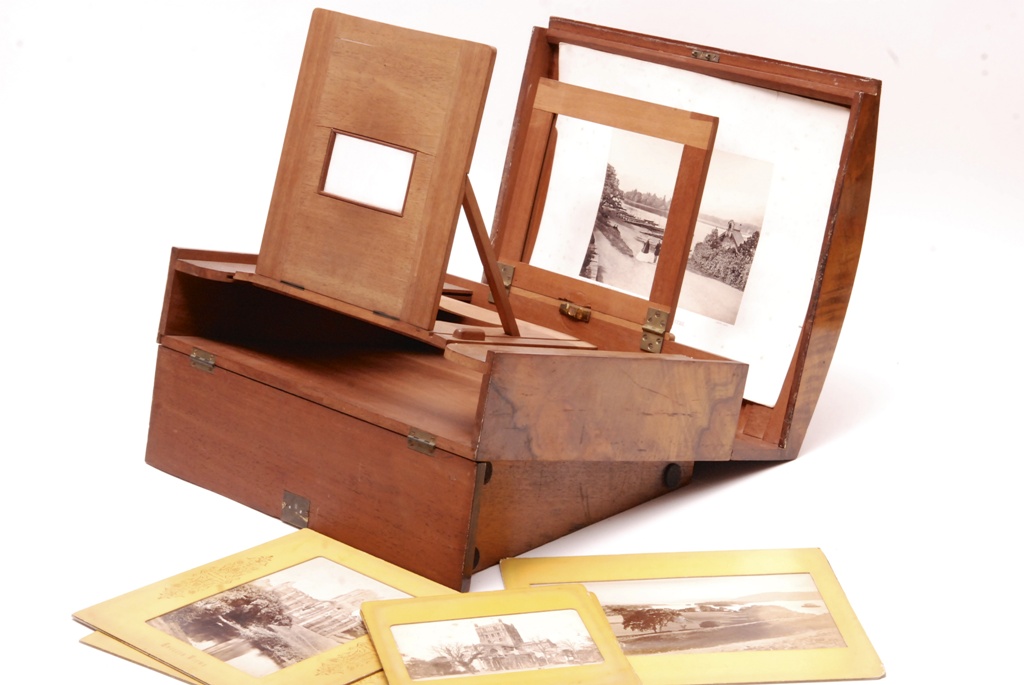 |
Figure GT49.2 – Cosmoscope |
| This example, for sale by Antiq Photo (Paris) has included with it Frith's specially-mounted images. Note how the front flap folds under and, along with two wedge-shaped flaps, tilts the device up towards the observer. Photo © Antiq Photo, Paris. |
This is a collapsible biconvex-lens viewer designed to enhance the 3D illusione of large-format photographic prints. It is an example of an "optical machine " and is included in the Optical Machine Taxonomy.
Francis Frith (1822-1898) designed this device probably on the inspiration of Carlo Ponti's Megalethoscope (or Alethoscope, 1861). The Megalethoscope, Neomonoscope (1860), Cosmoscope and Graphoscope (1864) were the first biconvex-lens viewers designed specifically for photographs. They are testament to the optical machine's ongoing ability to merge with new technologies.
Rectangular Lens
The Cosmoscope shares with Ponti's devices the rectangular lens, provision for various standard-sized photographs, and a curved image-plate. No previous optical machines had rectangular lenses. The precedent may have been lenticular stereoscope lenses. David Brewster recommended "semi-lenses" – a single lens cut in half and flipped with the cut edges out – for stereoscopes. Once cut, it made sense to square off the other edges. Holmes-style stereoscopes (1861) had square lenses exclusively. Squared off for technical reasons, and installed in the most popular platform for photographic images, they may have signalled the new photographic aesthetic.
Proprietary Images
Both Frith and Ponti were photographers catering to a demand for armchair travel through photographs of distant places. Newly-invented photographs-on-paper were physical artefacts in search of apparatuses and social contexts for viewing. The most popular in the 1850s was the stereoscopic format – miniature and requiring a special viewer. Frith was a successful stereo-photographer but he was in competition with thousands of others producing millions of images for that device. With the Alethoscope and Cosmoscope, Ponti and Frith created platforms that, while able to accommodate other formats, were best suited to their own proprietary image-formats.
Paper Dioramas
The example for sale by Antiq Photo (Figure GT49.2) is shown with a collection of Frith's paper dioramas that he called "Photoscopic Pictures." Frith appears to have taken the idea from Alfred Hautecoeur's Vues Photoscopique some of which are identical in form and dimensions. However, there are evidently at least three formats depicted in Figure GT49.2.
The curved back-plate cannot be back-illuminated. However a 19 x 19 cm Photoscopic Picture would fit in the image-holder at the back of the hood. There is not a lot of space for back-illumination behind it, but the hood, by darkening the front, would heighten whatever back-illumination that there was.
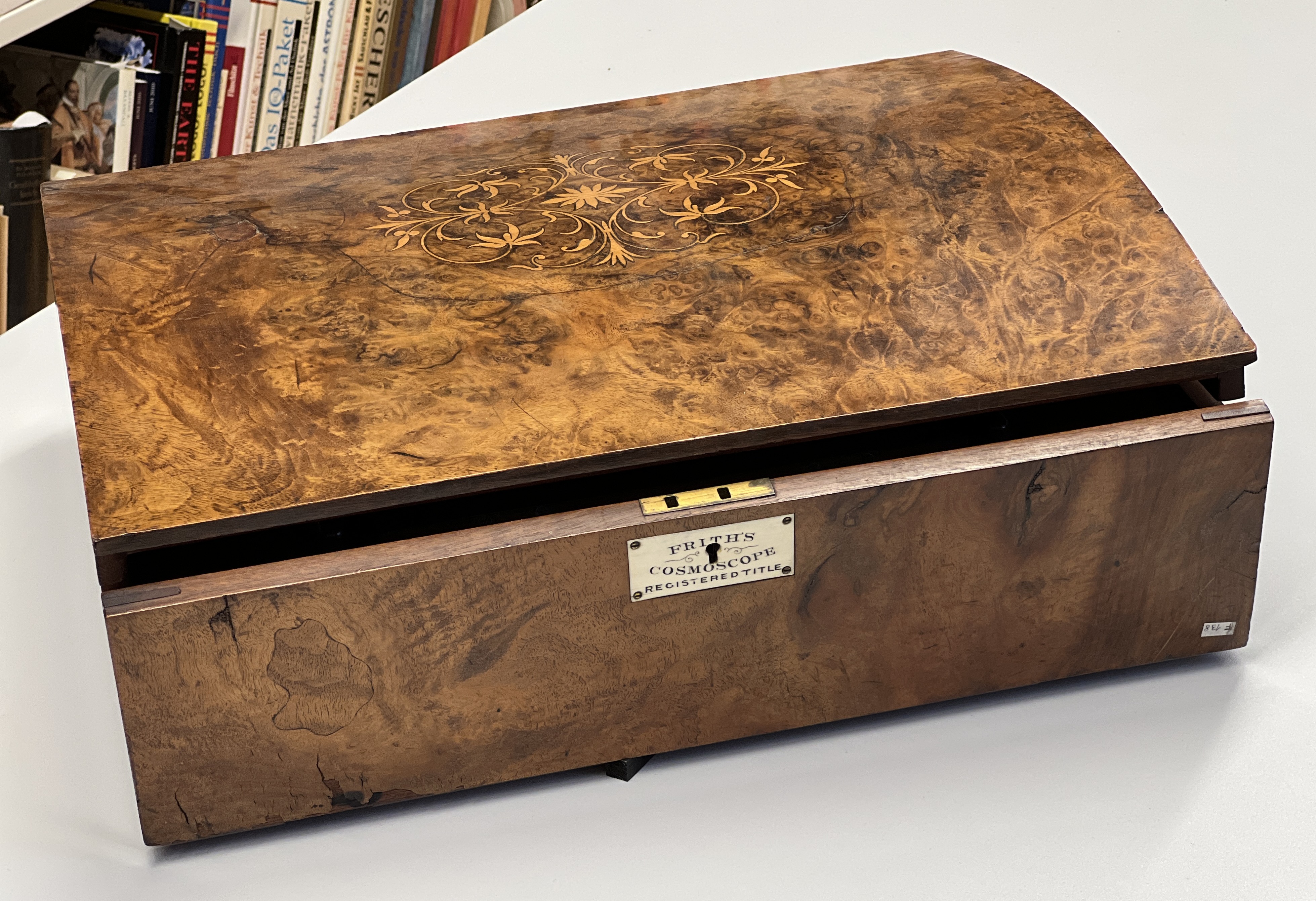 |
Figure GT49.3 –Folded Cosmoscope |
| Photo © Rod Bantjes. |
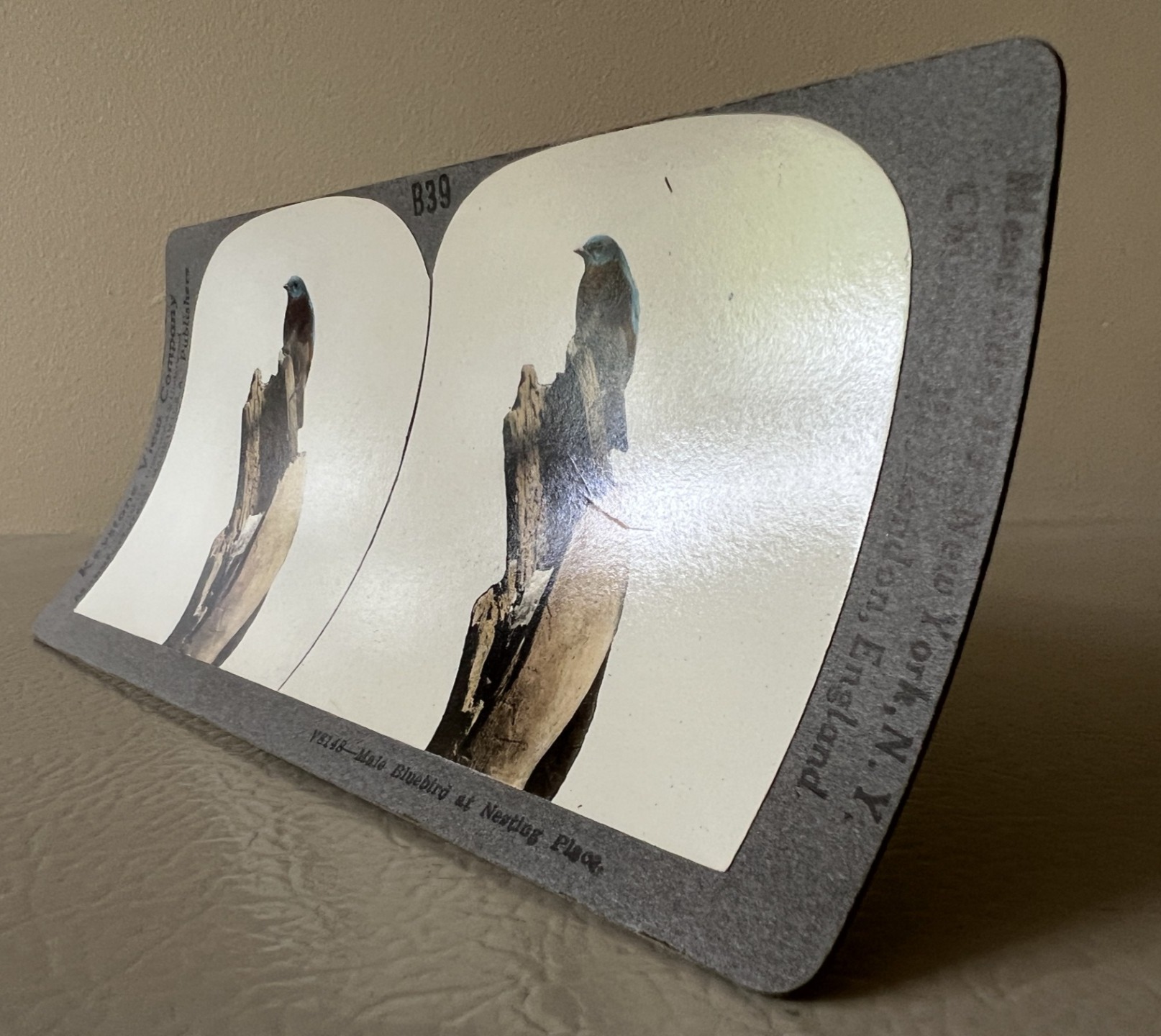 |
Figure GT49.4 –Keystone Stereographic Image No.V8148 "Male Bluebird at Nesting Place" |
| Note the pronounced curvature of the mount. The curve makes the sheen on the image hard to eliminate and may be what Naya is referring to when he says that curvature prevents the image from "being properly seen by reflection." Photo © Rod Bantjes. |
Curved Image-Plate
Both supplied specially-formatted images that could fit the curved image-plates of their devices. Frith's were mounted on thin card that was the exact width to fit the curved guide-slots at the back of the device and with large top and bottom margins to ensure the image was centred properly for viewing (See Figure GT49.2). The idea that a curved surface could enhance the depth effect of an image was proposed in the 18th century by Joseph Harris, but rarely, if ever, put into practice.[3] It may have been re-introduced by Ponti and Frith for the promised depth effect. Certainly both were aiming for a "stereoscopic" effect in devices that they hoped would be more exclusive than the stereoscope. The cosmoscope was described in these terms in 1886: "a newly-invented handsome instrument for giving magnified perspective and beautiful stereoscopic effect".[4]
Carlo Naya (1816–1882) who manufactured Alethoscopes after Ponti's patent became unenforceable in 1866, reverted to a flat image-plate and his reasons for this choice point to contemporary debate about the supposed effects of curvature: "The concave system of mounting is injurious to the solidity of the photographs, augments the defect of Sphericity and prevents the photographs from being properly seen by reflection [i.e. reflected light as opposed to back-illumination]."[5] This "defect of sphericity" seems to refer to the fact that a lens with a short focal length and high magnification distorts straight lines – such that verticals curve inwards from the sides and horizontals inwards from the top and bottom. Naya implies that others thought that curved image-plates helped to correct for this defect. He writes that his Alethoscope is superior to all previous versions since with it "straight lines can be obtained without employing photographs mounted on concave frames."[6]
Clearly, people saw, or believed that they saw, different things when they looked through a biconvex lens at an image on a curved surface. Harris saw an enhanced depth-effect and Naya saw "solidity" – a contemporary term for the illusion of spatial volume – undermined. Ponti apparently saw straight lines distorted by the lens and corrected by the curved surface. It is difficult to say what you see unless you are attending carefully to an image of a uniform grid. When I view a grid through a short-focus convex lens, it does appear to me to be slightly distorted. However, giving the image a concave curve does not straighten the lines, but instead distorts them further. I agree with Naya, in other words, that curvature "augments the defect of Sphericity."
Many perceived a "beautiful stereoscopic effect" with the Cosmoscope and some were convinced, I suspect, that curvature enhanced it somehow. Ponti's curvature was as though drawn with a vertical rotation; Frith's was as though with a horizontal rotation (the same as in Figure GT49.4). Frith's curve was taken up by the prolific American producers of stereoscopic "boxed sets" in the early 20th century: the Underwood & Underwood and Keystone View Companies. They produced millions of copies of their stereoviews and went to the extra expense of ensuring every one had a pronounced curve (see Figure GT49.4). There must have been a strong conviction about a perceptual effect built into this costly choice, but the logic of it is still uncertain.
Quality of Construction and the Social Class of Users
The Cosmoscope folds up like a little treasure chest (Figure GT49.3) with a burled walnut top decorated with inlay. The box is of mahogany with a brass lock and ivory escutcheon that doubles as an elegant maker's mark. The workmanship is of high quality. Frith clearly intended it for an exclusive clientele capable of purchasing many of his specially-mounted prints.
Megalethoscopes were intended for the same market and were even more elaborate in function and decoration. Ponti's prints, which included back-lighting effects, were more dramatic and evocative of mood. Collapsibility was the only advantage of the Cosmoscope over the Megalethoscope. On the evidence of the number that have survived and the amount written about them, both now and in the 19th century, the Megalethoscope was far more successful. The London-based instrument makers, Negretti and Zambra had graphoscopes and even zograscopes in stock in 1886, but were selling cosmoscopes by special order only, which suggested that it was not an item in high demand.[8]
The only reference to the Cosmoscope that I could find in Google Books between 1850 and 1880 was in a talk given to the Rochdale Workingmen's Club in 1886. Rochdale was England's first community-owned, democratically-run workers' co-operative. One of their enterprises was a lending library where working-class people and their families could sign out scientific and educational devices for a small fee. The Cosmoscope and 250 of Frith's images for it were among these. The viewer and 50 views could be had for sixpence per day with three pence for every additional 50 views.[8]
In place of the genteel context that Frith imagined for his device we can picture instead a working-class tenement in Manchester where it was the great attraction for a tradesman's family hosting a kind of pre-cinema "film night" for a collection of friends and neighbours. We can imagine them passing the 50 photos from hand to hand, admiring the amazing verisimilitude and detail, commenting on the things and places never seen before even in depictions, then taking turns slipping the prints into the viewer and allowing themselves to be transported to distant places.
[1] I would like to thank Dr. Peter W. Marx for permission to access the collection and Charlene Fündgens, Emma Gebbeken and Gerald Köhler for their generous assistance in the archive..
[2] Based on Neke's numbering that will likely change once the Cologne Theatre Studies Department properly catalogues the collection..
[3] Harris, Joseph, A Treatise on Optics: Containing Elements of the Science, Etc (London: B. White, 1775), 232..
[4] E. V. Neale, True Refinement: A Paper Read at a Meeting of the Rochdale Workingmen's Club, (Manchester: Cooperative Printing Society, 1877), 11. Neale is using the word "stereoscopic" metaphorically. The 3D mechanism of optical machines, including the Cosmoscope, is not stereoscopic. That term is best reserved for 3D effects produced through binocular disparity as discovered by Charles Wheatstone (1838). See my explanation of the different principles involved in the optical machine.
[5] C. Naya, "Transcription of Text Found in the Alethoscope," 1860-1880, Museums Victoria Collections https://collections.museumsvictoria.com.au/items/384562 Accessed 13 August 2025. I designed my optical theatre so that the curvature of the image-plate could be tested for its depth effect (very minimal). I will have to look again to see how it affects distortion..
[6] Ibid..
[7] Negretti, Enrico Angelo Lodovico, and Joseph Warren Zambra, Negretti and Zambra's Encyclopædic Illustrated and Descriptive Catalogue of Optical, Mathematical ... Instruments, Etc (London: Hayman Brothers and Lilly, ca.1886)..
[8] E. V. Neale, True Refinement: A Paper Read at a Meeting of the Rochdale Workingmen's Club, (Manchester: Cooperative Printing Soceity), 11..