Rod Bantjes, “WN-2187_Bioscope.html,” created 10 August, 2025; last modified, 10 August, 2025 (https://people.stfx.ca/rbantjes/).
Bioscope
Werner Nekes Collection, Theatre Studies, University of Cologne[1] #WN-2187
English? c.1910
Dimensions: H=79 cm, W=73.7 cm, D=48.2 cm[xxx]
Lens: ⌀=6.1 cm, ƒ=55 cm[xxx]
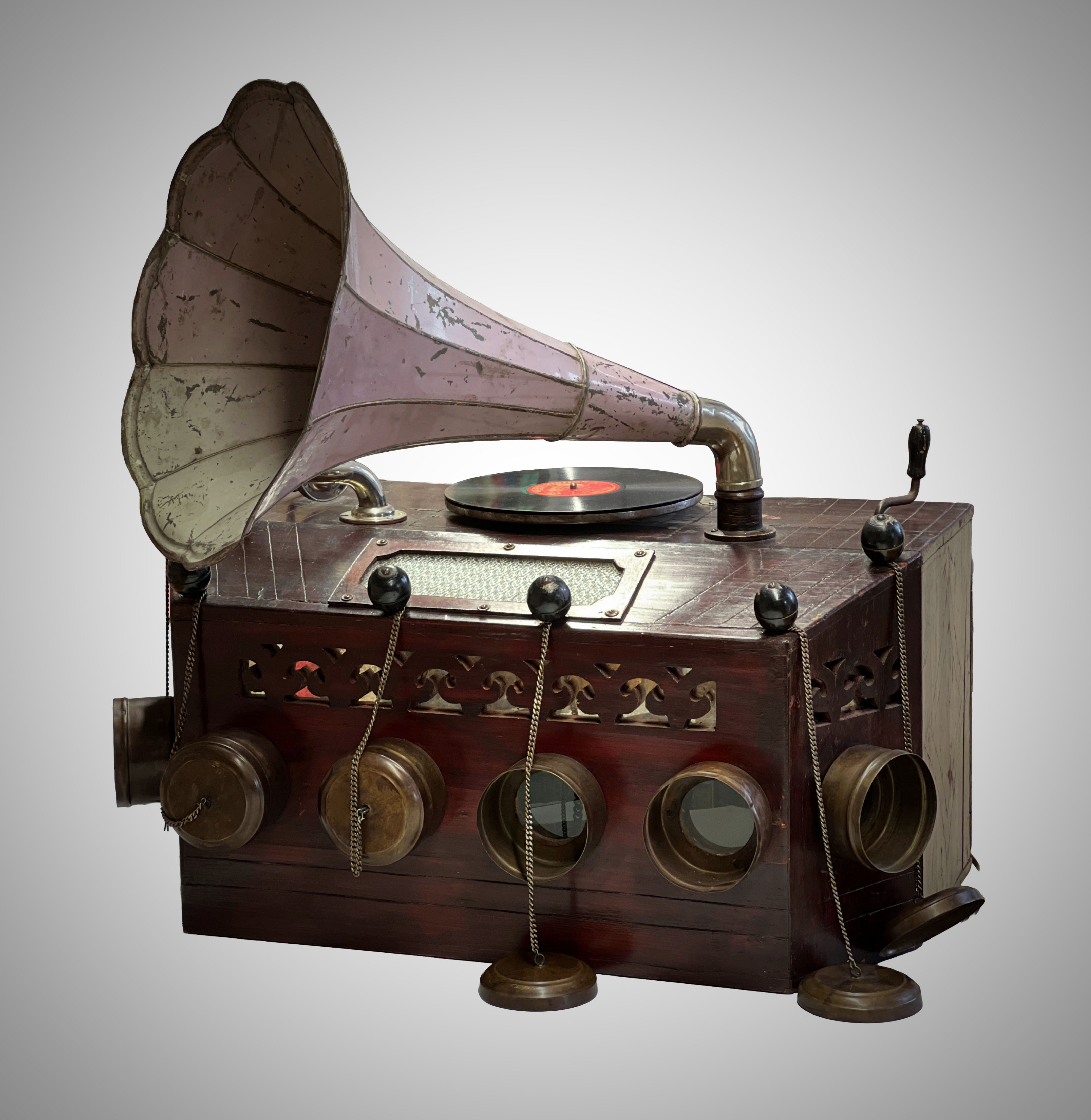 |
Figure 2187.1 –Bioscope |
| Gramophone Bioscope. Photo © Rod Bantjes. |
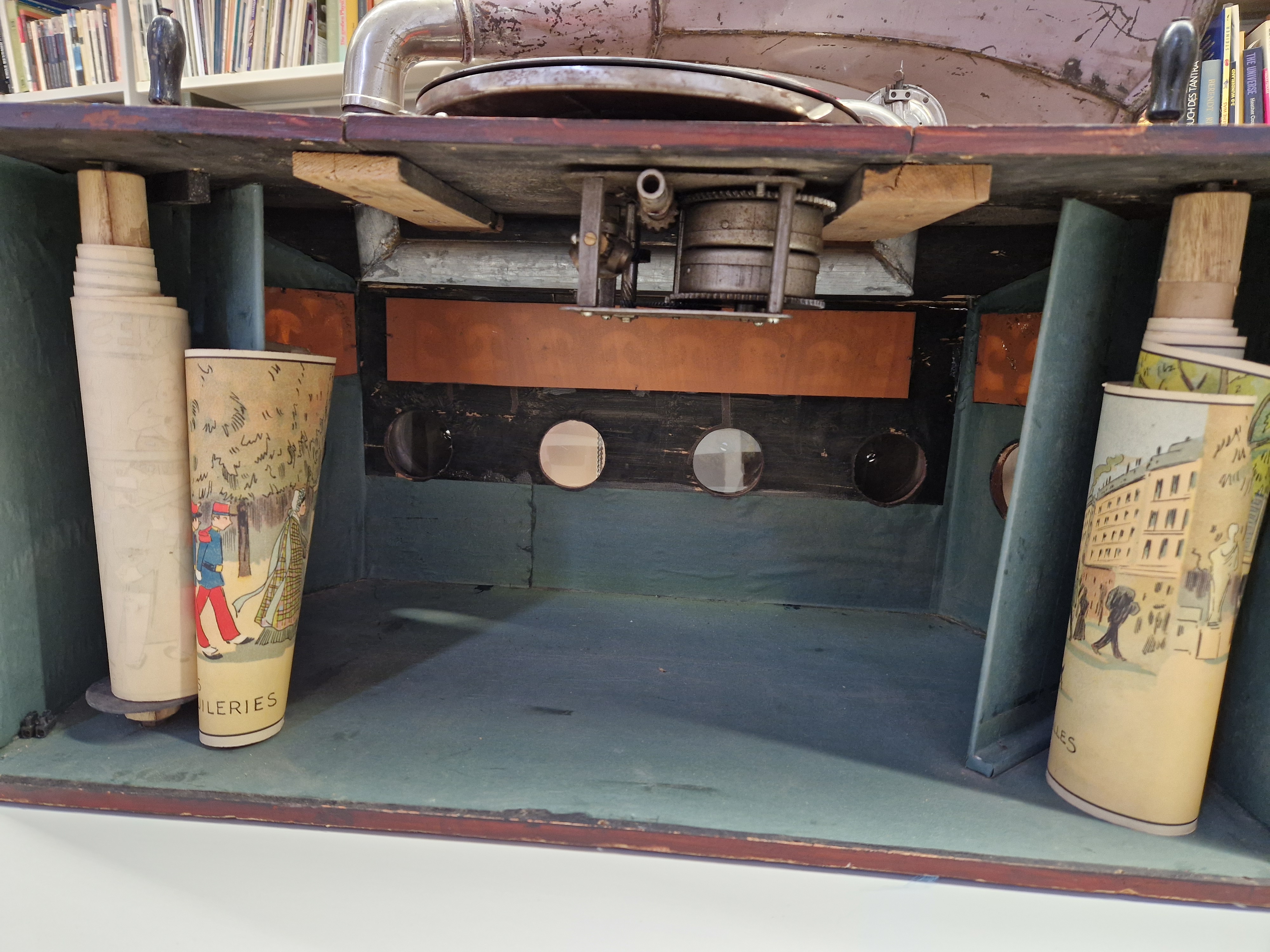 |
Figure 2187.2 –Roll Mechanism |
| This is a view inside the device from the back. Photo © Theatre Studies, University of Cologne. |
This is a multi-lens 3D viewer of a roll of images. It is fitted with a hand-cranked gramophone. It is the oldest example of a species of gramophone bioscope. There are three documented cases in the Optical Machine Taxonomy: this one, which may be European in origin; an Indian one (MNC-0267) from the 1980s; and one newly-constructed one from 2017 (SML-2019-257).
Structure: The three bioscopes are identical in structure down to details like the decorative lines incised into the wood: parallel lines on the top and front, a lozenge-shape on the sides. They have six lenses – four across the front and two angled side-lenses. The top of the box slopes down towards the lens-array like a Mondo Niovo. This sloped surface contains a translucent plate, apparently made of plastic, that helps to illuminate the images. Further illumination is provided by a wooden grill with a repeating palm-tree-like motif. The lens-frames are tin with tin lens-covers attached by light chains to decorative balls along the top edge of the device. Bioscopes are the only optical machines that have these external lens covers.
Roll-Mechanism:: In figure 2187.2 you can see the roll-mechanism exposed. A long paper roll with lithographed images on the front face is wound onto two wooden axles. Hand-cranks at the top of the box allow the bioscope-wallah to roll the images left or right across the viewing area. In this case the paper scroll has been torn asunder and will not work as intended.
I was not able to see the scroll during my visit to the Werner Nekes Collection, but it appears to be a travelling panorama of Paris. The style of the lithograph seems consistent with the age of the gramophone – 1910s or 20s.
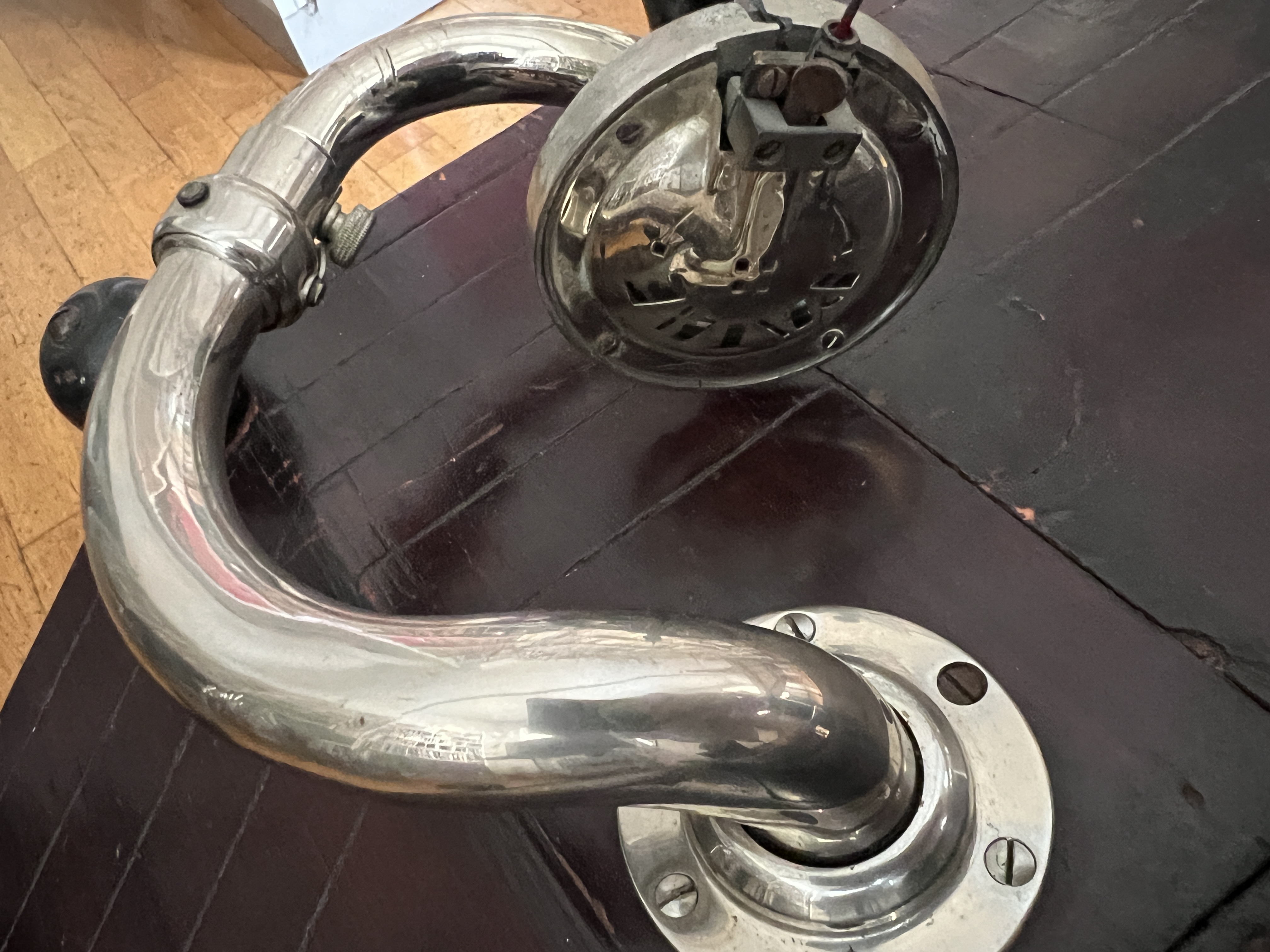 |
Figure 2187.3 –Bioscope Tone-Arm |
| The first section of the arm pivots counter-clockwise, then the second section pivots over so that the needle assembly drops to the record-disk. The needle in this image is pointing upwards. Photo © Rod Bantjes. |
The gramophone is driven by a hand-cranked wind-up mechanism (Figure 2187.2). The crank fits into the little tube at the back which is visible in Figure 2187.2. The sound is amplified by an acoustical resonator – the tin horn at the top of the machine (Figure 2187.1). No electrical cables, and no batteries are needed to make it work. It can be set up anywhere with additional no cost or equipment, which makes this sound-system ideal for the itinerant showman.
These simple features, along with the distinctive design of the tone-arm (see Figure 2187.3) indicate that the gramophone originated around 1910 or 20.
The early 20th century seems a surprising time for a new showbox to be designed and marketed. Clearly this box was, like the Raree Show intended for public performances. However, raree shows had already ceased to money-making concerns by the late 19th century. The image in this box looks to be of European origin, but the idea of this being a European box is puzzling.
One possibility is that the makers hoped that adding the very modern gramophone might revive the fortunes of the optical machine as a show-piece in European fairs and marketplaces. Another is that the box was designed for the foreign market. Perhaps it was a collaboration with Indian entrepreneurs who saw its potential in their country where competing optical amusements had not yet become as common as in Europe.
It was probably not an exclusively Indian invention since an identical box (MNC-0267) has a plate implying that the design was protected by "British and Eiriann letters patent" and that royalties had been paid either by a sub-contractor or importer to India. At some point, perhaps from the outset, or at least early in the 20the century, production shifted exclusively to India where it continues to this day.
Exhibition Practices: See the general page on bioscopes for what we know so far about how they were used.
Endnotes:
[1] I would like to thank Dr. Peter W. Marx for permission to access the collection and Charlene Fündgens, Emma Gebbeken and Gerald Köhler for their generous assistance in the archive.
[xxx] These are the full measures of the device including the gramophone horn and the forward protrusions of the lenses with lens-caps on. Here are the measures of the box plus crank-handles for comparison: H=44.8 cm, W=73.7 cm, D=40.7 cm. The same measures for MNC-0267: H=51 cm, W=73.9 cm, D=41 cm. The low front of the box is H=30.7 while MNC-0267 is 31.7. So the two boxes are nearly identical in proportions.
[xxx] An average of 55 cm with variations from 50 to 67 cm as measured by the lens-clock.