Rod Bantjes, “Genus_Bioscope.html,” created 15 December, 2025; last modified, 6 February, 2026 (https://people.stfx.ca/rbantjes/).
Roll-Bioscope Genus (1890 - 2010)
Defining Features: The Roll-Bioscope is a travelling show-box with multiple lenses which are meant to enhance the 3D effect of internal images. The lens array is similar to that of the Italian Mondo Niovo – at the low end of a sloped, wrap-around front. It differs from the European travelling show-box or raree show in the way that the images are changed – by a continuous roll mechanism rather than a draw-string. The roll-mechanism is a feature it shares with the Persian Shahr-e Farang.
For a history of the roll-mechanism, click here.
Social Position: The bioscope, carried from place to place by an itinerant showman or bioscope-wallah, has been a fixture in markets and fairs in India, Pakistan and Bangladesh during the 20th century, and in rural areas, well into the 21st. It served the same class strata and occupied the same social-structural position as the European raree show did in the 18th and 19th centuries. To learn more about how they were toured and exhibited, click here.
Ambiguous Name: The first part of the term "bio" in "bioscope," means "life." It was used in 19th-century Europe for a variety of different devices which people claimed produced "life-like" images. That has meant different things to different people. For Max Sclandanowsky, inventor of a cinematic "bioscope," (1895) that meant an image that has internal motion or animation. In India and South Africa "bioscope" has become synonymous with cinema. The roll-bioscope does have a kind of motion in the sense that the images move across the viewing area as they are interchanged. However, that is an altogether different kind of "moving image."
The roll-bioscope is not cinematic since it does not exhibit animated images. There is a cinematic version of a bioscope which I propose to call the ciné bioscope. However, if the visual evidence is any indicator, these were very rare: there are photos of hundreds of roll-bioscope, but only of a simgle ciné bioscope belonging to bioscopewallah Mohammad Salim.
Roll-Bioscope Species:
| Gramophone Bioscope: | 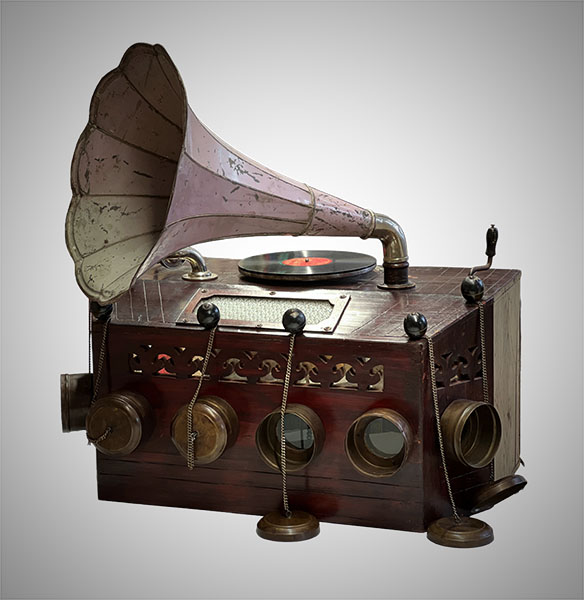 |
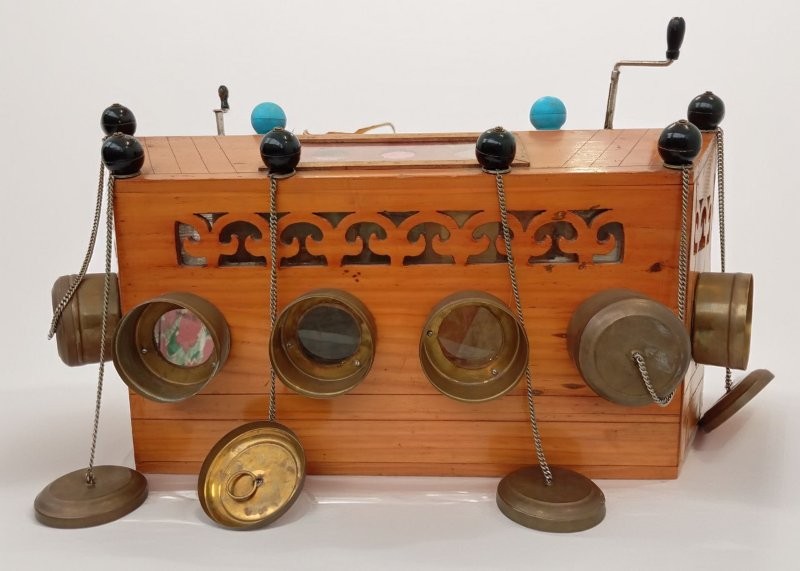 |
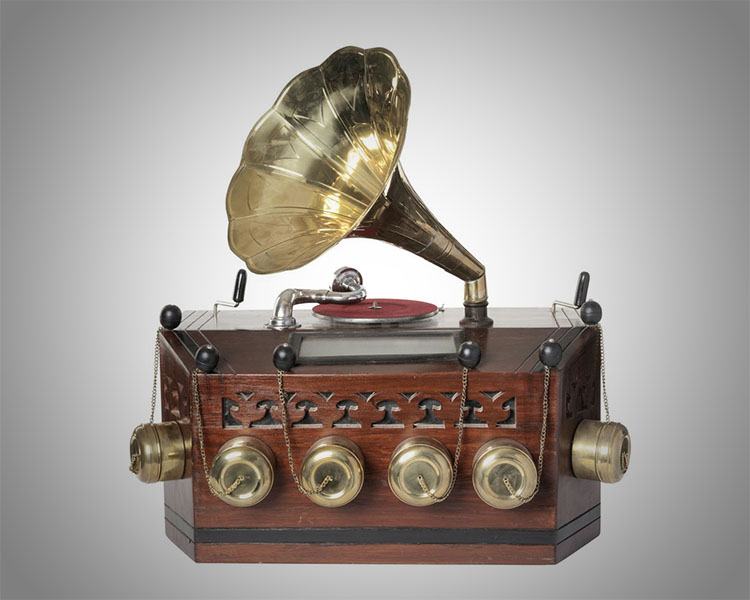 |
| WN-2187 | MNC-0267 | SML-2019-257 |
This may be the original type with European, possibly English origin. It is fitted with a hand-cranked gramophone (MNC-0267 has had its removed). The lens array has a flat section with 3 to 4 lenses plus two side-lenses angled back. The box has a sloping front-section containing a translucent window for illumination of the images. This sloping plate for illumination is similar to the Mondo Niovo. The lens-holders are tin and have tin lens-covers affixed with chains to decorative balls on top of the device.
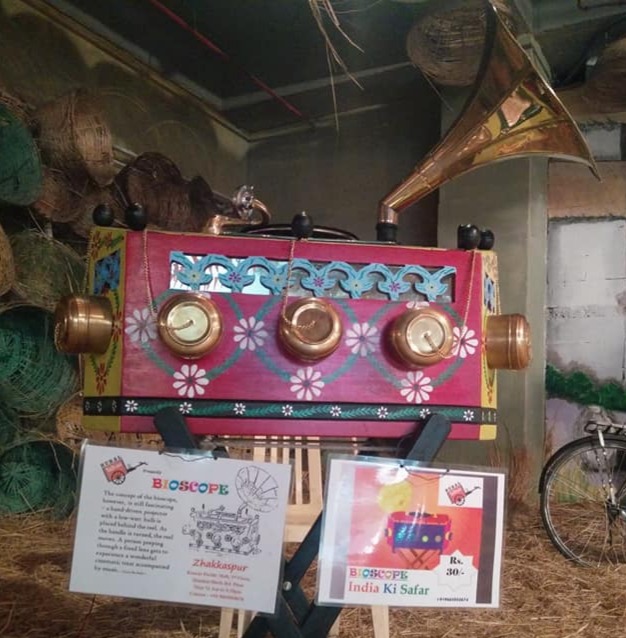
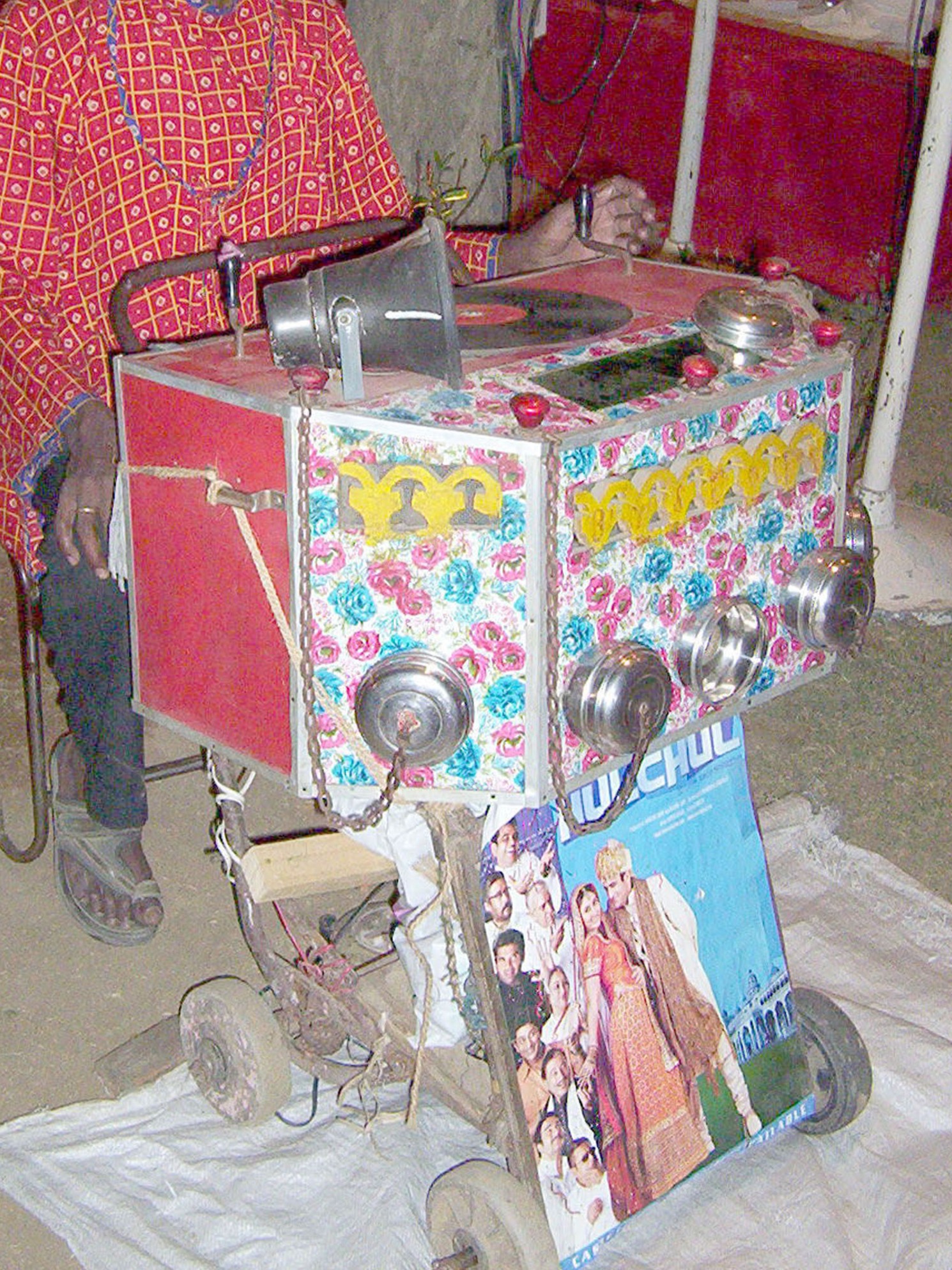
| Gramophone Bioscope: | 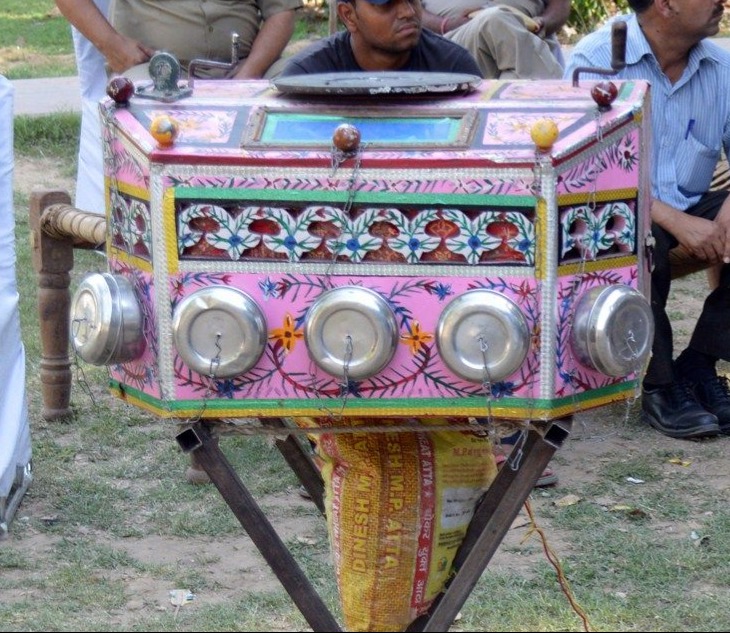 |
 |
 |
| BP_GR_1 | BP_GR_2 | BP_GR_3 |
These boxes have the same features as the original type, but are decorated in the bright, variegated colour-patterns popular in the Indian sub-continent. These have five lenses (3 across the front) rather than six (4 across the front), but I consider this a minor variation and include all together in the same species.
Note the standardized pattern cut through the wood above the lenses. This is a near-universal feature present even in home-made versions (see BP_GR_3).
BP_GR_1 has the remnants of the original gramophone. The maker of BP_GR_3 has substituted some sort of electric loudspeaker instead and seems to have added the vinyl LP for show.
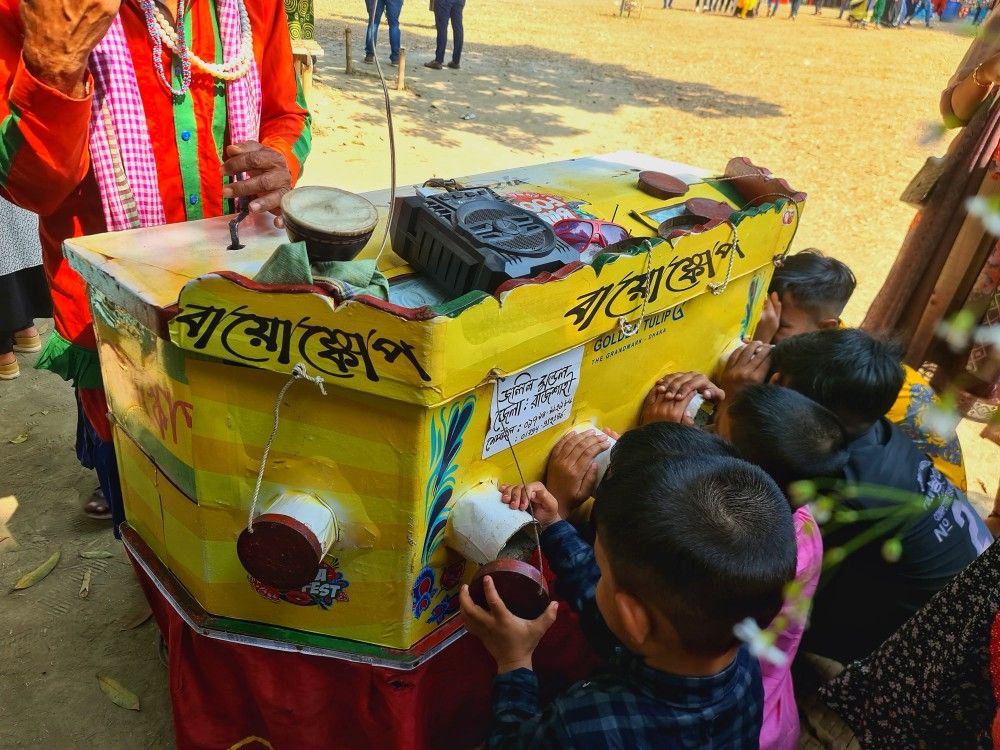
| Roll-Bioscope II: | 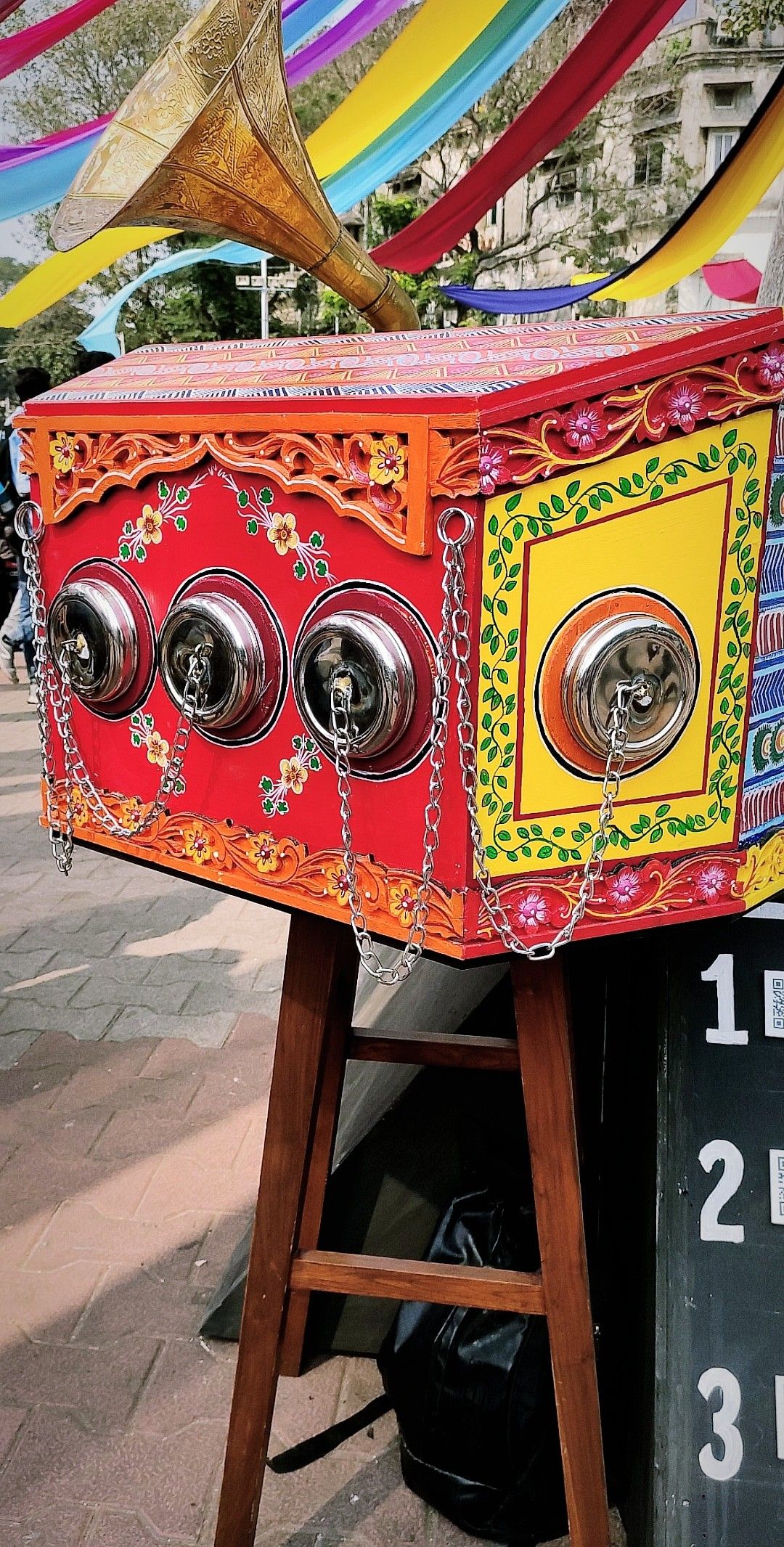 |
 |
 |
| BP_RL_1 | BP_RL_2 | BP_RL_3 |
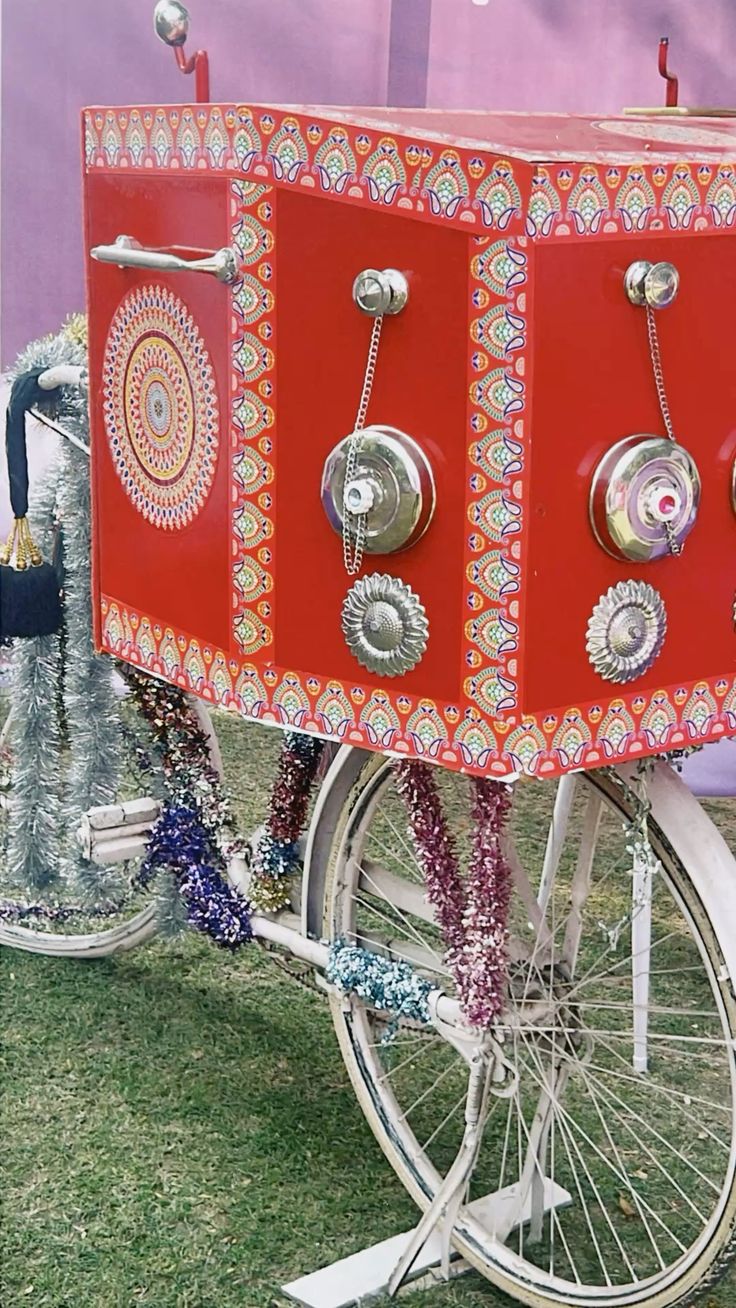
These are all slight mutations of the original gramophone bioscope – in the structure of the top-front and illmination-window or lack of it.
Some of these devices are not factory-made (e.g. BP_RL_2 and BP_GR_3 in the previous section) or are modified in various ways. For this reason, like the European devices of the 18th century, they are fluid in form and boundaries between types are relatively permeable.
| Bioscope Farang: | 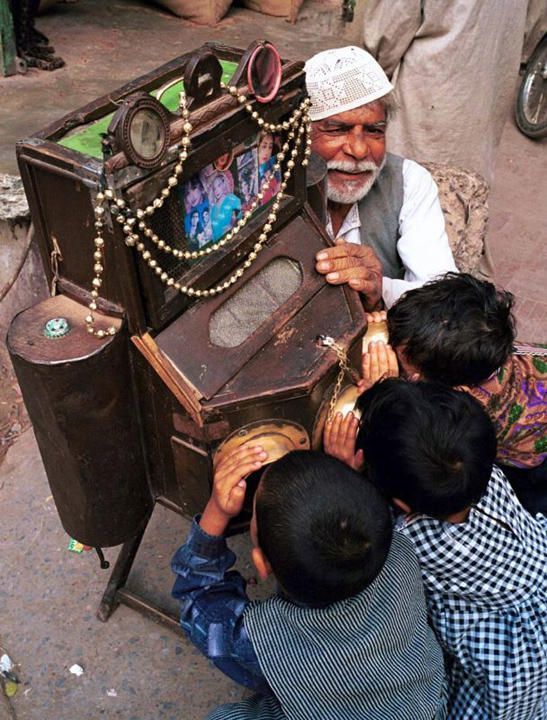 |
 |
 |
| BP_SF_1 | BP_SF_2 | BP_SF_3 |
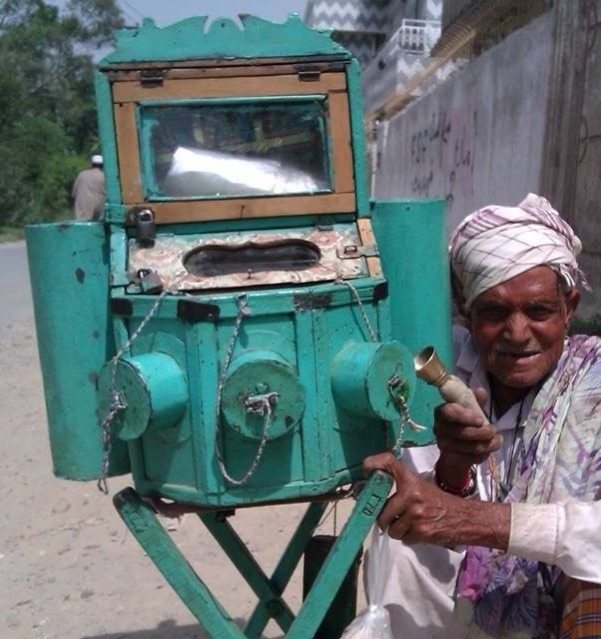
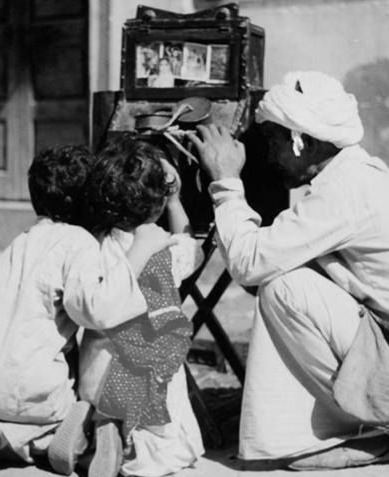
These bioscopes are a synthesis of features of the Indian roll-bioscope and the Persian Shahr-E Farang. Like the Shahr-E Farang they have external roll-tubes, curved 3-lens array, sloping front flap with window for illumination and display-box atop the box.
These examples are all from Lahore, Pakistan. Along with the Shahr-E Farang, they might be seen as the "muslim bioscope." However, they lack the minarets and general mosque-like aesthetic of the Shahr-E Farang.
Like the roll-bioscope, the body of the box is probably made of wood, rather than embossed tin. These boxes also have folding stands like bioscopes, rather than the integrated legs of the Shahr-E Farang which makes it look like a piece of ornate furniture.
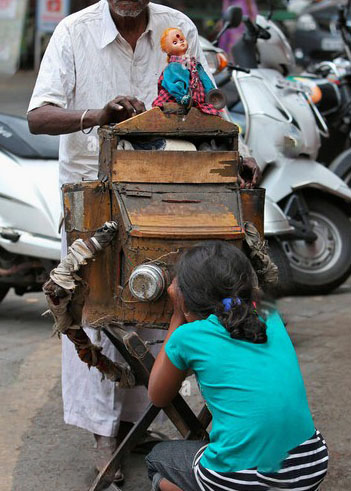
| Pune Bioscope: | 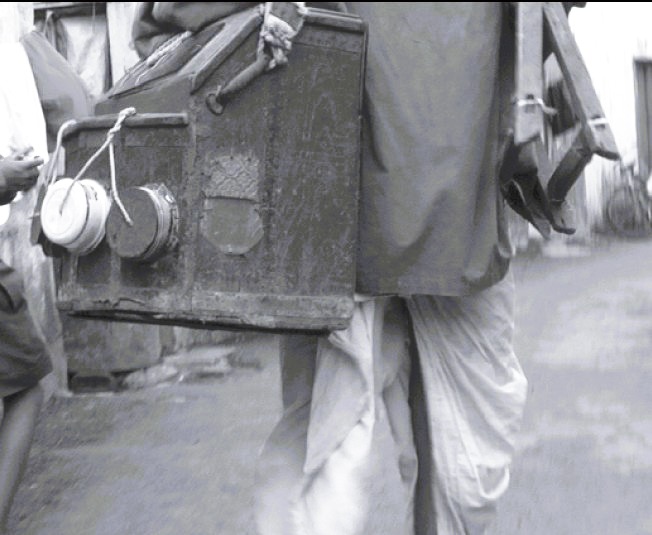 |
 |
| BP_GR_1 | BP_SF_II_1 |
These two roll-bioscopes are from Pune in western India. They have some Shahr-E Farang influence, but far less than the bioscope farang (above). The front shape and lenses are the same, but the roll-tubes are absent. The display-box is attenuated or possibly absent (BP_GR_1).
| Outliers: | 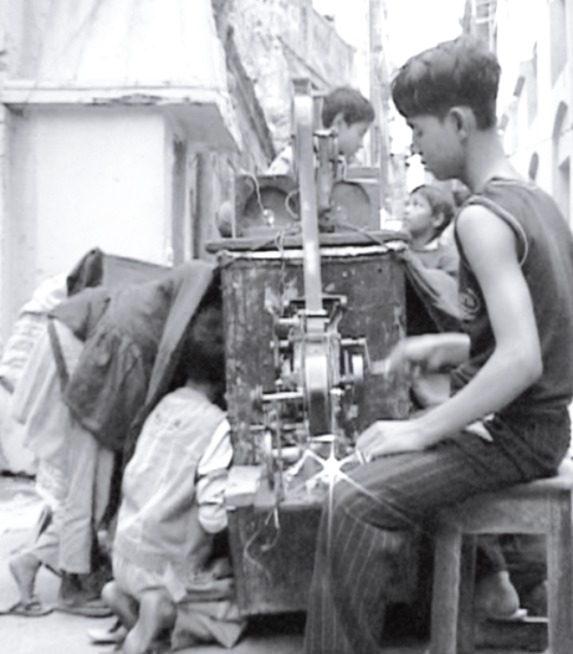 |
| BP_CN_1 |
This device, which I propose to call a ciné bioscope, is a kind of cinema-box. The viewers put their heads under a black cloth where they see moving images projected on a miniature screen by a hand-cranked film-projector.
Audience members do not view the images through a lens for a 3D effect, so this is not an "optical machine " and cannot be included in the Optical Machine Taxonomy, nor is it a member of the roll-bioscope genus. There are optical-machine - cinema mashups, like the Kinora, but these retain the function of the biconvex lens.
Sudhir Mahadevan misleadingly discusses the ciné bioscope together with the roll-bioscope as though they were variants of the same thing. Their optical principles and visual experience are quite different.[xxx]
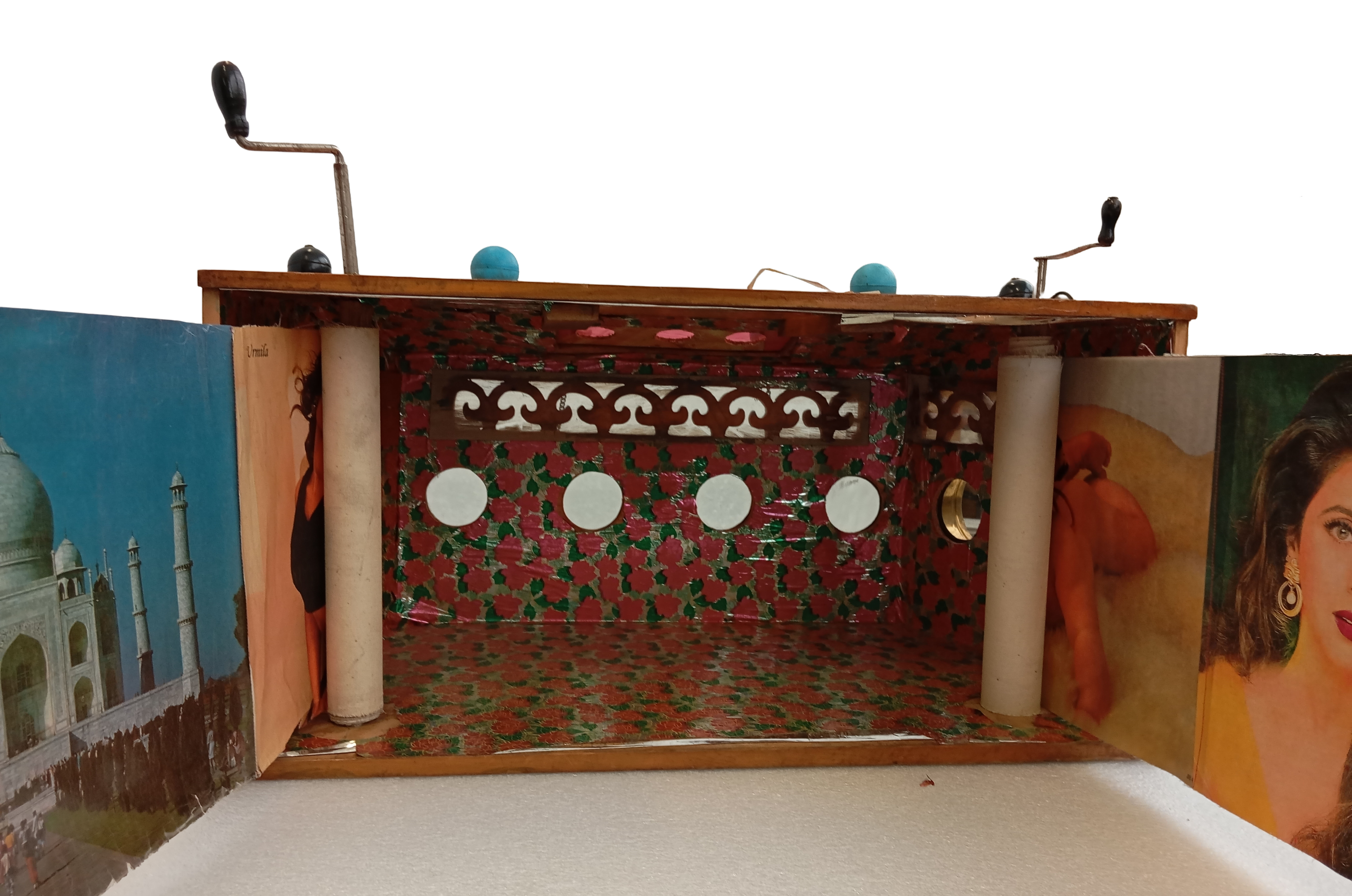 |
Figure 2187.5 –Roll and Images |
| The roll is pulled back so you can better see the mechanism and the lenses. Normally it runs directly from spindle to spindle. The inside of the box is covered with decorative paper, a common modification of European boxes as well. This box is in the Museo Nazionale del Cinema Collection. Photo © Ana David Mendes. |
History of the Roll-Mechanism: The roll-mechanism is rare in European optical machines but is the common standard in Iran and the Indian sub-continent. Japan and China adopted the more common European pull-string mechanism. How can we account for this pattern?
The earliest record of the optical machine in India is of a "Panoramic Machine" or "Print Examiner" exhibited in Bombay in 1853. This device probably looked like a Trapez-Guckkasten where the image[s] lie flat and you look at them through a lens and angled mirror. It also had a roll-mechanism like the French Cyclorama.
The cyclorama image was a true panorama of Paris. In other words it was a 360° view taken from a fixed position in space. These had been made popular in the early 19th century by the great painted panoramas exhibited in vast cylindrical rooms. The term "panorama" like so many in the history of optical machines, was used loosely and ambiguously for quite different types of images that somehow became related in people's minds. One was the moving or travelling panorama, where the images follow a trajectory in space like a train journey or ocean cruise.[xxx] In the true panorama it is as if the eyes sweep around as the body rotates; in the travelling panorama it is as though the eyes look in one direction as the body is moved forward. The term "panorama," is also rather misleadingly used for what might better be described as a scrolling montage, that is, a series of thematically- or narratively-related images that move through the viewing area on a continuous roll (see Figure 2187.5). Strictly speaking this is a stop-motion action where the movement is just for scene-changes. However, it gives a greater impression of movement and continuity than the pull-string mechanism of the Raree Show.
It is unclear what sort of panorama the 1853 "Panoramic Machine" was, but the bioscope roll-mechanism is for a scrolling montage. I am speculating here, but a possible account of the adoption of the roll-mechanism in India is as follows. The gramophone-bioscope, invented possibly in England in the early 20th century was imported to India.
This particular form of the optical machine may have met with success because it resonated with an ancient Indian tradition of itinerant storytellers who used song and a continuous scroll of images to convey their narratives. These were the Patuas of West Bengal. Their hand-painted images, of Hindu mythological stories, were attached to a fabric scroll in the same way that bioscope rolls are.
Hauser describes Patua practice as follows: "As soon as he enters a village, the children announce his arrival. Usually all the people from one compound gather for a performance: children, women, and others who have been busy around the house. The Patua shows about three to four scrolls at each presentation. The narratives tell the well-known myths and legends of the Bengali Hindus: Behulā Lakhindar, the renunciation of Caitanya, stories on Radha and episodes from the Ramayana (see Figure 1) etc. Apart from these, political and social events have also become topics for narratives. A performance takes about half an hour altogether. Then the Patua asks for gifts (dan) and alms (bhiksā)."[xxx]
The Patua performers occupied a social status close to that of a holy beggar and often engaged in other tricks and trades like peddling goods, performing magic or juggling. In these ways they were very like the 19th-century European Savoyards who toured Raree Shows or the 20th-century bioscopewallahs. They occupied a pre-existing social matrix int which the technology of the bioscope and practice of the bioscopewallah fit neatly.
However plausible this explanation is, it still leaves unanswered the question of how the roll-mechanism became predominant also in Pakistan and Iran.
Street Exhibition: People who grew up in India still remember fondly the bioscopewallah. His arrival, often carrying the bioscope on a bicycle (see BP_RL_3) or small wheeled carriage (BP_GR_3), would be loudly proclaimed by the village children. They would run to get small coins for admission. In Madhya Pradesh (the Central Indian province), the show was about 10 minutes long and cost 50 paise (equivalent to a Canadian penny).[xxx]
Sarower Reza, who studied bioscopes and bioscope-wallahs in Pakistan in the 2020s, describes the performance as follows:
| The peepholes are always for one-eye viewing. The showmen always narrate the passing images by singing (and gestures) while they keep changing images. It’s a must. For ...instance, if the image that is right now on focus through the peephole is of a monument, the showman would sing something like :'and now you see the famous...'. It goes like this. If it’s a mythological image, the story would be told in very brief.[xxx] |
The bioscope was an entertainment primarily for children. Yogesh Ghore remembers feeling too grown-up for it when he was 11 or 12, in grade 5. He remembers seeing them at "seasonal fairs, festivals and rural bazaars" as late as 2010. However they were clearly in decline in the 21st century. Like the Raree Show at the end of the 19th century that hung on in their traditional role only in the most rural and out of the way places. They still can be seen in the urban centres now but as curious nostalgia items.
Endnotes:
[xxx] Mahadevan, Sudhir. "Traveling Showmen, Makeshift Cinemas: The Bioscopewallah and Early Cinema History in India." BioScope 1, no. 1 (2010): 27–47.
[xxx] Hauser, Beatrix. "From Oral Tradition to 'Folk Art': Reevaluating Bengali Scroll Paintings." Asian Folklore Studies LXI, no. 1 (2002): 105-22.
[xxx] One exception is the Dolfini Teatro Rotondo.
[xxx] The oldest bioscope that we know of (WN-2187) has a travelling panorama. Indian bioscopes seem rather to have scrolling montages. This is an issue for further investigation.
[xxx] Yogesh Ghore, email correspondence, August 31, 2025.
[xxx] Sarower Reza, email, 14 July, 2025.