Rod Bantjes, “WN-224_Zograscope.html,” created 10 August, 2025; last modified, 10 August, 2025 (https://people.stfx.ca/rbantjes/).
Wide-Angle Zograscope
Werner Nekes Collection, Theatre Studies, University of Cologne[1] #WN-224
Western Europe c.1780
Dimensions: H= cm, W= cm, D= cm
Lens: ⌀=16.7 cm, ƒ=51 cm
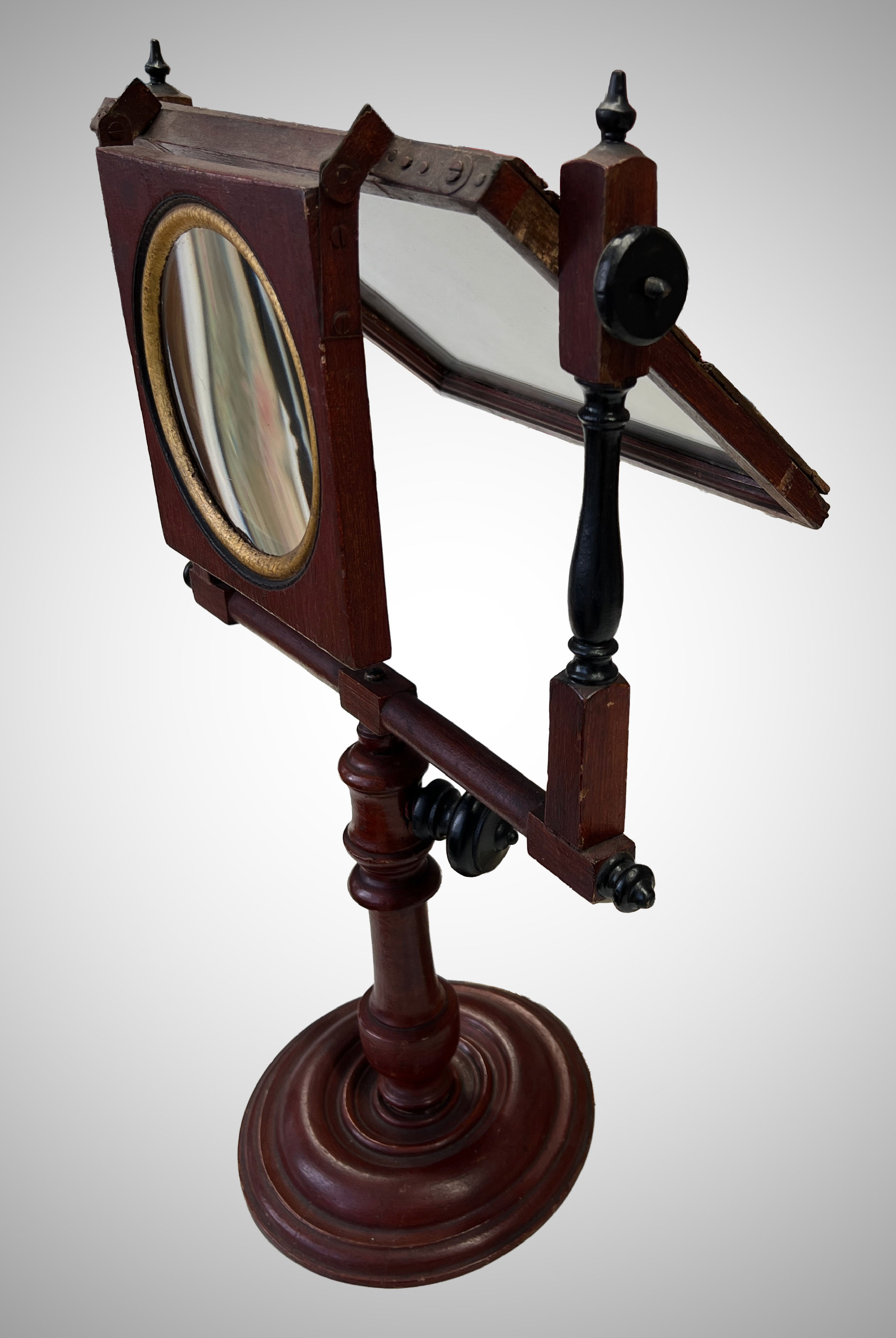 |
Figure WN-224.1 –Zograscope |
| Photo © Rod Bantjes. |
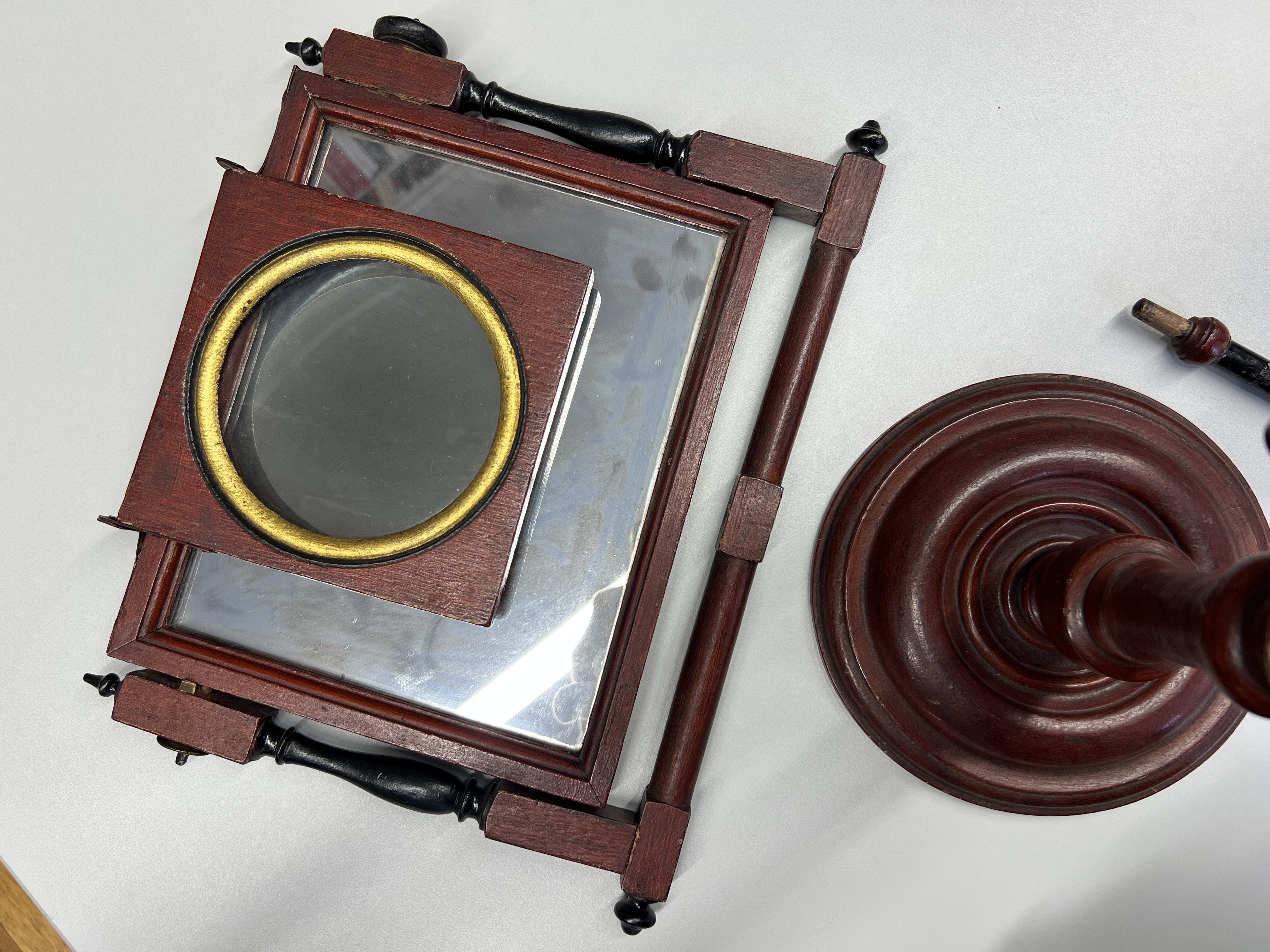 |
Figure WN-224.2 –Oversized Mirror |
| Photo © Rod Bantjes. |
This is a biconvex-lens viewer for enhancing the 3D-effect of copper-plate engravings known as vues d'optique.
It is a member of the genus Pillar Zograscope of the family Zograscope in the Optical Machine Taxonomy. Zograscopes are distinguished from other diagonal-mirror viewers in the Optical Machine Taxonomy by the fact that they have no enclosing box or image-holder and so rely on a surface such as a table to support the image.
This zograscope is distinguished from other species in the pillar zograscope genus by the extra-wide mirror. It is possible that the wide mirror is meant to better capture the full breadth of vues d'optique which are typically wide-angle views. The dimensions of the unusual mirror are:
The mirror assembly is cantilevered so that it balances nicely in its open position. Like most zograscopes it folds up and the lens/mirror assembly can be removed for storage and transport.
In all other respects it is typical of zograscope design and detailing. The distance between the lens/mirror and the print (which lies flat on the table) can be adjusted to suit the users eyes and the print size. That adjustment is made by means of a sliding column secured with a wooded thumbscrew. The column has numerous dent marks indicating that users set it at a wide range of positions, similar to EXBD-69024.
For more about zograscopes and their uses and meanings, follow this link.
The Effect of the Oversized Mirror
Figure WN-224.3 – View through the Lens |
| Video © Rod Bantjes. |
The extra width of the mirror may make it possible to see the full print with minimal head movement side-to-side. This effect would have to be more systematically compared to a conventional zograscope mirror.
Note the intrusion of a large area of background "noise" (the apparently moving bookcase). Other optical machines, including the lowly Raree Show, masked out such distractions and were thought for this reason to create a superior immersive illusion.
[1] I would like to thank Dr. Peter W. Marx for permission to access the collection and Charlene Fündgens, Emma Gebbeken and Gerald Köhler for their generous assistance in the archive..