Rod Bantjes, “OAU-001_Neomonoscope.html,” created 9 August, 2025; last modified, 9 August, 2025 (https://people.stfx.ca/rbantjes/).
Neomonoscope
#OAU-001
English, 1860
Dimensions (closed): H=2 cm, W=8 cm, D=12 cm
Lens: ⌀= cm, ƒ= cm
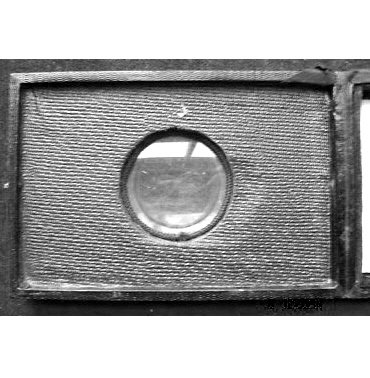 |
Figure OAU-001.1 –Neomonoscope |
| This is the only, very poor-quality, image I could find of one of these devices. |
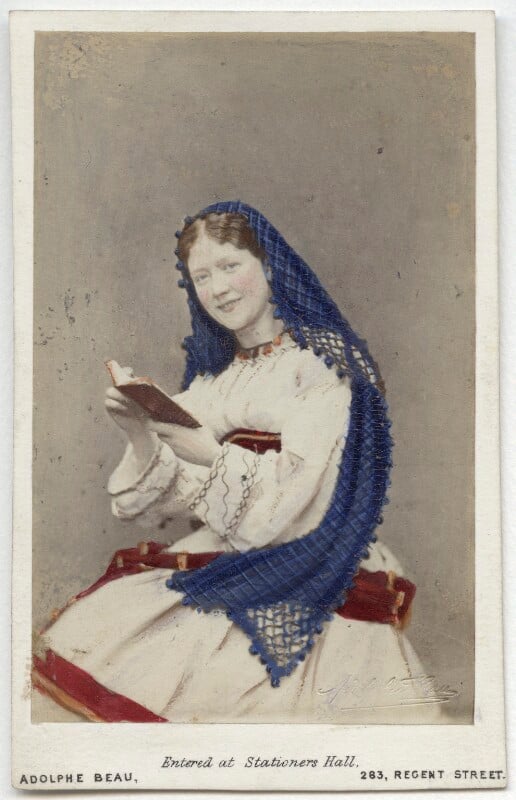 |
Figure OAU-001.2 – Carte de Visite |
Adolphe Paul Auguste Beau, 1863, Kate Terry as Blanche de Nevers in 'The Duke's Motto', hand-coloured albumen carte-de-visite, 8.8 x 5.6 cm (image size), © National Portrait Gallery, London. Creative Commons license 3.0
This is an example of the kind of image Beau designed his viewer for. |
This neonomoscope is a folding optical machine designed for viewing photographs in the carte-de-visite format (see Figure OAU-001.2).
Paul Adolphe Auguste Beau (1828 - 1910) received a provisional English patent for his neonomoscope in 1860. That makes it the first of the optical machines designed especially for photographs. It was followed by the Megalethoscope (ca. 1861), Graphoscope (1863) and Cosmoscope (ca. 1880).
Beau was a London photographer who specialized in portraits of stage actors. You can see an example of his work in Figure OAU-001.2. When viewed through the lens of the neomonoscope, the figure of the actress Kate Terry was supposed to appear fully volumetric. The tray of this neomonoscope held a stack of 12 such cartes-de-visite. Beau describes his device as follows:
| My Invention consists in constructing a neomonoscope or apparatus with one glass or several glasses superposed for the purpose of obtaining a similar effect to that derived from viewing pictures in or through a stereoscope. The monoscope is a pyramidal or conical-shaped case, with a part of one of the sides removed to admit light, fitted with a flap or not as desired. The glass is fitted in the top of the apparatus, and in some cases flaps for forming, when raised, a dark chamber between the eye and the glass, are added. The bottom of the apparatus is made to slide to admit of its being entirely removed, in order to view transparent objects or others apart from the apparatus itself. The sides of the apparatus are either made rigid or to fold. I sometimes add a pocket which forms part of the sides or bottom of the apparatus to contain photographic or other representations.[1] |
From this description it sounds like a small, folding Trapezguckkasten without a diagonal mirror. One views down through the lens to the enclose image. Like the Alethoscope, it is designed to accept transparent views, whether photographs on glass or paper dioramas is unclear. To make this work, the base would have to be turned to the light and the device held horizontally like a Lorgnette Pittoresque.
Beau's patent mentions variations of the design. Three such variations appear in Casella's Instrument Catalogue of 1871:[2]
1556. NEOMONOSCOPE, covered with plain cloth . . . 1 shilling 1557. NEOMONOSCOPE, in mahogany polished, with large lens . . 2 shillings 6 pence 1558. NEOMONOSCOPE superior, in ebony, and gilt or red; large lens . 5 shillings 6 pence |
The one depicted in Figure OAU-001.1 is the cheapest. We will keep a lookout in the hopes that examples of these viewers turn up hidden in archives or private collections somewhere.
Endnotes:
[1] British Patent no.823, 30the March, 1860, "An Apparatus for Viewing Photographic Pictures."
[2] Cassella, L., Catalogue Of ...Instruments (London: D. Lane, 1871)..