Rod Bantjes, “MCS-1_Alethoscope.html,” created 12 August, 2025; last modified, 12 August, 2025 (https://people.stfx.ca/rbantjes/).
Naya Alethoscope
Museé Camera Suisse[1] #MCS-1
Italian c.1867
Box dimensions: H=62 cm, W=46 cm, D=90 cm
Outer lens: H=13 W=17 cm; inner lens H=12.5 W=15.5 cm
Combined ƒ=50 cm
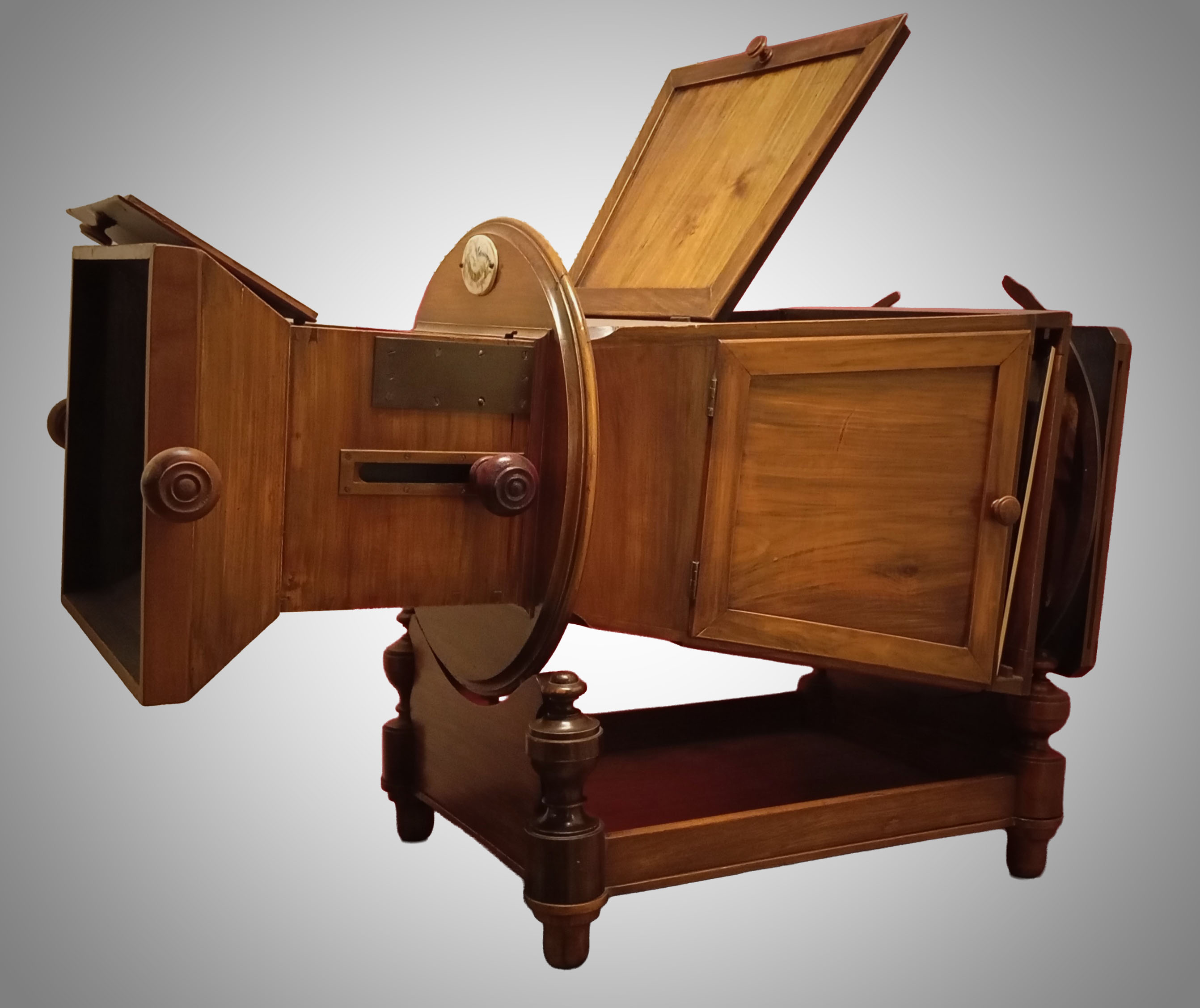 |
Figure MCS-1.1 – Naya Alethoscope |
| Photo © Ana David Mendes. |
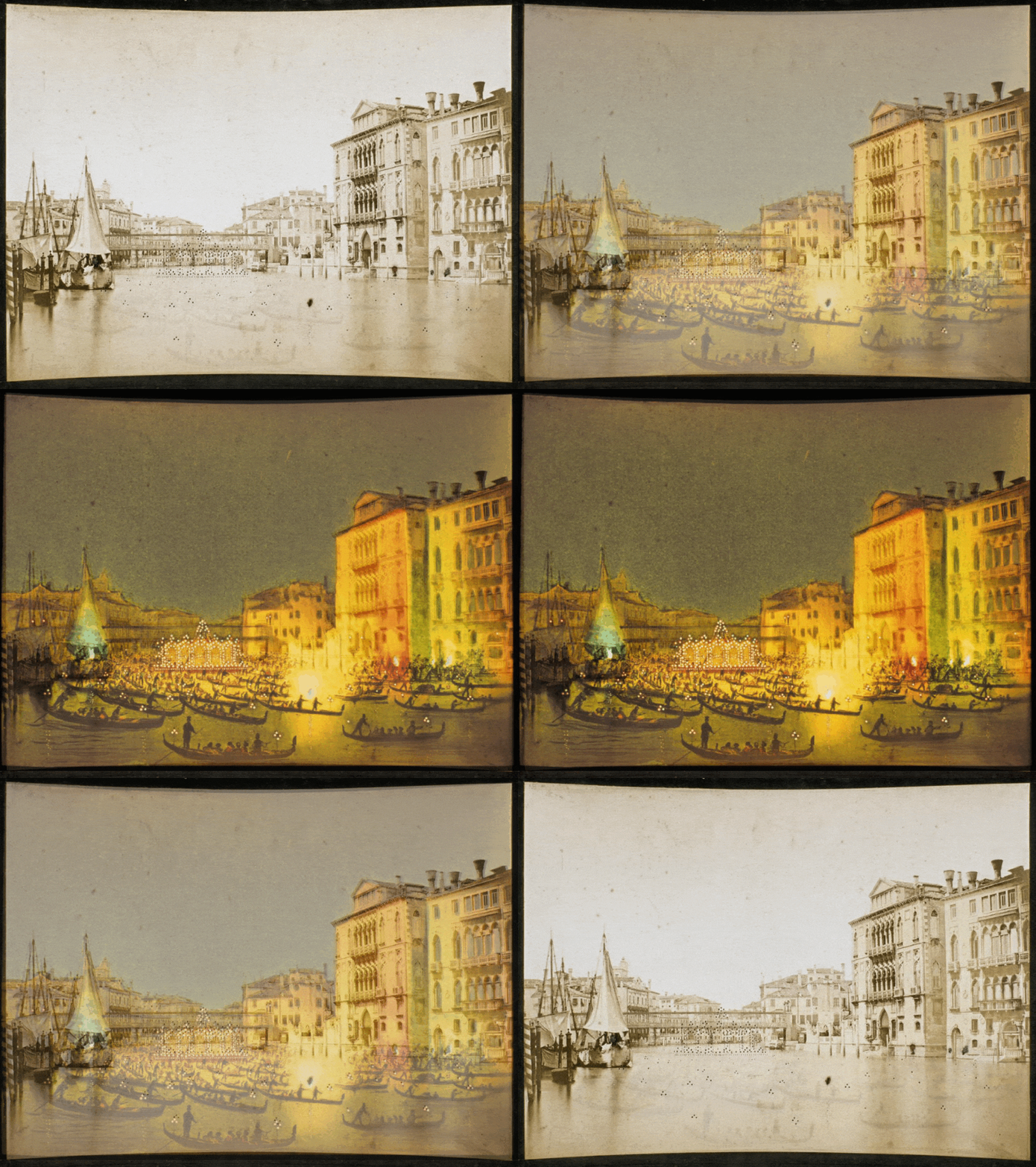 |
Figure MCS-1.2 –Tissue View |
| Carlo Ponti, ca. 1870. Venise, quai des Esclavons et place Saint-Marc Gif animation © Rod Bantjes. |
"The Alethoscope" in Carlo Naya's words "is an optical instrument by means of which all kinds of photographs can be seen in rilievo – presenting a splendid perspective – nearly as large as nature."
Carlo Ponti (ca.1823 - 1893) designed the Alethoscope (1861)[2] and related Megalethoscope[3] to be the unequalled perfection of the optical machine. His key innovation was replacing prints based on hand-drawn images with photographic paper dioramas.
The Alethoscope is the second of four early devices, including Adolphe Beau's Neomonoscope(1860), Charles John Rowsell's Graphoscope (1864) and Francis Frith's Cosmoscope, (ca. 1870) to apply the 18th-century biconvex lens to the photograph.
Revival of 18th-Century Features:
At the height of the popularity of the stereoscope, a competing and technically superior 3D device, and in defiance of a 19th-century trend towards miniaturization, Ponti revived many of the features of the grand optical machines of the previous century. His boxes were massive – heavily constructed and almost a metre in length like the early 18th-century Dutch Rarekieks.
Grand Scale
Like old Italian show-boxes, Megalethoscopes were often richly decorated, although in a style that was somewhat more stately than the colourful and theatrical predecessors. The Megalethoscope in the Cinémathèque française collection is embellished with "five sculptures on the sides and back: the lion of Venice, the invention of photography, telegraphy, achromatic lenses, and the use of steam." These boxes were meant to be objects of fine furniture to be proudly displayed rather than folded up and stored after use (like the Rarekieks and Cosmoscopes).
Binocular Lens
Most importantly, Ponti returned to the large lenses that had been typical of 18th-century devices. These had been supplanted in the early 19th century with small, monocular lenses in boxes designed as children's toys. The large lenses, that allowed viewing with both eyes, were superior in their 3D effect. Ponti's lenses had slightly shorter focal lengths (50 cm as opposed to 60 - 90 cm more typical in the 18th century) more prone to distortion towards the edges of viewed images. Ponti may have attempted to correct this defect by cutting out only the centre portion of his lenses when he squared them off for use in his devices. The use of two lenses in series may have been meant in some way to have been a corrective. Given his celebration of the achromatic lens on the Cinémathèque française megalethoscope, he may also have made one of his lenses an achromatic doublet (although this corrects for a different defect, the differential focus of different colours of light, that some believe contributed to the 3D illusion of optical boxes). His lenses would have to be examined more carefully to answer these questions.
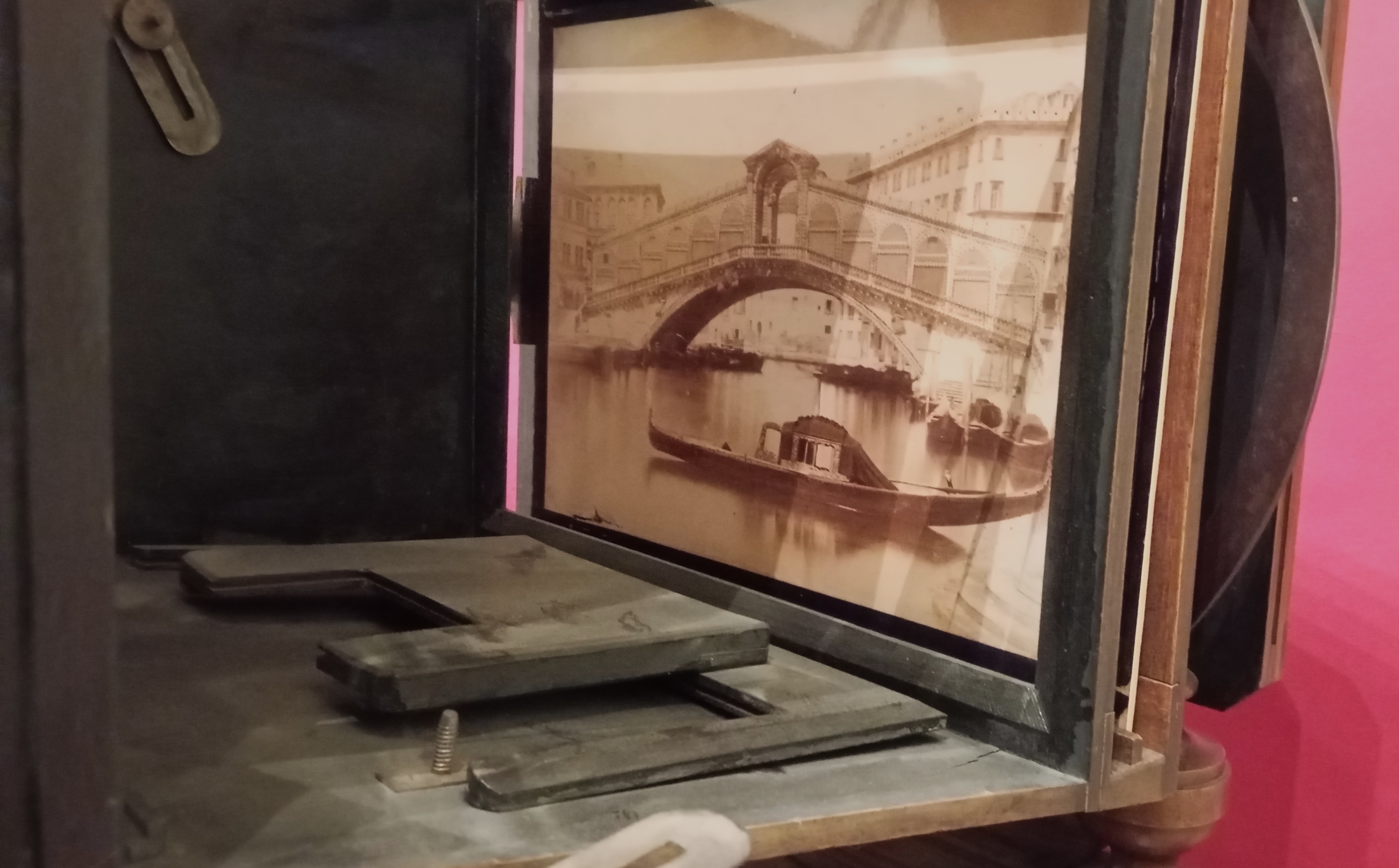 |
Figure MCS-1.3 –Alethoscope |
| Looking in from the side, you can see a paper diorama in place, plus two frames for holding smaller-format photos. |
| Photo © Rod Bantjes. |
Additional Design Features:
Masking
Ponti incorporated many of the best ideas from other optical boxes into the Megalethoscope. The lens is inset in a rectangular hood to minimize reflection on the glass surface and to screen out distractions. Curtains that closed around the backs of viewers' heads were sometimes used in showboxes for the same purpose. The rigid hood for the Holmes stereoscope (1861) was more like Ponti's design. The Megalethoscope as well as this Alethoscope had "diaphragms" inside to mask around the edges of a variety of different sized images. Similar black masks can be seen in many previous boxes (e.g. ...) although these could not be changed out for different sizes. These features were designed to fill the viewer's visual field with the image alone and thereby deepen their sense of immersion in its depicted space.
Lens Adjustment
Megalethoscope lenses can be moved forward or back to find the ideal position for each viewer. Other boxes with this functionality achieved it by simply dragging a lens box in or out of the main box in the style of hand-held camera obscuras. Lefort achieved it with the pleated sleeve in his polyorama panoptiques (ca. 1849). Ponti's lenses were held in an inner cartridge that could be moved forward and back by a pair of knobs at the sides of the cabinet (the knobs in slots visible in Figure MCS-1.2). These adjustments were not a question of focus, since the lenses do not focus an image, but rather of finding the position that for each viewer seemed best to enhance the 3D effect.
Landscape /Portrait Orientation
Perhaps the only novel feature of the Megalethoscope was its ability to rotate 90° to allow images to be viewed in what we would now call "portrait" versus "landscape" orientation. The vues d'optique for older optical machines were invariably in "landscape" orientation: their width always greater than their height. Ponti was taking photographs with different orientations depending on subject matter. In Figure MCS-1.2 you can see the circles of wood (at the front end) and metal (at the back) on which the box could be rotated. To do this one was meant to grip the two knobs on either side of the hood and turn it like a steering wheel.
Optional Features
Like Ponti, Naya offered a richly-carved version. He also made one with an attachment for viewing stereoviews. (from label)
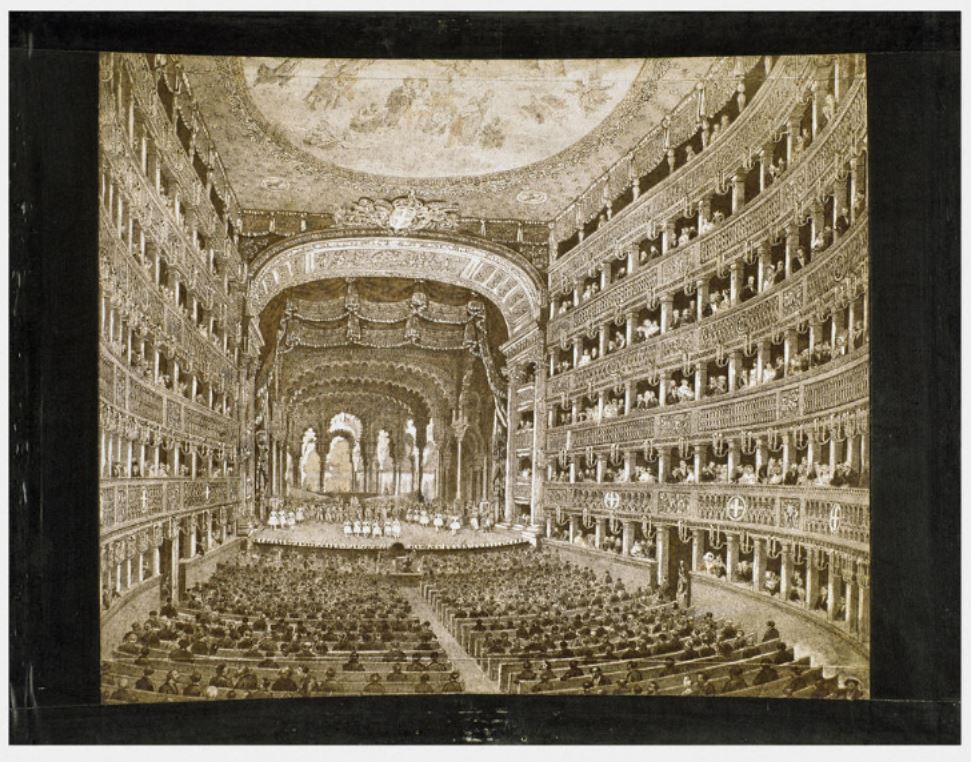 |
Figure MCS-1.4 –Photographic Paper Diorama |
| Carlo Ponti, ca. 1870. Teatro della Scala Milano Albumen print of an original drawing, layered with coloured tissue. |
Photographic Dioramas or Large-Scale Tissue-Views
Ponti's photographic prints for the Megalethoscope were attached to light wooden frames and functioned as the first layer of multi-layer paper dioramas (see Figure MCS-1.2). The underlayers, when back-illuminated, take the viewer out of the realm of realist photography and into dreamy worlds of the imagination. Paper dioramas also used in Henri Lefort's polyorama panoptique, have a long lineage that extends back to the pierced vues d'optique of the 18th century and Baroque illuminated stage flats. Photographic dioramas were pioneered by Lefort for use in the stereoscope and these are now universally referred to as "tissue views". Ponti's immediate inspiration, as well as the technique of printing albumen photos thin enough to be translucent, came from the stereoscopic tissue view.
Like all optical boxes that allow back-illumination of transparencies, the Alethoscope has a set of flaps to control the light. The back flap is fixed to the stand and does not rotate with the box. In addition to the hinged cover, it has a slot which may be meant for colour transparencies that would give the whole image a particular glow. Other optical boxes have one front flap that opens at the top of the box. The Alethoscope has two.
Hybrid Projection
While Ponti had re-conceived the optical machine for the new medium of photography, impressed like so many others by the perfection of its record of detail, he was unsatisfied with its limitations. Photography could not record time and the changing moods of a scene over the course of a day. The older technology of the paper transparency could solve that problem. As you can see in Figure MCS-1.2 where gondolas in the torchlight appear in the underlayer, drawing had to come to the aid of the photograph.
Early photographers discovered other deficiencies of the new medium. When they looked up at buildings – as we normally do to appreciate their grandeur and scale – the vertical lines converged in a way that was unfamiliar and seemed wrong.[4] To capture the wide sweep, up, down and side-to-side of an interior like the Teatro della Scala a modern photographer would use a wide-angle lens. But that would produce curvilinear distortions that would have been even more offensive to 19th-century sensibilities than upwardly-converging vertical lines. In Figure MCS-1.4 Ponti (or possibly Naya) has resorted to "hybrid projection" – a wide-angle view where the obviously curved lines have been straightened. This was an 18th-century technique typical in vues d'optique.
Ponti was not the only photographer who resorted to drawing in hybrid projection to overcome photography's deficiencies. Giorgio Sommer uses exactly the same image in one of his stereoviews. Others mounted such images for the sterescope as well. Hybrid projection appears in the graphoscope as late as the 1890s. These examples are testament to the enduring appeal, not only of the optical machine, but of its unique imagery.
Naya's Flat Image-Plates
Carlo Naya (1816–1882) began making Alethoscopes (which he sometimes labelled "Graphoscopes") after 1866 when Ponti's patent was no longer in force. This is a Naya Alethoscope which was unique in having a flat image-plate. Ponti's Alethoscopes and Megalethoscopes had curved image-plates perhaps to reduce image-distortions produced by the lens and/or to enhance the depth effect. There was uncertainty and debate around the value of curved image-plates: Naya was against them, but Ponti, Francis Frith (inventor of the Cosmoscope) and the American makers of stereograms were in favour of them. You can read more about these differing views and the reasons for them in my discussion of the Cosmoscope.
Endnotes:
[1] I would like to thank the staff at the Museé Camera Suisse for their generous assistance to me and Ana David Mendes..
[2] In his 1861 patent he calls it an Alethoscope rather than a Megalethoscope: "Carlo Ponti, brevet français n° 51 221, déposé le 30 août 1861, délivré le 23 novembre 1861, 'appareil d'optique dit aléthoscope'. Carlo Ponti, brevet anglais n° 1988, 10 juillet 1862 : 'An improved apparatus for viewing photographic pictures and the preparation of photographic pictures to be used in such apparatus'".
[3] Comparing this Alethoscope with the Megalethoscope in the Cinémathèque française collection reveals relatively minor differences. The megalathoscope (62 x 48 x 90cm) is not, as others suggest, much larger than the Alethoscope (62 x 46 x 90cm). The Megalethoscope is more ornate. For adjusting the lens it has handles and two slots rather than knobs and a single slot (this alteration would make it less likely to jam). This Alethoscope by Naya has a flat image-plate while the megalethoscope has a curved one. However, I believe that only Naya insisted on the flat plate and that Ponti's Alethoscopes would have had curved plates.
[4] Bantjes, Rod, "Vertical Perspective Does Not Exist:" The Scandal of Converging Verticals and the Final Crisis of Perspectiva Artificialis," Journal of the History of Ideas 75, no. 2 (2014)..