Rod Bantjes, “AP-95-1613_Megalethoscope.html,” created 28 February, 2026; last modified, 28 February, 2026, 2025 (https://people.stfx.ca/rbantjes/).
Ponti Megalethoscope
Cinématèque française Collection, Paris #AP-95-1613
Italy ca.1864
Dimensions: H=62 cm, W=48 cm, D=90 cm
Lens: ⌀= cm, ƒ= cm
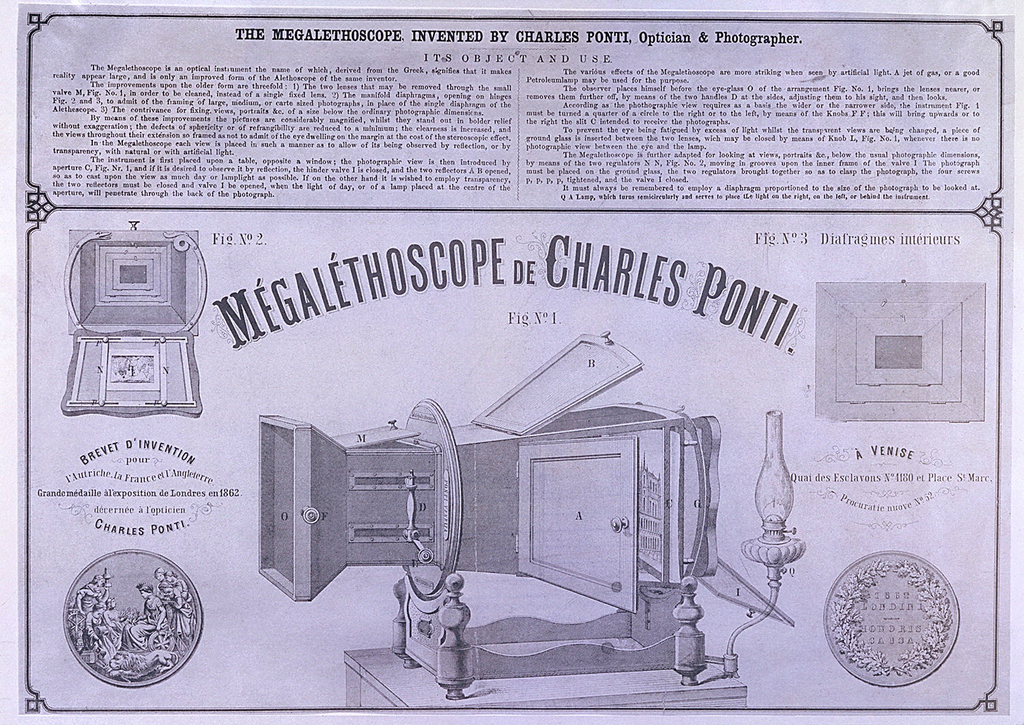 |
Figure AP-95-1613.1 – Megalethoscope |
| This is a clearer copy of the printed sticker in the device in the Cinématèque française collection. |
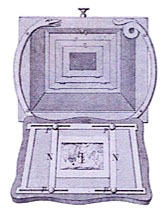 |
Figure AP-95-1613.2 – Variable Image-Frame |
| Detail of sticker within the device. |
The Megalethoscope is Carlo Ponti's improved Alethoscope. It is an example of a biconvex lens 3D-viewer called an "optical machine" and is included in the Optical Machine Taxonomy.
The Megalethoscope has all the features of the genus Alethoscope including:
| • a rotating body to change between "landscape" and "portrait" orientation of prints; | ||
| • two mirrored front-flaps, the choice of which depends upon the orientation of the print; | ||
| • a viewing-hood to minimize glare on the lens; | ||
| • a large squared lens in a movable carriage adjustable by brass side-knobs; | ||
| • internal masking to eliminate all distractions from the internal illusion. |
Like the Alethoscope, it is designed to be used with paper dioramas. For back-illumination of these transparencies, it has a fixed back-flap (which does not rotate with the body) and a removable ground-glass like those found in Brewster stereoscopes. I had assumed that the ground-glass was to diffuse light, but Ponti suggests that it is to minimize glare when images are changed.
A key improvement over the original Alethoscope design was a set of alternate image-plates that allowed for numerous image-formats to be used. These are illustrated in the diagram (Figure AP-95-1613.1) by figures numbers 2 and 3. Carlo Naya's Alethoscope also has variable image-plates but he does not give it the grand title "Megalethoscope." Ponti here includes an adjustable image-plate (Figure AP-95-1613.2) where two bands (N and N) can be slid together or apart and fixed in place by thumb-screws (P).
There are some minor improvements that Ponti advertises, including a double lens that can be removed for cleaning via a top flap (M in the diagram). He claims that the optics of the double lens are superior, with the result that "the enlargement of the images is significantly increased, the relief more developed, but without exaggeration; defects of sphericity or refractivity are minimized; the clarity is greater"
He also suggests that the masking is better: "the range of views is framed in such a way as to prevent the eye from wandering over the margins at the expense of the stereoscopic effect." These are both claims that bear testing with an Alethoscope side-by-side with a Megalethoscope.
A final minor improvement that he does not mention is that the mechanism for adjusting the lens-assembly has handles rather than knobs and runs along two slots rather than one, which would make it less likely to jam.
From the diagram it is clear that the ornate carvings of the Cinématèque française example are not definitive of this mega-variant of the Alethoscope. Like Naya, Ponti must have offered both simple and more ornate styling (at greater cost) for the same device.