Rod Bantjes, “Genus_Alethoscope.html,” created 24 February, 2026; last modified, 24 February, 2026 (https://people.stfx.ca/rbantjes/).
Alethoscope Genus (1861 - 1880?)
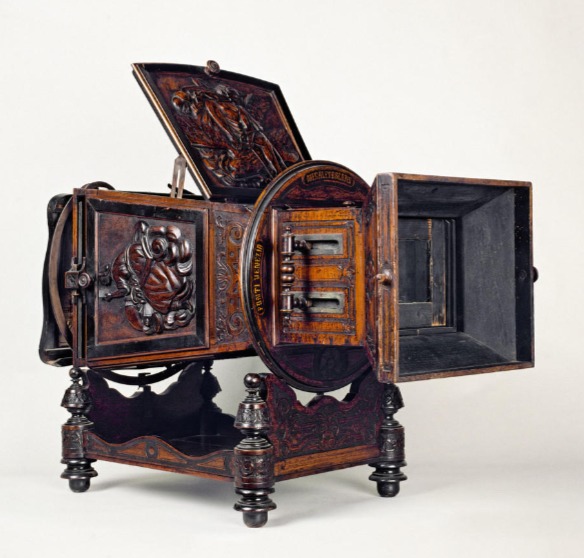 |
Figure AP-95-1613.1 –Megalethoscope |
| Source: Cinématèque française |
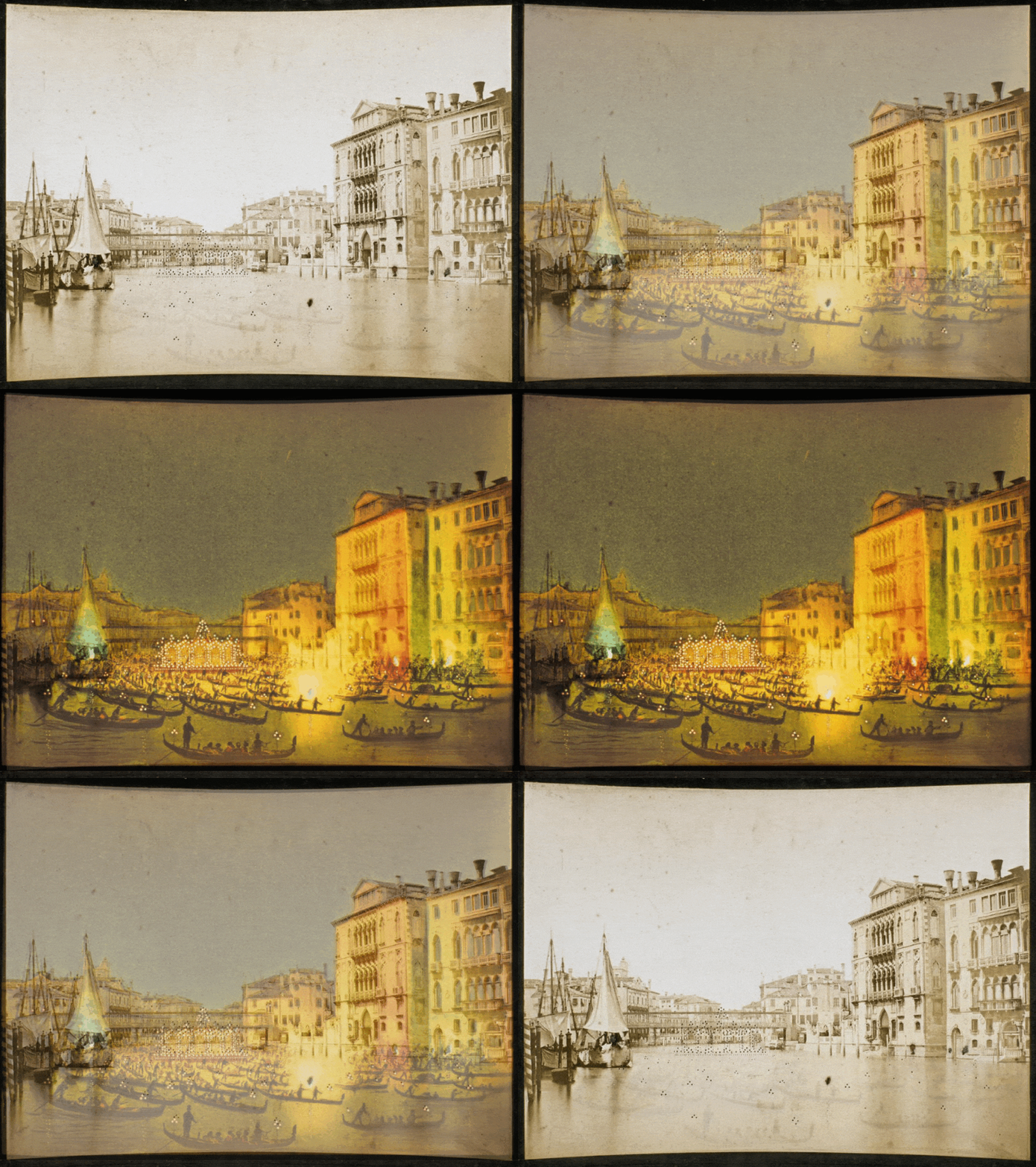 |
Figure MCS-1.2 – Paper Diorama |
| Carlo Ponti, ca. 1870. Venise, quai des Esclavons et place Saint-Marc Gif animation © Rod Bantjes. |
Carlo Ponti (ca.1823 - 1893) designed the Alethoscope (1861)[1] and related Megalethoscope to be the unequalled perfection of the optical machine. These are large-scale viewers for photographic paper dioramas.
The defining features of the genus are:
| • a rotating body to change between "landscape" and "portrait" orientation of prints; | ||
| • two mirrored front-flaps, the choice of which depends upon the orientation of the print; | ||
| • a viewing-hood to minimize glare on the lens; | ||
| • a large squared lens in a movable carriage adjustable by brass side-knobs; | ||
| • internal masking to eliminate all distractions from the internal illusion. |
The Alethoscope is the second of four early devices, including Adolphe Beau's Neomonoscope(1860), Charles John Rowsell's Graphoscope (1864) and Francis Frith's Cosmoscope, (ca. 1870) to apply the 18th-century biconvex lens to the photograph.
Here I identify three species of Alethoscope. There is at least one more: the Ponti Alethoscope that has a curved image-plate unlike the Naya version that has a flat plate.
| Ponti Megalethoscope: | |
| AP-95-1613 |
The Megalethoscope (62 x 48 x 90 cm) is similar in size to the Alethoscope (62 x 46 x 90). It takes the same sized images, plus a number of smaller formats. Alternate image-frames, including one for the popular carte de visite format, is touted as one of the improvements over the original Alethoscope, although the min-Alethoscope has this capacity as well.
The other improvements that Ponti claims for the Megalethoscope are either minor – a double lens that can be cleaned – or to be taken with a grain of salt: "the enlargement of the images is significantly increased, the relief more developed, but without exaggeration; defects of sphericity or refractivity are minimized; the clarity is greater, and the range of views is framed in such a way as to prevent the eye from wandering over the margins at the expense of the stereoscopic effect."[2]
| Naya Alethoscope: | 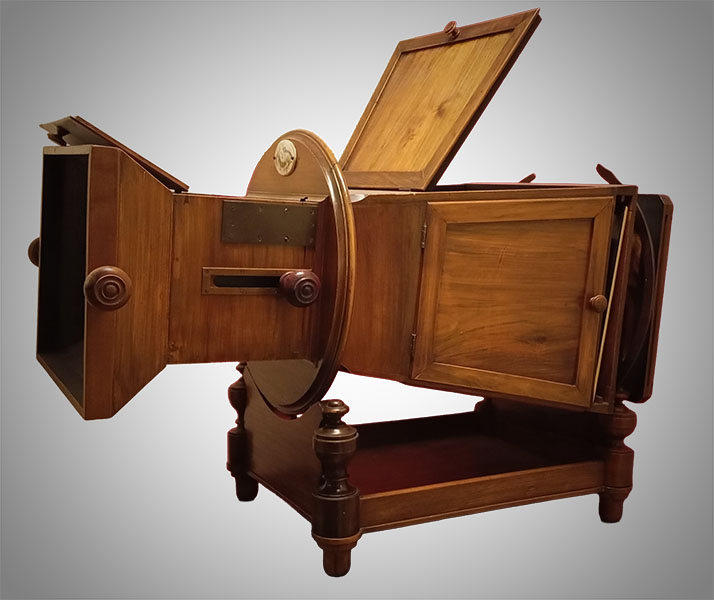 |
| MCS-1 |
The Naya Alethoscope embodies most of the improvements of Ponti's Megalethoscope, but is unique in having a flat, rather than a curved image-plate.
| Mini-Alethoscope: | 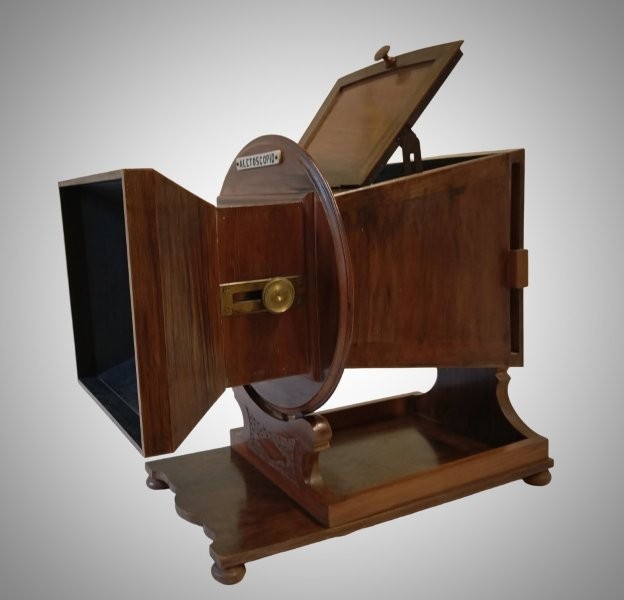 |
| MNC-M02003 |
At 47.3 cm in length, this device is about half the size of the Megalethoscope (90 cm). Like the Megalethoscope, it can accept different sizes of images, the largest of which is curved and 17 cm wide. That is less than half the width of the Alethoscope image-plate (36 cm).
Endnotes:
[1] In his 1861 patent he calls it an Alethoscope rather than a Megalethoscope: "Carlo Ponti, brevet français n° 51 111, déposé le 30 août 1861, délivré le 13 novembre 1861, 'appareil d'optique dit aléthoscope'. Carlo Ponti, brevet anglais n° 1988, 10 juillet 1861 : 'An improved apparatus for viewing photographic pictures and the preparation of photographic pictures to be used in such apparatus'".
[2] Quote from a printed notice pasted to the device. There are additional minor differences that he does not mention: the Cinémathèque française Megalathoscope is more ornate. For adjusting the lens it has handles and two slots rather than knobs and a single slot (this alteration would make it less likely to jam).