Rod Bantjes, “AP-95-1630_Gothic_Lower_Fly.html,” created 10 March, 2026; last modified, 10 March, 2026. (https://people.stfx.ca/rbantjes/).
Gothic Lower Fly
Cinématèque française Collection, Paris #AP-95-1630
Italy, ca. 1830
Dimensions: H=54 cm, W=51 cm, D=95
Lens: ⌀= cm, ƒ= cm
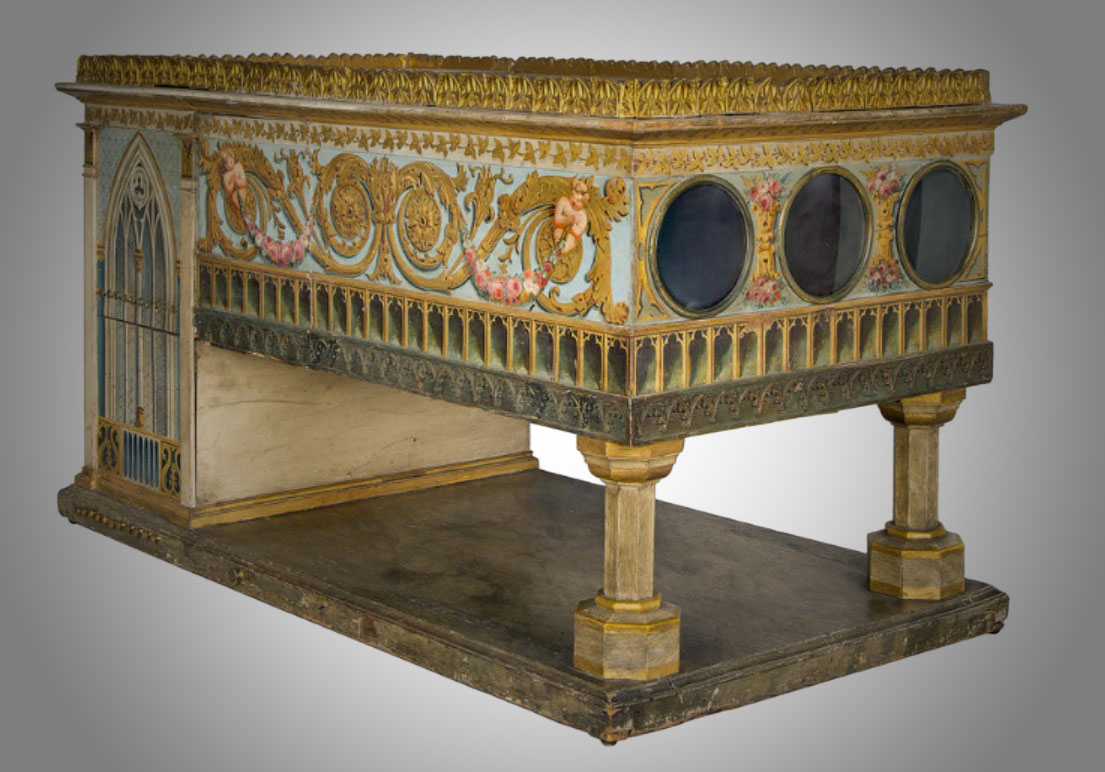 |
Figure AP-95-1630.1 – Gothic Lower Fly |
| Photo © Dabrowski Stéphane, Cinématèque française. |
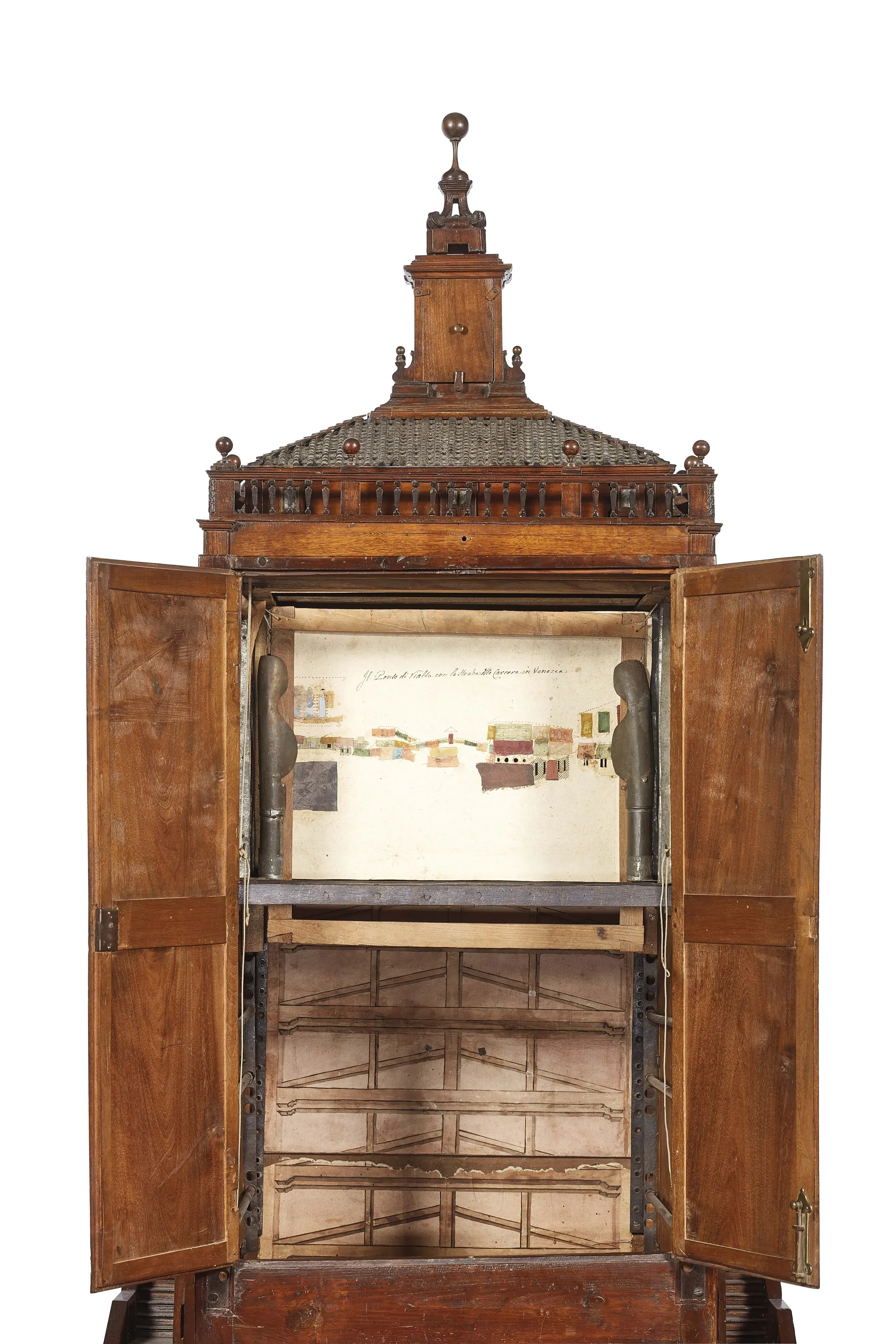 |
Figure GCCH-1000219483.2 – Friggeri Lower Fly |
| Photo © Pandolfini Auction House. |
This is a large, ornate optical box with three lenses whose purpose is to enhance the 3D effect of printed images. It is an example of an "optical machine " and is included in the Optical Machine Taxonomy.
Structure: The structure of the box, with its long, overhanging front-section, is unusual. In scale it is like a Rarekiek from the previous century. It is close to a metre long, with a long distance between lenses and image-plate. The lenses are huge – around 10 cm in diameter – and likely have a long focal length. It is designed therefore for binocular viewing which gives the best 3D effect.
Decoration: The Cinématèque française describes the decoration as follows: "trois lentilles cerclées de laiton ; boîte en bois peint en polychromie ; côtés ornementés avec décors à la cathédrale, dorures, fleurs et angelot ...galerie en bois doré." Perhaps I am misreading the French, but the images on the sides of the box appear to be papered rather than painted. Pasted lithograph decorations of this kind were common on optical boxes of this period.
Image Format: The viewing area is likely around 25 x 46 cm. There are vues d'optique within this range of size, but by the 1830s vues d'optique on laid paper were a thing of the past. The lower fly (see below) holds 11 images but it is uncertain what their format was. The box has a top-flap over the stage that opens to the back like a Boîte Dioramique of the period. The back also has a flap that may be to allow access to the lower fly, or to provide back-illumination for pierced or translucent views, or both.[xxx]
Lower Fly: The most important feature of the box from the point of view of our taxonomy, is that it has what I am calling a "lower fly" instead of a flytower. In other words, the images are raised by rigging into the viewing area from below rather than lowered from above. The lower fly is a feature of many depictions of Raree Shows. The Friggeri Tower also has one; but we have never examined one to see exactly how it works.
A photo of the back of the Friggeri Tower (Figure GCCH-1000219483.2) shows two lines attached to the top corners of a vue d'optique frame. The operator must open the back of the box and grasp both lines – one in each hand – and pull down to raise the image-flat into the viewing area. He/she then secures the lines on two small cleats like those found backstage in a theatre (or on a ship). There are two grooved dowels, above and on either side of the stage, that serve as pulleys for the two strings.
The Cinématèque française box cannot work this way. There is a line of 10 holes mid-way up on the right side of the box (facing forward) and a line of 11 tacks at the base (below the Gothic window) on which to secure them. Each hole is only large enough for a single string. How exactly they activate the image-flats is uncertain. If the intent was to pull from the top of the image-frames by any means (at the corners like the Friggeri Tower or at the centre) then the holes would be at the top. Pulling from the top would have the undesirable consequence that all except the first image in line would have strings dangling in front of them when they were in the viewing area.
Cross-String Mechanism: An alternate possibility is that the strings run down at a diagonal from the holes and through eyelets at the base of each image-frame. As the string was tightened the frame would move up and the string would remain out of the way of viewing. To avoid sideways tension that could jam the image-frame in its guide-channel, the string would thread through the lower eyelet and attach to the wall of the box opposite to the string-holes. Two eyelets, one at or near each bottom corner of the image-frame would provide better lift. This cross-string means of animation was likely used in other boxes and may have had its inspiration in techniques of puppetry.
Endnotes:
[xxx] The Cinématèque française does not allow researchers access to their collection so many important questions are impossible to answer.