Rod Bantjes, “GCCH-1000219483_Ornate_Tower.html,” created 2 March, 2026; last modified, 2 March, 2026 (https://people.stfx.ca/rbantjes/).
Friggeri Tower
Pandolfini Auction House, #GCCH-1000219483[xxx]
Italy, ca.1760
Dimensions: H=225, W=84, D=70 cm
Lens: ƒ
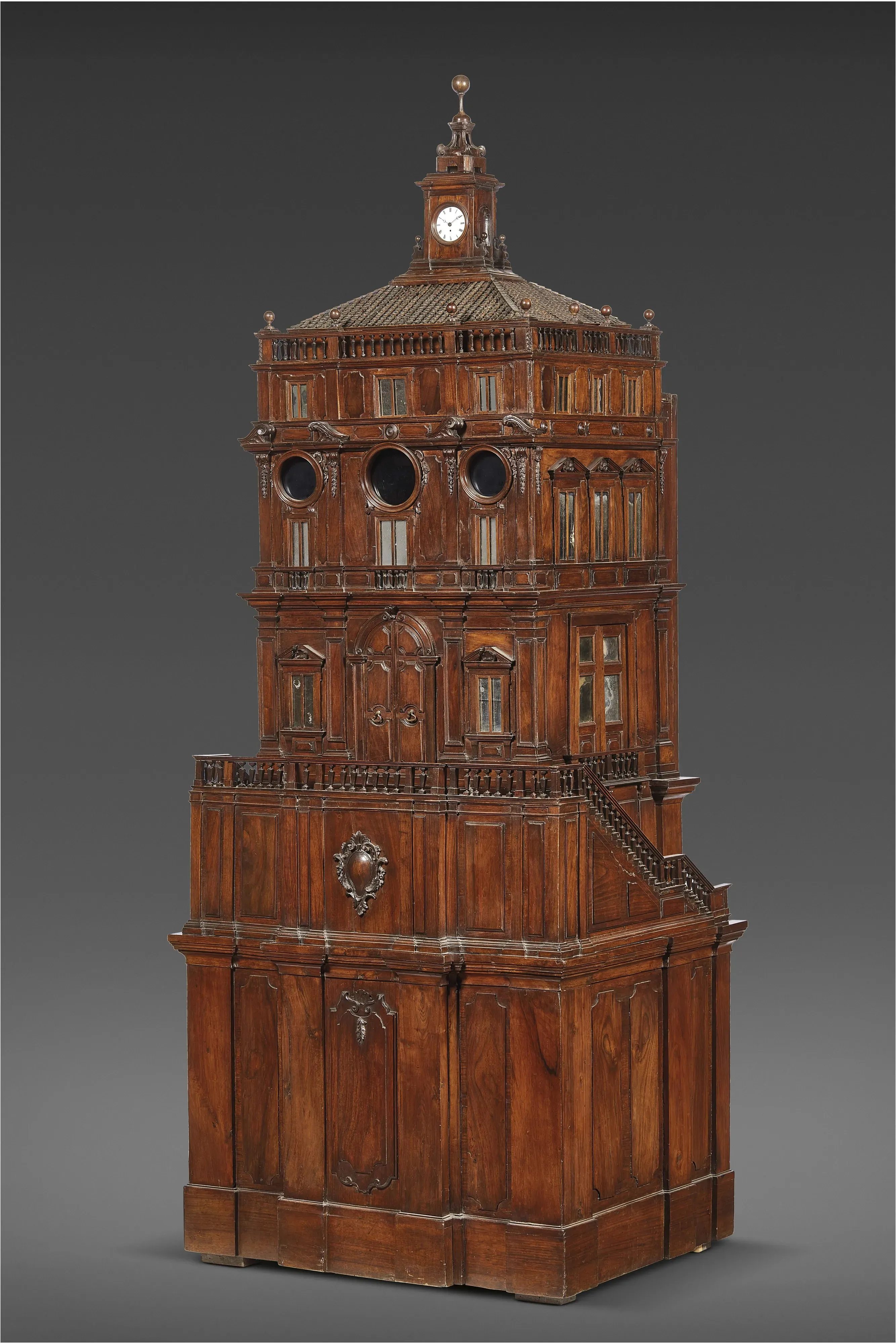 |
Figure 1000219483.1 – Friggeri Tower |
| Photo © Pandolfini Auction House. |
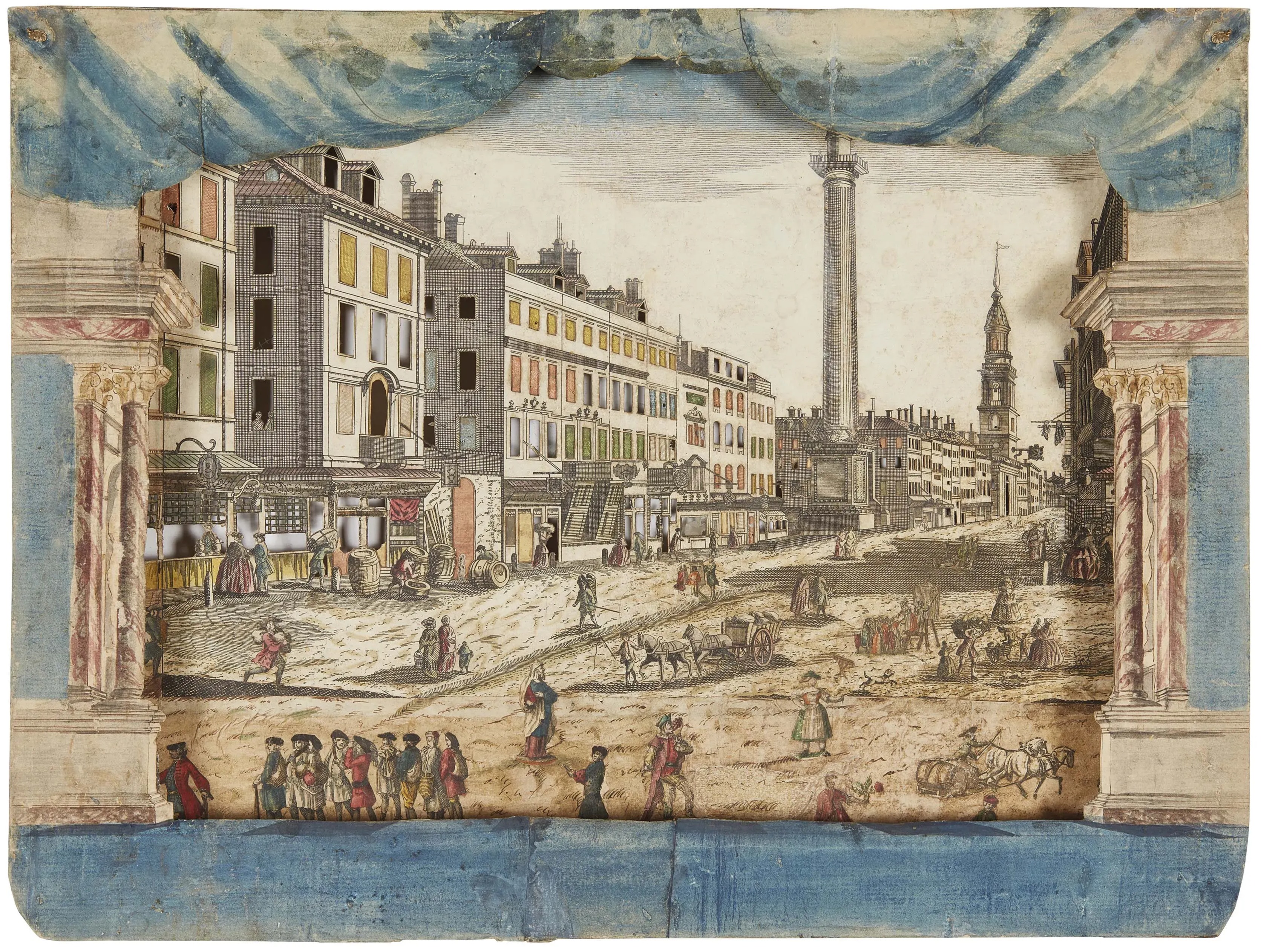 |
Figure 1000219483.2 – Vue d'optique |
| A pierced vue d'optique behind one of the coulisse-frames Photo © Pandolfini Auction House. |
This is an unusually ornate "optical machine " whose three biconvex lenses are meant to enhances the 3D effect of pierced vues d'optique. It is included in the Optical Machine Taxonomy.
Like many Raree Shows, its views, 10 of them on wooden frames, are attached to rigging so they can be raised and lowered from below the "stage." It is unusual in having a lower fly with a unique internal mechanism.
There are candle-holders, with rotating reflectors, behind the wings of the stage for front-illumination.[xxx] The back of the stage-area has doors that can be opened for back-illumination of the prints.
The stage is framed by four coulisse-frames. Images of beam and truss structure, reminiscent of Diderot and D'Alembert's "Machines de théâtre," are pasted inside the back compartment.[xxx]. This was an invocation of theatrical machinery for the "showman" (or woman), likely a member of the aristocratic Friggeri family, who operated that machinery. Given the 18th-century idea of the theatre as world-making, it would have been thought fitting for a young aristocrat to play that role.
While the device has the structure of a show-box, its opulent decor and ownership make it certain that it was never used as street entertainment. It is evidence both of the value that the elite placed on such devices in the 18th century and of the uses of multi-lensed optical machines as indoor entertainment presumably for select guests of the owner. See also the Dolfini Teatro Rotondo for a box of similar status.
The following is a crude Google translation of the Pandolfini Auction House description of the box's decorative form:
| "Architecturally designed to resemble a three-story building, the work is crowned by a lantern with a clock and rests on an architectural base with a double balustraded staircase supporting the elegant central wooden cabinet, where the projection took place.
| ||
| "The body of the latter is divided into three levels: the first, from the veranda, which leads to the central door flanked by three elegant windows surmounted by broken-line pediments; the second, ...is where the three eyepieces are located above the three windows and embellished with elegant volute friezes; finally, a third level with a balustrade and spherical elements running along the entire perimeter, crowned by a clock embellished with a small lantern at the top. |
Before being auctioned in 2022, the box was owned by Countess Maria Rizzoli Friggeri of Perugia, and adorned the Palazzo Friggeri. If anyone knows of its current whereabouts and how we might examine it, please contact us.
Here is a list of the vues d'optique that came with the device:
| • Christopher Wren, A Street in London with the Memorial of the Great Fire of 1666 | ||
| • ca. 1760, La Vue de la Grand Allée du Jardin de Vauxhall prise de l’Entrée | ||
| • German print, The Piazza di San Marco in Venice, circa 1770, engraving by Johann Jakob Stelzer | ||
| • The Square of Rennes | ||
| • 18th-century French print, The Vatican Library in Rome | ||
| • French print dated 1761-1780, Prospectus Pontis Rivoalti et Pricerum Venetiarum | ||
| • Circa 1770, Interior of Westminster Abbey | ||
| • Paris, circa 1770, VIEW OF SEVILLE | ||
| • Circa 1770, Rare Optical View of Corso Po in Turin | ||
| • Circa 1760, Prospectus Caesarei Palatii in Suburbio/ vulgo Favorita |
Endnotes:
[xxx] The number is from the "Catalogo generale dei Beni culturali cod. 1000219483."
[xxx] In one of the Pandolfini Auction House photos, they have the candles behind the view, but this would put the print too close to the lenses and offer no means of front-illumination.
[xxx] Encyclopédie ou Dictionnaire raisonné des sciences, des arts et des métiers, vol. 10 (plates). Paris, 1765.