Rod Bantjes, “EXBD-69054_Thames_Tunnel.html,” created 23 July, 2026; last modified, 29 July, 2026. (https://people.stfx.ca/rbantjes/).
Thames Tunnel
Bill Douglas Cinema Museum[1] #EXBD-69054
England, ca. 1840s
Dimensions Box: H=23.9 cm; W=23.8 cm; D=24 cm (excluding lens)
Collapsed Box (minus image-plate): H=4.7 cm; W=23.8 cm; D=24 cm
Lens: ⌀=3.2 cm, ƒ=36 cm
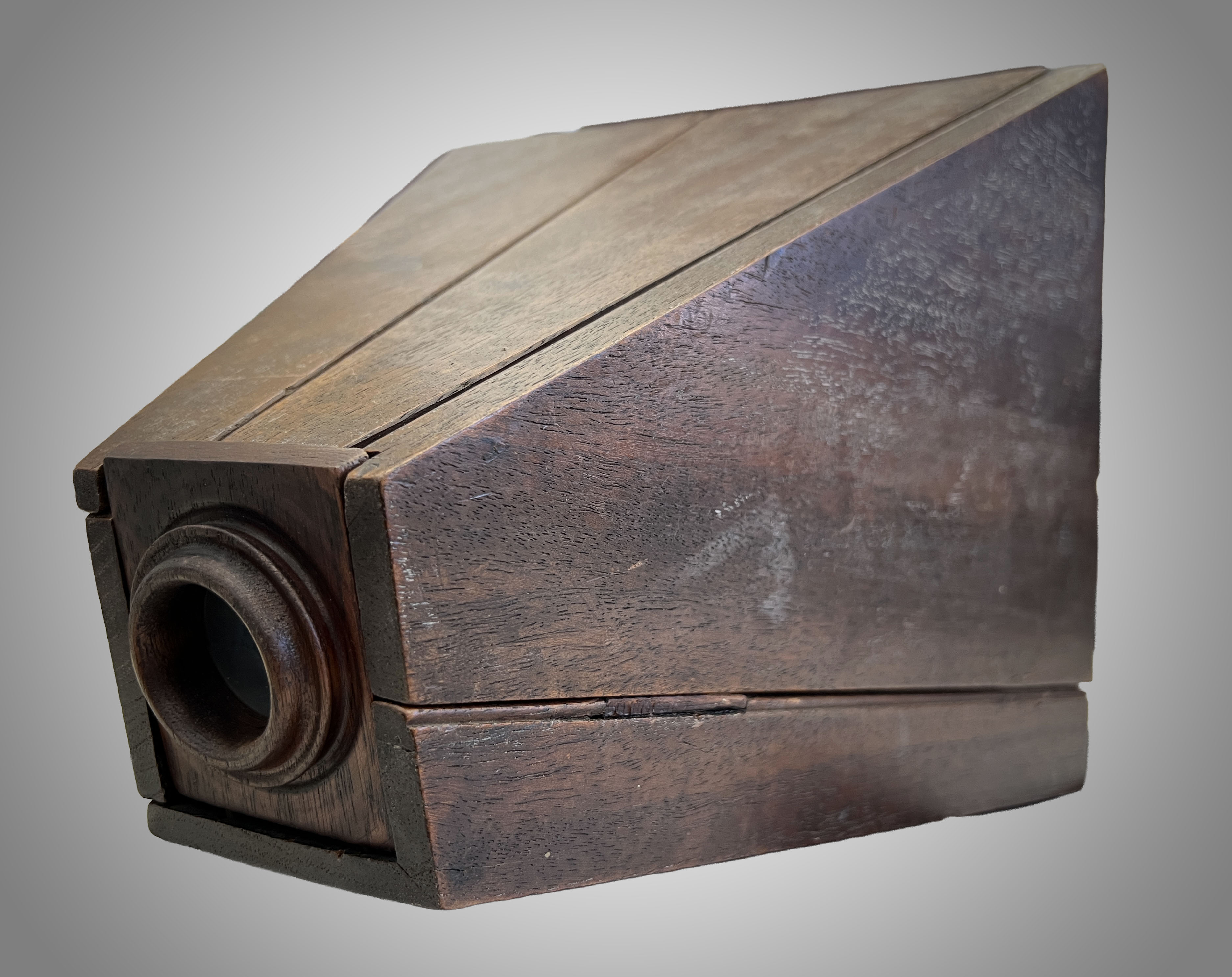 |
Figure EXBD-69054.1 –Thames Tunnel |
| Photo © Rod Bantjes. |
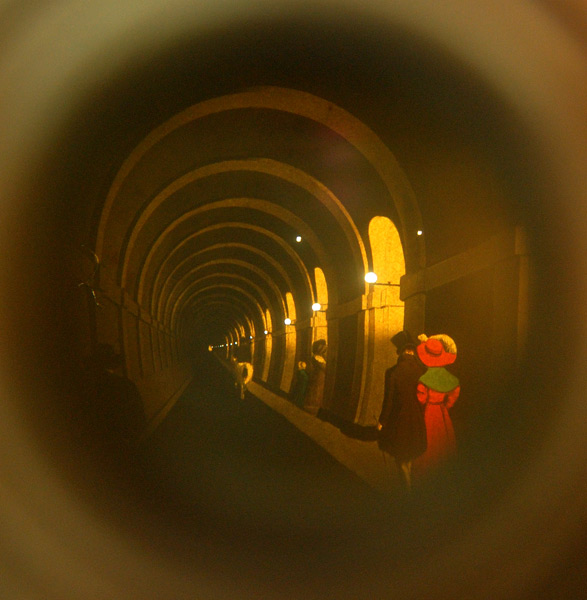 |
Figure EXBD-69054.2 – Thames Tunnel Image |
| Photo © Rod Bantjes. |
This is a portable, collapsible peepshow for viewing translucent images. It is an example of an “optical machine ” and is included in the Optical Machine Taxonomy.
The biconvex lens fitted to the small end of the box was meant to enhance the realism of the view by increasing the illusion of distance and therefore size of the depicted scene.[xxx]
The backplate is a variant of a paper diorama – an image-format popular in this period. It consists of a translucent image glued to a wooden frame backed by transparent tissue and then a sheet of glass. The image, of the Thames Tunnel, an engineering marvel of 1843, is pierced so that the gas lamps lining the tunnel appear to glow brightly. The back of the image would have been painted to create additional shading and illumination effects – such as the illuminated alcoves (Figure 69054.2). The image-frame was held in place by 4 latches. It is possible that different views could have been obtained for the box. It might in other words be more than a Thames Tunnel souvenir.
This viewer is similar in structure and use to the Lorgnette Pittoresque of the same period. Both need to be hand-held and the back surface pointed toward a light source (like a Brewster stereoscope). You look into the narrow end of a pyramid in the case of the Thames Tunnel viewer, and into the narrow end of a cone in the case of the Lorgnette Pittoresque.
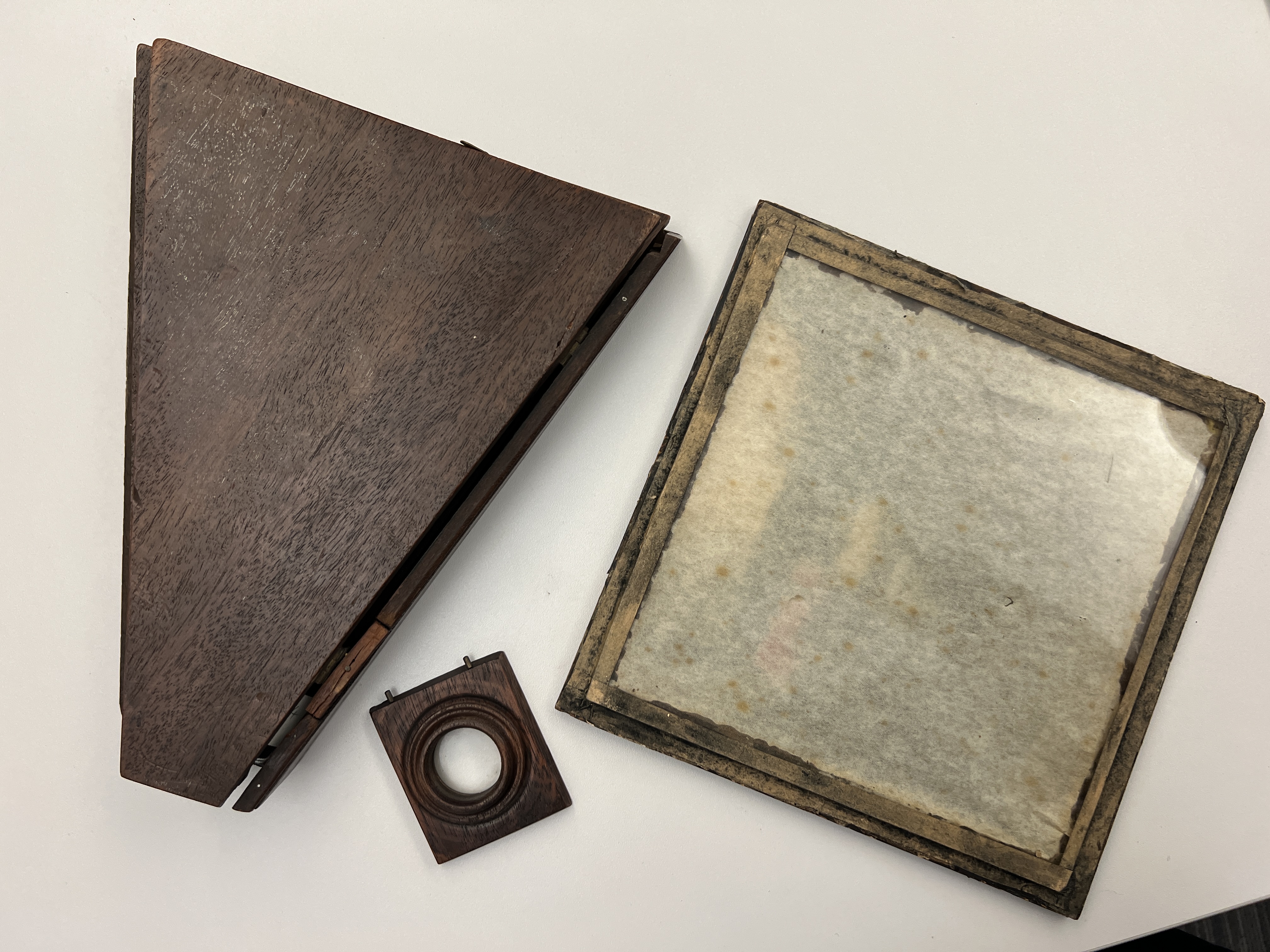 |
Figure EXBD-69054.3 –Thames Tunnel Collapsed |
| Photo © Rod Bantjes. |
Once the image-plate is removed, and the lens drawn out of its slot, the hinged sides fold in such a way that the box can be rolled flat for storage or transport. Despite this ingenious form of collapsibility, the device is far heavier and more cumbersome than the delicate Lorgnette.
Endnotes:
[1] I would like to thank the Bill Douglas Museum for a stipend that supported my research there and the staff of the museum for their generous assistance.
[xxx] Unlike the lenses of 18th-century optical boxes which are large enough to see through with both eyes, this one can accommodate one eye only. Period explanations for how a monocular lens could enhance the illusion of depth are fascinatingly confused. For a discussion of this confusion and what we can learn from it see Rod Bantjes, “The Mysterious Focus of the Eye,” created 30 December, 2024; last modified, 1 January, 2025 (https://people.stfx.ca/rbantjes/Optical_Devices/Principles/Focus_Theory_of.html).