Rod Bantjes, “Genus_Outdoor_Cosmorama.html,” created 29 August, 2026; last modified, 29 August, 2026(https://people.stfx.ca/rbantjes/).
Outdoor Cosmorama Genus (ca. 1830 - 1903)
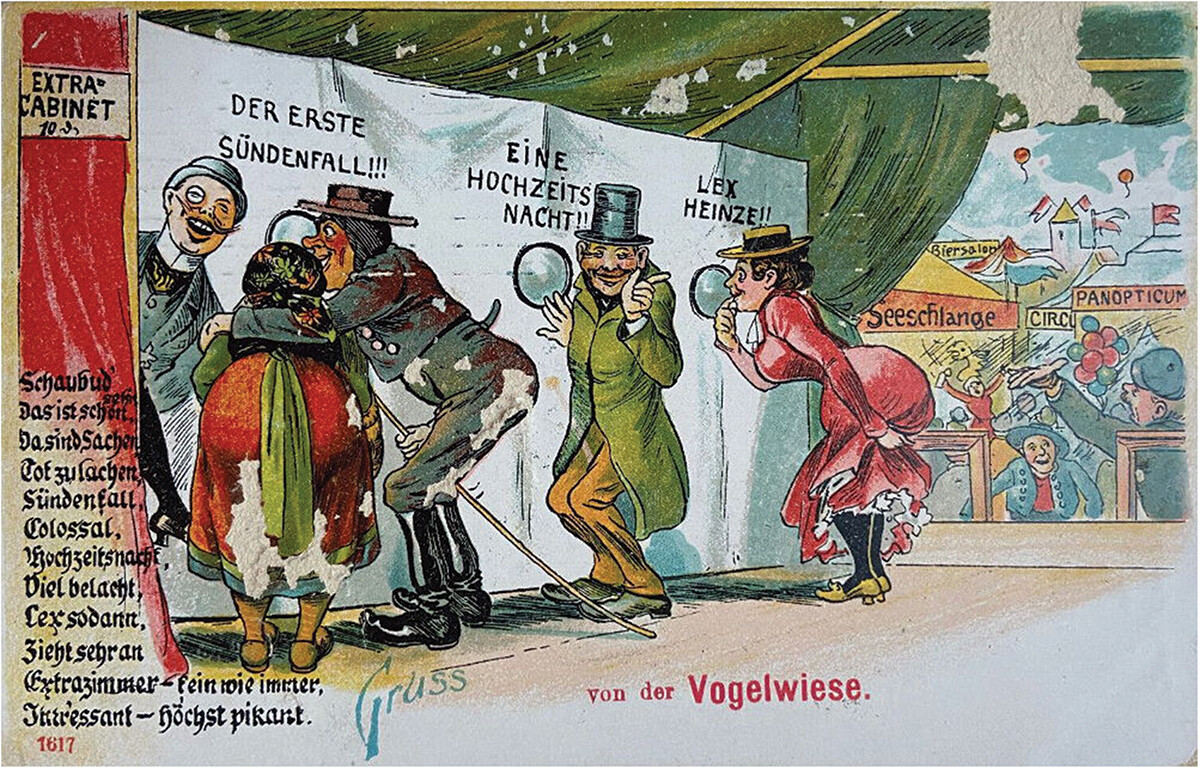 |
Figure OCG.1 – Outdoor Cosmorama at a Fairground |
| Source: Fairground Cosmorama, 1903, Postcard, Collection of Stefan Nagel: Schaubuden.de. |
The Outdoor Cosmorama is a simultaneous display of multiple images, each enhanced by convex lenses. It is distinguished from the Indoor Cosmorama by not being housed in a permanent building. It is an example of an “optical machine” and is included in the Optical Machine Taxonomy as a member of the Cosmorama family.
These were touring amusements set up in temporary buildings, tents or unhoused in the street. Their itinerant, temporary nature marks a step down in prestige from the Indoor Cosmoramas often housed in elegantly appointed quarters in fashionable neighbourhoods and making claim to the status of high-art galleries. The cosmorama depicted in Figure OCG.1 is clearly a down-market version, not only in its surroundings, but also in the salacious content on offer. The three views are labelled “The Fall of Man” implying surrender to sexual temptation, “Wedding Night” and “Lex Heinze” which is a reference to a German anti-obscenity law. Whether or not erotic images were actually shown at German fairgrounds in 1903, the caricaturist is implying that the delights on display are of a merely bodily kind – they carry the stigma of mechanical art.
For ease of transport these displays were often made of light-weight materials. ...the temporary,throw-away illusions of the stage
List of Species
Each row in the following table represents a different species:
| Fabric Cosmorama: | 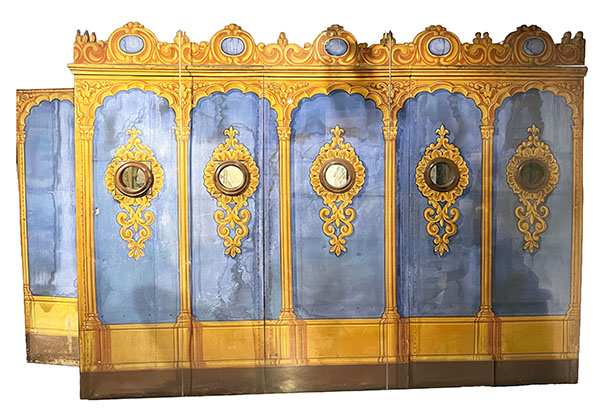 |
 |
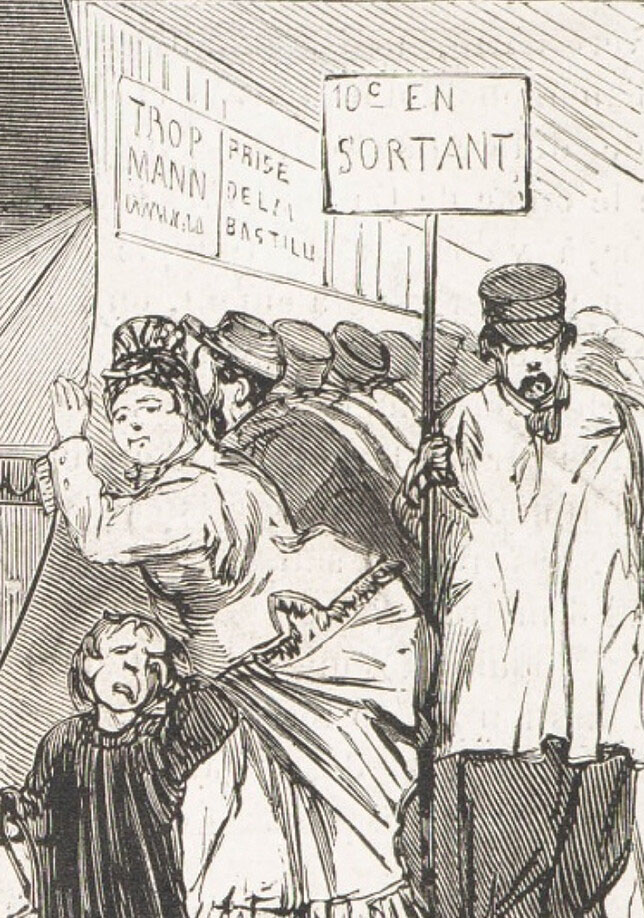 |
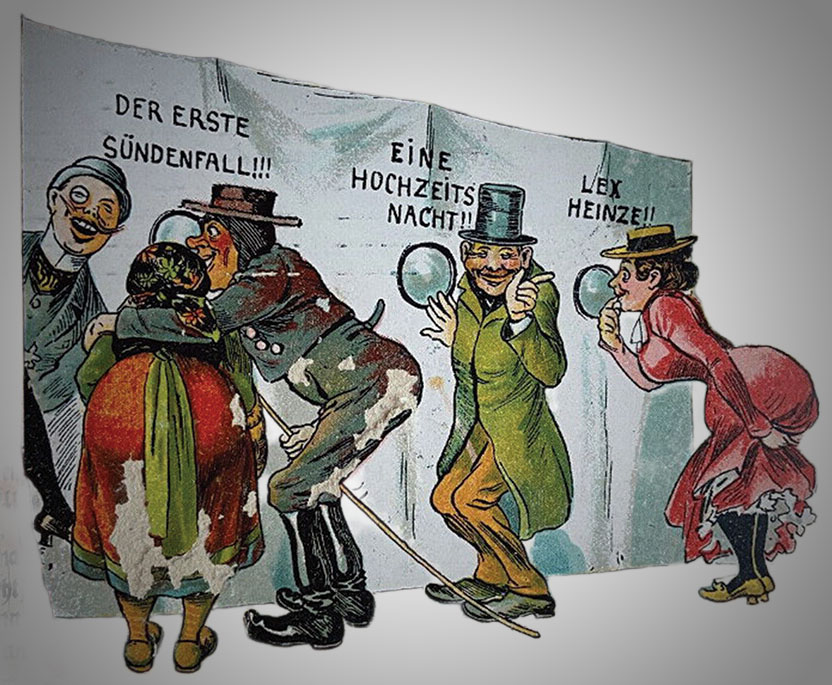
| Girona Cosmorama | German Tent | French Tent |
These were touring outdoor cosmoramas with viewing-walls made, like stage-flats, from fabric on wood frames . They were probably mostly set up within circus tents.
The Girona Cosmorama exhibited vues d'optique. Others may have exhibited paintings, in which case they would be a separate species.
| Kinder Cosmorama: | 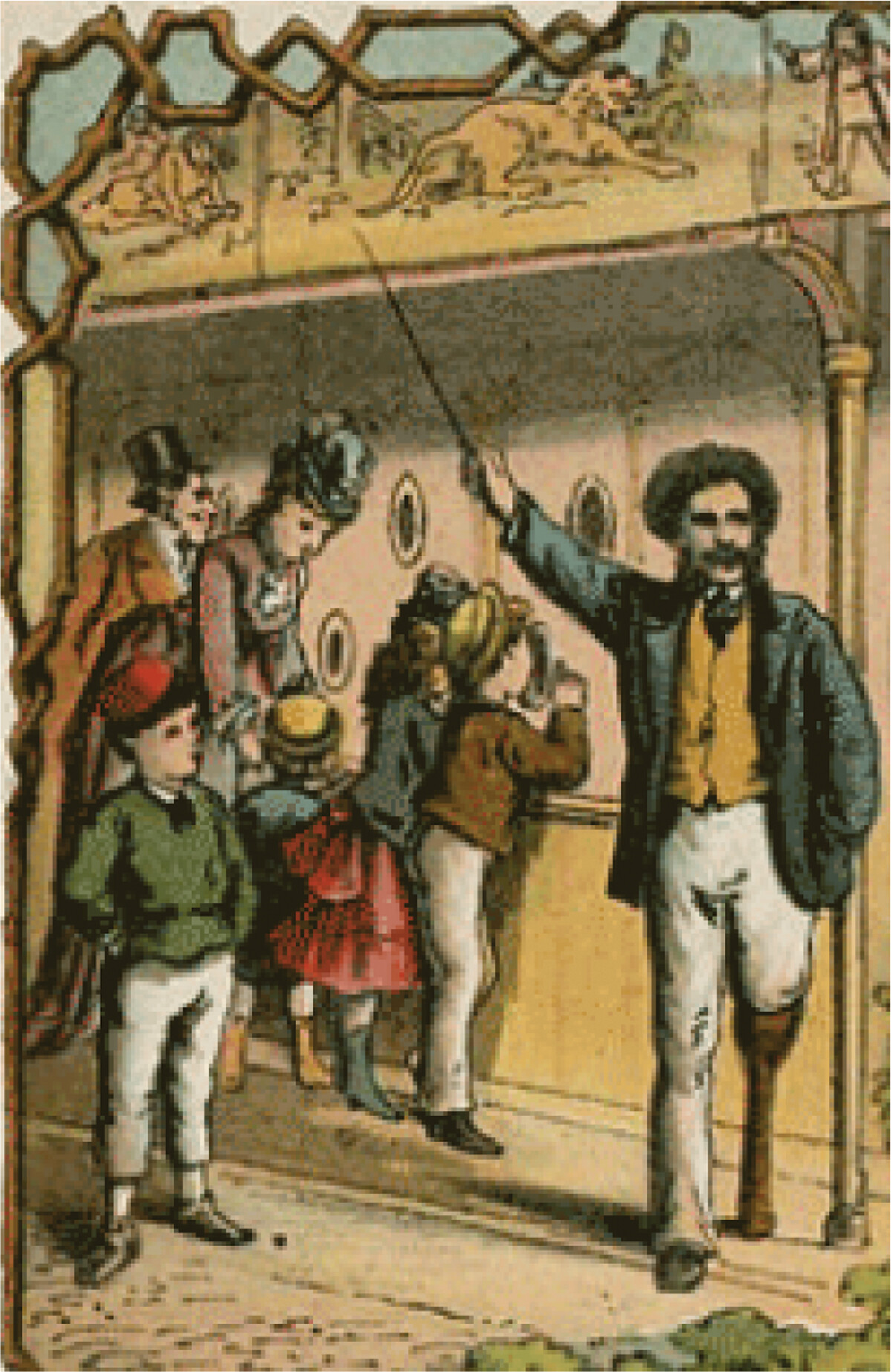 |
| Korporaal Smit |
This is an outdoor cosmorama housed in a tent. Its fictional proprietor, Korporaal Smit, was previously a Raree Show man who in 1877 had gone up-market. What marks his device as a cosmorama rather than raree show is the wide distance between the furthest left and right lenses and the fact that, like the Girona Cosmorama, the lenses occupy sections painted on the viewing-wall. What makes it a separate species from Fabric Cosmoramas is the line of lower lenses for children..
| Temporary Building: |  |
| No Image |
Hubert Sattler's touring Cosmorama (1840-1870) consisted of large paintings (H=100 x W=130 cm) and “a specially made temporary building” to house them in.[xxx]
| Van Cosmorama: | |
| No Image |
Hutchinson’s Fine Art Exhibition was described in 1861 as “Twenty-five glasses around a Van.” [xxx] It probably looked something like a Russian Raek, although longer. The viewers would have stood outside the structure looking in – the reverse of the room-style cosmorama. The number of lenses suggests that numerous images must have been viewed simultaneously, so it was not a large Raree Show. The pretentious name also suggests a cosmorama.
Endnotes:
[xxx] According to https://artvee.com/, Hubert Sattler “ exhibited his cosmoramas in many countries including in North America, travelling with a specially made temporary building.” Presumably, these were the same tours between 1840 and 1870 during which he painted many of the views that he incorporated into the cosmorama (Victor Flores. "Hubert Sattler's Cosmorama." In Cosmorama: The Forgotten Medium, edited by Victor Flores and Susana S.Martins. Lisbon: CICANT, 2025, p. 74). Travelling with large-scale paintings and a temporary building was a feat inspired by accompanying his father, Johann Michael Sattler, who toured his panorama of Salzburg throughout Europe between ca. 1829 and 1839. “ With 30 tons and crossing approximately 30,000 kilometres of land and water,” Sattler senior boasted, this was “a feat no one had ever done before me and one which would be difficult to repeat in the future.” (from Comment, The Panorama cited by https://en.wikipedia.org/wiki/Johann_Michael_Sattler) The main conveyance for the tons of canvas that made up the panorama was a canal-barge – a 19th-century innovation for efficiently transporting heavy cargo long distances (https://www.meisterdrucke.uk/artist/Hubert-Sattler.html).
[xxx] Plunkett, John. 2026. “Cosmoramas, Immersive Viewing and the Evolution of Peep Practice.” Early Popular Visual Culture, August, 18.