Rod Bantjes, “Genus_Pedestal-Graphoscope.html,” created 19 April, 2026; last modified, 19 April, 2026 (https://people.stfx.ca/rbantjes/).
Pedestal-Graphoscope Genus (ca. 1879 - 1886)
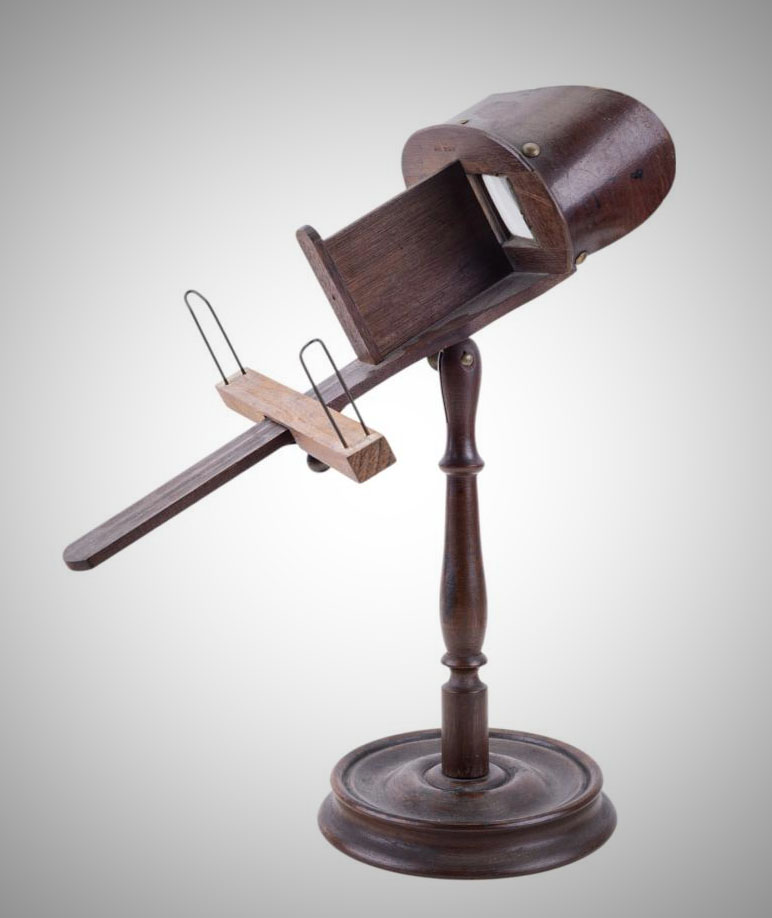 |
Figure PG.1 – Pedestal Stereoscope |
| This is not a Pedestal-Graphoscope, but was probably the inspiration for its design. Photo © invaluable. |
The Pedestal-Graphoscope is a large-lens, short-focal-length viewer that is supposed to enhance the depth-effect of 19th-century photographic formats such as the carte de visite. It is a genus of "optical machine" within the Optical Machine Taxonomy.
The original graphoscope, patented by Charles John Rowsell in 1864, integrated a pair of Stereoscope lenses with the graphoscope lens. At what point manufacturers decided that the graphoscope lens could be marketed as a stand-alone is uncertain. The two dates we have for these pedestal versions are 1879 and 1886.
Rowsell's design had a rectangular base or pediment and his inspiration for the stereoscope elements was the English Brewster-style stereoscope. American designers used the lighter, more skeletal Holmes stereoscope as their inspiration. These frequently came with table-top supports which were invariably pedestal-style: a slender turned column on a wide turned base (Figure PG.1). I suspect that the Pedestal-Graphoscope was designed by way of the Pedestal-Stereo-Graphoscope. If so, then the Mono-Graphoscope version was a kind of afterthought. No surviving examples, other than the illustrations below, have come to my notice.
Defining Features: The defining features of the Pedestal-Graphoscope are:
| • A single, large lens (⌀>8 cm, ƒ<40 cm) with the unique features described under the Graphoscope Family | ||
| • A pedestal-style base | ||
| • An adjustable armature supporting the lens and image-plate |
Each row in the following table represents a different species of Pedestal-Graphoscope.
| Anderson Krum: | 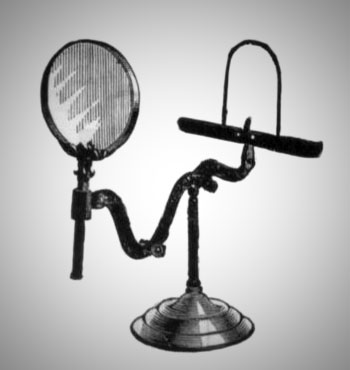 |
| [Future] Link |
This graphoscope is from an 1886 advertisement Anderson Krum's devices. It has an articulated armature that allows the distance between lens and image-plate to be adjusted. The device is made of nickel-plated steel.
| Pattberg: | 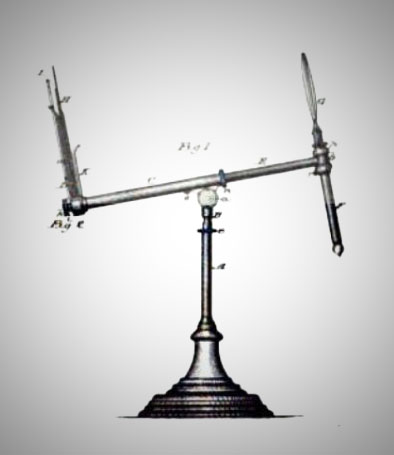 |
| [Future] Link |
This is an illustration from a patent application made by H. Pattberg in 1879. It has a telescoping armature that tilts.
We do not know if it was ever manufactured for sale.