Rod Bantjes, “Miniaturization.html,” created 12 June, 2025; last modified, 21 June, 2025 (https://people.stfx.ca/rbantjes/).
The Optical Machine: Miniaturization, Portability, Privatization
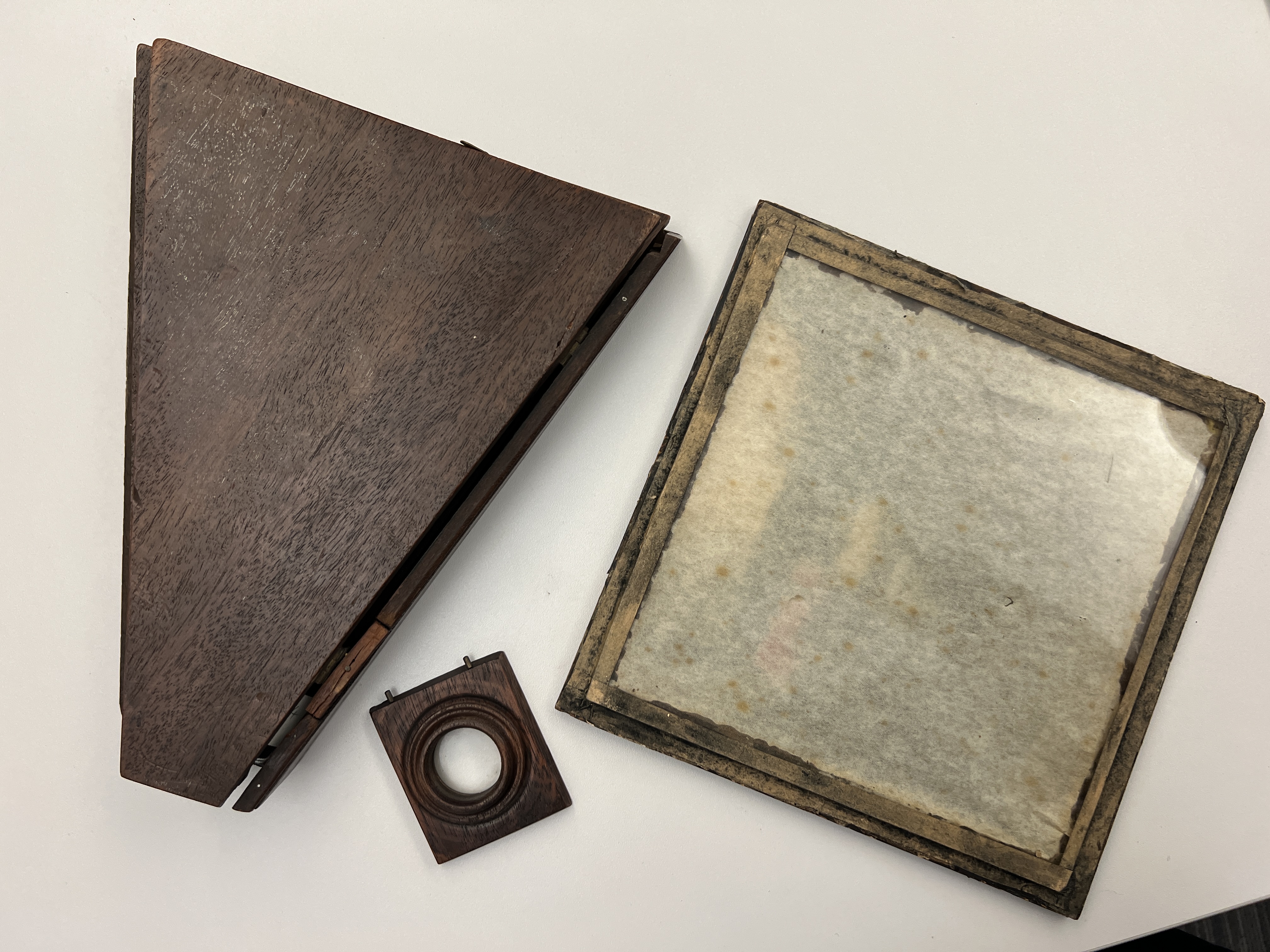 |
Figure MPP.1 – Collapsed Optical Viewer |
| Thames Tunnel viewer (#EXBD-69054).
Image © Rod Bantjes, 2025. |
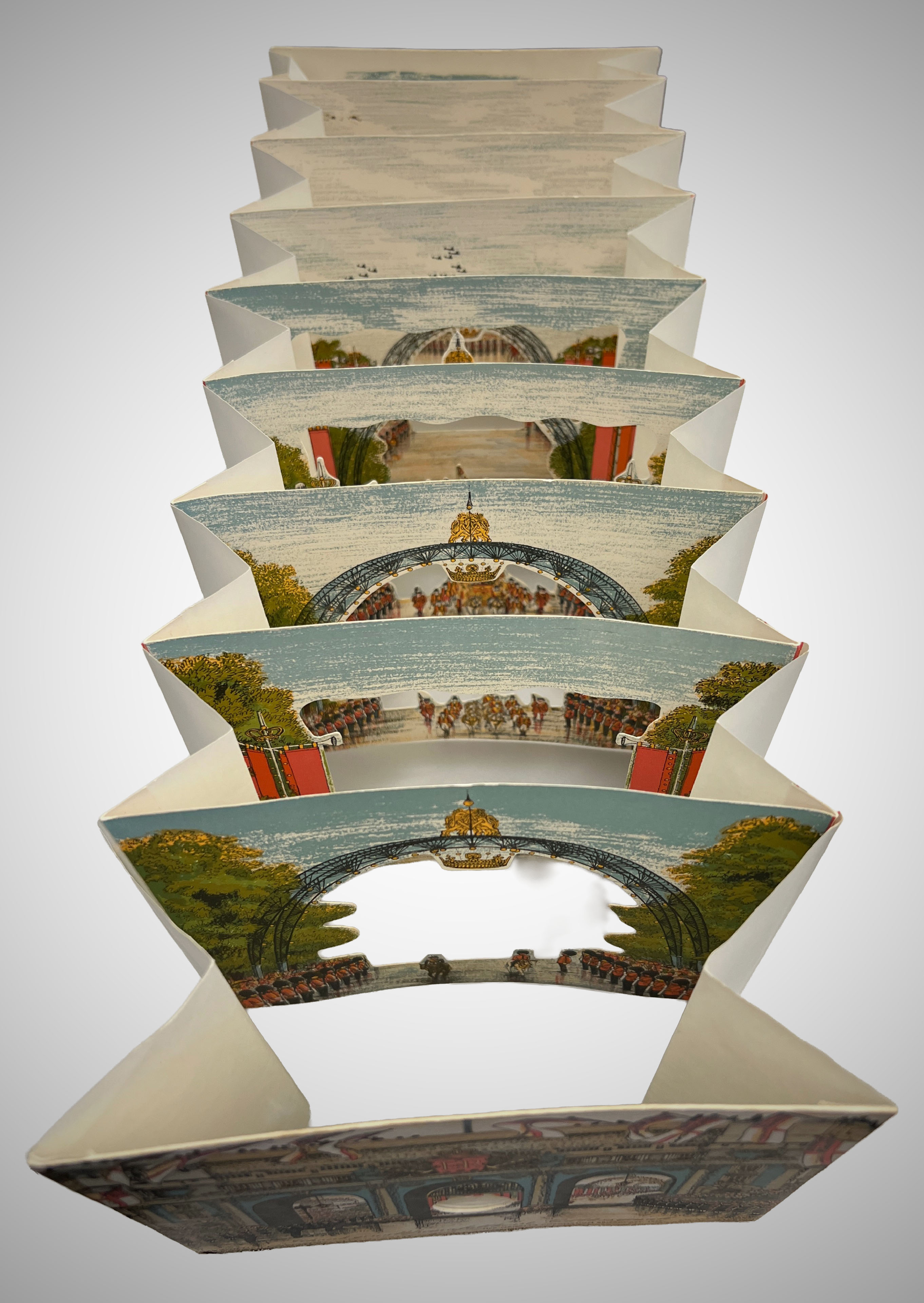 |
Figure MPP.2 – Collapsible Paper Theatre |
| Tim's Telescopic View (#EXBD-69415).
Image © Rod Bantjes, 2025. |
One thing I did not expect before I came to the Bill Douglas Cinema Museum to study old 3D viewers was how many of them were collapsible. There is the Thames Tunnel viewer (#EXBD-69054) which folds up flat, as you can see in Figure MPP.1. Even though it is a large pyramid made of wood, the maker has ingeniously hinged its sides so that it rolls up. The many paper theatres in the collection fold, accordion-like, as flat as can be (figure MPP.2). I was also struck by the miniature viewers in the collection such as Henri Lefort’s ‘lorgnette pittoresque,’ the smallest ‘diorama’ ever made, and the charming little 'peep-eggs' that the Museum has so many of (e.g. #EXBD-69071). These are all devices from the mid-19th century.
Privatization:
I could not help wondering whether there had been a trend towards miniaturization, collapsibility and portability in the early 19th century. I suspected that one reason for such a trend might be that the large Show-boxes that had entertained crowds in the 18th century were replaced, as more people were able to afford them in the 19th century, by smaller devices that people could enjoy at home. This sort of privatization of 3D visual entertainments was possible for only a small elite in the 18th century. They could afford very expensive elegant optical boxes or else the simpler zograscope version (e.g. #EXBD-69075).
However, in the 19th century there was, on the one hand, a growing middle class in western Europe, better able to afford luxuries, and on the other hand, new forms of production enabling luxuries to be produced more cheaply. The lorgnette pittoresque is a good example. It is made of cheap material – tin – and very little of it. While no two 18th-century optical boxes were the same, the lorgnette pittoresque was standardized and could be made in multiples with all the cost-cutting that that makes possible. Its images are tiny colour lithographs – much cheaper to manufacture than the large, hand-tinted engravings (vues d'optique) of the optical box or zograscope.
Portability:
Portability was a feature of 18th-century devices. The zograscope was understood to be a more portable version of the optical box.[1] Show-boxes had shoulder straps so that wandering showmen could heave them up onto their backs and carry them from place to place.[2] Eighteenth-century Dutch versions of the show-box, called rarekieks, were collapsible to make them easier to store and carry. However, there is a difference between the portability of a show-box, close to a meter wide and weighing surely more than 40 pounds and a lorgnette pittoresque, weighing a few ounces and measuring 8 cm in width. The question, for making meaningful comparisons, is how portable, and how collapsible?
The Optical Machine Taxonomy:
| Private | Public | |||||
| Era | Avg. | No. | Avg. | No. | ||
| 1750-1819 | 44 | 16 | 39 | 3 | ||
| 1820-1860 | 21 | 20 | 163 | 2 | ||
| 1861-1899 | 23 | 6 | 213 | 1 | ||
| 1900-1920 | 15 | 3 | ||||
Table 1 – Image-Plate Size[3] | ||||||
| Binocular | Monocular | Total | |||
| No. | % | No. | % | No. | |
| 1750-1819 | 19 | 95% | 1 | 5% | 20 |
| 1820-1860 | 8 | 38% | 13 | 62% | 21 |
| 1861-1899 | 5 | 100% | 0 | 0% | 5 |
| 1900-1920 | 3 | 100% | 0 | 0% | 3 |
| post-1920 | 0 | 0% | 2 | 100% | 2 |
| Total | 35 | 69% | 16 | 31% | 51[5] |
Table 2 – Lens: Binocular vs Monocular | |||||
I was in the Bill Douglas Museum to collect data for a taxonomy of a particular type of 3D device that uses either a convex lens or a concave mirror to enhance the spatial illusion of images. These devices were in use for 300 years and were very diverse in form.[4] That diversity is so great that it is hard to come up with a term that encompasses all of them – I will make do with an 18th-century term, 'the optical machine.' The taxonomy is meant to help map the relationships between all of the variants of the optical machine. My colleague Ana David and I have been noting key characteristics of each device and recording them in a database. That database should be able to help answer my questions about portability, collapsibility and miniaturization.
Except, alas, we were thinking about form rather than size when we built the database. We should have included fields to record outside dimensions when in use and outside dimensions when collapsed (if collapsible). I have added those now, plus a field that calculates an index of collapsibility. So, for example a rarekiek collapsed down to about 30% of its original volume; an early 20th-century Reflectoscope collapsed down further (11%) and a paper theatre nearly vanished at 4% of its expanded form. I would need more cases than these, however, before I could chart trends with any confidence.
The database offers alternate ways to measure miniaturization. One is by the size of the image that each device was designed for. When I separate the boxes meant for public exhibition from those meant for private use, an interesting pattern emerges. The private boxes undergo miniaturization in the early 19th century, just as I suspected; but the public boxes grow larger (Table 1, note the average width not the number of cases). One of the pleasures of research is these serendipitous discoveries: the growing size of public boxes was a surprise I was not looking for and something I will attempt to explain shortly. First I want to pursue how early 19th-century miniaturization got in the way of 3D technology.
From Binocular to Monocular 3D:
Table 2 reveals another striking trend: a decrease in lens diameter. Eighteenth-century optical theorists insisted that the lenses of 3D viewers should be wide enough to accommodate both eyes.[6] The 3D effect works best that way. If you want to understand why, check out this explanation (with animated illustrations). They also recommended that the print be the focal-length’s distance from the lens and that the focal length be long: 61 – 66 cm.[7] Eighteenth-century theory demanded a large device.
In the early 19th century, this advice seems to have been forgotten in the interests of miniaturization. Boites d’optique, polyoramas panoptique and lorgnette pittoresque all start to use lenses smaller than 6 cm in diameter – too small for both eyes. Before 1819 only 5% of boxes are monocular, but in the early 19th century (1820-1860) 62% are (Table 2). A monocular lens can have a similar effect to a binocular one, but a much weaker, some might say an imperceptible one. Click to see an animation of how the lens affects the focus of the eye and could slightly alter our perception of the distance of depicted objects. When optical boxes shifted from binocular to monocular they became easier to miniaturize and privatize, but their 3D illusion became weaker.
Changing Function of the Convex Lens:
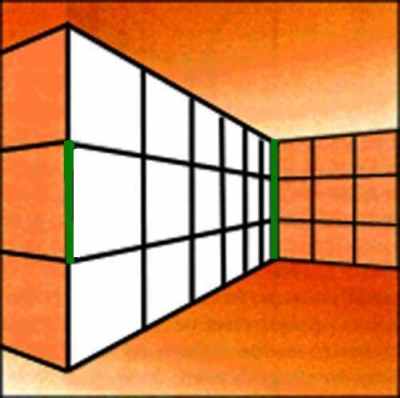 |
Figure MPP.3 –Perspective Illusion |
| The two green lines are identical in length, but the one that perspective tells us is further away appears larger.
Source: http://brainden.com/visual-illusions.htm. |
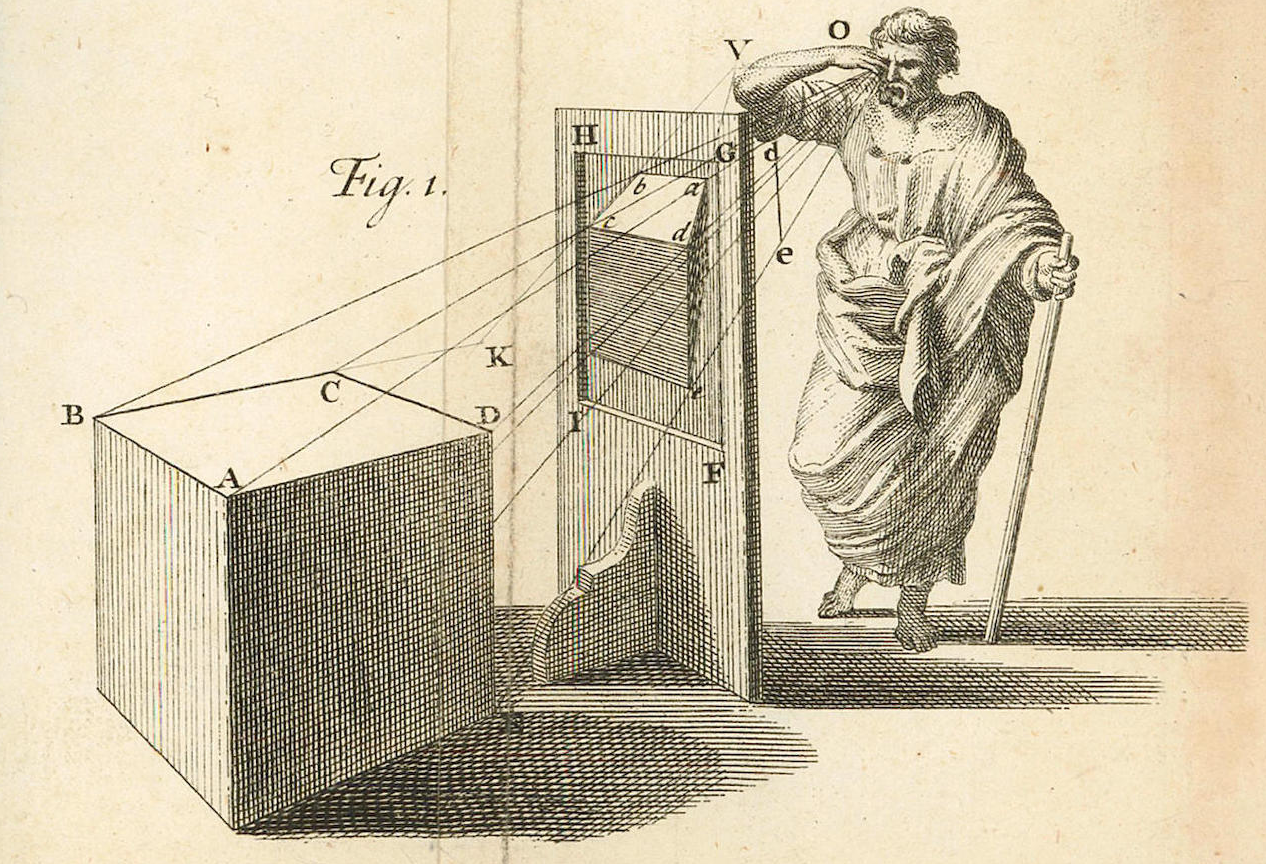 |
Figure MPP.4 –The Visual Cone |
| A perspective picture is any slice of the visual cone.
Source: Taylor, Brook. 1719. New Principles of Linear Perspective. London: printed for R. Knaplock. |
There seems also to have been growing confusion over what a convex lens does to our perception of a picture.[8] One of the 18th-century authorities on these devices, Joseph Harris, had explained it this way: 'Now the refracted rays being [made] nearly parallel [by the lens], they affect the sight thus far as if they came from a remote object; …[this] causes ... the images [to] appear a great way off, and consequently to appear proportionably large.'[9] You can see what he means by looking at the perspective illusion in figure MPP.3. Perspective cues tell us that the green line on the right is further away. Even though we know that it is the same size as the green line on the left we can't help perceiving it as larger. The lens in an optical box makes things depicted in pictures seem farther away by changing the angle of convergence of the eyes. At the same time it makes them seem larger. Eighteenth-century observers thought that depicted scenes in this way appeared life-sized.
By contrast, Pierre de Valenciennes in 1800 describes the lens-effect in this way: 'An optical view is a painting painted in gouache or watercolour, which is viewed through a convex glass which, by its ability to magnify objects, produces the illusion of Nature.'[10] True, a convex lens is a magnifying glass. But its power of magnification is not what creates either the 3D effect or the illusion of a life-sized scene.
If we consider only the magnification of the piece of paper on which the image is printed, then what we see through the lens is a slightly enlarged picture. If it conforms to the rules of linear perspective, a small picture – the depicted cube in figure MPP.4 for example – will project an image on the observer's retina that is identical in size to the image projected by the depicted reality – the actual cube in figure MPP.4. A perspective picture can be thought of as a slice of the visual cone – a larger slice if further away from the artist; a smaller slice if closer to her (see figure MPP.4). It should appear 'as large as life' if placed at the correct distance from the eye (a small picture will be close and a large picture will be distant). Taking a small picture and enlarging it with a lens would be pointless – better to simply place it at the correct distance from the eye.
If, on the other hand we consider magnification of any object represented in the image, a tree let’s say, then it will simply appear to be a representation of a tree that is larger, with its painterly imperfections magnified, not a tree that is any larger, smaller, more distant or closer than without the lens.
Magnification: Peep-Eggs and Stanhopes
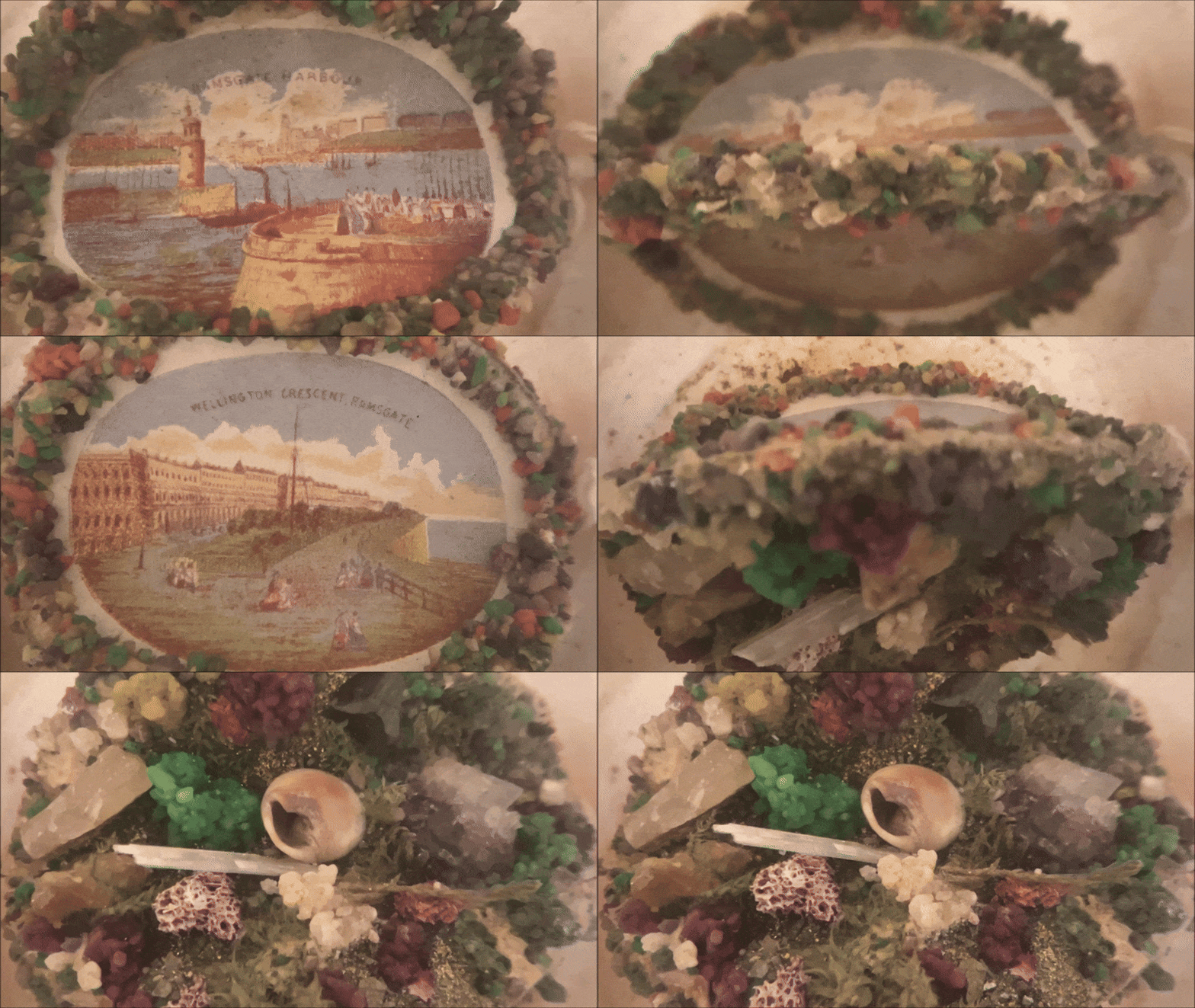 |
Figure MPP.5 – Peep-Egg |
| Views inside the Ramsgate peep-egg.
Gif image © Rod Bantjes, 2025. |
With progressive miniaturization of optical boxes, particularly where they pass the threshold of size where the lens no longer admits two eyes and therefore has a diminished 'distancing' effect, the lens takes on a new function of making the image easier to see.
The Bill Douglas Museum has a wonderful collection of 'peep-eggs.' I was curious to see them because in form at least they are similar to other viewing devices in our taxonomy. They contain hidden images that can be viewed only through a lens. They follow the rule that the distance between image-plate and lens should approximately equal the focal length of the lens. They have a mechanism to change views and a means of illuminating them within their enclosure.
However, when you look into a peep-egg, its depicted scenes do not seem 'large as life' nor do the objects in these scenes appear to be in the far distance. They instead appear like precious miniatures. All the lens does is make the tiny, poor-quality lithos easier to see. The peep-egg is at the limit of what should be included in our taxonomy. The little 'dioramas'[11] they contain, consisting of pebbles and tiny shells that evoke sea-bed dream-scapes, perhaps give them enough 3D credibility to admit them nonetheless (figure MPP.5).
The stanhope viewer though (e.g. #EXBD-69148), with a very similar form, takes miniaturization beyond the limit. The images in these devices are microscopic. An image-plate of about three square millimetres often contains multiple images. They are glued to the back of a high-powered lens the size of a bead. The lens makes them discernible but adds no 3D effect.
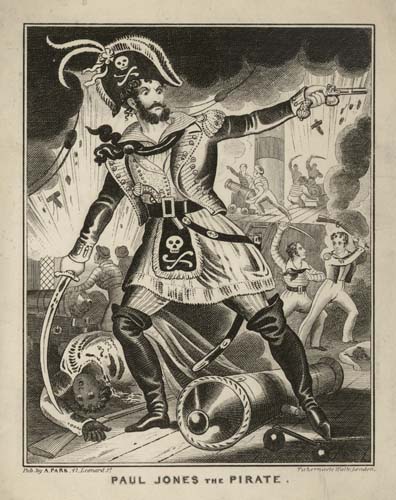 |
Figure MPP.6 – Paul Jones the Pirate |
| This print is 18.6 x 14.7 cm; whereas a typical vue d'optique was between 37 and 44 cm wide. Published in the early 19th century by A. Park, 47 Leonard St. Tabernacle Walk, London.
Source: The Old Print Shop, New York. |
There seems to have been a passion in the mid-19th century for privatization of viewing in a slightly different sense than I have used above. People delighted in secret access to private images in public. Stanhopes were hidden in everyday objects such as jewellery, pens and letter-openers, so that others would be unaware even that the user held a viewer.[12] The lorgnette pittoresque was recommended to women in the following terms: 'During the lengthy recitatives of our great opera singers, you can sneak away to Switzerland, Germany, or Saint-Petersburg, right in the middle of the Stemboch arcade'.[13]
Changes in Image-Making Technology
I want to return to the question of the growing size of optical machines meant for public performance (Table 1). The period between 1820 and 1860 was characterized both by changes in the the way that images were made and an increase in the availability of cheaply-reproduced images.[14] The old vues d'optique, hand-tinted copperplate engravings on laid paper, were replaced by wood engravings that appeared in illustrated magazines as well as by cheap lithographs, sold separately, or in folio form. Lithos also appeared in the new hand-held private optical boxes. The folio lithographs were typically smaller than vues d'optique and less suited to the show-box.[15]
Widely-available privately-consumed images offered competition to the show-box. New forms of public visual spectacle – the panorama, the diorama (1822) and the cosmorama – drew away the more well-heeled clientele. These were large-scale entertainments permanently housed in buildings. The Boites d’optique, polyoramas panoptique and lorgnette pittoresque were all miniature dioramas for the home – incorporating transparency and lighting effects modelled on the public shows. The cosmorama was an upscale variant of the peep-show with large-scale paintings in place of vues d'optique. It is included in our database and affects the numbers in Table 1. But the travelling showmen too switched to larger images, no doubt in response to the new competitive environment.[16]
Errki Huhtamo has noted that 19th-century descriptions of peep-show images do not match what we see in surviving vues d'optique.[17] In vue d'optique imagery, human figures take second place to architecture and public spaces. The scenes dispassionately surveyed are typical of the European grand tour with occasional stops in the Middle and far East. Nineteenth-century peep-show images are much more engaged with current events and notable people including murders and villains. Contemporary prints of the murder of Maria Martin or the famous pirate Paul Jones (figure MPP.6) were too small for the show-box, so showmen commissioned painters to produce, or reproduce, them in the needed sizes (about 2 feet or 61 cm wide).[18]
John Plunkett has discovered wonderful descriptions of these commissions as well as of do-it-yourself modifications to existing images. To depict a recent murder, he writes, 'a woman’s body cut from another picture was pasted onto a background scene. Her head was pasted onto the floor separately, “and with a plentiful supply of carmine for gore the trick was done”.'[19] These were clearly 'down-market' works of art that collectors ignored. After 1860 peepshows were in decline and only survived by seeking out obscure, rural markets far from the cultural mainstream. The few showmen who hung on suffered increasing poverty. No-one sought to preserve or collect their bulky, worn and abused boxes after their owners were gone and none are known to have survived. We therefore lack physical evidence of the size of the images for these 19th-century show-boxes.
After 1860 all the private optical machines switched from using prints to photographs. This new image-technology enabled a further shift in the form of the optical machine.
Return of the Binocular Speculum: Graphoscopes, Reflectoscopes and Megalethoscopes
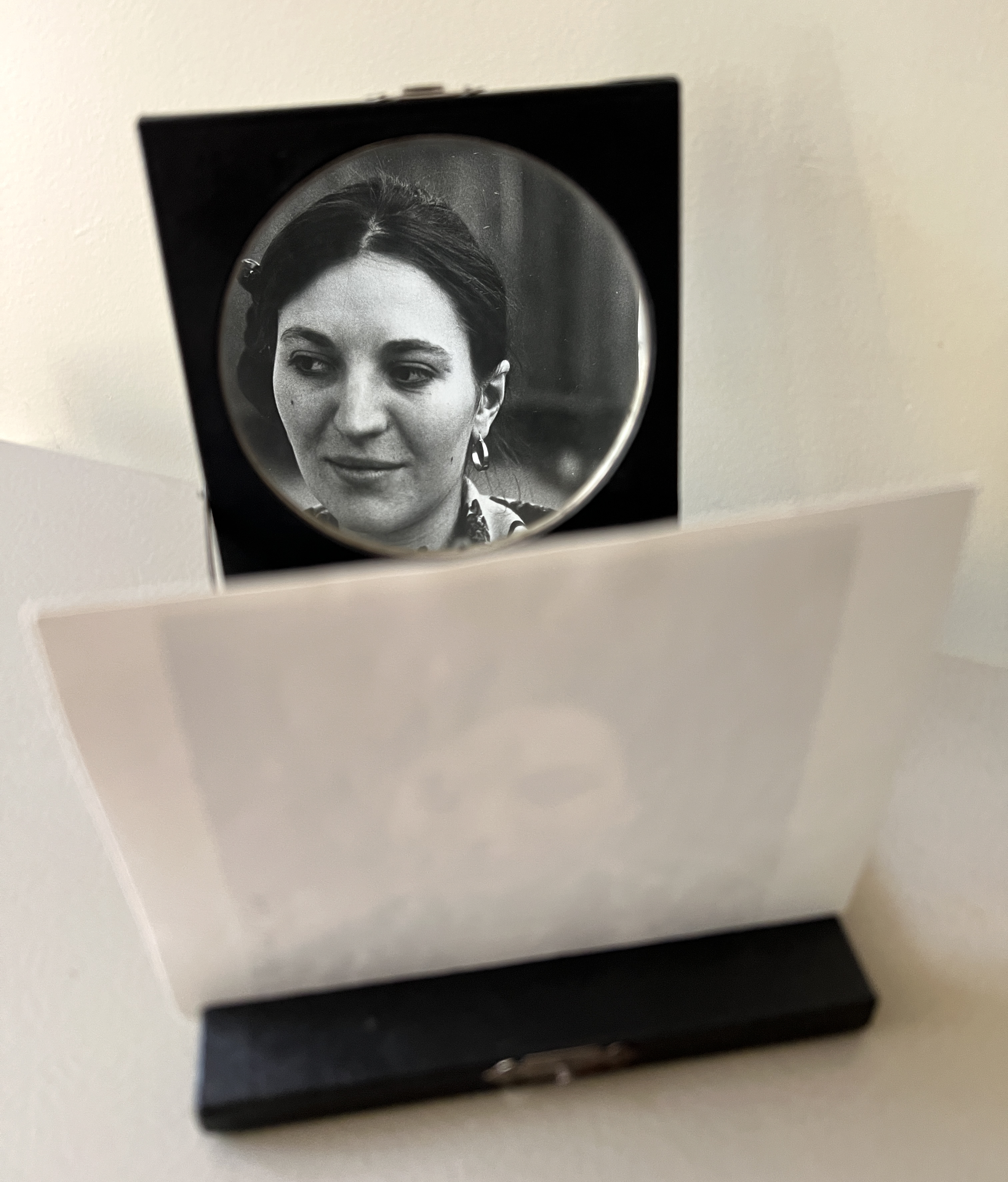 |
Figure MPP.7 –Shomescope |
| This is an American concave-mirror viewer for photographic snapshots, patented in 1913.
Image © Rod Bantjes, 2025. |
| Avg (cm) | |
| 1750-1819 | 74 |
| 1820-1860 | 55 |
| 1861-1899 | 33 |
| 1900-1920 | 21 |
Table 3 – Focal Length | |
If you refer back to Table 2 you will see that after 1860 all of the private devices shift to binocular lenses. The 1861 to 1899 devices include Carlo Ponti's megalethoscope and the popular French graphoscopes (e.g. #EXBD-69117). The 20th century devices are all variants of the Reflectoscope (including the Shomescope depicted in figure MPP.7). These use a concave mirror instead of a convex lens. The image is viewed in reflection, but the enhancement of depth is the same as with the lens.[20] Surviving concave mirrors are rare but they were often described in the 18th century. They almost completely vanished in the 19th century and then re-appeared in the 20th century as devices for viewing snapshots.
On average the mirrors and lenses of these later periods are at least twice as large as the monocular lenses of 1820 to 1860. While the lenses had become larger again, the focal lengths had become shorter – it was a very pronounced trend that you can see in Table 3: from 55 cm down to 21 cm. This means that the observer's eye was brought much closer to the image and the degree of magnification was greater.[21]
I suspect that what happened was that experience with photographic stereoviews showed makers that the unprecedented precision of photographic detail could bear very close scrutiny and magnification in a way that engravings and lithographs could not. The old 18th-century advice about large prints and long focal lengths no longer applied. The new devices could use small images and short distances between lens /mirror and image-plate. It now became possible to miniaturize the binocular technology.
The new devices were small and also collapsible. The common Souvenir de Paris graphoscope was 23 x 13 x 21 cm, and folded down to 18% of its original size. The mirror viewers, such as the Shomescope, were even smaller – 16 x 14 x 16 cm folding down to 15% of that size.
The trend toward miniaturization and collapsibility continued, and so too did the trend toward privatization. The snapshot, for which the 20th-century devices were intended, represented privatization in a further sense. Instead of great cities and public monuments, these were often images, taken by the user themselves, of the intimate world of family and friends.
Conclusion:
Between the 18th century and the 20th the privately-consumed optical machine underwent a process of miniaturization. Devices became both smaller and more portable. Over the same period, optical machines for public exhibition became larger in an effort to compete in a new environment saturated in images. After 1860 they were in decline and disappeared in Western Europe and North America.[22] The 20th-century shift from commercially-produced prints to photographic snapshots meant that the images for private-use devices became even more personal. Snapshots of the same public monuments, squares and famous buildings depicted in vues d'optique became more about one's individual encounter, as a tourist, with these sites.
The rise of the miniature private viewer was enabled by changes in social class structure, a gradual universialization of the values of individualism, changes in production processes, and technological innovations. The technical requirements of the 3D mechanism – the binocular convex lens /concave mirror – was unable to stall this trend. The brief shift toward the monocular lens enabled miniaturization at the expense of the optical machine's 3D pedigree. The invention of high-definition photographic images allowed both a return to binocular 3D technology as well as further miniaturization.
I doubt I would have been able to discern these historic patterns without access to the optical machines in the Bill Douglas collection. Museum websites do not record the kinds of measurements that I needed. Physical encounter with the devices was crucial. The physical presence of the objects helped me to attend to material qualities – their size, weight and collapsibility – that I had not previously recognized as relevant. It was also essential for me to assess the visual effects of each device. I am grateful for the Visiting Researcher Stipend that enabled my access to the collection and the generous assistance of the Bill Douglas Museum staff during my visit.
The taxonomy database that Ana and I designed has also proved its usefulness. It was only through summarizing the data in tabular form that I was able to demonstrate the trends I have discussed here. New patterns – the clustering of monocular viewers at a particular time; the correlation between photography and the return of binocular viewers; and the split in the trajectories of private and public devices – only became visible in this way. I am sure that as we add to and refine the database, new insights will become possible and the reliability of the evidence will grow stronger.
Footnotes:
[1] Harris, Joseph, A Treatise on Optics (London: B. White, 1775), 233..
[2] John Plunkett reports that in England in the 1850s peepshows in the cities were carried on the showman's back; those that were toured from town to town were mostly on wheels. Plunkett, John, "Peepshows for All: Performing Words and the Travelling Showman," Zeitschrift für Anglistik und Amerikanistik 63, no. 1 (2015), 22..
[3] 'Avg.' refers to the average width of the image-plate. 'No.' is the number of cases in the database for which we have that information. The numbers of cases, particularly for the public boxes, are relatively small. Caution is in order when drawing conclusions from so small a sample..
[4] See Bantjes, Rod, "The Optical Machine’s Asynchronic Progress," Technology and Culture 62, no. 4 (2021)..
[5] The total records only those records that have the relevant information (e.g. lens or plate size), not the actual number of cases in the database..
[6] Harris, A Treatise on Optics, 282..
[7] Harris, A Treatise on Optics, 282..
[8] Click here for an explanation of how a convex lens works..
[9] Harris, A Treatise on Optics, 232..
[10] 'On appelle vue d'Optique un tableau peint à la gouache ou à l'eau coloré, que l'on regarde à travers un verre convexe qui, par sa faculté de grossir les objets, produit l'illusion de la Nature.' Valenciennes, Pierre Henri, Èléments de Perspective Pratique à L'usage des Artistes (Paris: Chez l'auteur, 1800)..
[11] I am using the term 'diorama' in the modern sense of a depiction with concrete 3D elements. For 19th-century usages see the Polyormam Panoptique, note #1..
[12] See Bantjes, Rod and Zsuzsanna Szegedy-Maszak. 2023. “The Object Chargé as a Layered Embodiment of the Social: The Case of a Barabàs Stereoview.” Objects Chargé Symposium. April 20-21, 2023, University of Antwerp, Ghent..
[13] Pellerin, Denis. "Henri Lefort: The Ultimate Entertainer." The Stereoscopy Blog. (2022). Accessed June 7, 2025. https://stereoscopy.blog/2022/06/21/exclusive-free-online-publication-henri-lefort-the-ultimate-entertainer/, 20..
[14] Farwell, Beatrice, UCSB Art Museum., and Bibliothèque nationale (France), The Cult of Images: Baudelaire and the 19th-Century Media Explosion (Santa Barbara: UCSB Art Museum, University of California, Santa Barbara, 1977), 8..
[15] I draw this conclusion from a review of about 140, mostly French, prints in Farwell, The Cult of Images. More research is needed here..
[16] Plunkett ('Peepshows for All,' 23) cites George Sanger who estimated that an 'ordinary' peepshow image in the 1850s was 4 feet (122 cm) wide. I question Sanger's estimate for two reasons: 1) few of the many images of peepshows depict them as being wide enough to accommodate a 4-foot image; 2) Sanger was offering his estimate 60 years after the fact in a showman's account of showmanship that we might expect to be a bit boastful. Possible exceptions are an Italian box from 1815 (Balzer, Richard, Peepshows: A Visual History (New York, N.Y.: Harry N. Abrams, 1998), 79) and two German boxes from the 18th century. (Füsslin, Georg, et al., Der Guckkasten: Einblick, Durchblick, Ausblick (Stuttgart: Füsslin, 1995), 42, fig. 35 and 44 fig. 38). Even in these cases, width across the front was often to accommodate many lenses side-by-side and not a good indicator of the size of the views. In the case of the Italian Mondo Nuovo standard vues d'optique have been extended from 43 to 52 cm in width, but the box front is nearly twice that: 95 cm. I have a similarly extended vue d'optique in my collection that measures 67 cm. Plunkett (23) also cites Henry Mayhew (London Labour and the London Poor (London: Griffin, Bohn and Co., 1861), 89) who interviewed a showman in 1850 who gave a more plausible estimate of 18 inches to 2 feet (46 to 61 cm) in width. .
[17] Huhtamo, Erkki, "The Pleasures of the Peephole: An Archaeological Exploration of Peep Media," in Book of Imaginary Media: Excavating the Dream of the Ultimate Communication Medium ed. Eric Kluitenberg (London: Art Data, 2006), 97..
[18] Plunkett ('Peepshows for All,' 22). On the question of size, see note 16 above..
[19] Plunkett, 'Peepshows for All,' 19. He is citing Sanger, George Seventy Years a Showman (London: J.M. Dent, [1910], 1924), 51..
[20] See Bantjes, Rod, 'Testing the Concave Mirror's 3D Enhancement Effect,' https://people.stfx.ca/rbantjes/.
[21] The shorter the focal length of a convex lens, the greater its magnification..
[22] Showboxes have survived elsewhere through the 20th and into the 21st century. In India and Bangaldesh, they still survive are called 'bioscopes' and the showmen are 'bioscope wallas.' See Himanshu Brar Jatin Patial 'Chalta Phirta Cinema: Bioscope' YouTube. uploaded by Sri Guru Gobind Singh College of Commerce (DU), November 20, 2018, https://www.youtube.com/watch?v=BHCJsYRuVok.