Rod Bantjes, “MNC-M01041_Polyorama_30.html,” created 19 February, 2026; last modified, 19 February, 2026 (https://people.stfx.ca/rbantjes/).
Polyorama 33
Museo Nazionale del Cinema Collection, Torino, Italy[*] #MNC-M01041
France, ca.1850
Dimensions: H=29.7 cm, W=36 cm, D=19 cm[1]
Lens: ⌀=8.3 cm, ƒ=49 cm
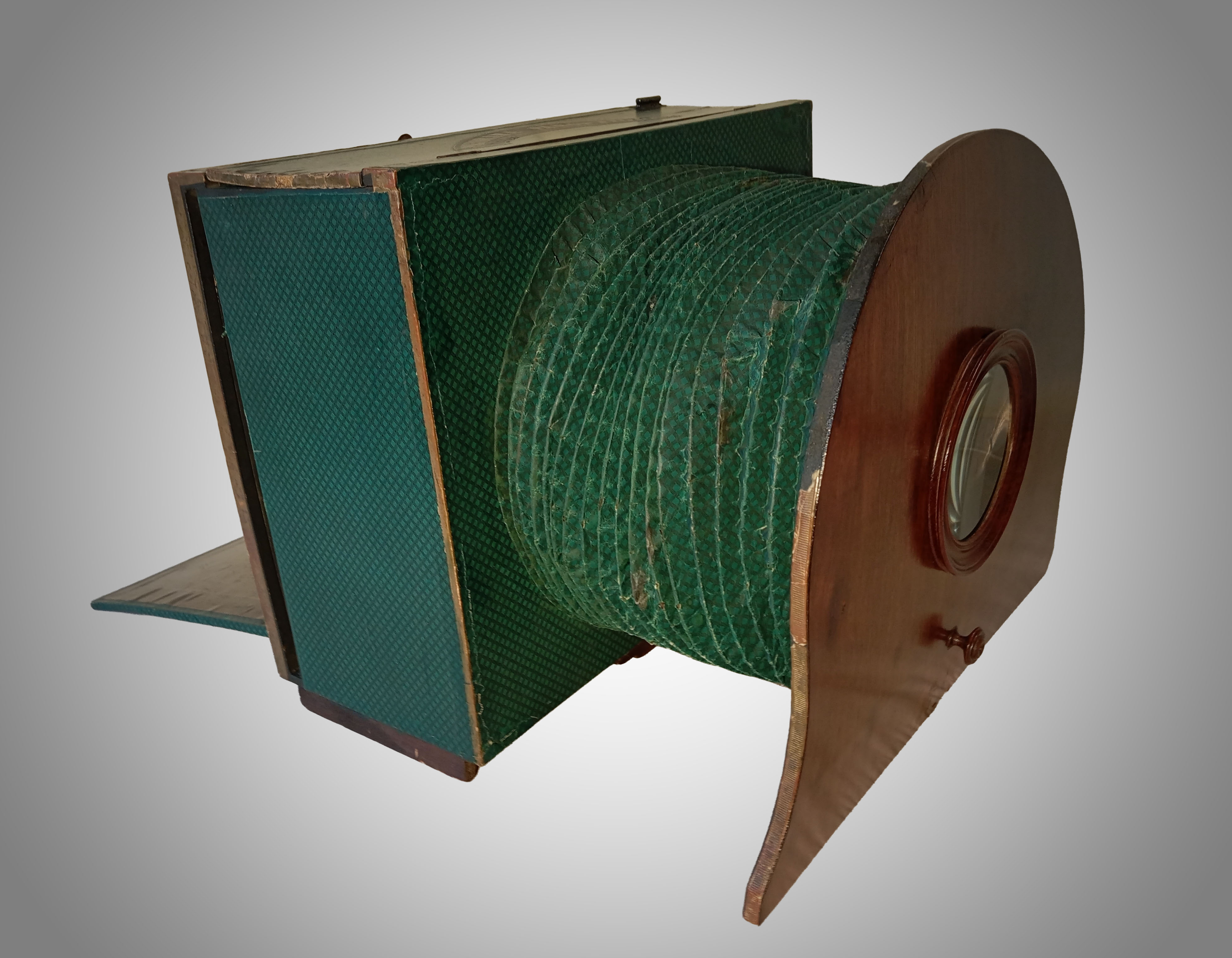 |
Figure MNC-M01041.1 – Polyorama 33 |
| Photo © Rod Bantjes. |
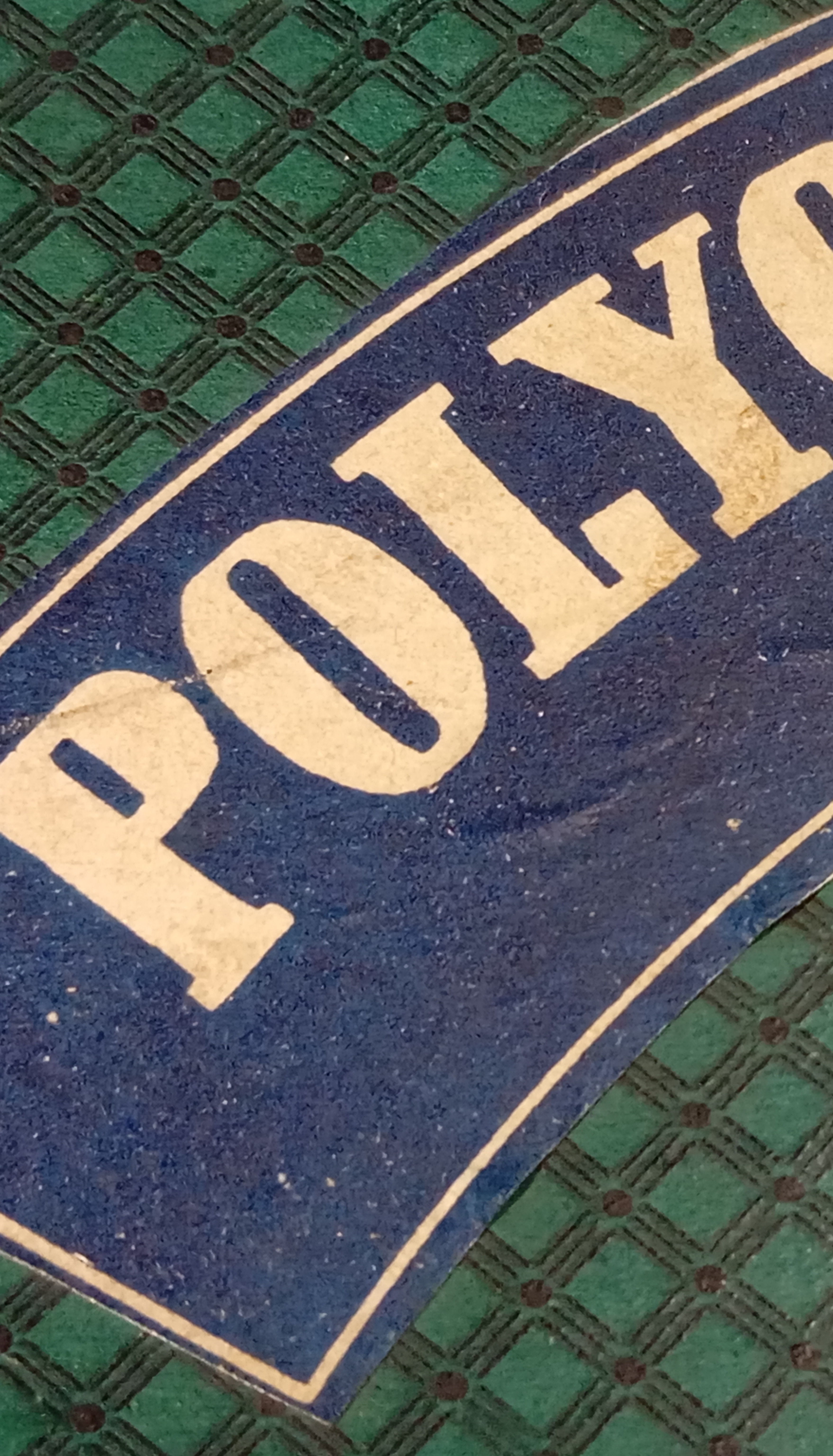 |
Figure MNC-M01041.2 – Eixample Pattern |
| Photo © Rod Bantjes. |
This is a viewer for paper dioramas characterized by the soft bellows for adjusting the viewing lens. It is the largest of Henri Lefort's Polyoramas Panoptique. It is an example of an "optical machine " and is included in the Optical Machine Taxonomy.
It bears comparison to the second-largest polyorama panoptique, an examples of which is in the Werner Nekes Collection. The lens diameter is nearly identical (differing by 2 mm). Both, at around 8 cm, allow for binocular viewing which gives the best depth effect.
This (Torino) box has an image-plate width of 31.5 cm while the Nekes image-plate is 22.5 cm wide. The paper diorama format for the Nekes box is 19 x 24 cm.[2] I have not seen a paper diorama for the Torino box, but I would guess it is 26 x 33 cm like this one in the Cinémathèque française collection.
The Torino box weighs 1.80 kg and the Nekes box is 1.19 kg.
The green papering has what I call the eixample pattern (see figure MNC-M01041.2) like one of Lefort's early boxes (MNC-M04936) The eixample pattern is reminiscent of the plan of the Eixample district in Barcelona: square blocks with "streets" that have centre-lines and dots at the intersections.
For more on Polyoramas Panoptique you can read my discussion of the one in the Bill Douglas Cinema Museum in Exeter, UK.
Endnotes:
[*] We would like to thank Raffaella Isoardi and Valentina Malvicino for making our research possible and assisting us in every way, as well as Antoine ... for assistance in the archives.
[1] The depth is about 19 cm when the bellows is compressed. This is a rough measure that depends on how hard one wants to compress this very old delicate structure. An extended measure is often impossible because of the fragility of the bellows.
[2] The paper diorama fits into side-slots. It is wider than the "image-plate" which is measured as the open area between the slots.