Rod Bantjes, “Genus_Polyorama.html,” created 15 December, 2025; last modified, 18 February, 2026 (https://people.stfx.ca/rbantjes/).
Polyorama Genus (1849 - 1861)
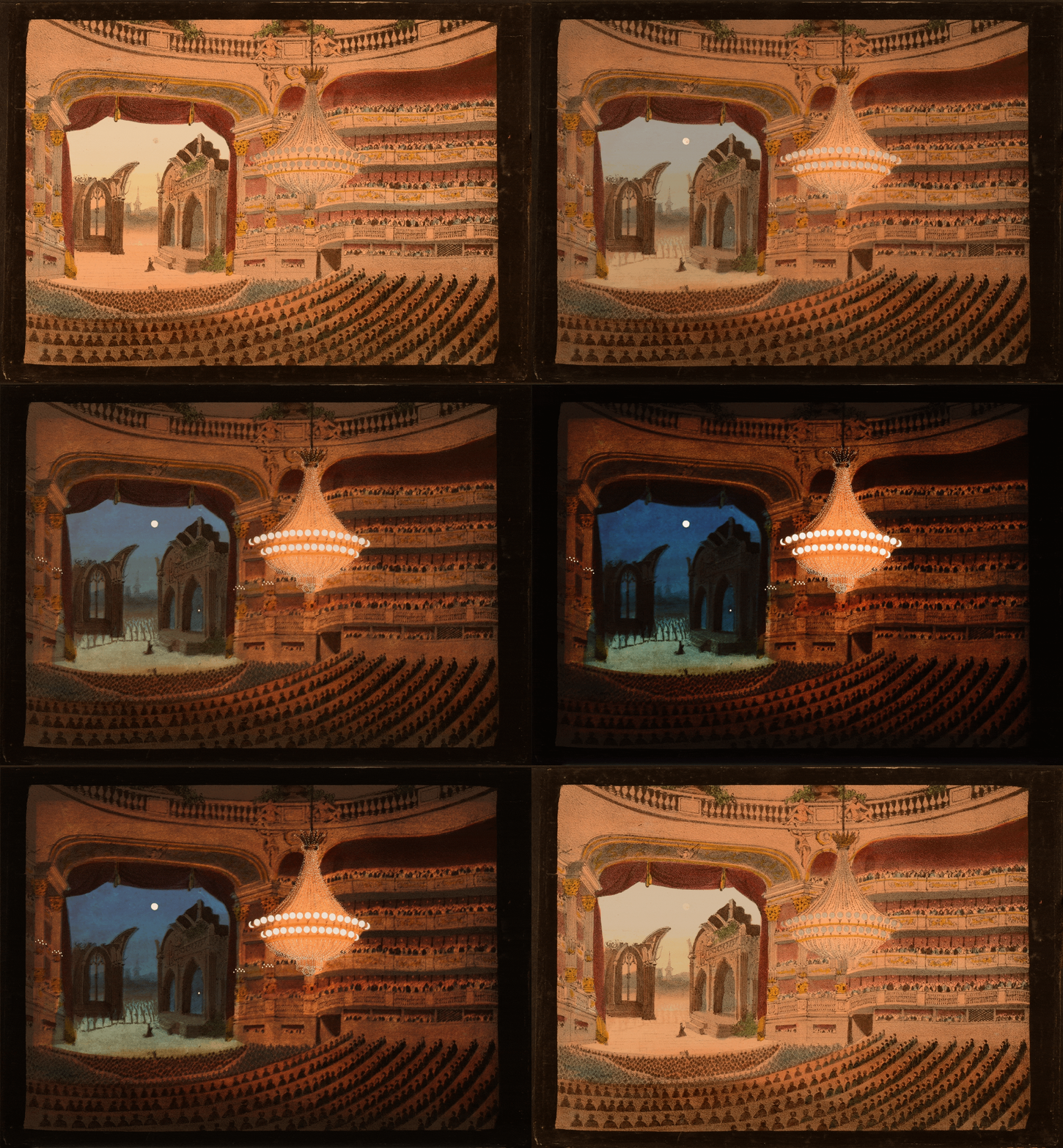 |
Figure PP.1 – Paper Diorama |
| Salle de l'Opera à Paris, 14.5 x 20 cm. Gif image © Rod Bantjes. |
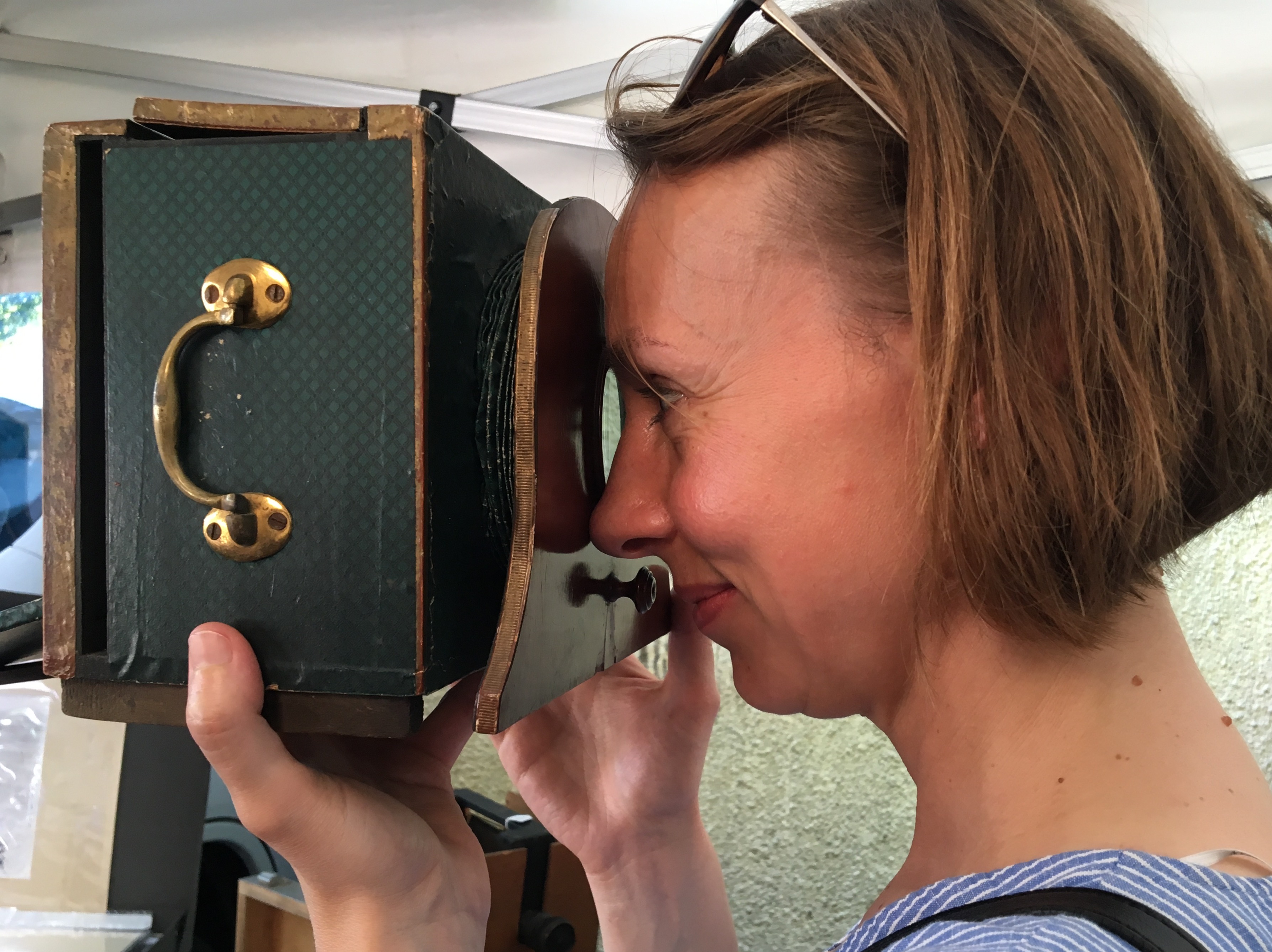 |
Figure PP.2 – Polyorama Viewing |
Photo © Rod Bantjes. |
The polyorama panoptique is a small viewer for paper dioramas patented in 1849 by the French toy maker Henri Lefort (1804-1880). It is an example of an "optical machine " and is included in the Optical Machine Taxonomy.
There were many optical boxes designed for paper dioramas in the Boîtes Dioramique Family to which this device belongs; but I am reserving the term polyorama panoptique for this one, described in the patent of 1849, and having the distinctive paper bellows for adjusting the lens distance.
The box has synchronized top and back flaps to control the lighting and create the beautiful mood transitions that you see in Figure PP.1.
Lefort's workshop produced polyoramas panoptique in 5 sizes corresponding to the 5 standard sizes of paper dioramas. From the paper dioramas in the Cinématèque française collection we know that there is a missing Polyorama 28 that accepted a 22 x 28 cm plaque dioramique.[1]
They are an example of standardized, factory production of optical machines. They are small, lightweight and relatively cheap compared to most 18th-century devices.
Each line in the following table represents a different species of polyorama panoptique.
| Polyorama 14: |  |
| EXBD-69055 |
This is the smallest variant of the polyorama panoptique
| Salmon 19: | 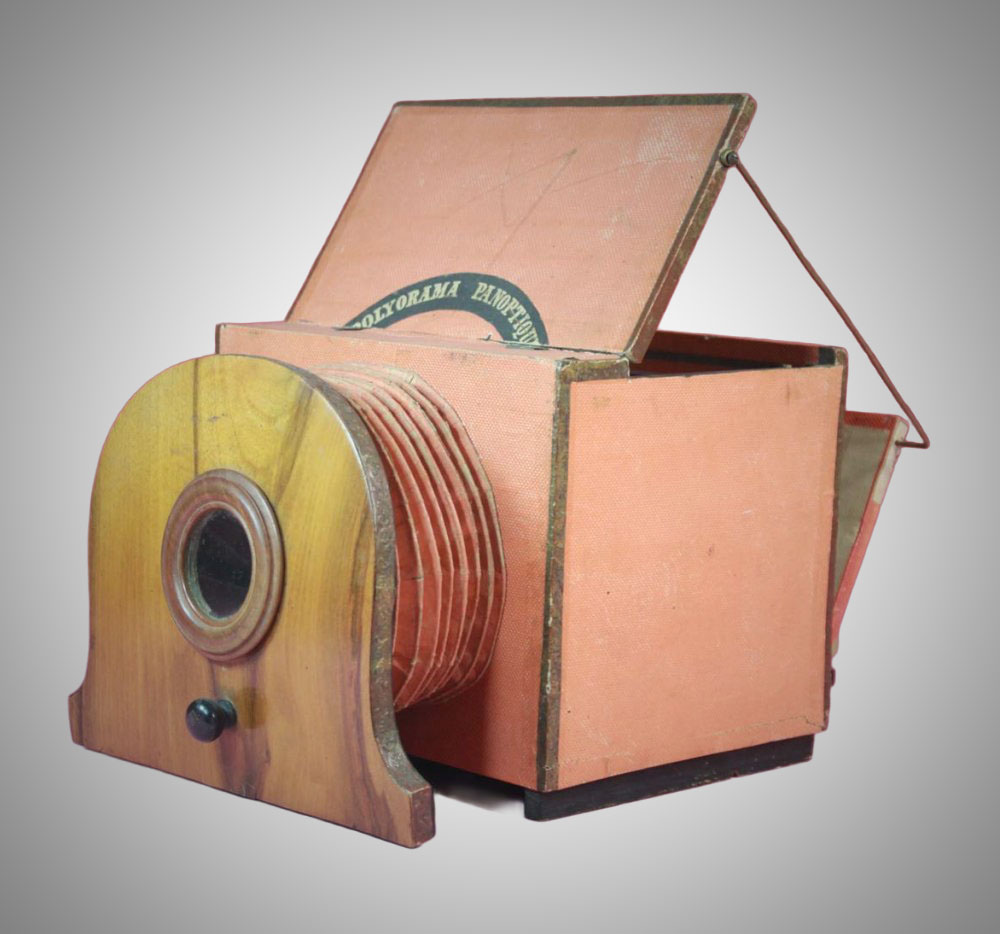 |
| FB-POL-13 |
Salmon is a very unexpected colour for a polyorama panoptique. Lefort used green almost exclusively. A light hardwood has been used for the face rather than Lefort's typical mahogany. The lens is turned to a different style. Otherwise it is identical to a Lefort box even including a similar label. François Binétruy, who owns this box, thinks that it is "certainement d'origine Allemande ou Hollandaise." Perhaps it was a non-French pirate version of Lefort's patented device.
It takes a non-standard paper diorama format: 15 x 19 cm, however it might fit a standard 14.5 x 20 cm (Figure PP.2).
| Polyorama 20: | 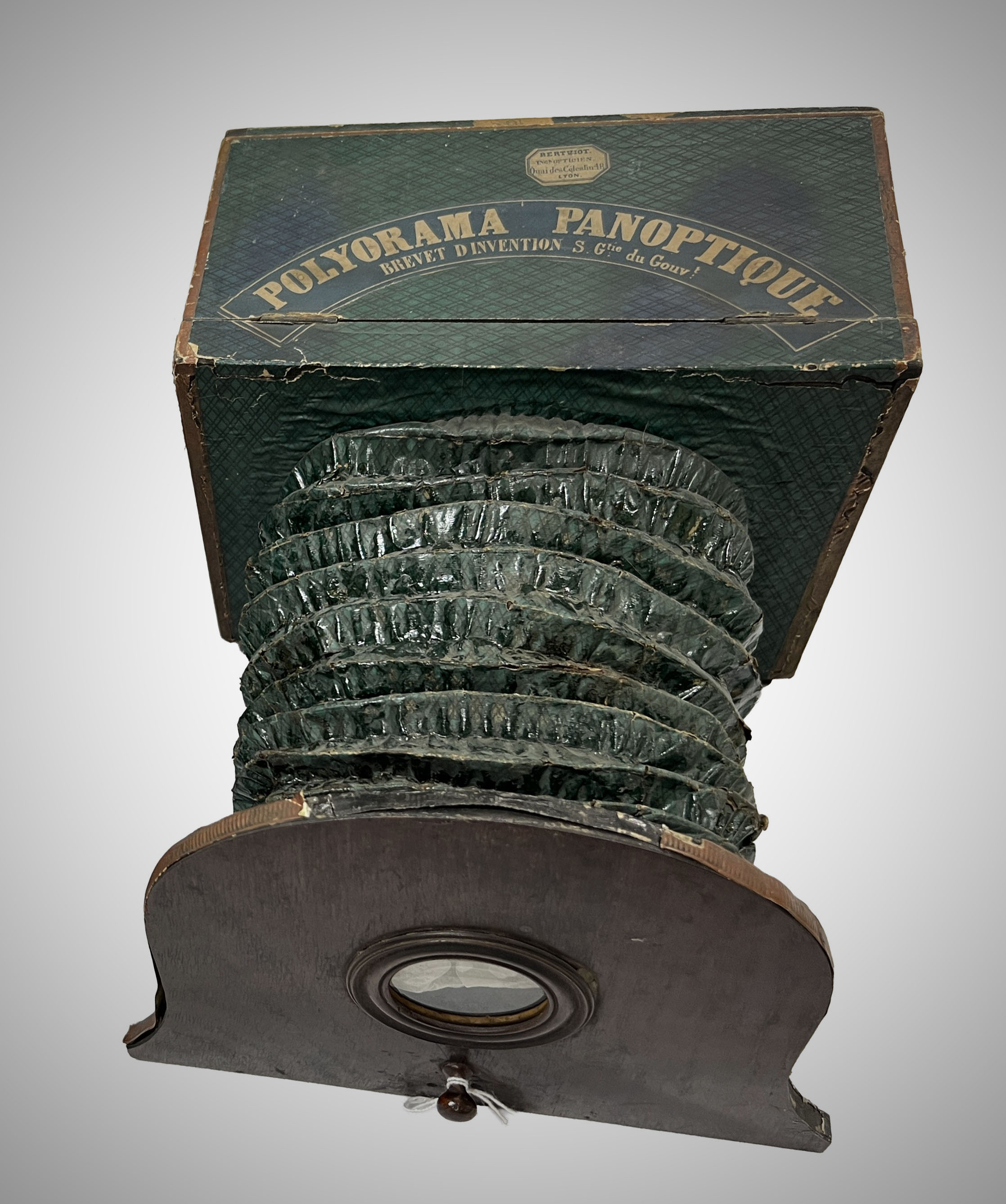 |
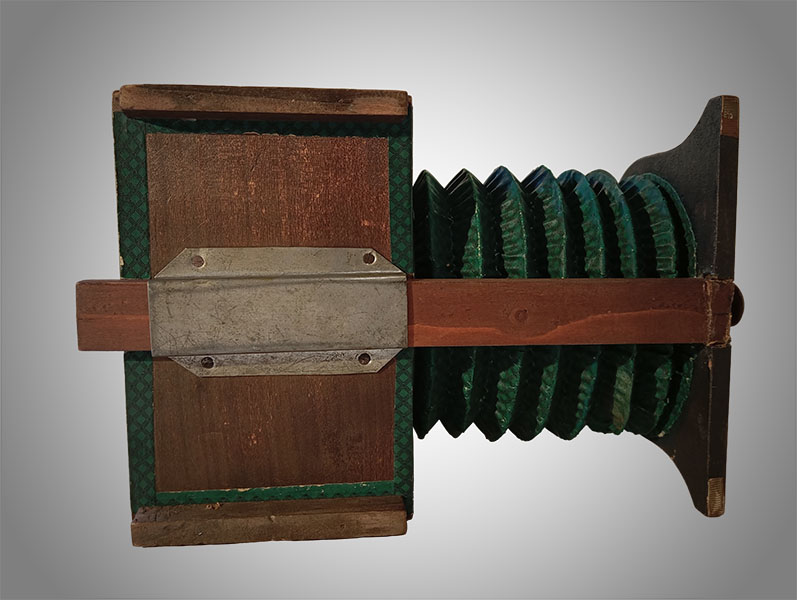 |
| MNC-M01039 | MNC-M01040 |
This is what is often referred to as a "medium" format polyorama panoptique. It takes a 14.5 x 20 cm plaque dioramique.
The underside view of MNC-M01040 shows the stabilizer for the bellows. On larger models, this stick is hinged and when retracted, folds up to close over the back of the box.
| Polyorama 24: | 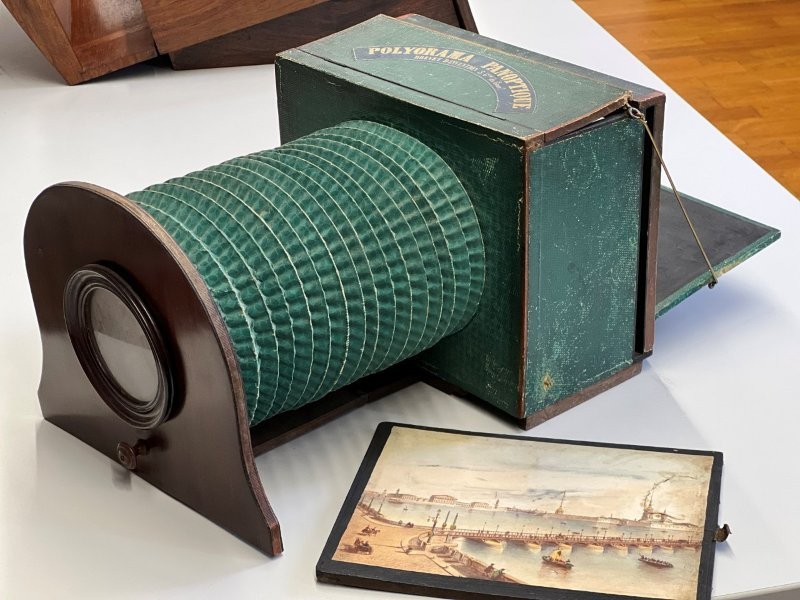 |
| WN-GT135 |
This a large polyorama panoptique that accepts a 19 x 24 cm paper diorama. Unlike the smaller versions, it conforms to the 18th-century stipulation that the lens should be large enough to see through with both eyes.
In this photo (see also FB-POL-13 below) you can see the wire that connects the top and back flaps and synchronizes their movement – opening for back-illumination while closing front(top)-illumination and vice-versa.
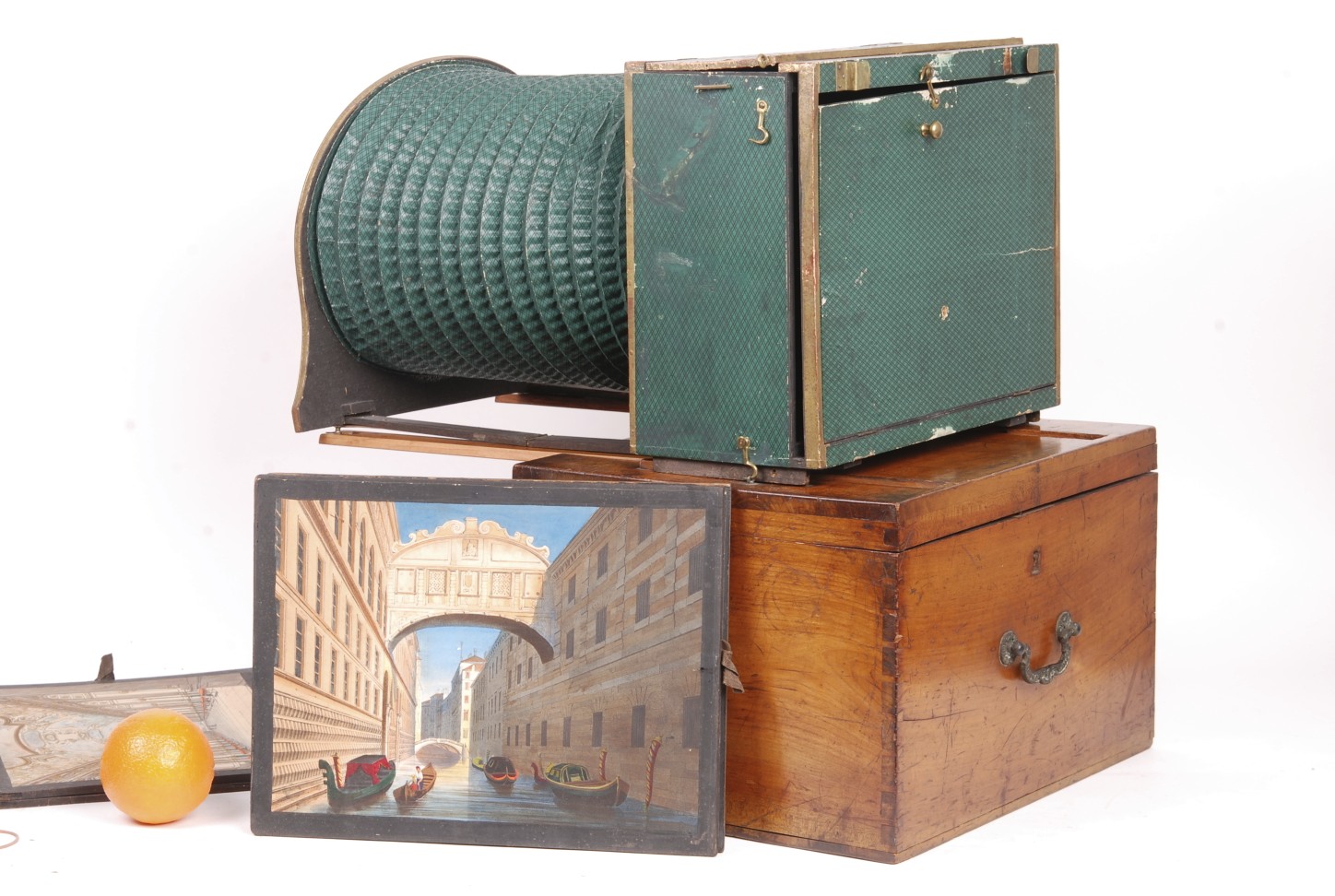
| Polyorama 33: | 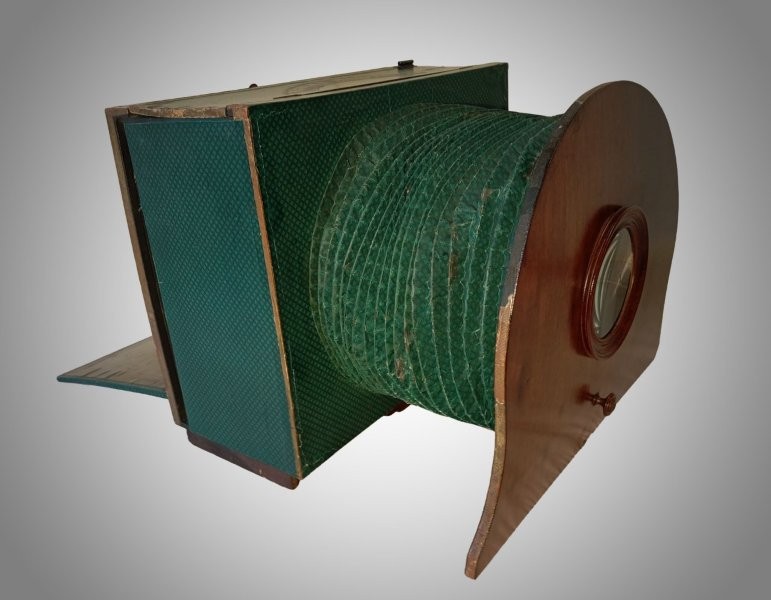 |
 |
| MNC-M01041 | SL-1849-01 |
This the largest polyorama panoptique which has an image-plate 31.5 cm wide. It conforms to the 18th-century stipulation that the lens should be large enough to see through with both eyes.
SL-1849-01, in the Antiq Photo archives, came with a box designed both for storage and mounting the device. Photo © Antiq Photo.
| Polyorama 33 Double: | 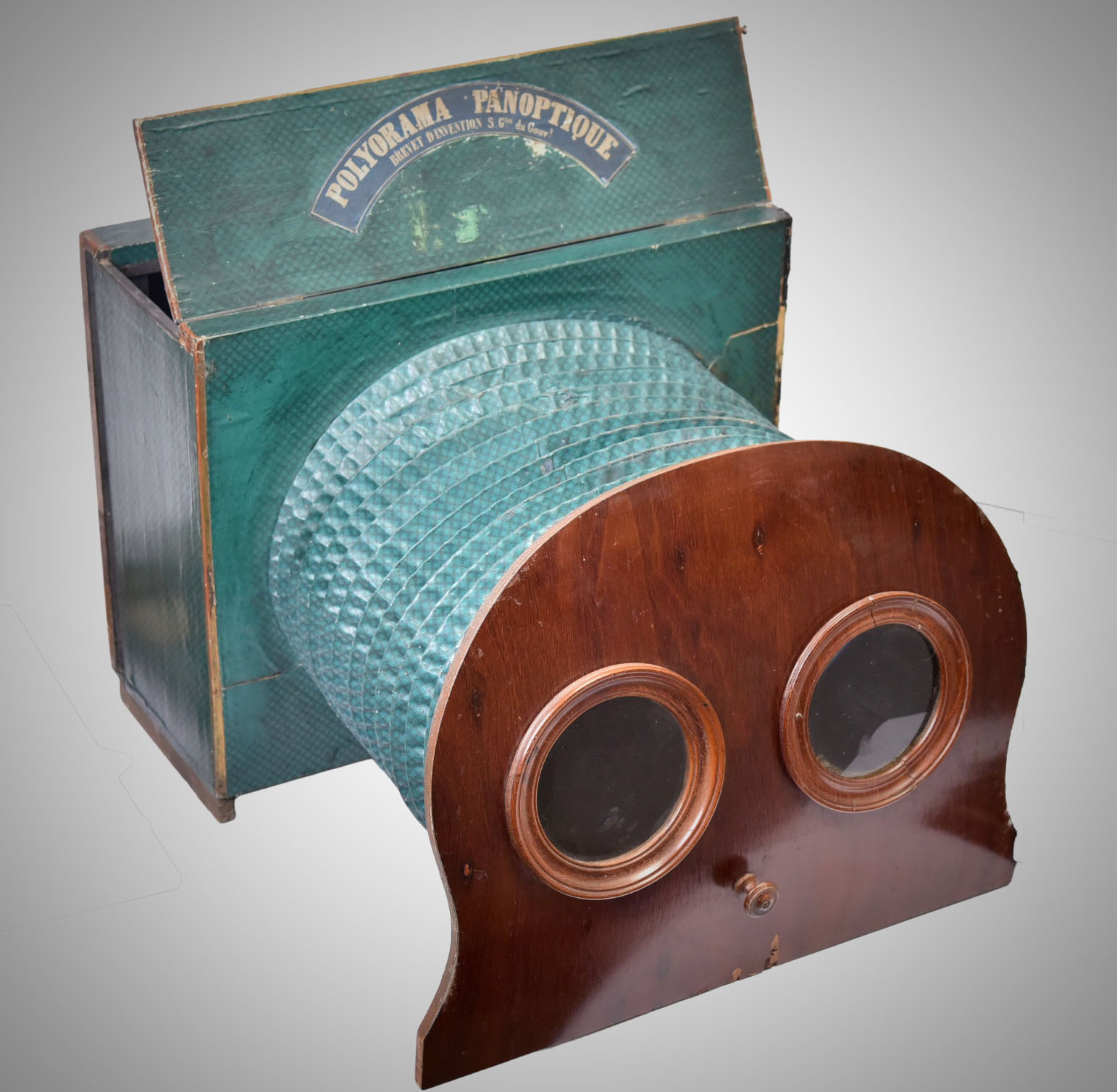 |
| SL-1850-01 |
This is an extremely rare 2-lens version of the previous box. It is in the Antiq Photo archives. Photo © Antiq Photo.
| Dial Polyorama 14: | 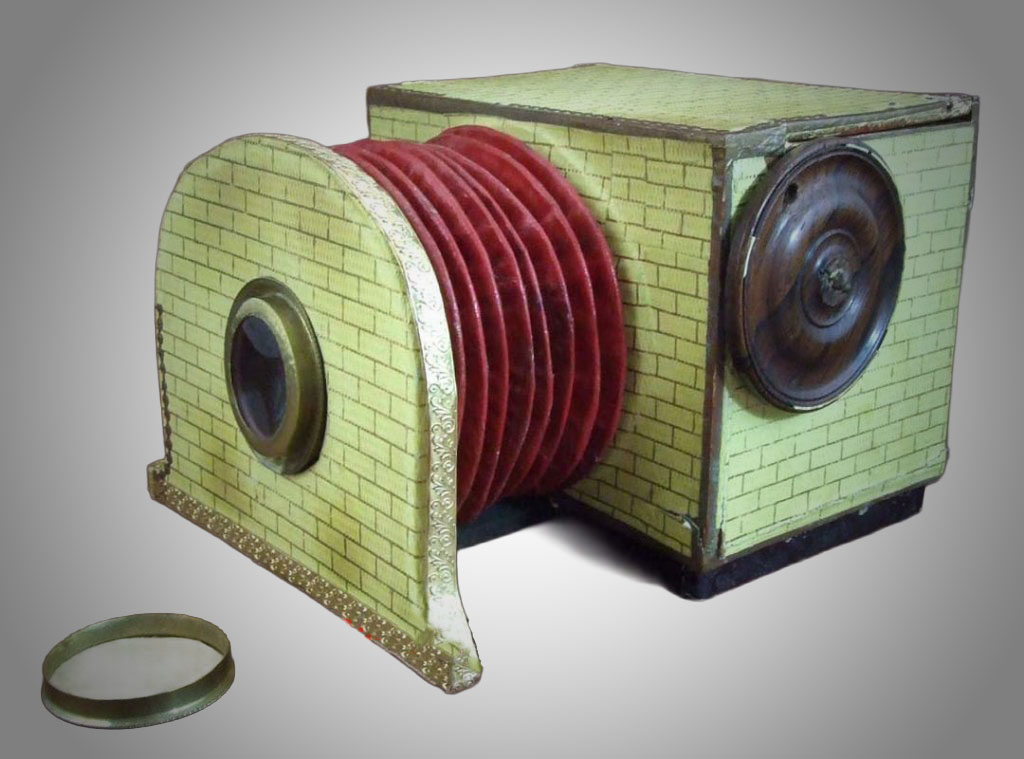 |
| FB-6068 |
François Binétruy, has suggested that this is a Lefort prototype. It has two improvements over the standard Polyorama 14.
The first is the wooden dial that activates a mechanism for synchronizing the opening and closing of the illumination flaps.
The second is that it accepts both 14 cm rectangular paper dioramas as well as round Lorgnettes Pittoresque dioramas by means of a special cartridge.
It also has a lens-cap, surprisingly rare and standard only in the Bioscope.
I suspect that these may have been improvements made by another manufacturer in order to circumvent Lefort's patent protection. The dial would have been costly to manufacture without giving much of an advantage over the much simpler rigid wire (see Polyorama 20 above).
| Polyorama Diagraphique 14: | 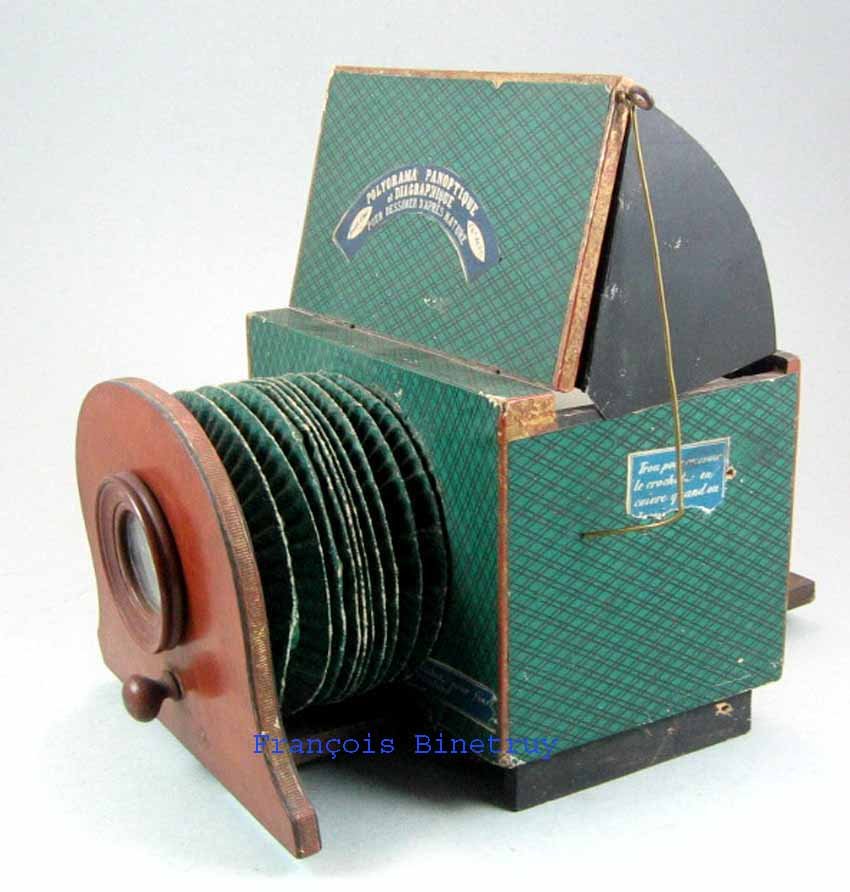 |
| FB-POL-19 |
This is a hybrid between a polyorama panoptique and a camera obscura; one of two in the François Binétruy collection. It is one of many camera-optique hybrids.
To convert it to a camera the user must insert a mirror, angled at 45° and a ground glass to receive the image.
| Lorgnette à Soufflet: | 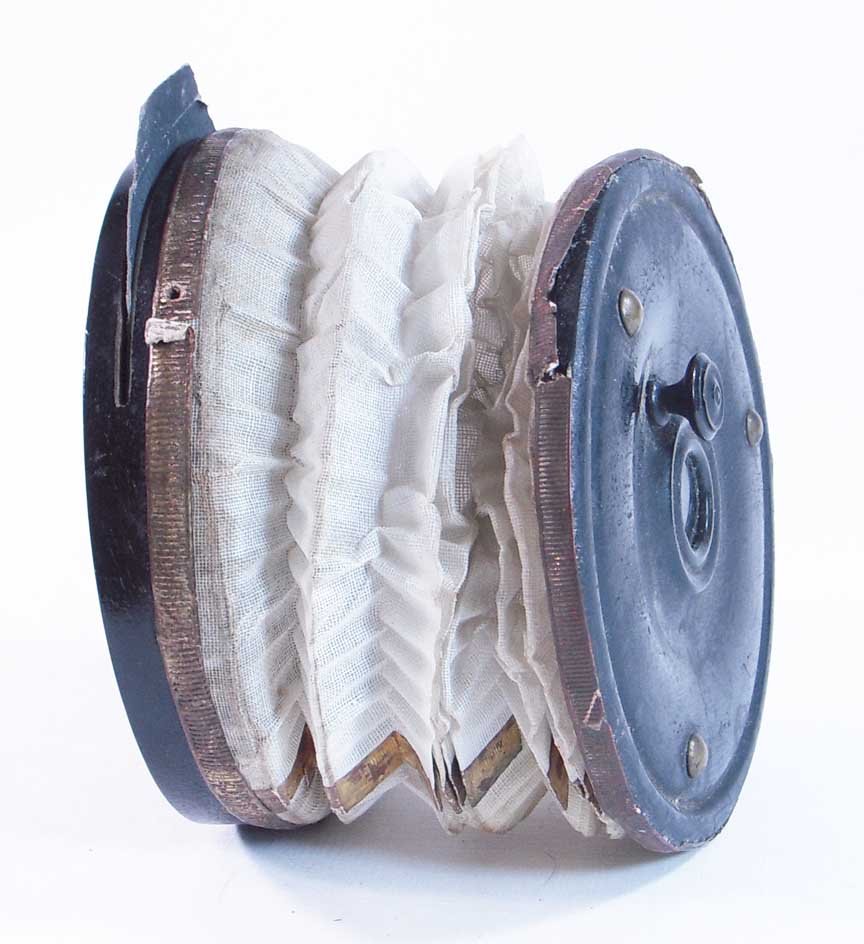 |
| FB-8130 |
This is a hybrid between a polyorama panoptique and a Lorgnette Pittoresque. Front illumination is through the translucent bellows. Control of back-illumination would be by the hand. The absence of front and back flaps for these functions place it on the borderline of the polyormama genus. It has its own format of circular paper dioramas similar to those of the Lorgnette Pittoresque.
It is likely inspired by a fixed-image version showing Napoleon's 1812 campaign in the François Binétruy Collection and also possibly in the Cinémathèque française collection.
It is in the François Binétruy collection. Photo © François Binétruy.
Endnotes:
[1] I use this term as a synonym for paper diorama. I like the connotation of the English word "plaque" that captures the hard, three-dimensional physicality of the paper diorama on its stiff wooden frame.