Rod Bantjes, “MNC-M02003_Alethoscope.html,” created 24 February, 2026; last modified, 24 February, 2026 (https://people.stfx.ca/rbantjes/).
Mini-Alethoscope
Museo Nazionale del Cinema Collection, Torino, Italy[*] #MNC-M02003
Italy, ca.1865
Dimensions: H=38.4 cm, W=28.3 cm, D=47.3 cm
Lens: H=10.5 cm, W=13.5 cm, ƒ=29.5 cm
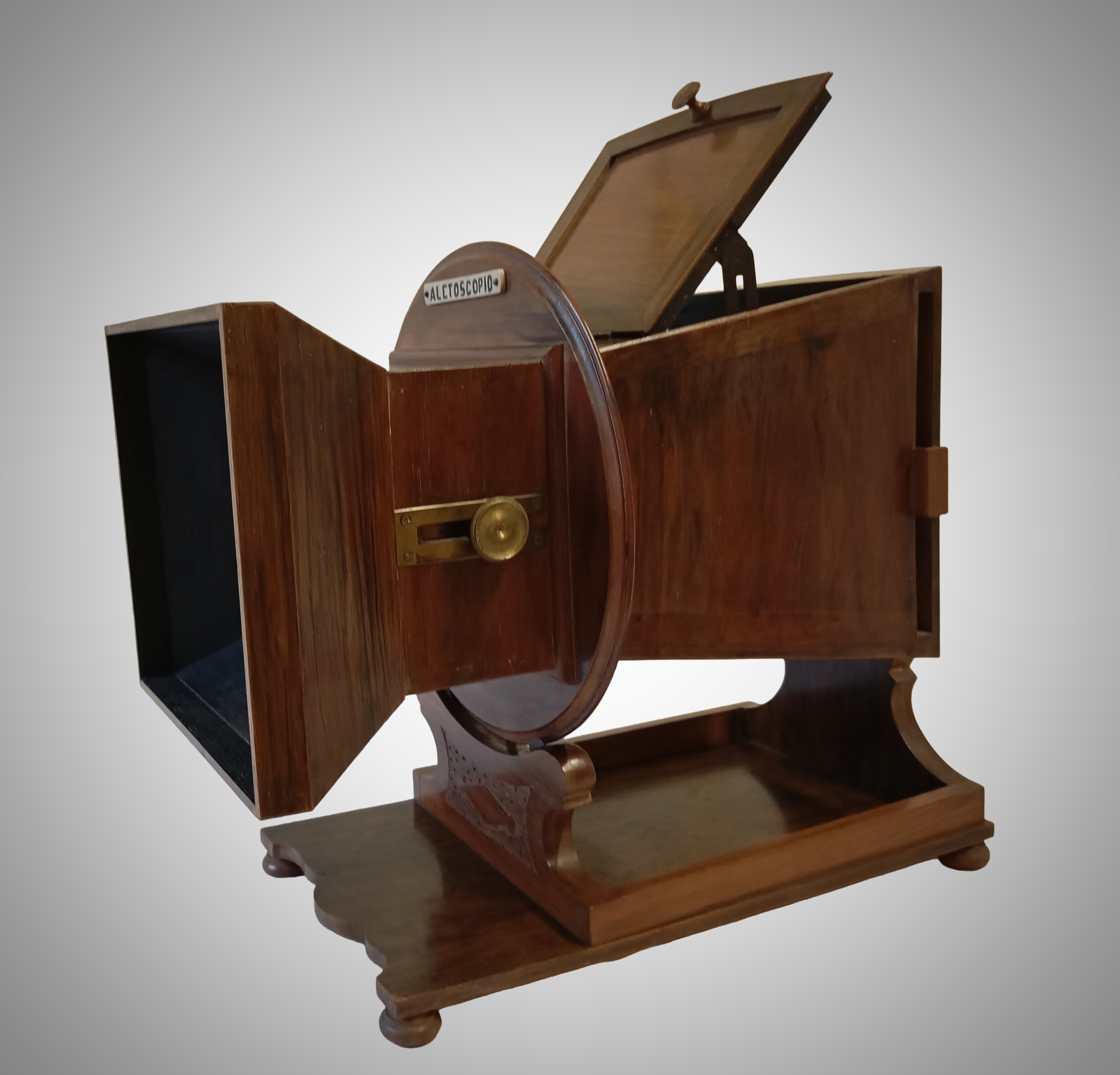 |
Figure MNC-M02003.1 – Alethoscope |
| Photo © Ana Mendes. |
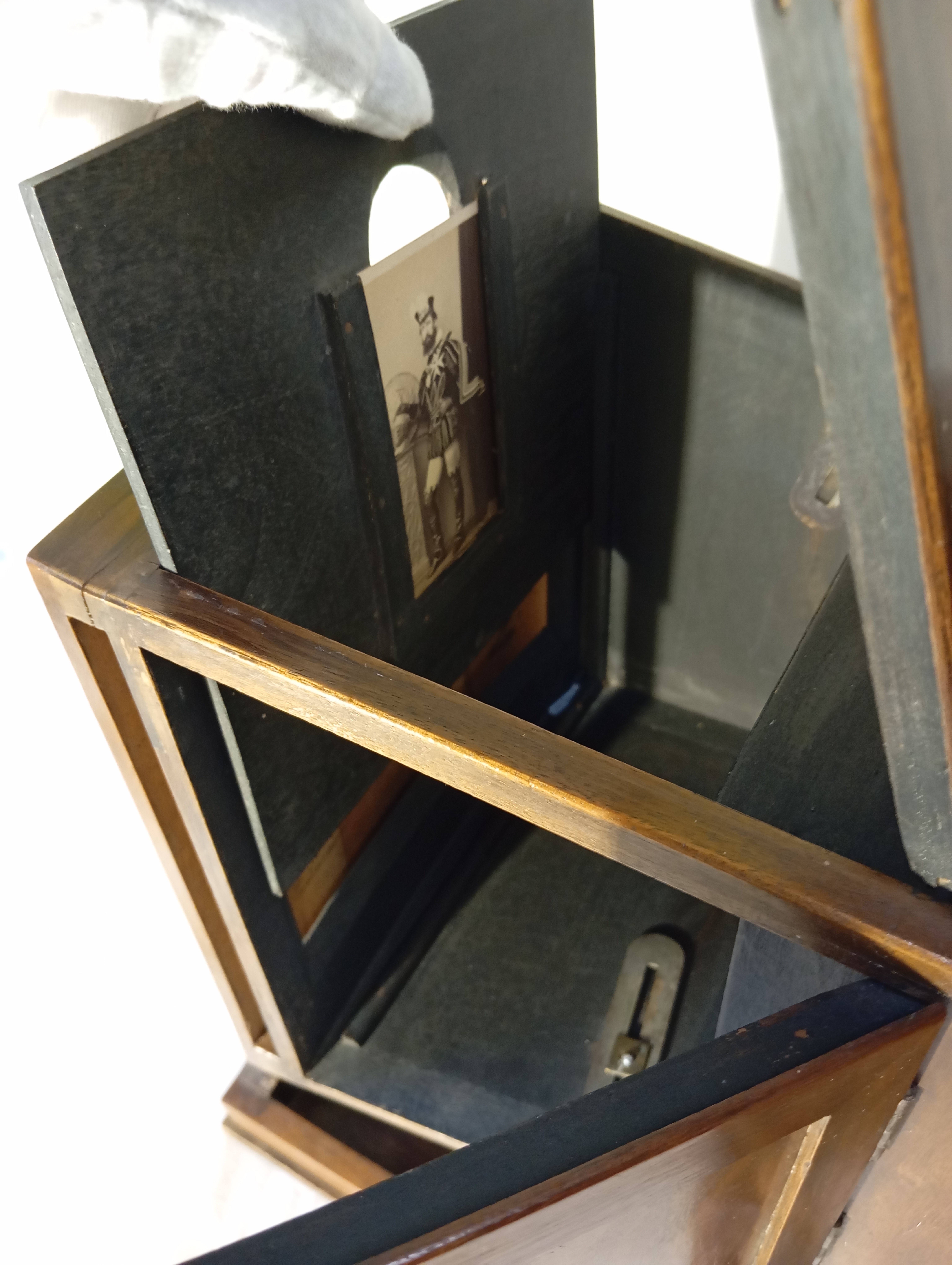 |
Figure MNC-M02003.2 – Small Image-Frame |
| Photo © Ana Mendes. |
Alethoscopes were designed in 1861 by Carlo Ponti (ca.1823 - 1893) as 3D-viewers for photographs in paper diorama form. This is the smallest of the genus Alethoscope. It is an example of an "optical machine " and is included in the Optical Machine Taxonomy.
This rare miniature Alethoscope is about half the size of the original design. However, with a lens 13.5 cm wide it is still for binocular viewing, and true to the 18th-century theory of the 3D effect for optical machines.
It has all of the defining features of the Alethoscope genus:
| • a rotating body to change between "landscape" and "portrait" orientation of prints; | ||
| • two mirrored front-flaps, the choice of which depends upon the orientation of the print; | ||
| • a viewing-hood to minimize glare on the lens; | ||
| • a large squared lens in a movable carriage adjustable by brass side-knobs; | ||
| • internal masking to eliminate all distractions from the internal illusion; |
This Alethoscope also has multiple image-plates like the Megalethoscope. Here there are four at different distances from the movable lens: 14-9.3 cm; 25.5-20.8cm; 25.8-21.1cm; 28.8-24.1cm. They measure in width: 15.0 cm; 5.1 cm; 19 cm; 17 cm.
The last of these plates is curved. The device is therefore likely to have been manufactured by Carlo Ponti rather than Carlo Naya who objected to curved images.
In addition to its size, what is most unusual about this Alethoscope is the absence of an open-able back-plate. It therefore is not for the use of paper dioramas. The solid back makes the rotational machanism simpler – it can pivot from the centre of the back rather than on the circular steel rail that the other Alethoscopes need in order to keep the back clear and open.
For a more complete discussion of Alethoscope design features in relation to other period devices, see the Naya Alethoscope.
Endnotes:
[*] We would like to thank Raffaella Isoardi and Valentina Malvicino for making our research possible and assisting us in every way, as well as Antoine ... for assistance in the archives.