Rod Bantjes, “MNC-M03372_Boite_Dioramique.html,” created 1 March, 2026; last modified, 1 March, 2026 (https://people.stfx.ca/rbantjes/).
Boîte Dioramique
Museo Nazionale del Cinema Collection, Torino, Italy[*] #MNC-M03372
France? ca.1850
Dimensions: H=14.8 cm, W=21 cm, D=28.8
Lens: ⌀=3.5 cm, ƒ= [lens is missing]
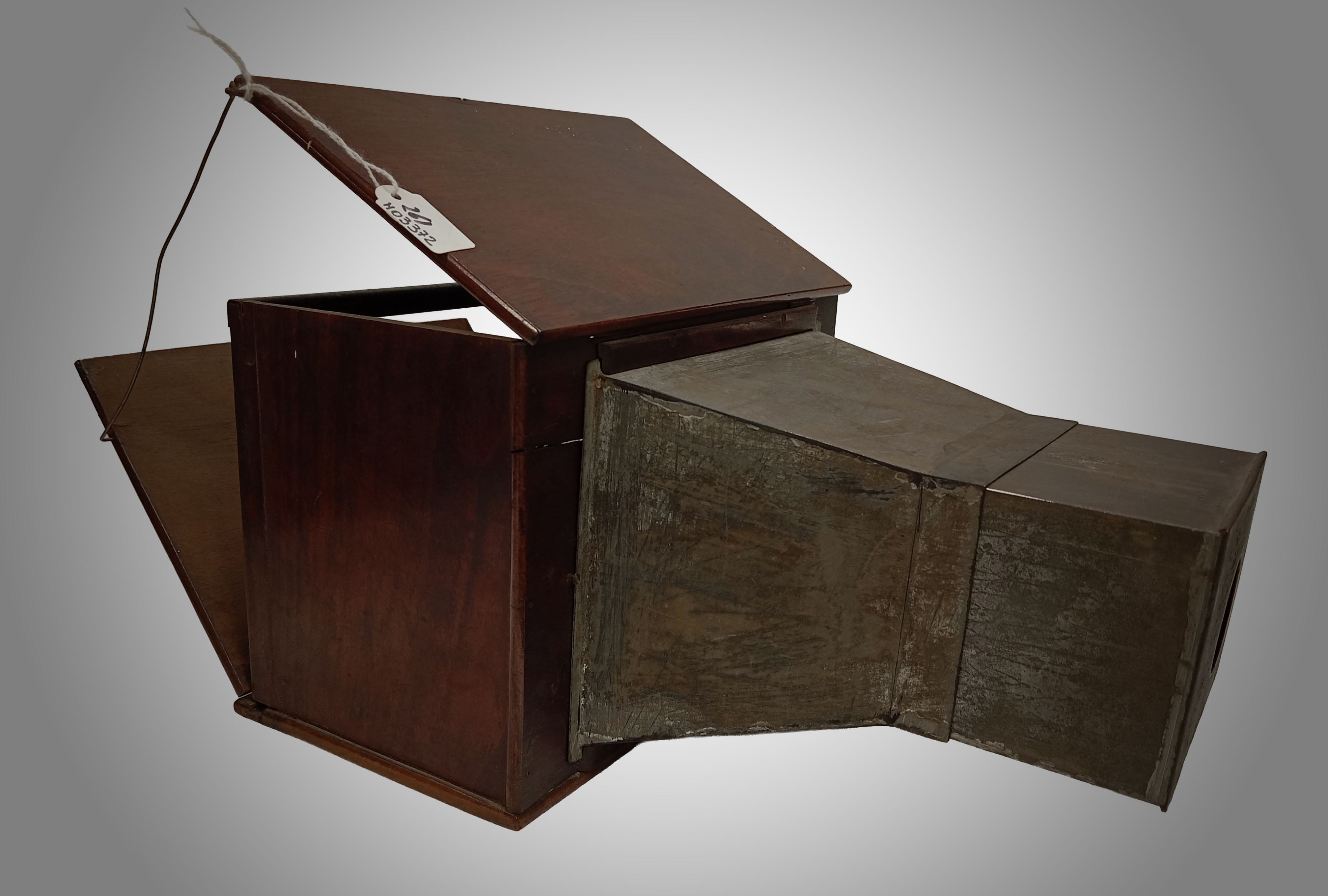 |
Figure M03372.1 – Boîte Dioramique |
| Photo © Rod Bantjes. |
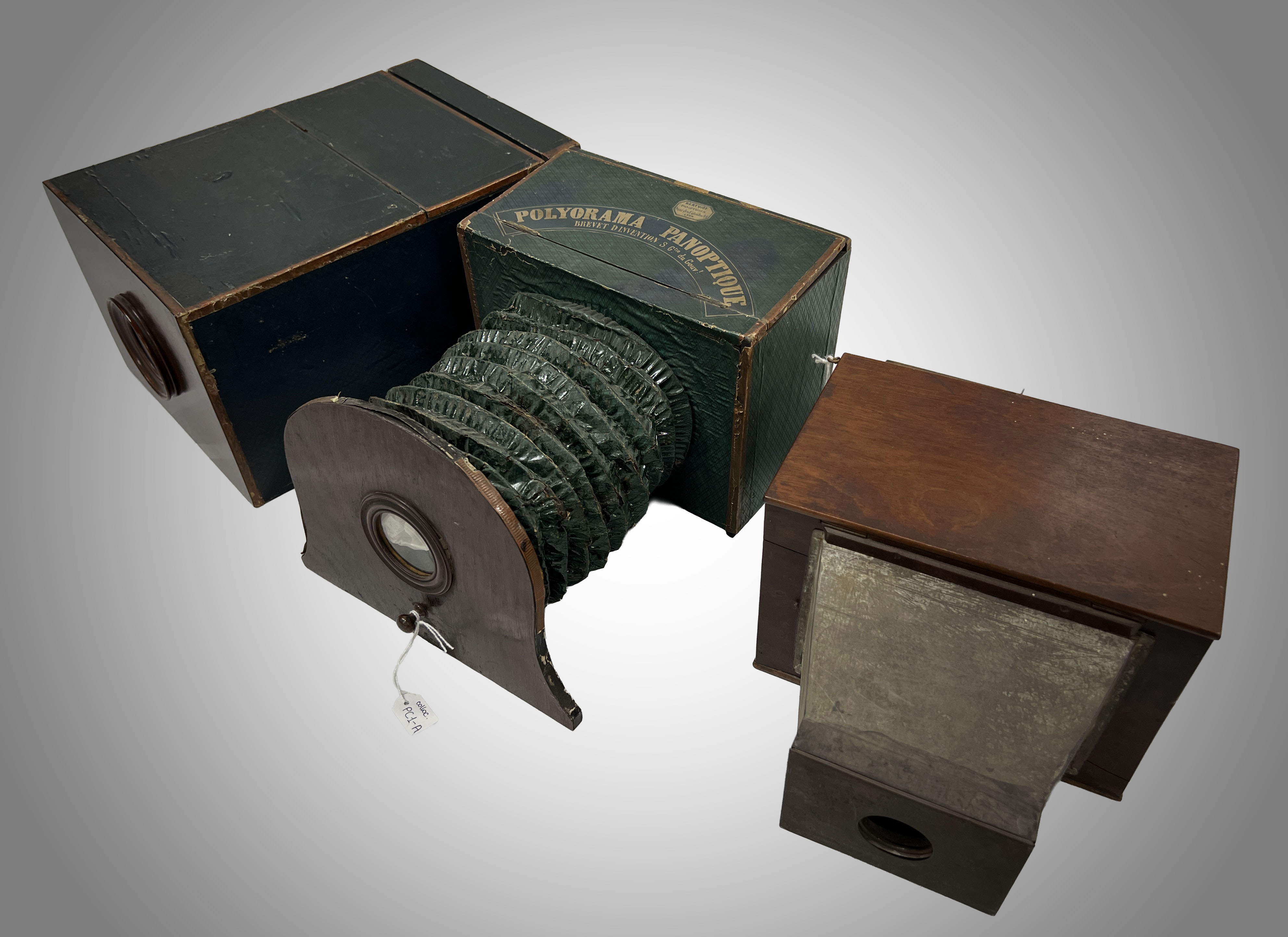 |
Figure M03372.2 – Boîte Dioramique with Lefort Boxes. |
| Photo © Rod Bantjes. |
This is a biconvex lens viewer for a form of paper diorama known as a plaque dioramique . It is an example of an "optical machine " and is included in the Optical Machine Taxonomy where it is part of a genus of Boîtes Dioramiques and a family of the same name.
This box has a back-flap for back-illumination of translucent paper dioramas and a top-flap for front-illumination. The opening and closing of the flaps is synchronized by a connecting wire. There is a slot for inserting and removing the plaques dioramiques. These are all features of polyoramas panoptiques from the workshop of Henri Lefort.
The adjustable lens extension differs from the bellows typical of the polyorama panoptique. On this box it is made of tin rather than pleated paper (Figure M03372.2).
I have placed it beside two Lefort boxes in Figure M03372.2 to show the similarity in scale and conception and to pose the question of whether they could all be from the same workshop.
The aesthetics of this boîte dioramique are different from the other two. However, it has the same construction details and aesthetics as two other candidates for Lefort boxes (FB-6898 and MNC-M01036): dark straight-grained hardwood, varnished rather than papered or painted, and with rounded overhangs top and bottom.
This box was either a prototype, where Lefort was experimenting with designs for the innovative adjustable lens, or a copy-cat design that used an alternate lens-adjustment to circumvent Lefort's 1849 patent (the only original element in which was the bellows).
Endnotes:
[*] We would like to thank Raffaella Isoardi and Valentina Malvicino for making our research possible and assisting us in every way, as well as Antoine ... for assistance in the archives.