Rod Bantjes, “MNC-M01036_Triple_Polyorama.html,” created 1 March, 2026; last modified, 1 March, 2026 (https://people.stfx.ca/rbantjes/).
Triple Polyorama
Museo Nazionale del Cinema Collection, Torino, Italy[*] #MNC-M01036
France? ca.1850
Dimensions: H=33 cm, W=55.9 cm, D=84.2
Lens: ⌀=8.5 cm, ƒ=74 cm
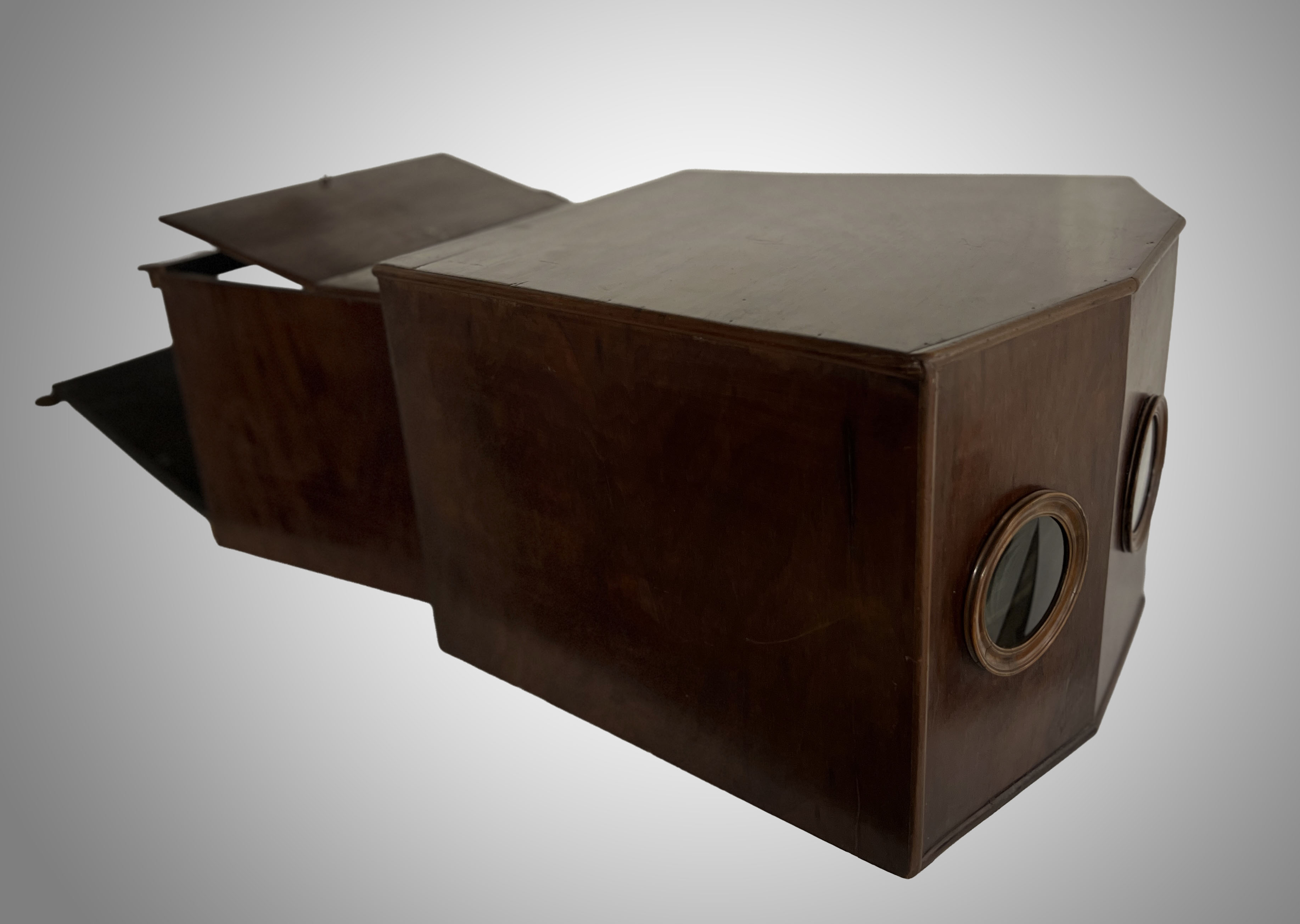 |
Figure M01036.1 – Triple Polyorama |
| Photo © Ana Mendes. |
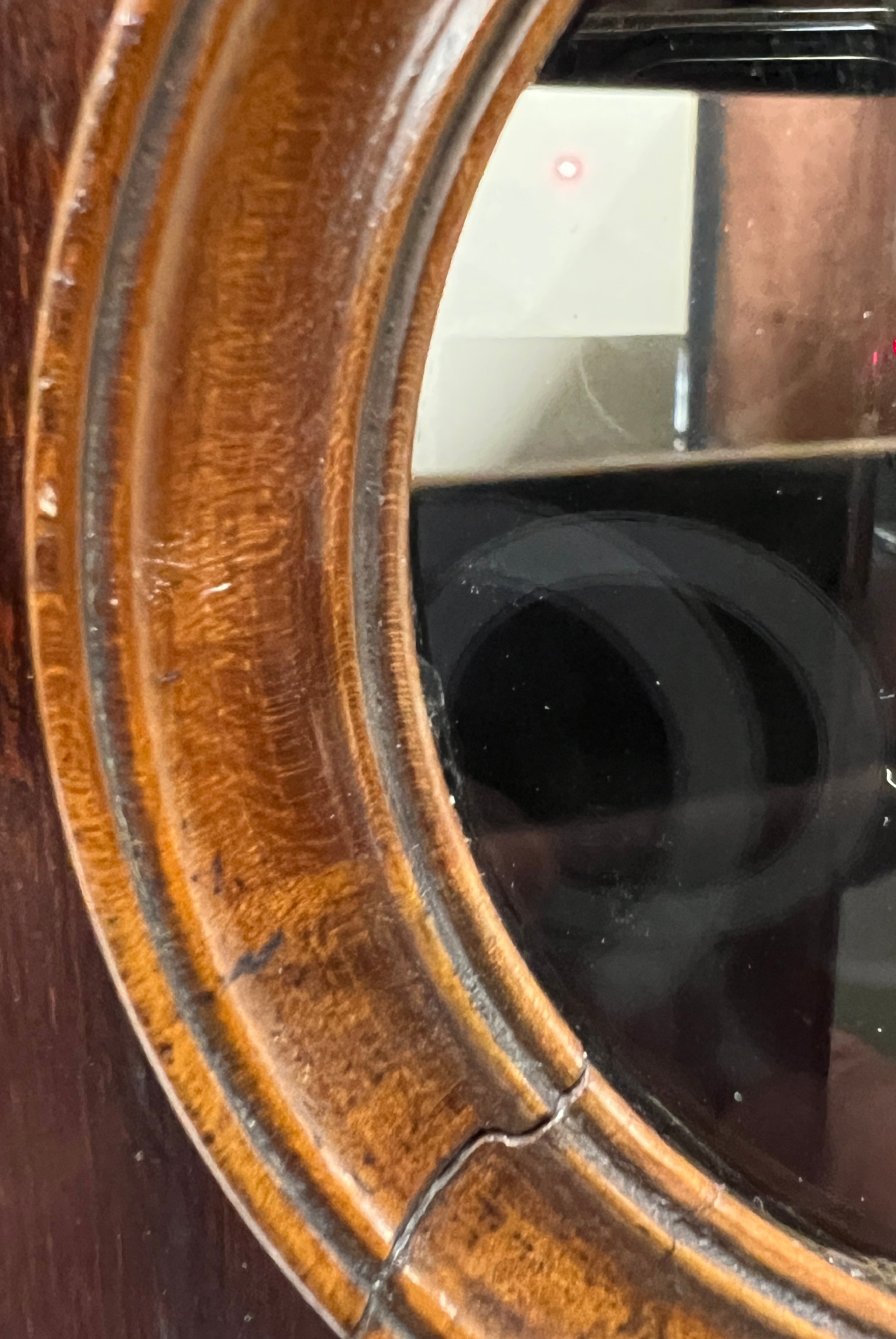 |
Figure M01036.2 – Lens-Frame |
| Photo © Ana Mendes. |
This is a multiple-lens viewer for plaques dioramiques. It is an example of an "optical machine" and is included in the Optical Machine Taxonomy. It is a member of a genus of multi-lens polyoramas and of the Boîtes Dioramique Family within that taxonomy.
Like all members of the Boîtes Dioramique Family it has a back-flap for back-illumination of translucent paper dioramas and a top-flap for front-illumination.
The image-slot measures 26 x 35 cm, but is a tight fit for a 25.6 x 33.6 cm plaque dioramique from the Polyorama 33, due possibly to the narrowness of the slot. The box would have been more attractive to buyers if the maker had met the Polyorama Panoptique standard exactly, opening up a wider choice of images for their device.
The main body of the box flares out towards the lens-bank, very like an Italian Mondo Niovo. Unlike the Mondo Niovo, it has a side-slot rather than a flytower for changing scenes.
The back-portion of the box containing the image-plate slides in and out to adjust the distance between image and lens. prior to Henri Lefort's invention of the Polyorama Panoptique in 1849, the Zograscope was the only optical machine that allowed of this kind of adjustment.
The box is finely constructed in varnished hardwood, with machine-made brass fittings. The lens-frame is turned with two double-ridges separated by a cove (Figure M01036.2), a variant of Lefort's style (see MNC-M04936 and Figure M01036.2). The top-flap also has a gold-coloured reflective surface typical of many Lefort boxes (see MNC-M01039).
These details of construction make me think it is possible that this box is from the Lefort workshop. I am inclined to think that the tight fit of the Lefort plaque dioramique is rather due to expansion /contraction or warping with age. If this device is from the Lefort workshop it is a departure from the lightweight, cheap amusements marketed to tourists or children that he is best known for. This is a luxury item more like a permanent piece of furniture. The question is, who was it intended for and how was it meant to be used?
Public Show-Box? The length of the box (84 cm when extended) would make it difficult for people viewing through the lenses to reach around to introduce plaques dioramiques or to make the adjustments of image-plate distance that the back-section is designed for. Full functioning presumes a small crowd – three people watching and one "showing," that is, adjusting the distance and changing the views. The form of the box is similar to a Mondo Niovo, and while three is a small number of lenses there are known examples of show-boxes with three or even two lenses (see for example the Sergeant Bell 2 Raree Show).
Private Parlour Entertainment? However the aesthetics and finish are, like that of the Alethoscope, more fitting for a bourgeois interior than a street attraction. The varnish would not be well-suited to exposure to the elements. There are also precedents of multi-lens optical machines for private display and performance for exclusive guests. For example the Friggeri Tower with three lenses and the Dolfin Teatro Rotondo with more than five lenses, are known to have been displayed in palaces of the Italian elite and are far too opulent to have been used for street performance.
Endnotes:
[*] We would like to thank Raffaella Isoardi and Valentina Malvicino for making our research possible and assisting us in every way, as well as Antoine ... for assistance in the archives.