Rod Bantjes, “MNC-M05119_Dipoletti_Scatola_Dioramico.html,” created 1 March, 2026; last modified, 1 March, 2026 (https://people.stfx.ca/rbantjes/).
Dipoletti Scatola Dioramico
Museo Nazionale del Cinema Collection, Torino, Italy[*] #MNC-M05119
Italy, ca.1850
Dimensions: H=18.7 cm, W=22.8 cm, D=20.5 cm
Lens: ⌀=4.9 cm, ƒ=28 cm
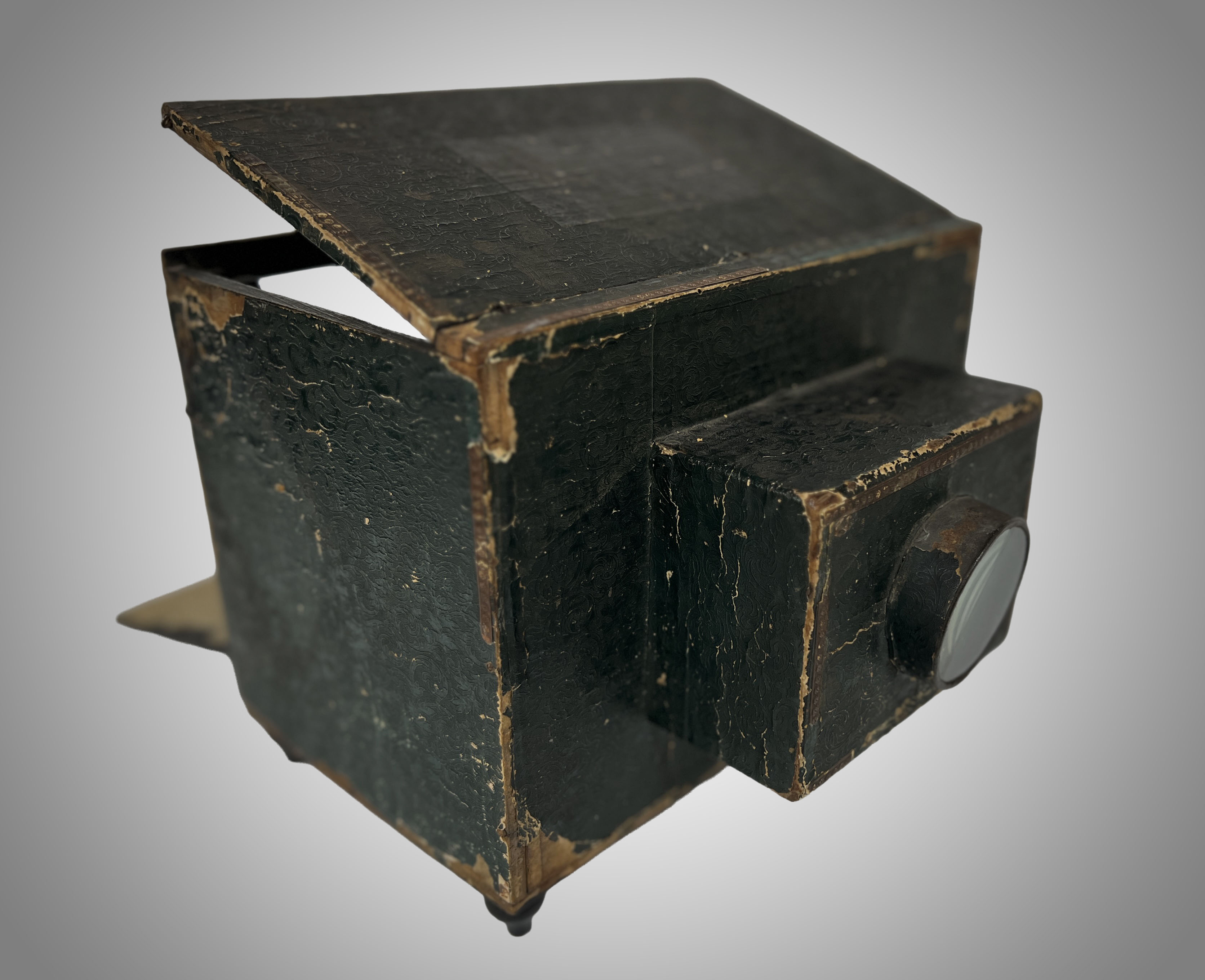 |
Figure M05119.1 – Dipoletti Scatola Dioramico |
| Photo © Ana Mendes. |
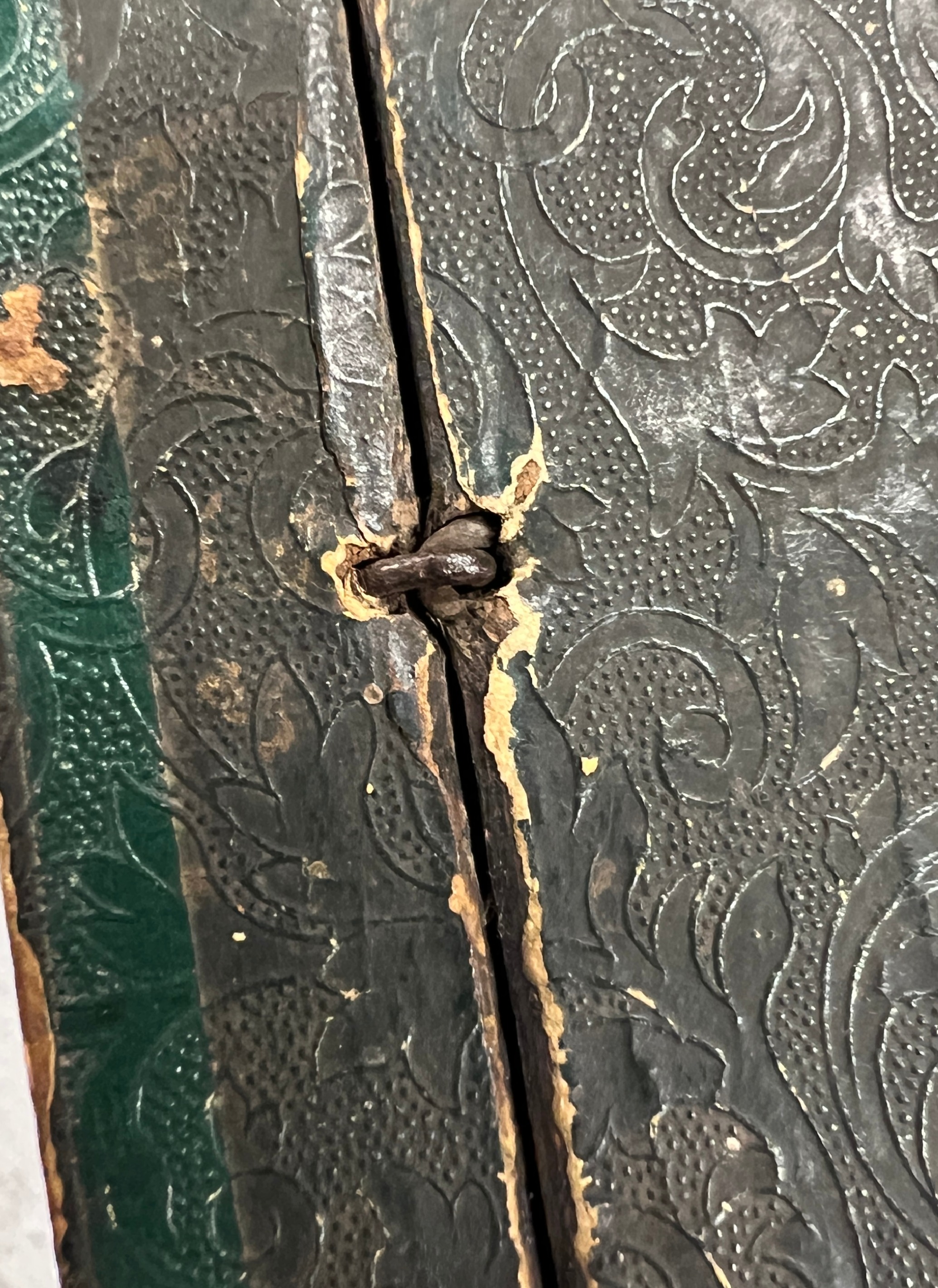 |
Figure M05119.2 – Wire Hinge |
| Photo © Ana Mendes. |
This is a small viewing-box for paper dioramas. It is an example of an "optical machine" and is included in the Optical Machine Taxonomy. It is a member of the genus Boite Dioramique in that taxonomy.
It bears a label indicating that it was made in Rome by Alexandre Depoletti. It is likely modelled after Henri Lefort's boxes for plaques dioramique. Depoletti does not use Lefort's bellows for lens adjustment, possibly to avoid patent infringement.
Illumination: Like all Boîtes Dioramique it has a back-flap for back-illumination of translucent paper dioramas and a top-flap for front-illumination, as well as a slot for inserting and removing the plaques dioramic.
The Lens: Like the Lefort boxes, it is for one-eyed viewing, so the 3D effect is weak. The focal length of his lens is also much longer than it should be for a 3D effect – the lens is too close to the image and that distance is not adjustable. The small-diameter lens is fixed in place by a tin frame.
Materials: The box is constructed with papered softwood. Lefort often uses green paper with an embossed grid pattern; Depoletti has used a very dark green with swirling-leaf motifs embossed in it. Latches and hinges are made of crude bent wire and affixed with nails (Figure M05119.2).
Italian optical machines, like the Mondo Niovo, and Alethoscope are often ornate, finely-crafted pieces of furniture. Depoletti here is following the 19th-century trend towards cheaply-made, lightweight boxes sold as toys or tourist souvenirs.
Images: The box is accompanied by ten plaques dioramique, in 14.5 x 20 format (?), depicting a selection of famous buildings and monuments in Rome. They may have been sold as "souvenirs of Rome" very like Lefort's boxes with "souvenirs de Paris" sets of images.
| • Roma, Arco di Tito | ||
| • Roma, Piazza Colonna e colonna di Marco Aurelio | ||
| • Roma, Piazza del Popolo con fontana della Dea Roma e Obelisco Flaminio | ||
| • Roma, Piazza del Popolo e chiese di Santa Maria in Montesanto e Santa Maria dei Miracoli | ||
| • Roma, Fontana dell'Acqua Felice | ||
| • Roma, Piazza San Pietro | ||
| • Roma, Santa Maria Maggiore | ||
| • Roma, interno della Basilica di Santa Maria Maggiore | ||
| • Roma, interno della Basilica di San Pietro | ||
| • Roma, interno della Basilica di San Giovanni in Laterano |
Endnotes:
[*] We would like to thank Raffaella Isoardi and Valentina Malvicino for making our research possible and assisting us in every way, as well as Antoine ... for assistance in the archives.