Rod Bantjes, “SL-26-01_Mini_Mono_Graphoscope.html,” created 28 July, 2026; last modified, 28 July, 2026 (https://people.stfx.ca/rbantjes/).
Miniature Mono-Graphoscope
Antiq Photo, Paris[*] #SL-26-01
France, ca.1895
Dimensions (open): H=14.6 cm, W=7.8 cm, D=14.6 Closed: H=2.7 cm, W=7.8 cm, D=13.6
Lens: ⌀=4.6 cm, ƒ=16.3 cm
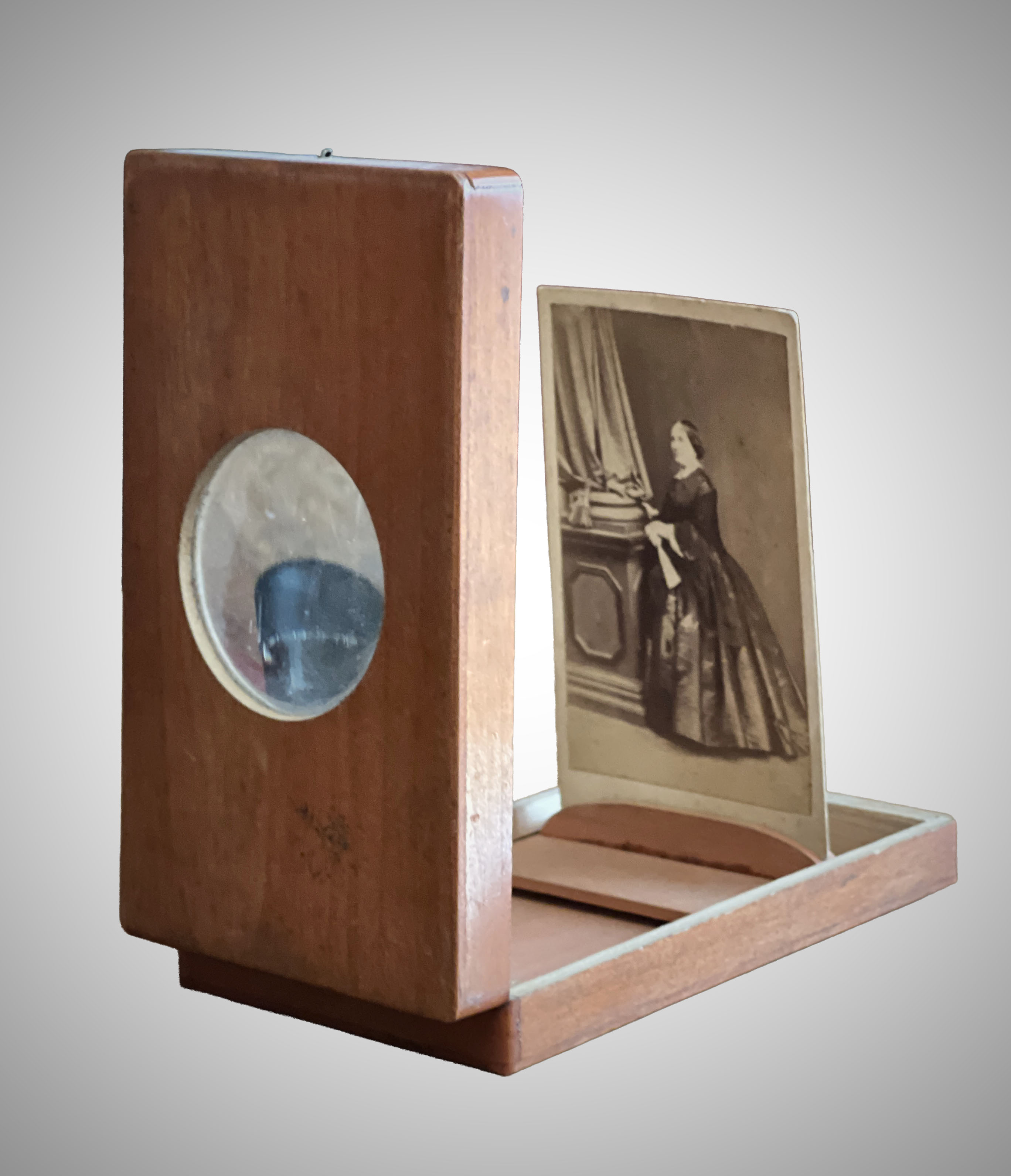 |
Figure SL-26-01.1 – Miniature Graphoscope |
| Photo © Rod Bantjes. |
Taxonomy: This object is the kind of thing that gives grief to those who love to categorize and delight to others who like to see categorization thwarted by the free and fluid nature of things. Its maker has clearly conceived it as a small graphoscope. In morphology it is identical to a mono-graphoscope. It has the single lens; the same folding cigar-box shape; the same sliding wooden image-holder. However in miniaturizing it, the maker has had to reduce the lens diameter and that has changed the way that the device functions. Instead of viewing through the lens with both eyes, an observer can only view with one eye and that changes the optical principles on which it works. It should for this reason be a different family of objects, but everything else about it says it is a graphoscope. So, we have decided to call it a sub-family of graphoscopes. We had previously defined a graphoscope as having “a large (> 8 cm), short-focus (< 40 cm) lens for viewing photographs.” This device is the only exception to that definition.[xxx]
Image-Format: The viewer was being sold with a stack of photographs. Measuring 9.1 x 5.6 cm (the photograph) on a 10.5 x 6.2 cm card, they are like miniature cartes de visite. While one possibility that occurred to us was that the device was meant to be a toy graphoscope, it seems more probable that it was purpose-built for this miniature image-format – a format that never became widely popular.
Endnotes:
[*] We would like to thank Sébastien Lemagnen and Romain Bourreau for allowing and assisting our measurement-taking.
[xxx] I considered quantifying the relationship between lens diameter and focal length, hoping that the mini mono-graphoscope might better fit. For other graphoscopes the ratio of diameter to focal length is .41 while the ratio for all binocular optical machines in our database is .21. So, on this measure, the graphoscopes are distinct. The ratio for the mini mono-graphoscope is .31. That is not close enough to the other graphoscopes to use this number as a defining feature of the family.