Rod Bantjes, “MNC-M01033_Mondo_Niovo_Domed.html,” created 5 March, 2026; last modified, 13 March, 2026 (https://people.stfx.ca/rbantjes/).
Mondo Niovo[xxx] Domed
Museo del Cinema Collection, Torino, Italy[*] #MNC-M01033
Italy, ca. 1750
Dimensions: H=102 cm, W=62.3 cm, D=89
Lens: ⌀=5.9 cm, ƒ=58.9 cm
The Mondo Niovo in General
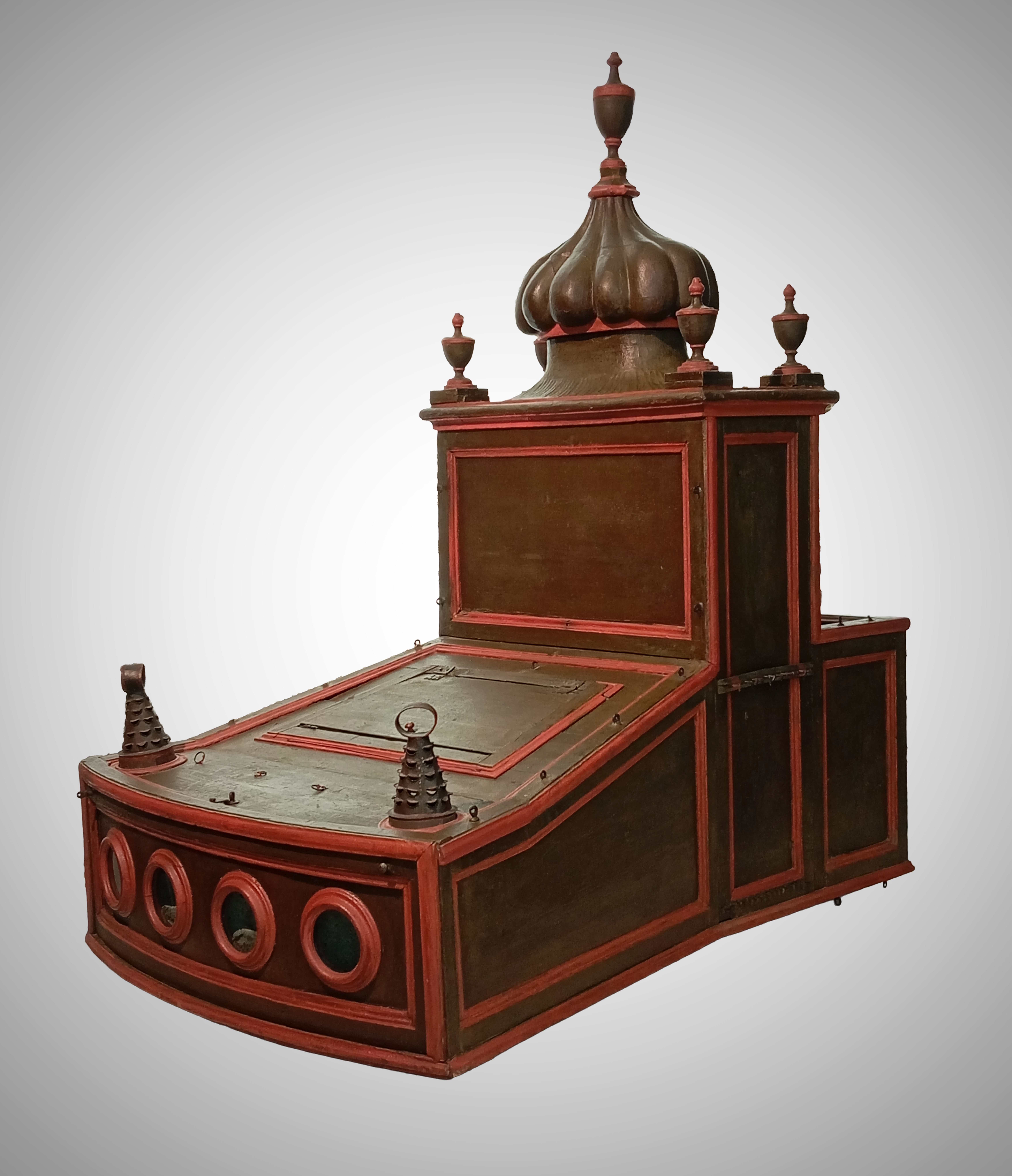 |
Figure M01033.1 – Mondo Niovo Domed |
| Photo © Ana Mendes. |
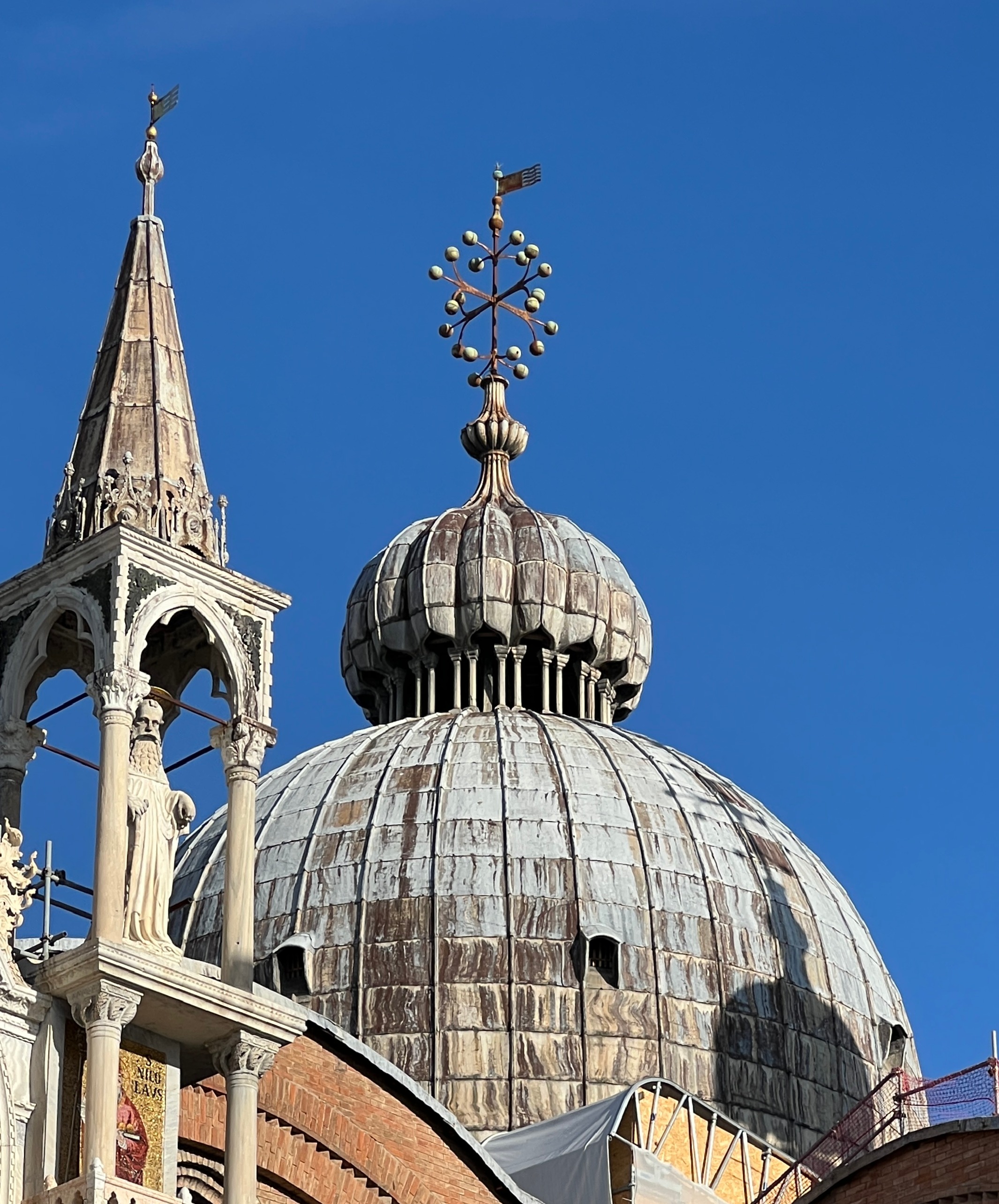 |
Figure M01033.2 – Dome of St. Mark's Basilica, Venice |
| Photo © Rod Bantjes. |
This is a Venetian-style multi-lens show-box for exhibiting pierced and illuminated vues d'optique. It is an example of an "optical machine" and is included in a genus "Mondo Niovo" in the Optical Machine Taxonomy.
The Mondo Niovo was the Italian version of the European Raree Show – a travelling spectacle popular in markets and fairs in the 18th century. Mondo Niovos always have three related features that are rarely seen together in the raree show:
| • a flytower above the central "stage" area; | |||
| • a front-section that fans out like the seating in a theatre toward a curved lens-array where the audience assembles to look inside; | |||
| • and a rear extension that has a flap and holds candles for back-illumination of the translucent images. |
The front-section's top-surface is downward-sloping and contains a top-flap for front illumination. The forward tilt helps to direct light back on to the front of the vue d'optique which falls like a back-drop on the stage.
For further discussion of the general features of these devices see the Mondo Niovo genus.
Description of this Box
Lenses: The four lenses are each just under 6 cm in diameter – too small to be looked through with both eyes. So the box can give only a mild enhancement of the 3D effect of its vues d'optique. The distance between the lens array and the images is close to the 18th-century theoretical ideal.
Remote Control: Not only is the raising and lowering of the vues d'optique string-controlled, but so is the front-candle illumination, internal lens-covers and probably also the front and rear illumination flaps. Conceived somewhat like a puppet or string-driven automaton, this optical machine was closer in its operation to the modern conception of a machine. The lines that actuated these motions are largely missing or have been replaced by thin, plastic-coated electrical wire. The physical remains of the original configuration are holes and eyelets through which lines were once threaded. The exact pattern is difficult to reconstruct.
Flytower: The flytower is the shallowest of the five mondo niovos that we have measured (20 cm as opposed to the average of 34 cm). The exit-holes for the pull-strings are hidden by a cornice. The pull-strings were grasped and secured by a ring-and-hook system. The hooks are irregular blacksmith-made iron. There are 13 hooks at the upper position on the left side of the box (this would be for the lowered position of each of the 13 vues d'optique. There are 16 hooks at the lower position (the raised position for the vues). The extra hooks are probably to secure lines for the other remote-control operations. We did not remove the domed cap of the flytower to see inside, so cannot comment on the stringer-rail or side channels.
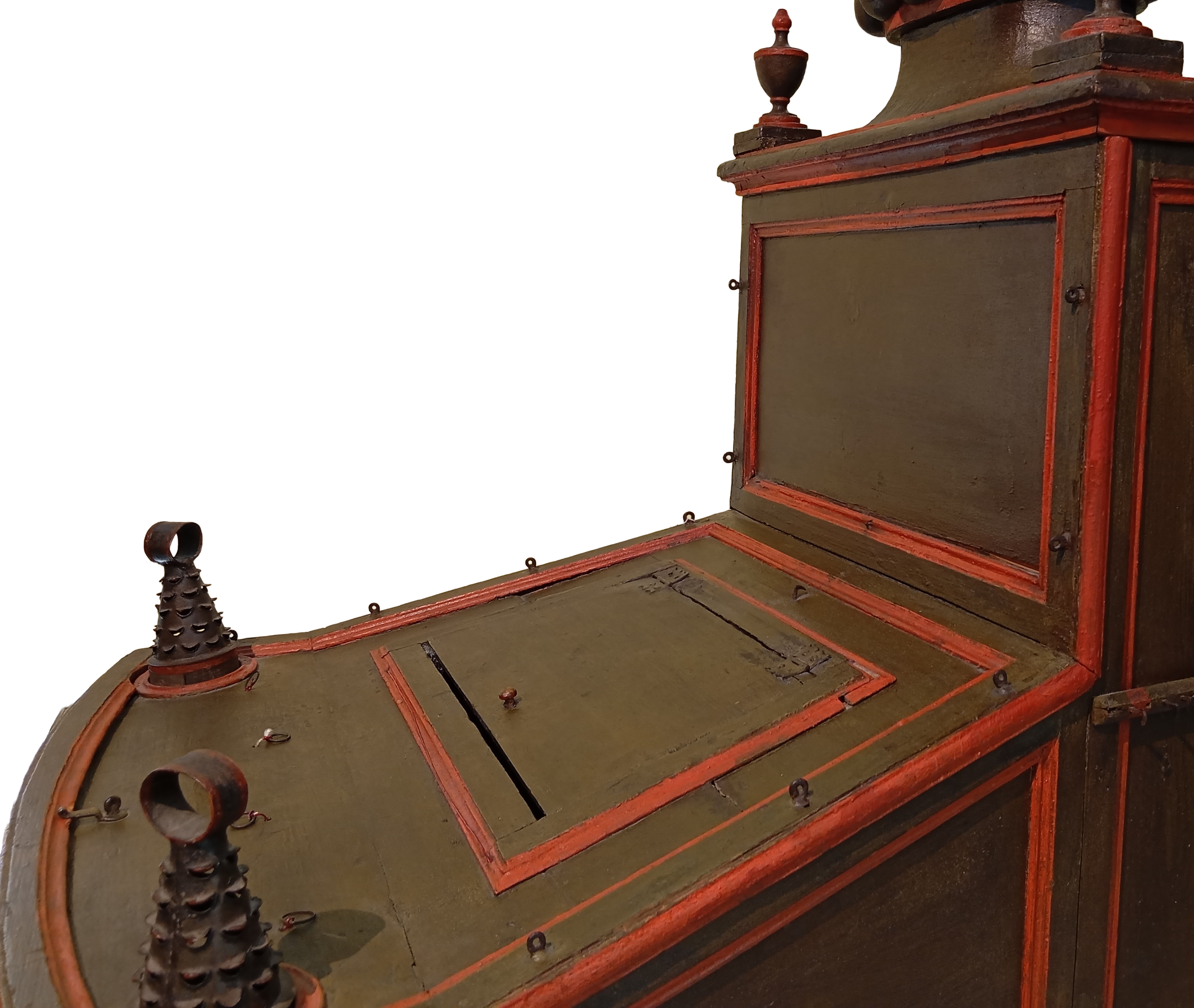 |
Figure M01033.3 – Closeup of Front Deck |
Note the multiple eyelets and the rings attached to hidden pull-strings along the lower deck. These pull-strings are to activate the internal lens-covers. Photo © Ana Mendes. |
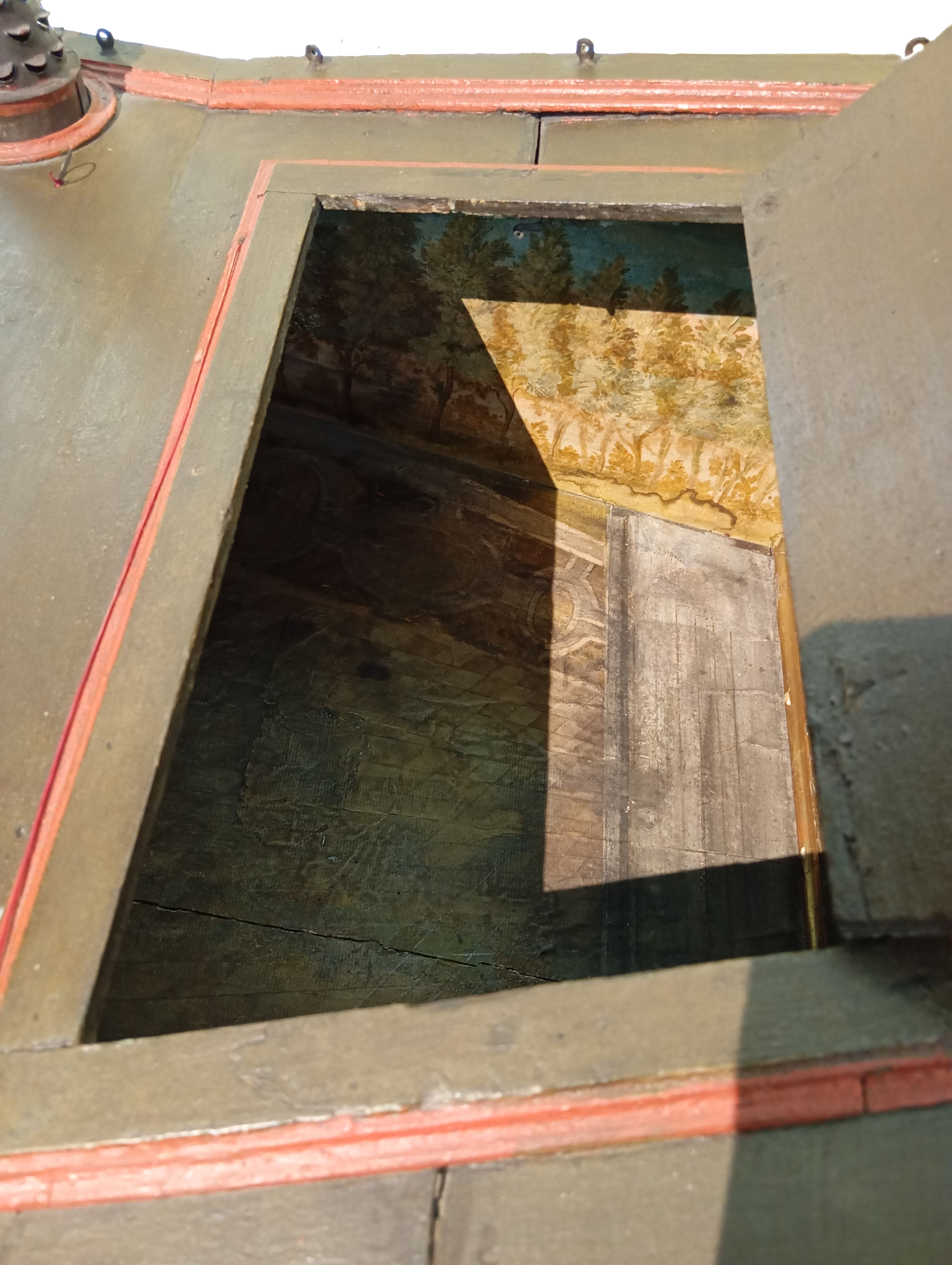 |
Figure M01033.4 – Audience Space from Open Front Flap |
You can see the orange-plastic draw-string to activate the candle-covers. It lies camouflaged along the lower, painted border of the opening. Photo © Ana Mendes. |
Illumination - Remote-Controlled Candles: Located behind the lens-array there are two candle-holders with elaborate chimneys for front-illumination. Instead of rotating to turn the lights on and off as in MNC-M01032, these tin holders have hinged cowlings that flip up. The bottom edge of the cowling is attached to a line which threads through a hole in the front-top, and down through another hole to the other light-cover. In this way their movement is synchronized. The external line was probably attached to a pull-string by means of a sliding ring. That line threaded through an eyelet at the front of the box and from there through a series of eyelets around to the operator's position at the left side of the box (facing forward towards the lens-array).
Rear Light-Box: This box is unique in offering two tiers of illumination to more evenly distribute the light for back-illumination. There are three candle-holders on each tier. There is also a back-flap for external illumination (e.g. natural light). Iron hardware on the flap and numerous eyelets on the light-box and back of the flytower (where they could offer upward leverage) all suggest that there was a pull-string system for raising and lowering the flap; however, its exact configuration is uncertain. The museum records indicate that 8 additional oil lamps came with this box. Perhaps they could have been used in place of the candles or else positioned for external illumination. We did not test these possibilities.
External Illumination - Front: The front-flap has a knob to lift it with. I suspect it could have been remote-controlled in the following way. Eyelets along the top edges of the box and front edges of the flytower face one another as though strings were meant to be pulled through them across the box. A string could be secured to the right-top eyelet on the flytower and threaded through the left top eyelet ending in a ring or hook for the operator to grasp. Another, let's call it the down-string, could be secured to the knob on the front-flap and thence up to the cross-string where it connects with a sliding ring. When the operator pulls the cross-string tight, the down-string is pulled up and the flap opens. I suggest a hook at the pull-end of the cross-string because there are so many little eyelets that it could be hooked into to hold the flap in its up or down position.
Automatic Lens-covers - Independent: Another unique feature of this box are the internal lens-covers whose purpose is to completely obscure the view through the lenses. The covers are tin disks that are hinged at the top with strings attached to the bottom edge – the same design as the candle-cowlings. As currently configured, the strings exit the box through the top-front where they terminate in separate pull-rings so that they can be opened or closed independently (Figure M01033.3). This setup suggested to us a means of controlling each customer's access or time at the lens. The operator might cut a customer off after a certain time and demand further payment to continue the show. The problem with this configuration is that there are no hooks close-by to secure each ring, and no plausible way to run all four strings over to the operator's side of the box.
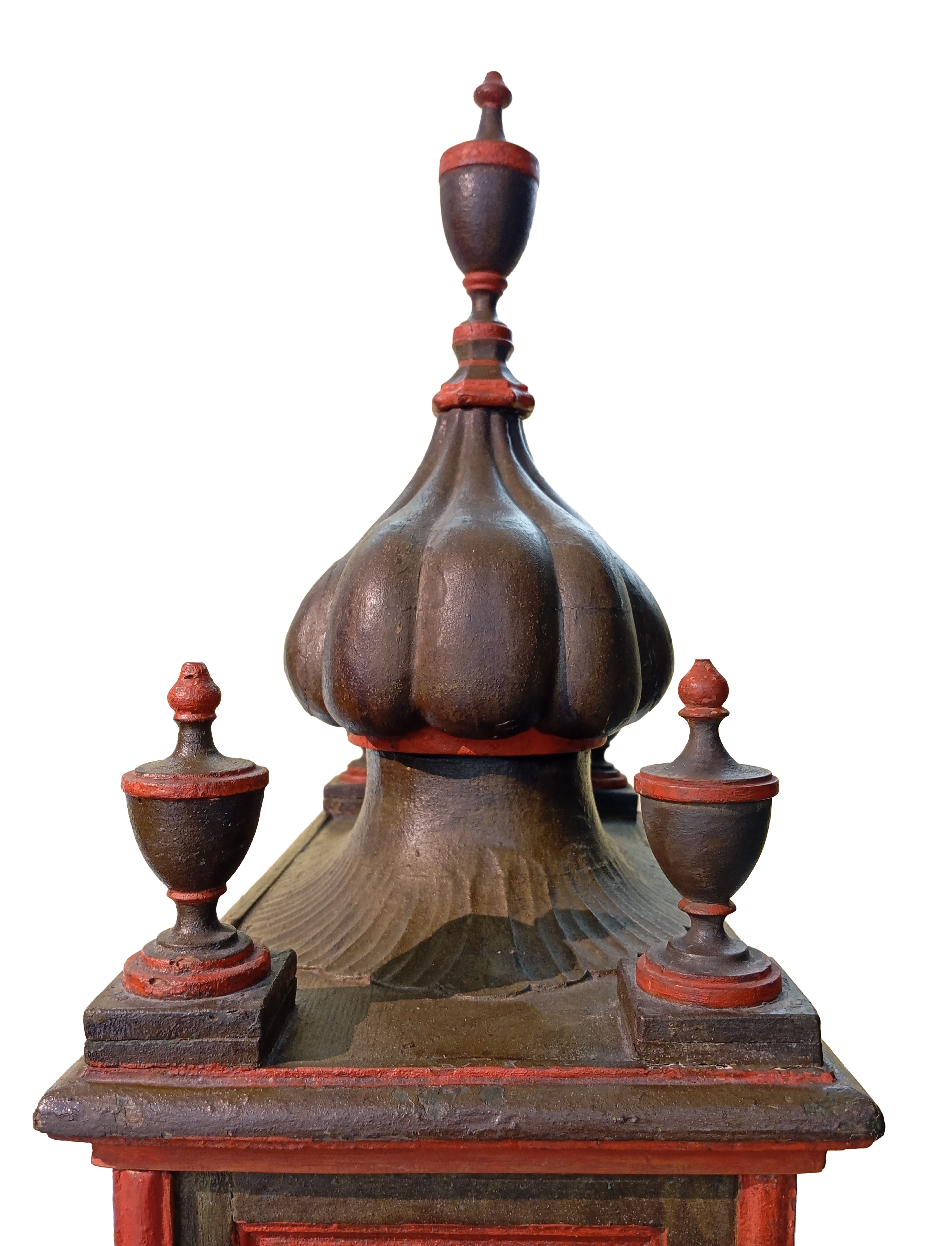 |
Figure M01033.5 – Closeup of Dome |
| Photo © Ana Mendes. |
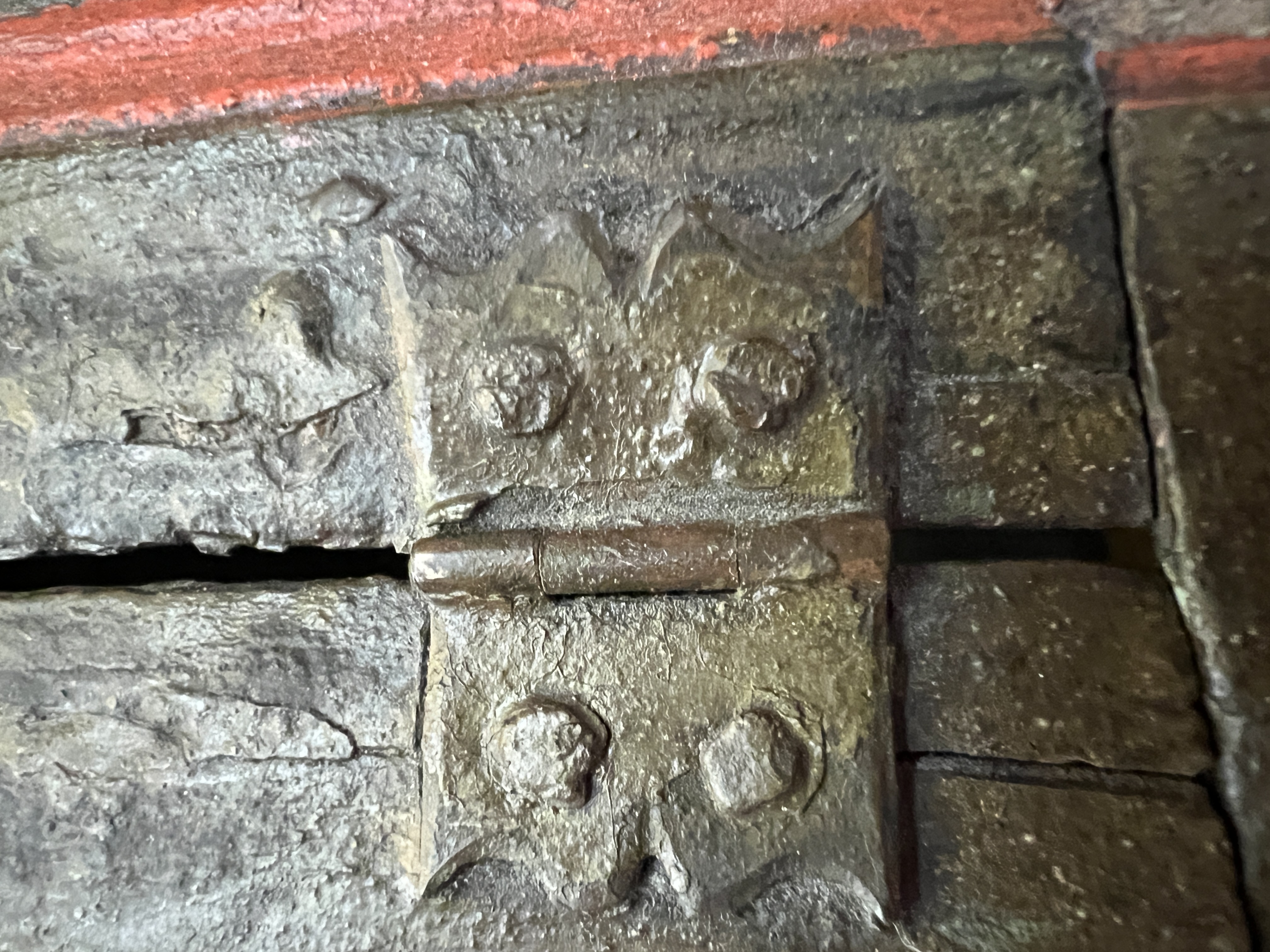 |
Figure M01033.6 – Hinge |
The hardware is fine blacksmith-made. Here the hinge is attached with hand-made nails. The box is encrusted from multiple re-paintings. Photo © Ana Mendes. |
Automatic Lens-covers - Synchronized: Instead it might be possible to lift them in the same way we have imagined lifting the front-flap. A cross-string could be secured to the third eyelet down on the right side of the front-top (Figure M01033.3) and strung across through all four rings and through the opposing eyelet on the left, or operator's side, terminating in another hook or ring for them to grasp. When pulled tight, the cross-string would lift all three down-strings simultaneously; when relaxed it would close all lenses simultaneously. This configuration suggests an alternate function – an obscuring of the view for scene-changes. It would be a hidden mechanism to hide the mechanism of the scene-change – i.e. the vues being raised and lowered on rigging – and increase the magic of the illusion.
Magic Performance: Seeing front- and back-illumination of well-prepared vues d'optique can be a wondrous experience of moving through time and changes of atmospheric mood. These effects combined with scene changes that moved the viewer from place to place must have been astonishing for a visually-naive public. When the mechanics were obscured and the operator's agency apparently transferred to the machine though a mysterious system of remote-control, the internal "new world" must have seemed animated by magic. People had trouble understanding the workings of standard show-boxes; this remote-controlled one must have been beyond most people's comprehension.
Other Automata?: There are so many eyelets attached to this box it is difficult to account for the function of all of them. The idea of the cross-string mechanism opens up other possibilities of function. It could have activated a jumping-jack automaton (what the French call a pantin) suspended from the front of the flytower. Figurines, puppets and automata were sometimes seen on Raree Shows. A simple string-driven puppet would be easy to imagine adding to a string-driven machine.
External Decoration: The box is painted military green with mouldings and accents highlighted in orange. It is topped with a carved wooden dome and urn-shaped, turned finials. The lobed style of the grand dome was unfamiliar to me, and I suspected I might find the model for it in Venice. Sure enough, I spotted it in St. Mark's square atop the Basilica (see Figure M01033.2). This is one of many visual claims to affinity with religious buildings that can be found on optical machines. The dome ties this box to a particular place. We can imagine it having been set up in what to us is a distant and almost mythical location, St. Mark's Square over 200 years ago, where it beckoned to people as a magic entry-portal into to other worlds.
Internal Decoration: The interior "audience space," which fans out from the stage like theatre-seating to where the audience looks in through the lens-array, is more muted in decor than that of other mondo niovos (e.g. MNC-M01034, MNC-M01032). The sides are hand-painted images, on 18th-century laid paper, of lines of trees. The floor has a kind of tiled pattern, like MNC-M01032. Its colours are greyed over, and there is evidence of water damage. The box may have been caught in a downpour. It is difficult to imagine how these boxes avoided such damage over decades, sometimes centuries, of outdoor use.
Portability: The box is no larger than others that we know to have been carried on the back. We were not able to weigh it, but the solid-wood dome, and the distance it would extend backwards, would make this a difficult carry. It is always easier to carry weight close to the body.
Endnotes:
[*] We would like to thank Raffaella Isoardi and Valentina Malvicino for making our research possible and assisting us in every way, as well as Antoine ... for assistance in the archives.
[xxx] The name means "new world" in Italian, perhaps because it introduced people to new worlds, including the distant Americas. The spelling with an "i" is Venetian and we use it (as opposed to Mondo nuovo or mondo novo) because this style seems to be uniquely Venetian.