Rod Bantjes, “MNC-M01039_Polyorama_20.html,” created 1 March, 2026; last modified, 1 March, 2026 (https://people.stfx.ca/rbantjes/).
Polyorama 20
Museo Nazionale del Cinema Collection, Torino, Italy[*] #MNC-M01039
France, 1849
Dimensions: H=17.2 cm, W=21.8 cm, D=37
Lens: ⌀=4.7 cm, ƒ=32.5 cm
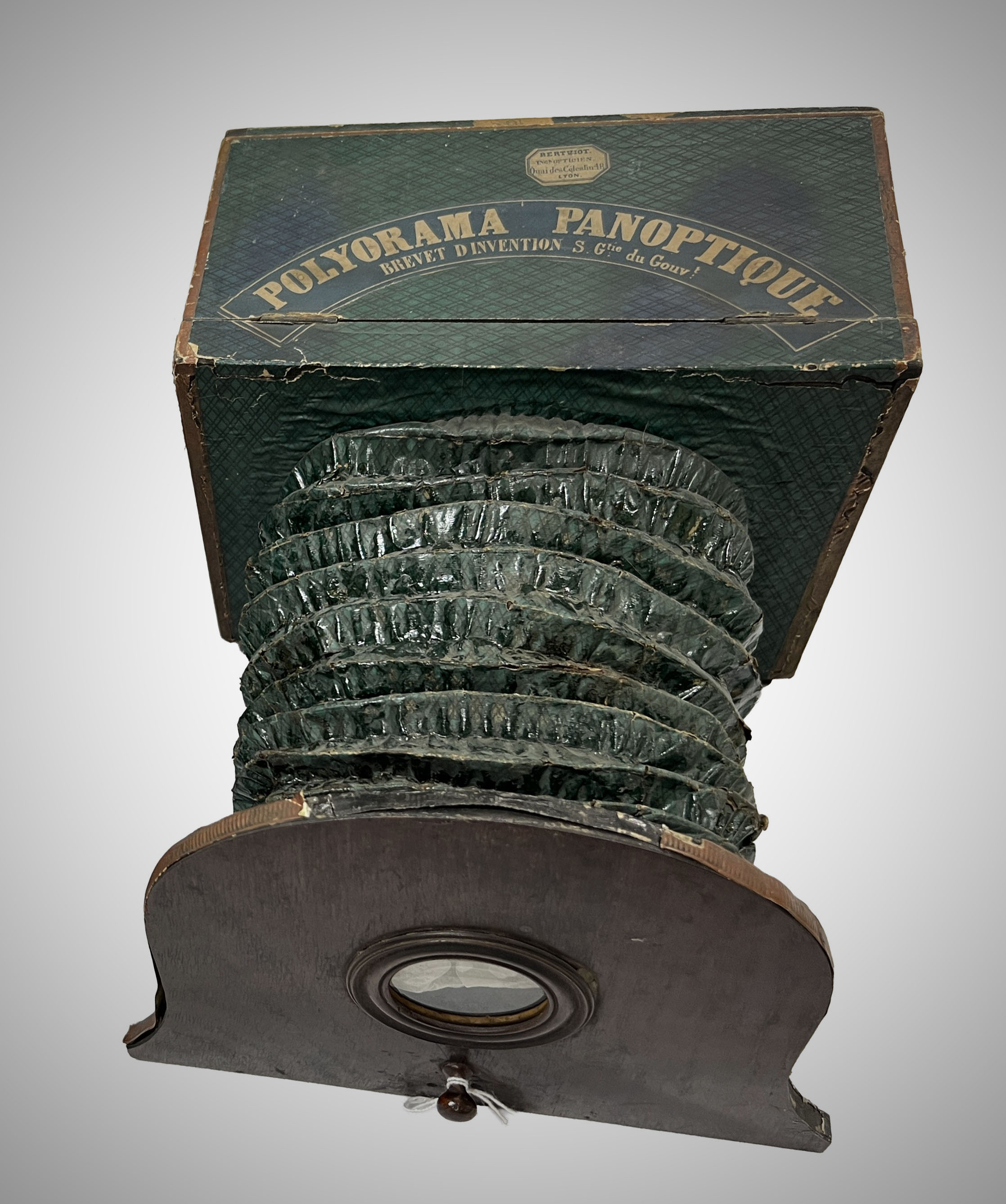 |
Figure M01039.1 – Polyorama 20 |
| Photo © Rod Bantjes. |
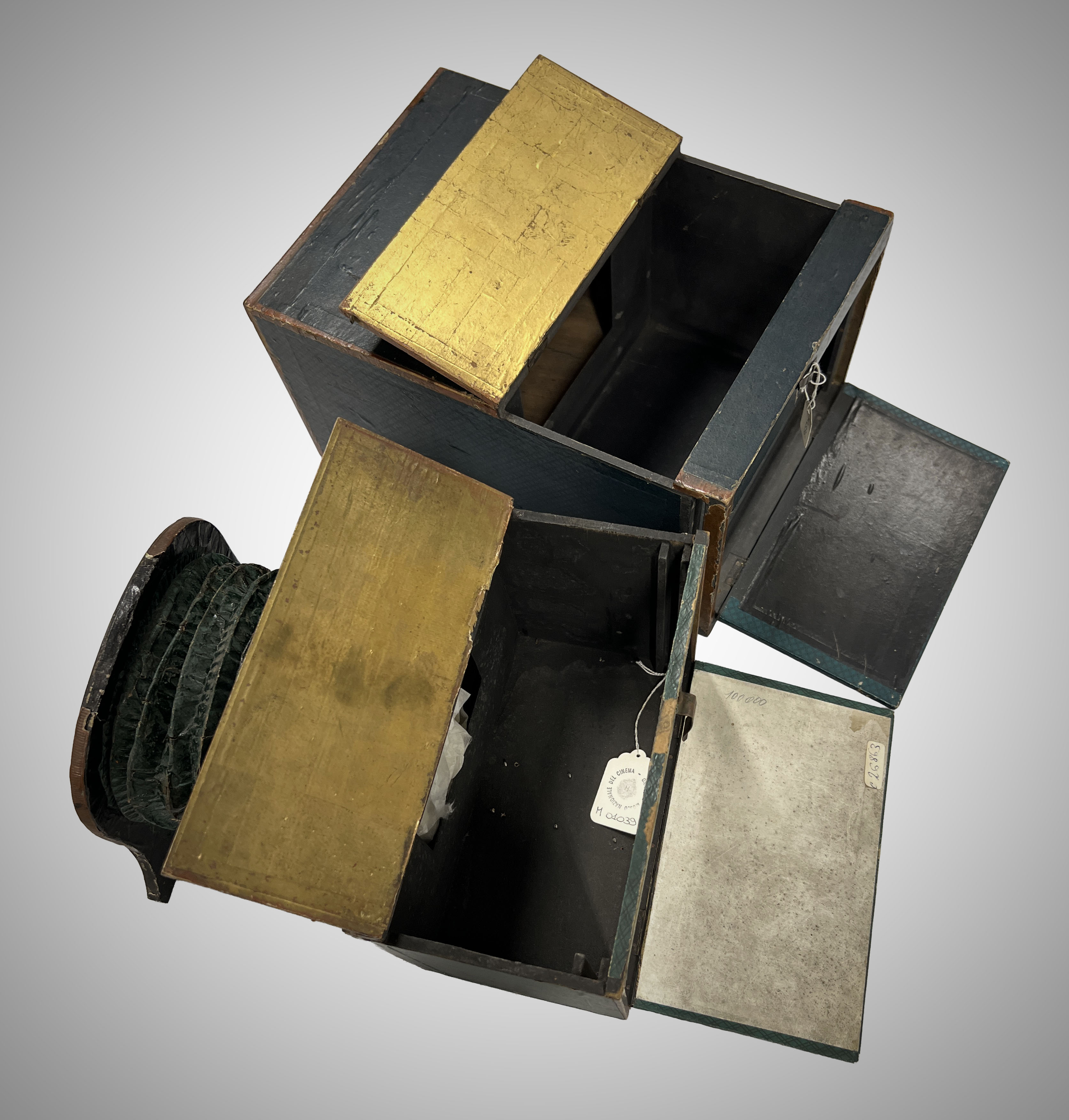 |
Figure M01039.2 – Polyorama 20 |
| MNC-M01039 (bottom) beside MNC-M04936 showing their reflective flaps.
Photo © Rod Bantjes. |
This is a viewer for paper dioramas characterized by the soft bellows for adjusting the viewing lens. It is the "medium" sized Polyoramas Panoptique, taking a 14.5 x 20 cm plaque dioramique. It is an example of an "optical machine" and is included in the Optical Machine Taxonomy.
It has typical features of Polyoramas Panoptique:
| • synchronized top and back flaps to control the lighting and bring out the transformations in the plaque dioramique; | ||
| • a bellows that allows for adjustment of the lens position (not focus); | ||
| • a small lens for one-eyed viewing (therefore a weak 3D effect); | ||
| • softwood body with green patterned paper (this box has a similar thin lozenge pattern to WN-GT135; | ||
| • a lens-frame turned in wood with a distinctive pattern: two double ridges separated by a cove or valley (see MNC-M03371). |
This box, along with MNC-M03371 and MNC-M04936 (Figure M01039.2) has a top flap with a reflective surface of gold-coloured foil. Lefort seems to have wanted the front-illumination to have a warm, sunset glow. Note that the back flap is silver-foiled.
For more on Polyoramas Panoptique you can read my discussion of the one in the Bill Douglas Cinema Museum in Exeter, UK.
Endnotes:
[*] We would like to thank Raffaella Isoardi and Valentina Malvicino for making our research possible and assisting us in every way, as well as Antoine ... for assistance in the archives.