Rod Bantjes, “DFF-90-A-354_Kulissentheatre.html,” created 9 August, 2025; last modified, 9 August, 2025 (https://people.stfx.ca/rbantjes/).
Horizontal Kulissentheater
Deutsches Filminstitut & Filmmuseum (DFF)[1] #DFF-90-A-354
German c.1750
Dimensions: H=14.5 cm, W=15.4 cm, D=47.5 cm
Lens: ⌀=3.6 cm, ƒ=39.3 cm
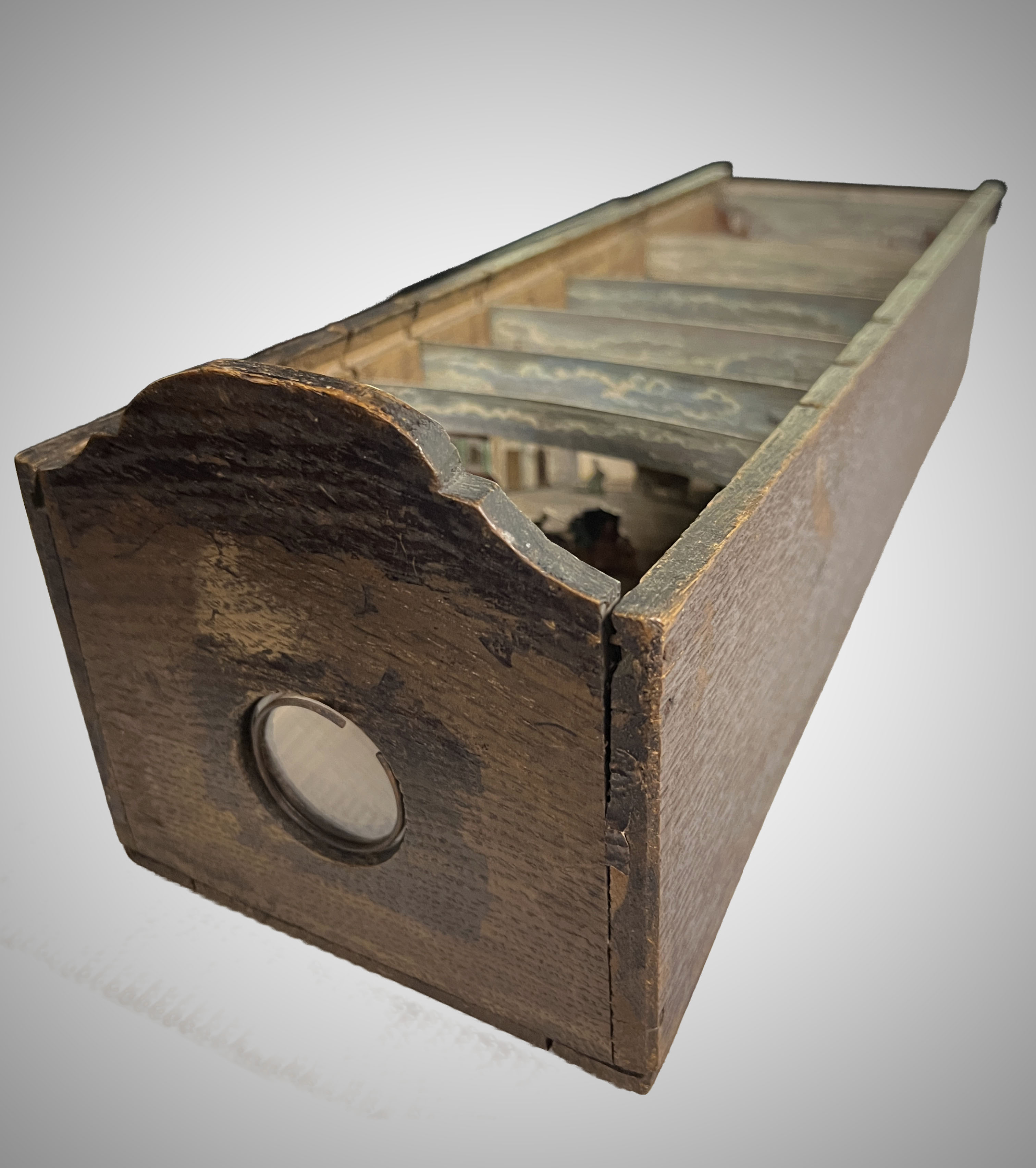 |
Figure 354.1 –Engelbrecht Horizontal Kulissentheatre |
| Photo © Rod Bantjes. |
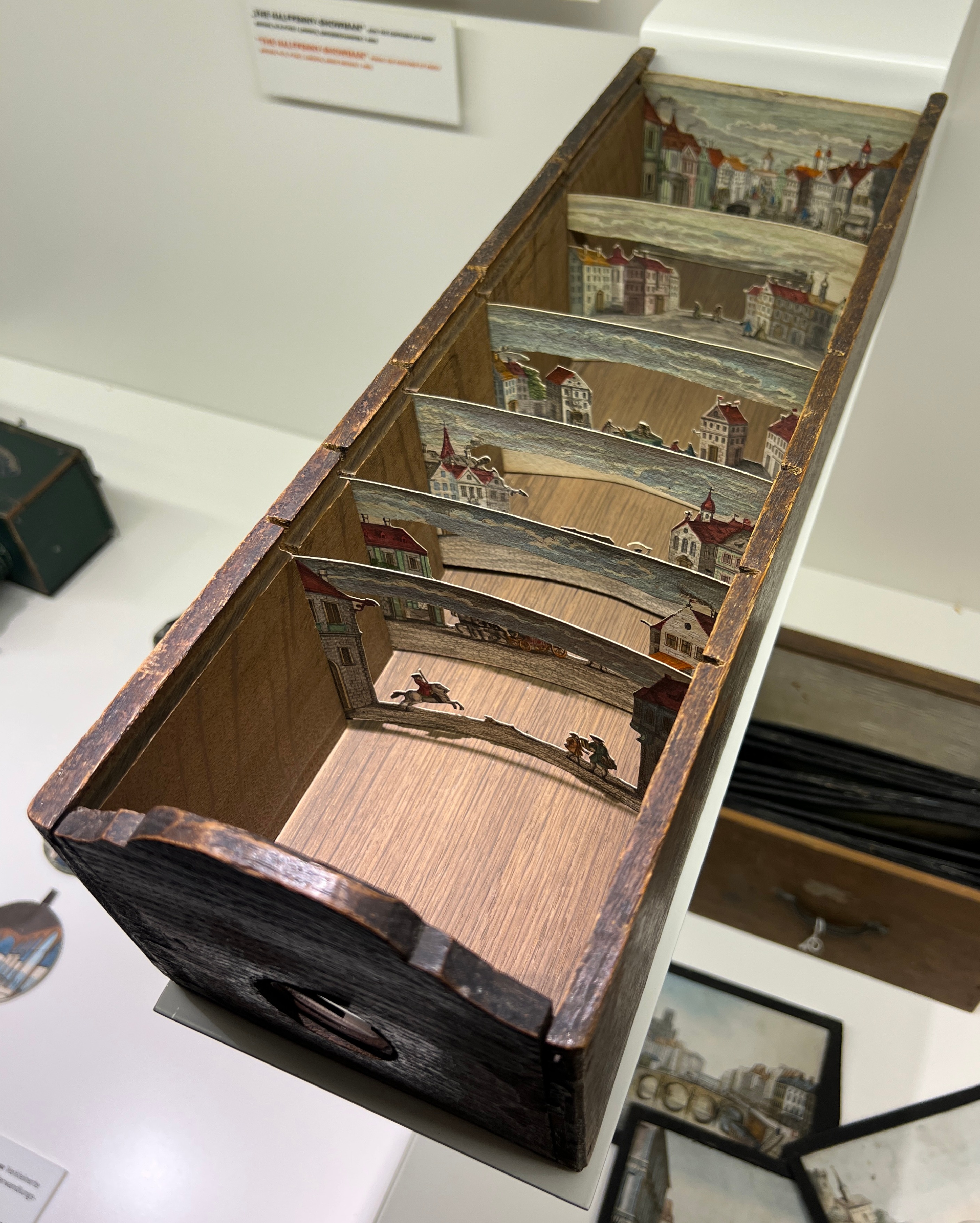 |
Figure 354.2 –Showing Coulisse Frames |
| Photo © Rod Bantjes. |
This is a horizontal small-lens viewer for cutout images arranged like the coulisses of the theatre. It is an example of an "optical machine " and is included in the Optical Machine Taxonomy. It is part of the genus Horizontal Kulissentheatre
This box holds a set of 5 coulisse frames and a backdrop which together comprise a single 3D scene. Scenes were interchangeable, and the Engelbrecht workshop produced around 200 sets of different subjects: religious, landscape and architectural views and scenes of everyday life.[2] A depiction of a city street has been slotted into this box.
The coulisse-frames are widely spaced, unlike in a perspectiefkast for instance, so as to increase the parallax effect when the observer moves her head side-to-side in front of the small lens. Watching the skydrops, depicting low-lying clouds, move in relation to one another gives a particularly strong spatial effect in this box.[3]
Image-sets came in three sizes, for three different sized boxes. This is an example of the medium-sized box, designed to be cheaply and simply manufactured so as to be affordable to as wide a clientele as possible. There is no complex joinery, no lathe work, not even for the lens frame. With the exception of the simple curve on the front face, there is no decoration. Hardware is minimal: nails sparingly used (possibly to repair a glued join); a brass ring to secure the lens.
Engelbrecht's small and medium viewers are early examples of the miniaturization of the optical machine. Their scale and simplicity suited them better for household use rather than public performance. They were likely affordable to families of the "middle classes" – a category which included what we would now call professionals – doctors, state officials, lawyers – but also probably petty-bourgeois[4] merchants and craftsmen like the Engelbrechts themselves.
While the large-sized boxes had lenses wide enough to see through with both eyes, like all other 18th-century optical machines, the rest of Engelbrecht's kulissentheaters do not. That means that they rely less on the lens than on the coulisses for their 3D effect. The binocular 3D effect of the wide lens is demonstrable; the monocular effect of these small lenses is doubtful.
For a more extended discussion of the design and function of the kulissentheater as well as more on the Engelbrecht workshop, see the vertical kulissentheater in the Werner Nekes collection.
Endnotes:
[1] I would like to thank Stefanie Plappert for her assistance at the DFF – Deutsches Filminstitut & Filmmuseum..
[2] Füsslin, Georg, et al., Der Guckkasten : Einblick, Durchblick, Ausblick (Stuttgart: Füsslin, 1995), 49.
[3] The coulisse frames are spaced in the same way as in the vertical kulissentheater : progressively further apart the further they are from the observer. The intent here may have to do with Engelbrecht's understanding of the focus of the eye, or of how the parallax effect should work within the scene (or both). The question bears further investigation..
[4] That is, they own their means of production and do the work themselves along with family members and a handful of employees..