Rod Bantjes, “EXBD-69117_Graphoscope-Stereoscope.html,” created 9 August, 2025; last modified, 9 August, 2025 (https://people.stfx.ca/rbantjes/).
Graphoscope-Stereoscope
Bill Douglas Cinema Museum[1] #EXBD-69117
English c.1860s
Dimensions: H= cm, W= cm, D= cm
Graphoscope Lens: ⌀=9.8 cm, ƒ=20 cm
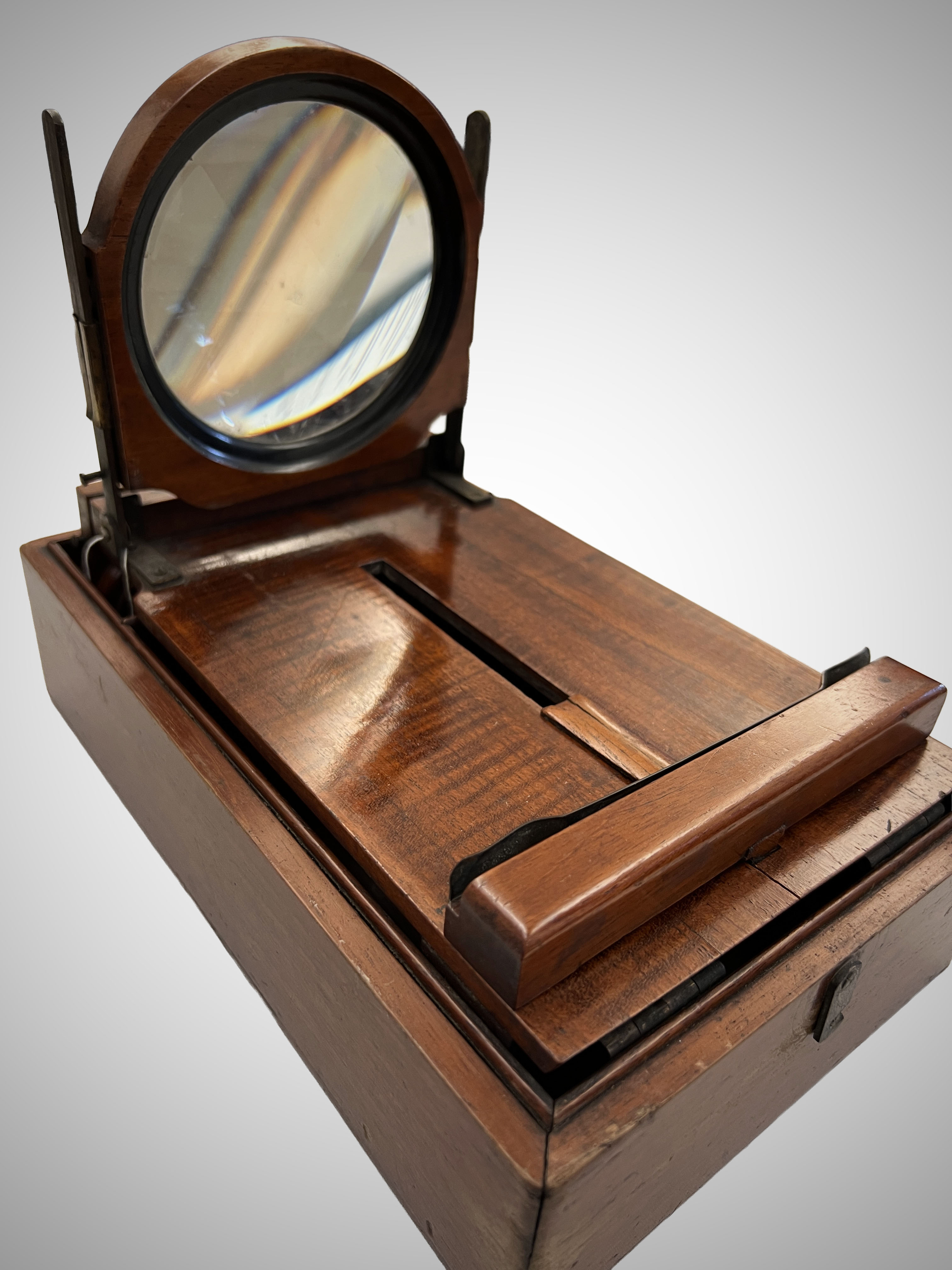 |
Figure 69117.1 –Graphoscope-Stereoscope |
| Shown with the graphoscope lens in place. Photo © Rod Bantjes. |
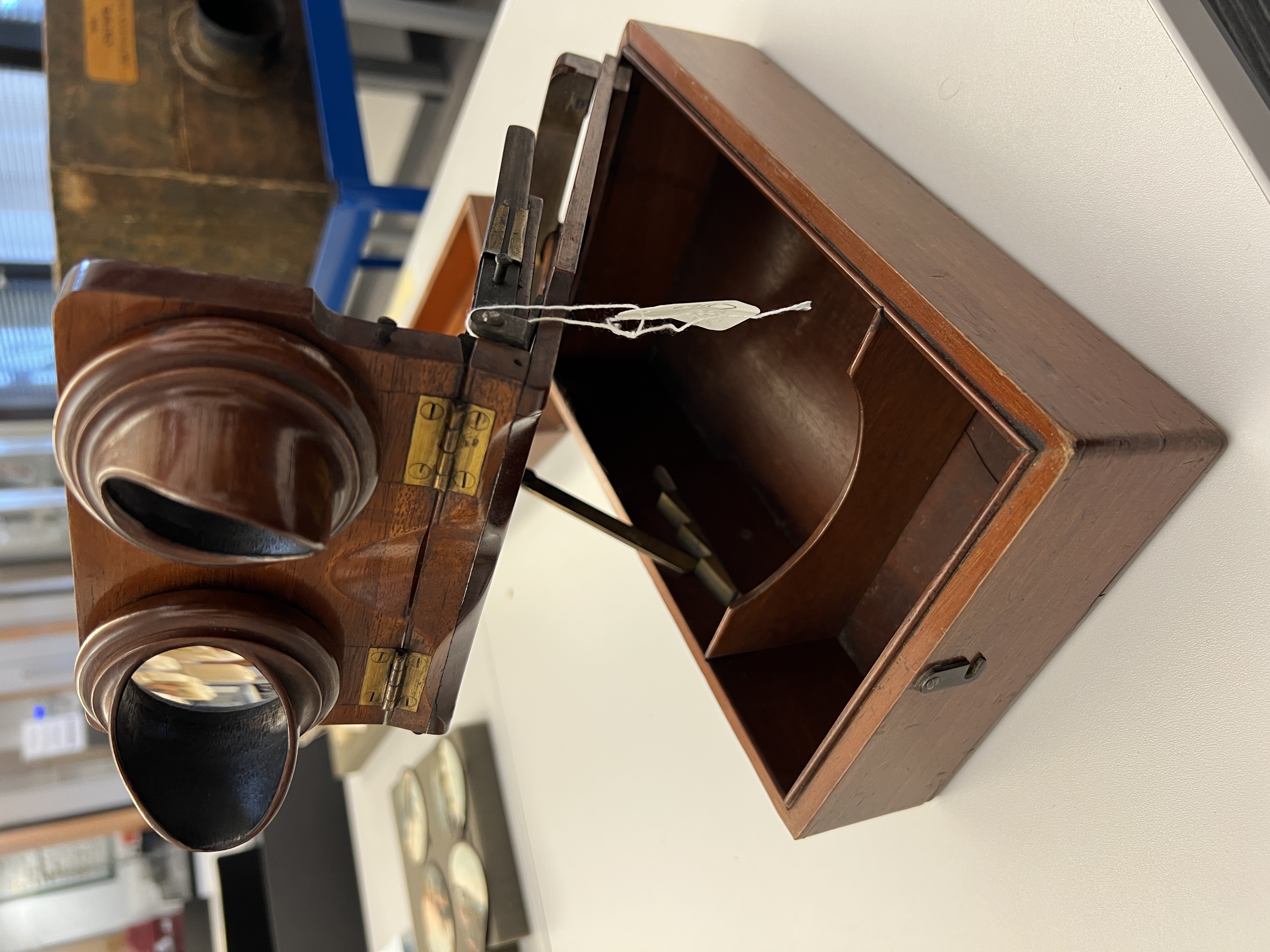 |
Figure 69117.2 –Stereoscope Element |
| The graphoscope lens is folded down and the stereoscope lenses folded up in its place. Photo © Rod Bantjes. |
This device combines an 18th-century 3D technology – the large biconvex lens – with a 19th-century one – the stereoscope. It is an example of an "optical machine" and is included in the Optical Machine Taxonomy.
The graphoscope has a single biconvex lens through which one looks with both eyes at a single image. It works on the same principle as the peepshows and zograscopes of the 18th century, except that instead of a large copper-plate engraving or vue d’optique, one looks at a smaller image, typically a photograph or carte de visite.
The graphoscope lens folds down so that a pair of stereoscope lenses can be erected in its place (Figure 69117.2). These lenses direct each eye to one of two slightly different images taken at slightly different angles – one from the left (for the left eye) and one from the right (for the right eye).
Charles John Rowsell received a provisional patent for the device in 1864. However he failed to extend patent protection, and his complaint in 1870 that other manufacturers were copying his design tells us perhaps about his regret, but also that his device had become popular in England at that time.[3] This example is made of hardwood (probably mahogany) with sturdy brass fittings and good-quality craftsmanship. Higher-quality examples can be found with carved elements and ivory accents. These were clearly intended for a well-to-do bourgeois market.
In the 1890s the French produced simpler, cheaper 'souvenier' models out of lighter woods, covered in papier maché and lacquer, with lighter hardware.
The graphoscope was one of a cluster of devices, including Carlo Ponti's Alethoscope and Megalethoscope, and Francis Frith's Cosmoscope, designed in the 1860s for the 3D viewing of photographs. The unprecedented fine detail of photographic images allowed makers to use lenses with short focal lengths which magnified the image surface and would have exposed the imperfections of the engravings that had formerly been used in such devices. Shorter focal lengths meant a shorter distance between lens and image and smaller devices than the 18th-century predecessors.[4] Rowsell, Ponti and Frith returned to large lenses typical of 18th-century optical boxes that allowed viewing with both eyes and a much more powerful 3D effect.[5]
In the first half of the 19th century, just prior to the introduction of these devices, most private-use optical machines had been made as children's toys using cheap materials and monocular lenses (see for example the popular Polyorama Panoptique ). The quality of cabinetry of many graphoscopes marks these as more 'serious' devices serving the universal craze for photographic images. Like the stereoscope, these were probably intended for use by all family members, and visitors, within bourgeois households.
The mixing of graphoscope and stereoscope makes this an "inter-media hybrid." Why designers from Charles Rowsell (1864) onward insisted that the 18th-century 3D-technology of the biconvex lens had to have a place side-by-side with the 19th-century (and to my mind far superiour) 3D-technology of the stereoscope is curious and calls for explanation. It may have been that tastes in imagery changed with the growth in the carte de visite format while the fad for stereoscopy waned.
Endnotes
[1] I would like to thank the Bill Douglas Museum for a stipend that supported my research there and the staff of the museum for their generous assistance..
[2] Judge, Arthur William, Stereoscopic Photography, Its Application to Science, Industry and Education, (London: Chapman & Hall Ltd., 1926), 139..
[3] British Journal of Photography, Vol. 17, No.506, (January 14, 1870), p.14.
[4] On the question of photography and the miniaturization of optical machines see my post "The Optical Machine: Miniaturization, Portability, Privatization".
[5] For an explanation of the different ways that monocular and binocular lenses were thought to enhance a 3D effect, see my post "Explaining 18th-Century 3D Illusions".