Rod Bantjes, “MNC-0267_Bioscope.html,” created 6 September, 2025; last modified, 6 September, 2025 (https://people.stfx.ca/rbantjes/).
Bioscope
Museo Nazionale del Cinema Collection, Torino, Italy[*] #MNC-0267
India, ca. 1940
Dimensions: H=51 cm,[xxx] W=73.9 cm, D=41 cm
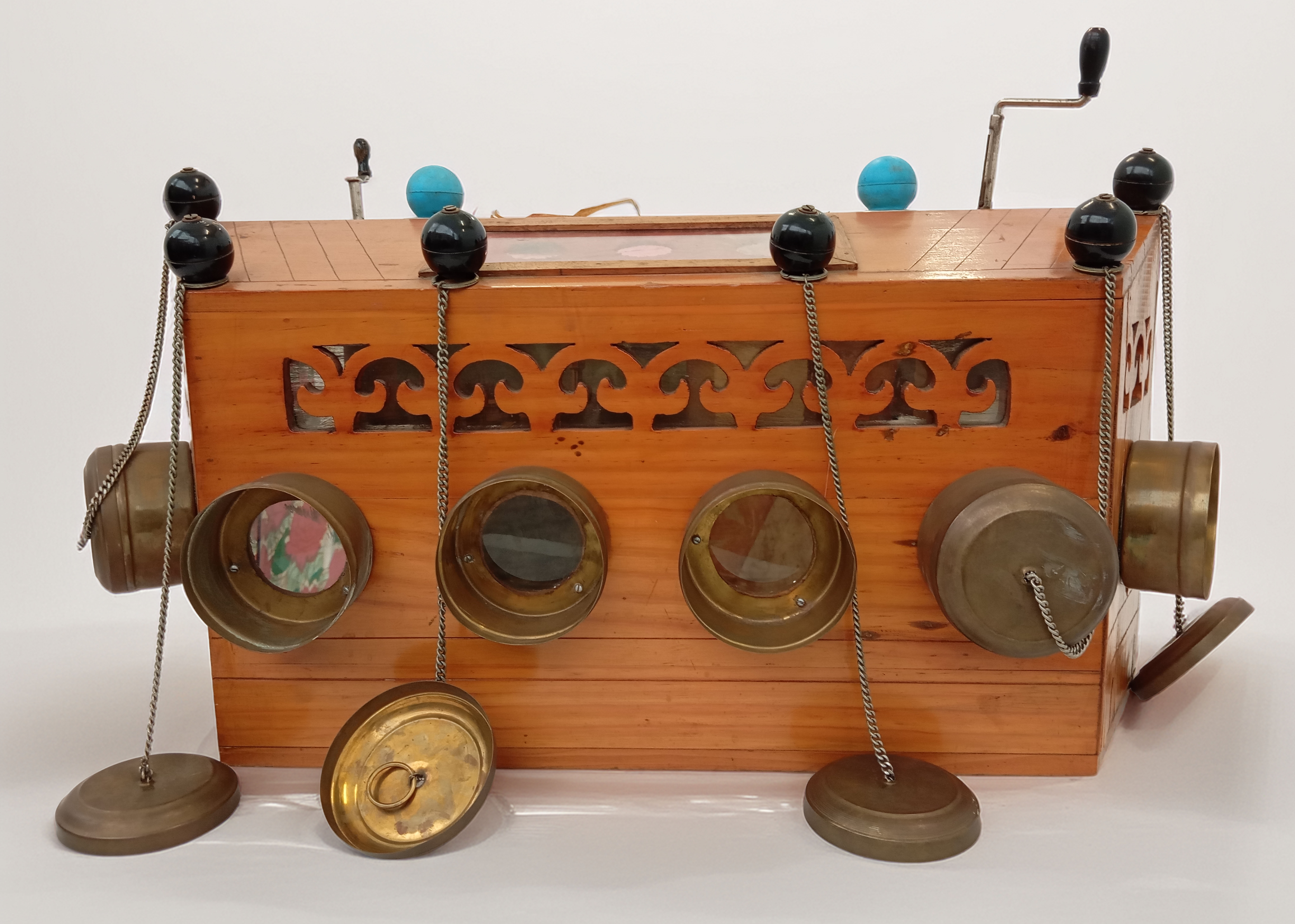 |
Figure MNC-0267.1 –Bioscope |
| Image © Ana David Mendes /Rod Bantjes. |
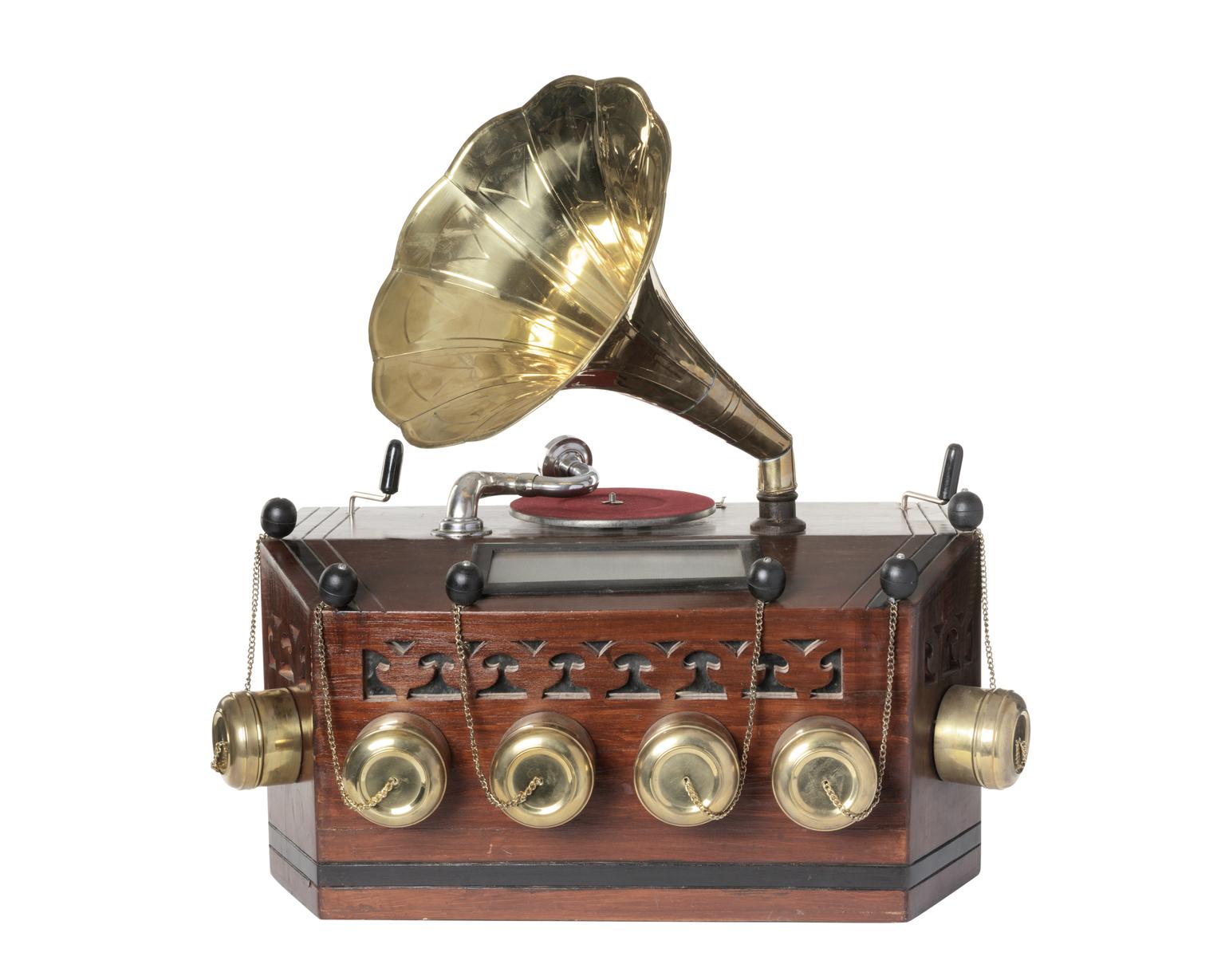 |
Figure MNC-0267.2 – 21st-Century Bioscope |
| This bioscope was manufactured in India in 2017. It is part of the collection of the London Science Museum. Image © London Science Museum. |
This is a multi-lens 3D viewer of a roll of images. It was once equipped with a hand-cranked gramophone (see Figure MNC-0267.3). This makes it a species of gramophone bioscope. There are three documented cases in the Optical Machine Taxonomy: this one, which is Indian; a European one (WN_2187); and a newly-constructed one in the collection of the London Science Museum (SML-2019-257).
Structure: The three bioscopes are identical in structure down to details like the decorative lines incised into the wood: parallel lines on the top and front, a lozenge-shape on the sides. They have six lenses – four across the front and two angled side-lenses. The top of the box slopes down towards the lens-array like a Mondo Niovo. This sloped surface contains a translucent plate, apparently made of plastic, that helps to illuminate the images. Further illumination is provided by a wooden grill with a repeating palm-tree-like motif. The lens-frames are tin with tin lens-covers attached by light chains to decorative balls along the top edge of the device. Bioscopes are the only optical machines that have these external lens covers.
Lenses: The six lenses of the Museo Nazionale del Cinema box vary considerably in focal length. Three of them are close to what the 18th-century theorists recommended: equivalent to the distance from the lens to the image-plate. One is longer by 14 cm and the two side "lenses" are not lenses at all but rather flat pieces of glass with no focal length. Whether these were as-manufactured or replacements for broken or lost lenses, their use points to a disregard for the 3D function of optical machine lenses.[xxx]
While the lenses are just wide enough to fit our definition of "binocular" (> 6 cm), children typically peep into them with only one eye, cupping both hands around the lens-casing to minimize glare.[xxx] By this means they would only be getting a monocular 3D effect which, if it exists at all, is very weak.
Regarding the supposed 3D or immersive effect, Sarower Reza, who studied bioscopes and bioscope-wallahs in Pakistan, writes as follows:
| I didn’t find any of the showmen claiming anything about the 3D effect or immersive effect of their show, to be honest. The oral narratives also don’t quite support this type of claim from the showmen. [The only claim they make] translated literally [is] : “What a strange view you see …”. This is the common catch line for all the songs/narrations and comes by rotation in every performance.[xxx] |
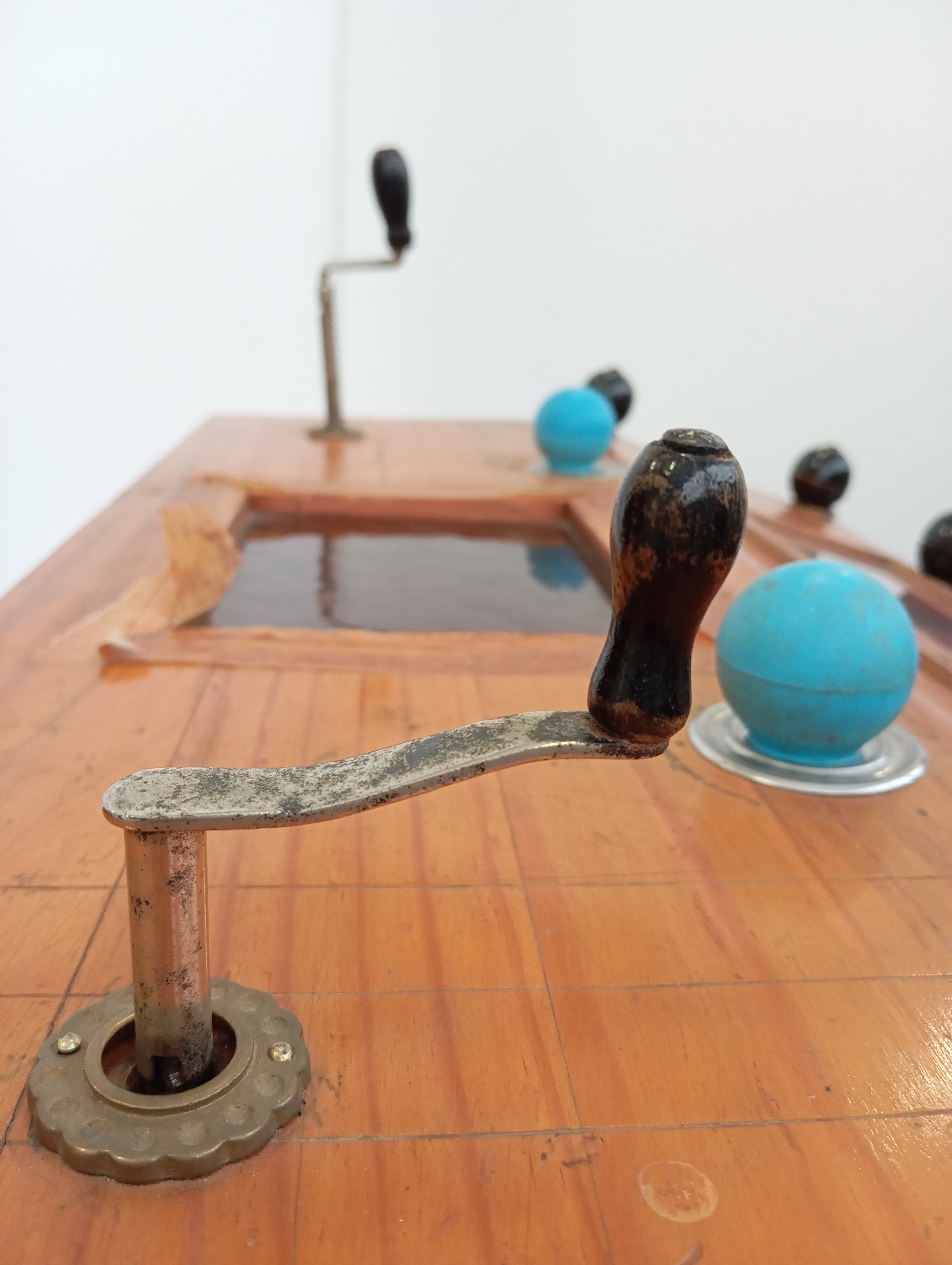 |
Figure MNC-0267.3 – Bioscope Top View |
| The window with fake adhesive wood-grain covers the opening for the gramophone mechanism. The blue plastic balls cover the mounts for the tone-arm and horn amplifier.Image © Ana David Mendes. |
Indian Adaptations: Indian bioscopes have, according to some authors, "followed a path of localized adaptation" as the showmen or bioscope-wallahs repair, modify and adapt them using recycled and found materials. Some of that innovation can be seen in examples on our bioscope page: they have splendid, brightly-coloured decoration, are mounted on what appear to be the remains of old baby-carriages (BP_GR_3), are enhanced by found parts (BP_GR_3), or are entirely home-made (BP_RL_2).
However, even the home-made ones (BP_RL_2) show a tremendous respect for the basic structure of the early 20th-century original). Even minor details like the palm-tree-motif grill are retained. Even those manufactured in the 21st century conform the original model (Figure MNC-0267.2). Most of these boxes are, after all, manufactured products, despite later modifications. Few are like the pre-industrial (18th century) European boxes that were often one-off or small-batch productions that consequently varied widely in design. As I write this, it occurs to me that while private-use boxes became uniformly factory-made in the industrial era, show-boxes, or raree shows did not. The bioscope may be the first factory-built showbox.
Origin: I suspect that these boxes are originally European in origin. I discuss that possibility in relation to the Werner Nekes box. However, this box carries evidence relevant to that question. A small plaque has been affixed to the back that reads: "Royalty has been paid on this apparatus pursuant to a licence agreement with the grantors of the Broadcast Sound Receiver Licence known as 'A7S' authorizing the use of certain British and Eiriann letters patent." It makes sense only if British royalties were collected in India when it was a British colony (prior to 1947). The implication is that this was a British design exported to India.
This bioscope has a roll of images from the 1980s. It might be a box manufactured prior to Indian independence (1947) and used until the 1980s when it was purchased and eventually found its way into the Museo Nazionale del Cinema Collection.
Roll-Mechanism: To understand how the roll-mechanism works, see the Werner Nekes box.
Exhibition Practices: See the general page on bioscopes for what we know so far about how these devices were toured and exhibited.
Figure MNC-0267.4 – Image-Scroll |
| Image-scroll unrolled for inspection. Video © Ana David Mendes. |
The Image-Roll: The Werner Nekes box has a paper roll with the image lithographed directly on to it. This one is cloth-backed with a hand-picked selection of images glued to it. This form is similar to the ancient Indian Patua scrolls. The Nekes scroll is a travelling panorama, while this one is a scrolling montage characteristic of most roll-bioscopes. In other words it is a series of separate images united by a theme or narrative. While the word "bioscope" in India is synonymous with cinema, and while roll-bioscope images are often of Bollywood stars and scenes, their presentation in scroll-montage form is not cinema. I emphasize this point because there seems to be persistent confusion on it.
The roll is 261 cm long and 30 cm high.
This montage is made up of colour-lithos from magazines and movie posters preserved under sheets of transparent adhesive film. The theme seems to be the joys of hetero-normative love, religion and family life (interspersed with Indian and European monuments). Images of beautiful women and cute babies would have had a broad cross-[cis-]gender appeal. Bioscope presentations were often sponsored by state agencies as a way of disseminating public health or family planning messages to rural areas. The social-moral tone of this roll is consistent with that educative impulse.
The photographic aesthetic as well as the styles of male and female beauty have a 1980s feel. This judgment is confirmed by the inclusion of an image of the Lotus Temple which was completed in 1986. I conclude that this box was last toured in India in the late 1980s.
Endnotes:
[*] We would like to thank Raffaella Isoardi and Valentina Malvicino for making our research possible and assisting us in every way, as well as Antoine ... for assistance in the archives.
[xxx] This is an average of the 6 lenses.
[xxx] The two outside "lense"s are flat glass. This focal-length is an average of the four actual lenses.
[xxx] This is the height of the box including the handle. Without the handle it is 40.5 cm. The device originally had a gramophone horn which increased its height considerably.
[xxx] The lenses of the Werner Nekes bioscope also vary significantly: from 50 to 67cm as measured by the lens clock.
[xxx] Sarower Reza, email, 14 July, 2025.
[xxx] Sarower Reza, email, 14 July, 2025.