Rod Bantjes, “Theatre_Maquette.html,” created 6 September, 2025; last modified, created 6 September, 2025 (https://people.stfx.ca/rbantjes/).
Theatre Maquette
Bibliothèque-musée de l'Opéra, Paris
French 1758
Dimensions: H= cm, W= cm, D= cm
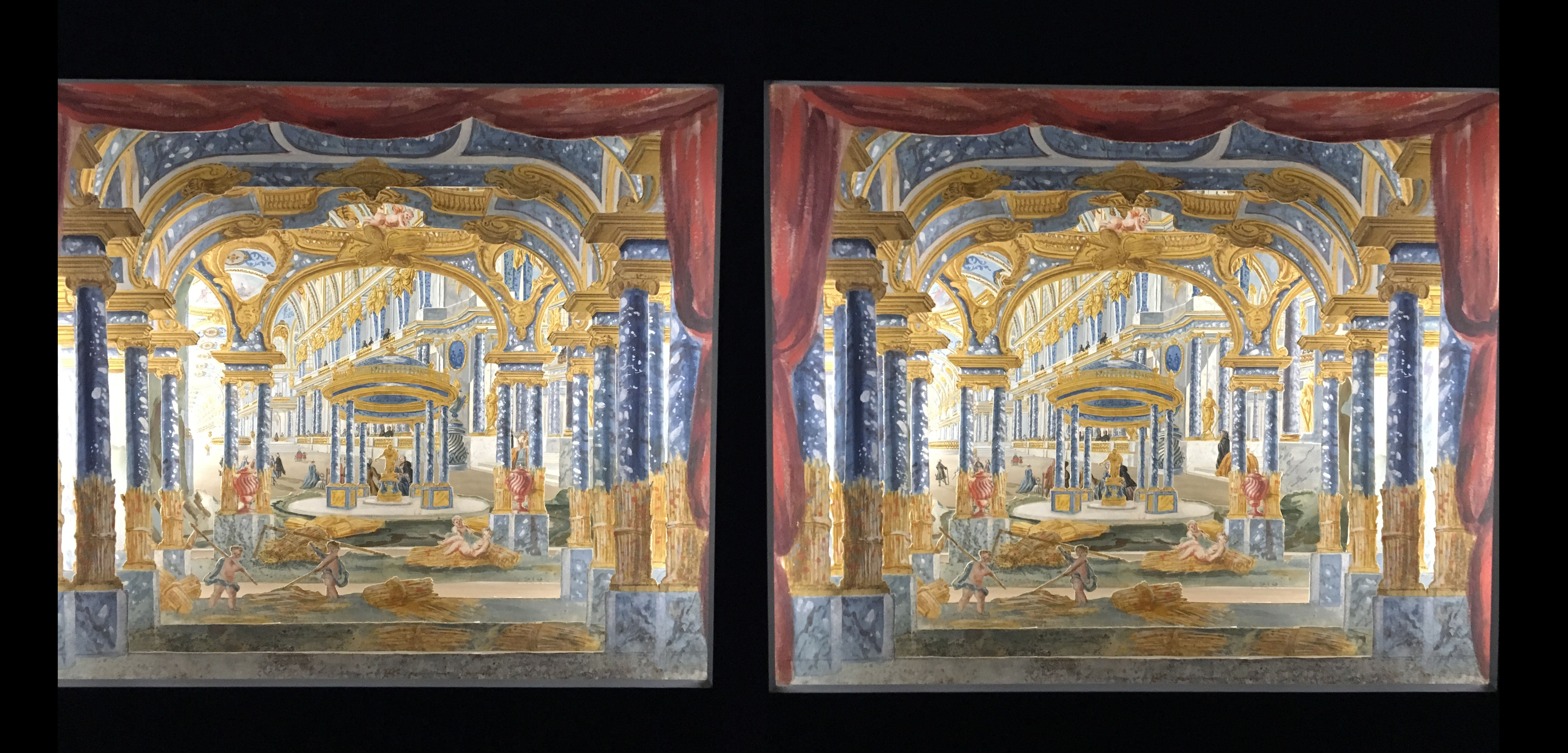 |
Figure TM.1 –Theatre Maquette |
| If you can freeview the stereo image cross-eyed you will see how the coulisses overlap and define space. |
| Source: Piero Bonifazio Algieri, Palais de Cérès, maquette of scenography for Act I of Proserpine de Lully, 1758, gouache with gold highlights, La BnF de l’Opéra, Paris, photographed in stereo © Rod Bantjes. |
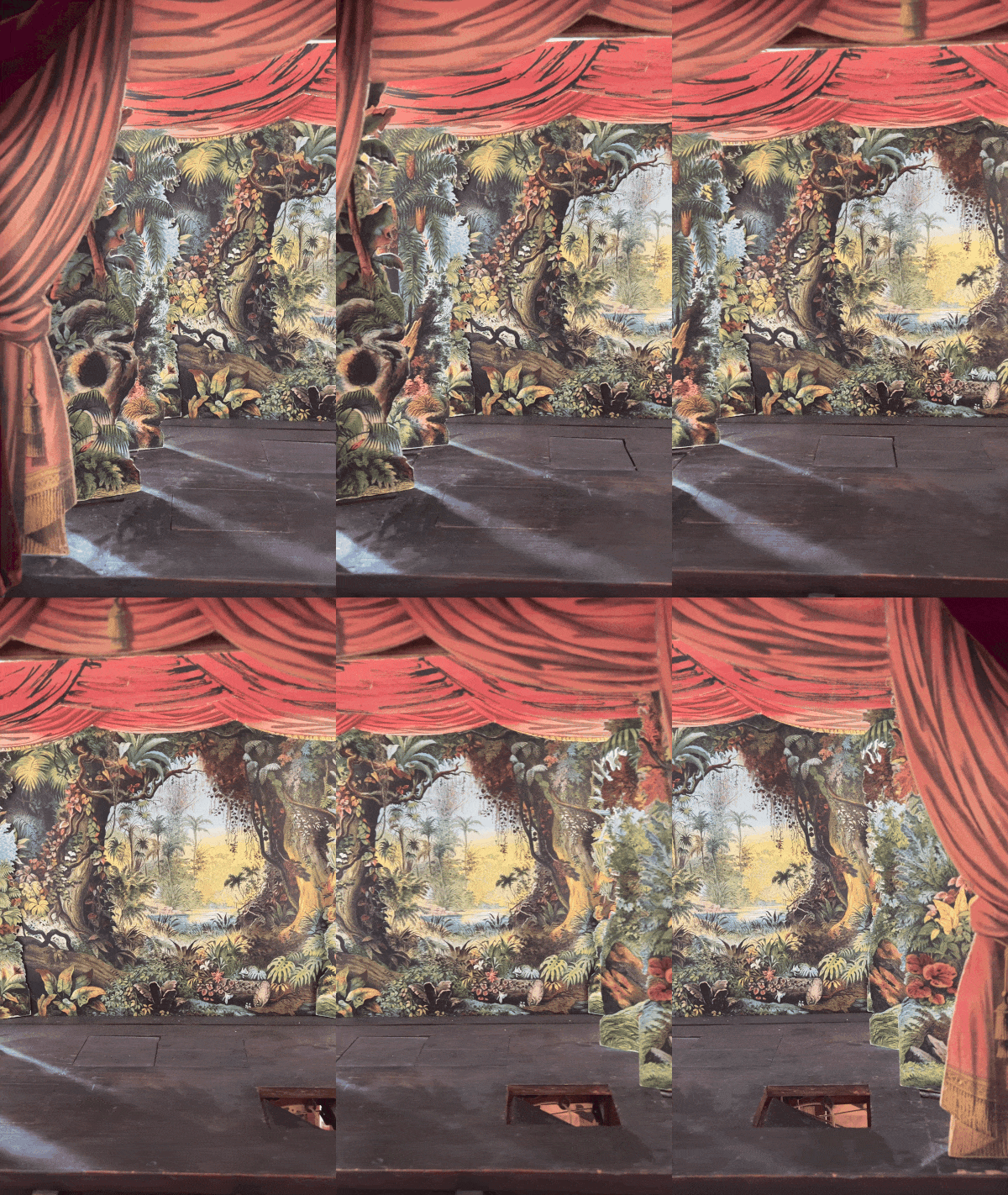 |
Figure TM.2 –Theatre Model |
| This pan across the stage shows a shifting overlap or parallax effect between the wings or coulisses. |
| Gif image © Rod Bantjes. |
On the left is a small model of a set design known as a theatre maquette. It is not an "optical machine " because it lacks a viewing device with a lens or mirror, but is included in the Optical Machine Taxonomy as an outlier.
The maquette was a way to try out ideas for theatre set designs. It also makes a charming miniature theatre and was surely the inspiration for many optical boxes.
Theatre as Space-Making Machine
Enlightenment experts on vision, Philippe de La Hire (1685) and William Porterfield (1759), believed that the theatre was unrivalled in its ability to persuade our senses with its 3D illusions. They identified 6 ways that our "visive faculty" judged the distance of objects. Painting used only two: 1) the apparent size of objects, and 2) the "vividness of their color." In perspective painting things diminish in size with distance and they are painted with less distinct colour and sometimes with a bluish haze at the far distance in a landscape.
But there were four other means of judging the distance of objects that painting could not affect: 3) "the direction of the two eyes" (binocular convergence), 4) "the parallax of objects" 5) "the necessary Conformation of the Eye for seeing distinctly at different Distances" (i.e. focus), and 6) "the distinctness of small parts of the object" (we might say "resolution").[xxx] These exposed and undermined painting's spatial illusions.
Principles 3 to 5 – binocular convergence, parallax and focus – involve movement of the parts of our perceptual apparatus. For binocular convergence the two eyes must change direction, for parallax the head must move, for focus the muscles of the eye must move to change the shape of the lens. Playing upon them required an apparatus, and the epitome of that apparatus was the theatre, conceived of as a kind of machine.
This mechanical, physiological way of understanding vision and pictorial representation was an innovation of the Enlightenment period. An older paradigm which relied on geometric optics and perspective remained influential among some theorists, but people who built devices of illusion were already working in the new paradigm.[xxx]
The theatre could affect and manipulate all 6 of our means of perceiving depth and for this reason was seen as the most powerful means to create worlds of illusion. Optical machines too were designed to affect binocular convergence, parallax and focus. This mechanical effect on our senses was likely the reason for the choice of the term "machine" for these devices.
La Hire and Porterfield were not alone in their admiration for the theatre's reality effect. Philosophers such as George Berkeley and David Hume used the theatre as a metaphor for how the machinery of perception creates the world that we are conscious of.[xxx]
The Anatomy of the Coulisse
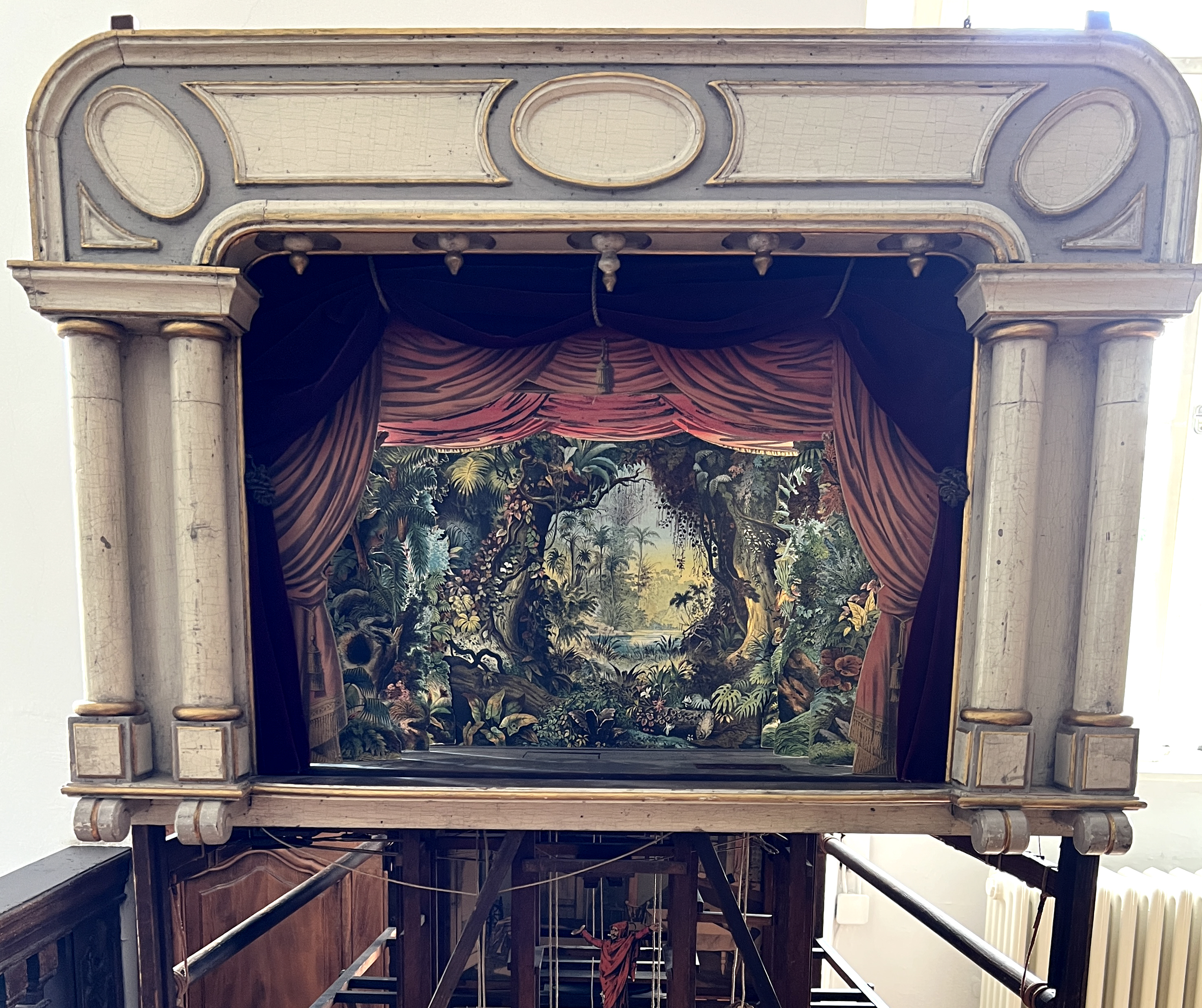 |
Figure TM.3 –Theatre Model |
| This is the staged scene that is animated in Figure TM.2 |
| On Display in Schloss Wahn, Theatre Studies Collection, University of Cologne. Photo © Rod Bantjes. |
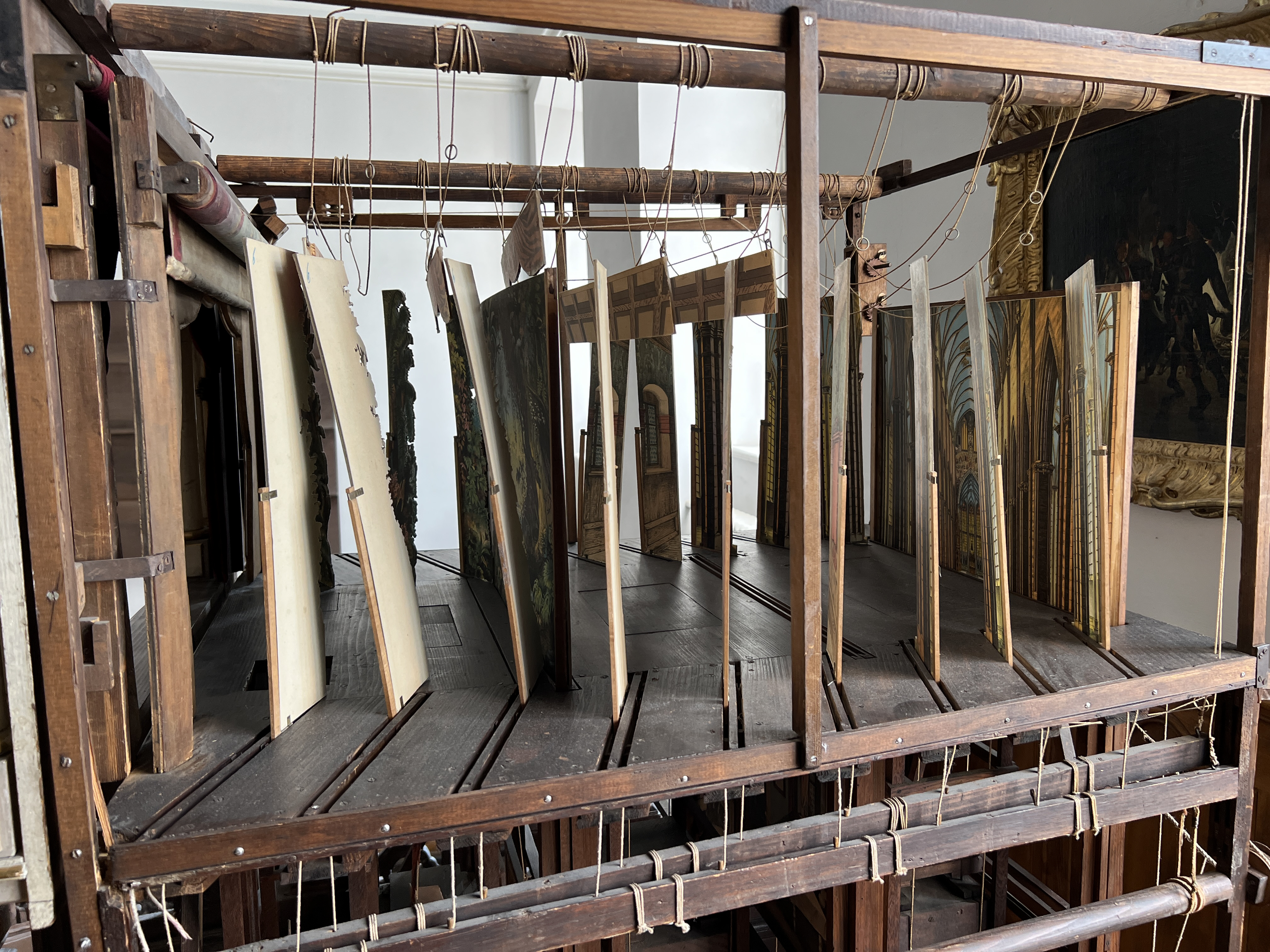 |
Figure TM.4 –Coulisse Machinery |
| This is the side view of the theatre model in Figures TM.3 and TM.2. |
| Photo © Rod Bantjes. |
Coulisse: Coulisses are paintings of portions of a scene that come in from the sides of the stage. From the viewer's position they overlap one another and a painted backdrop so that if she moves her head even slightly the parts of the image will appear to move in relation to one another in a parallax effect (see Figure TM.2).
Scene Change: Figure TM.4 shows the coulisse machinery from the side. They slide in tracks actuated by machinery from below. There are two scenes, one behind the other, in this model theatre. When the coulisses of the jungle scene slide away and the backdrop slips down through a slot in the stage, we are transported to the interior of a cathedral. Such complete scene changes were the precedent for the 19th-century diorama and the "dissolving views" of 19th-century optical machines.
Flytower: Backdrops, or "flys" are more commonly lifted up to a space above the stage called a "flytower." Optical machines with changeable vues d'optique use the same technology: some entering from and retreating to flytowers, some to a space below the stage as is the case in this model (Figure TM.4).
Skydrop: Flys that come down from the top, like the bands of red drapery, are called "skydrops." They often depict clouds.
Groundrow: Stage flats along the stage floor, evident in Figure TM.1, are called "groundrows." They sometimes depict waves on the ocean or undergrowth in the forest.
Coulisse Frame: Coulisses in optical machines like the kulissentheatre and perspectiefkast typically join coulisse, skydrop and groundrow in a single "coulisse frames" (see also Figure TM.1).
Deception of the Coulisse
La Hire and Porterfield thought that the overlap and separation of the coulisses brought into play parallax (see Figure TM.2), binocular convergence and focus. The two eyes converge to fix on the closer coulisses and diverge to fix on the more distant ones. This binocular convergence/divergence is the most powerful perceptual signal of depth. As we look at each coulisse in turn, our eyes have to change their focus as well. While we are completely unaware of it, the constant focus-adjustment signals differential depth in the scene.
Many in the 18th and 19th centuries wrote of these effects as "deceptive" as though people were captured against their will by immersive illusions. However, the design of some optical machines suggests a much more playful conception of the viewer's participation in illusion-making. Where coulisses, like those in Engelbrecht boxes are used as component of the depicted scene, the intent is probably realist. Similarly where the coulisse is not so much representational as deceptive – a dark frame that masks out visual distractions. However in other cases the coulisse represents a proscenium arch of a stage or a view from a theatre box – reminders that the scene beyond is a fiction.
Endnotes:
[xxx] text of footnote.
[xxx] See La Hire, Philippe de, Un Traite Des Differens Accidens De La Vue (Paris, 1685), 237; Porterfield, William, A Treatise on the Eye, the Manner and Phænomena of Vision (Edinburgh: G. Hamilton and J. Balfour 1759), 410..