Rod Bantjes, “MNC-M01034_Mondo_Niovo_Binocular.html,” created 5 March, 2026; last modified, 27 March, 2026 (https://people.stfx.ca/rbantjes/).
Mondo Niovo[xxx] Binocular
Museo del Cinema Collection, Torino, Italy[*] #MNC-M01034
Italy, ca. 1740-1910
Dimensions: H=67.7 cm, W=65.2 cm, D=130.3
Lens: ⌀=9.6 cm, ƒ=60.5 cm
The Mondo Niovo in General
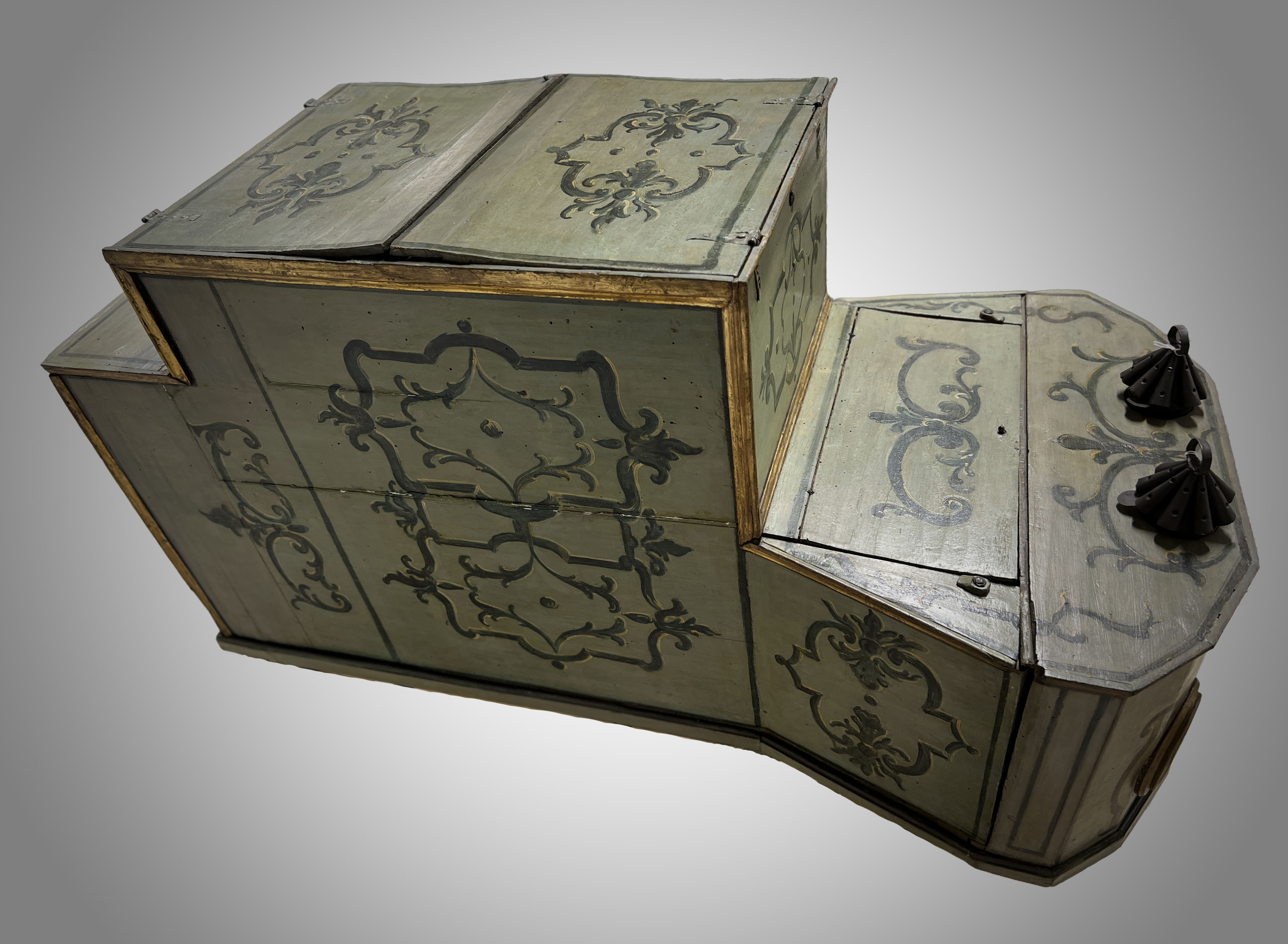 |
Figure M01034.1 – Mondo Niovo Binocular |
| Photo © Ana Mendes. |
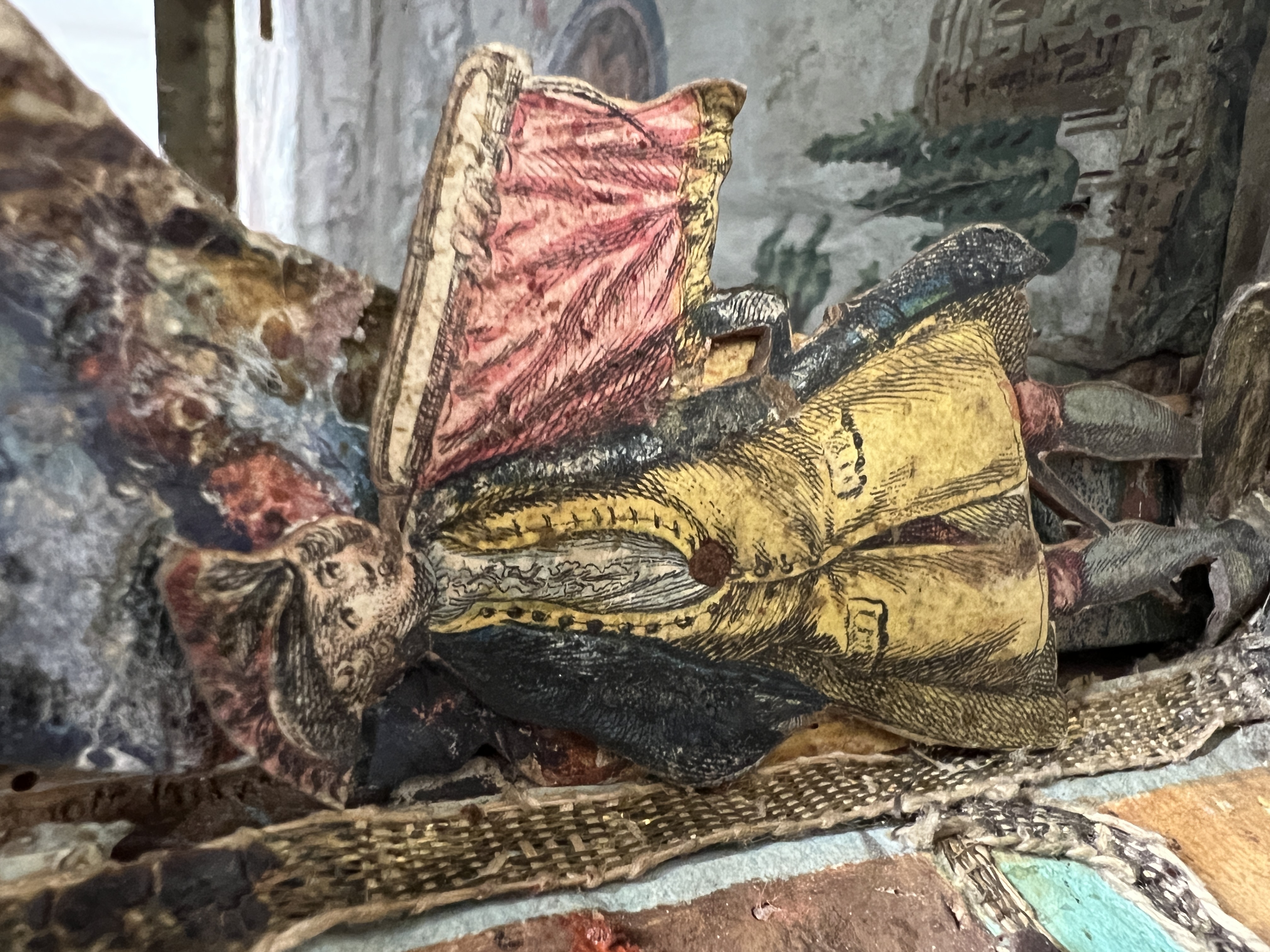 | 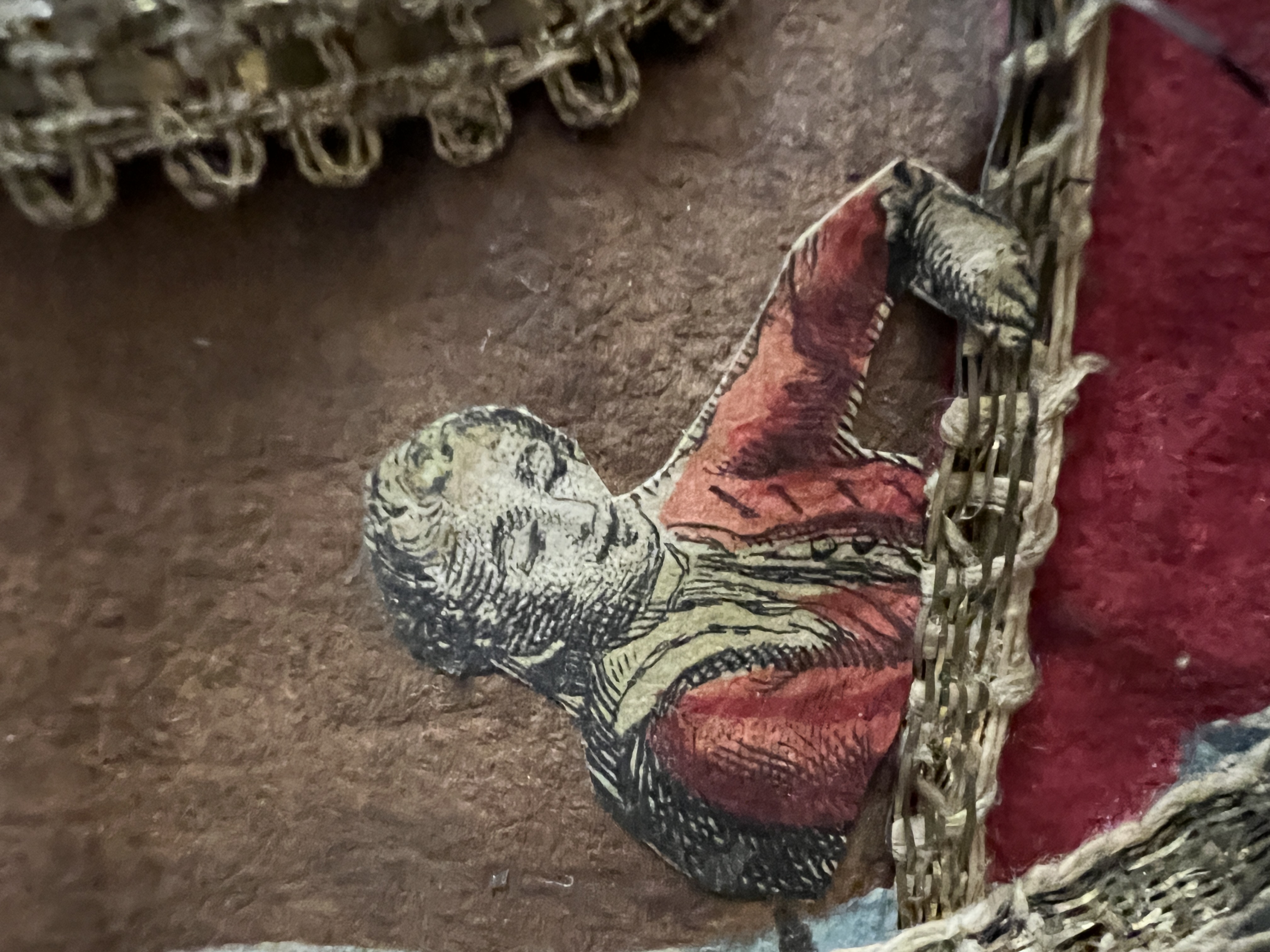 |
Figure M01034.2 – Detail from House | Figure M01034.3 |
Click to enlarge. Photo © Rod Bantjes. |
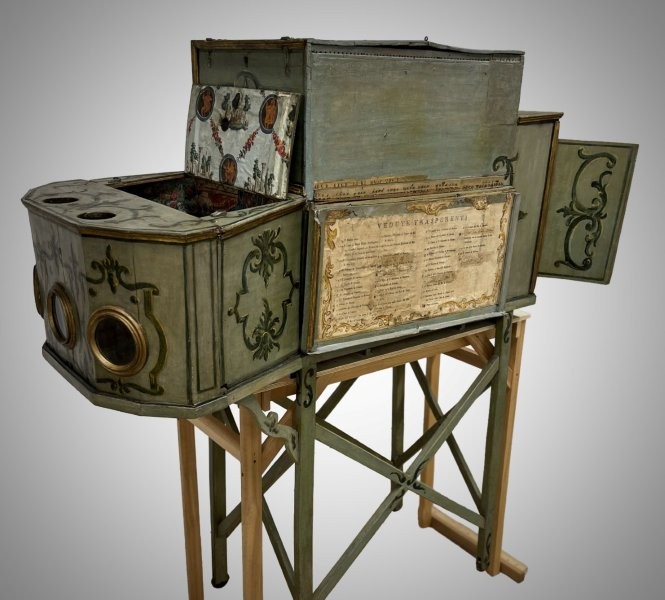
This is a Venetian-style multi-lens show-box for exhibiting pierced and illuminated vues d'optique. It is an example of an "optical machine" and is included in a genus "Mondo Niovo" in the Optical Machine Taxonomy.
The Mondo Niovo was the Italian version of the European Raree Show – a travelling spectacle popular in markets and fairs in the 18th century. Mondo Niovos always have three related features that are rarely seen together in the raree show:
| • a flytower above the central "stage" area; | |||
| • a front-section that fans out like the seating in a theatre toward a curved lens-array where the audience assembles to look inside; | |||
| • and a rear extension that has a flap and holds candles for back-illumination of the translucent images. |
The front-section's top-surface contains a top-flap for front illumination. The top is typically downward-sloping to help direct light back on to the front of the vue d'optique which falls like a back-drop on the stage. This box is perhaps the only example with a flat top.
For further discussion of the general features of these devices see the Mondo Niovo genus.
Description of this Box
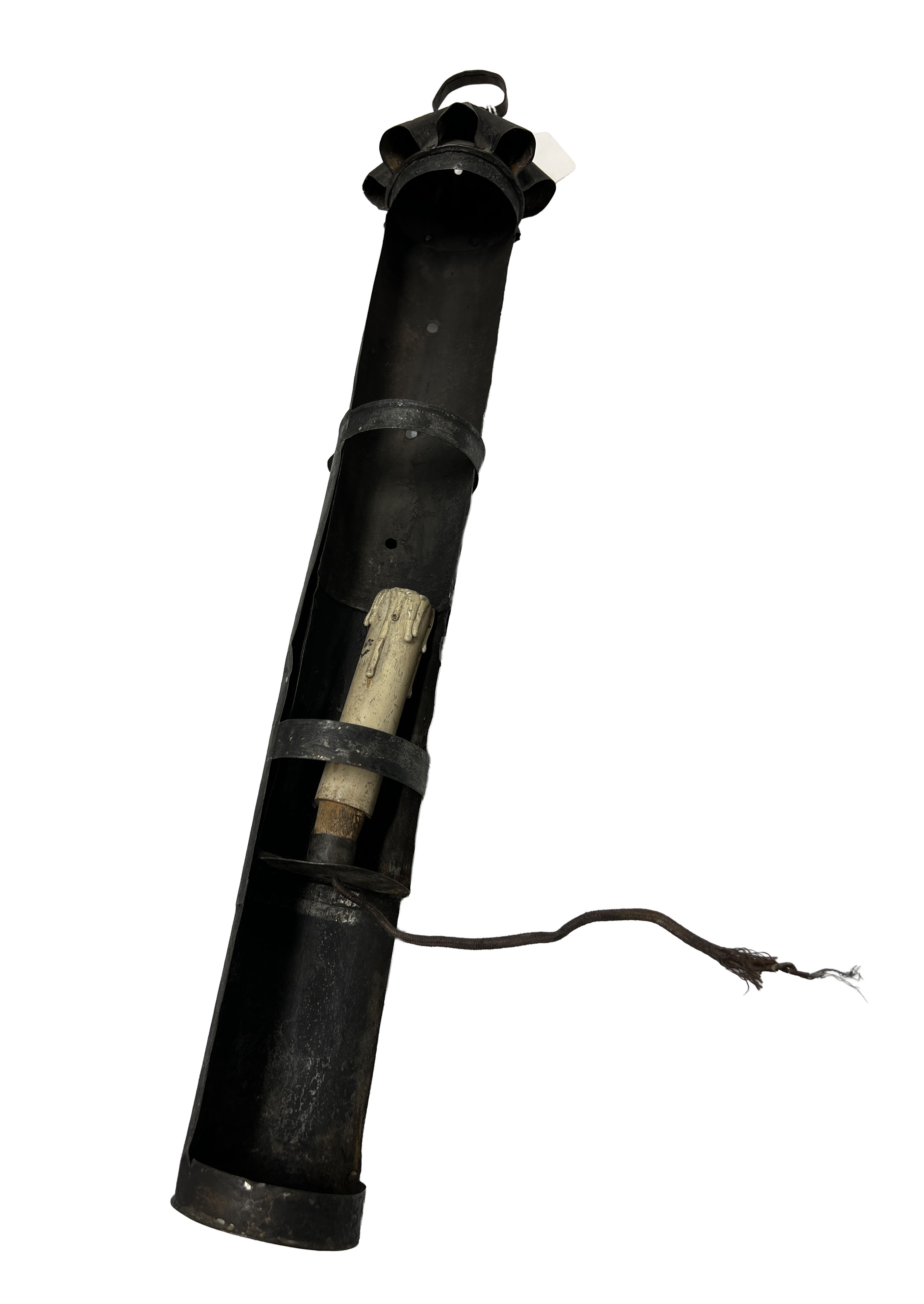 |
Figure M01034.4 – Candle-Holder |
Click images to enlarge. Photo © Ana Mendes. |
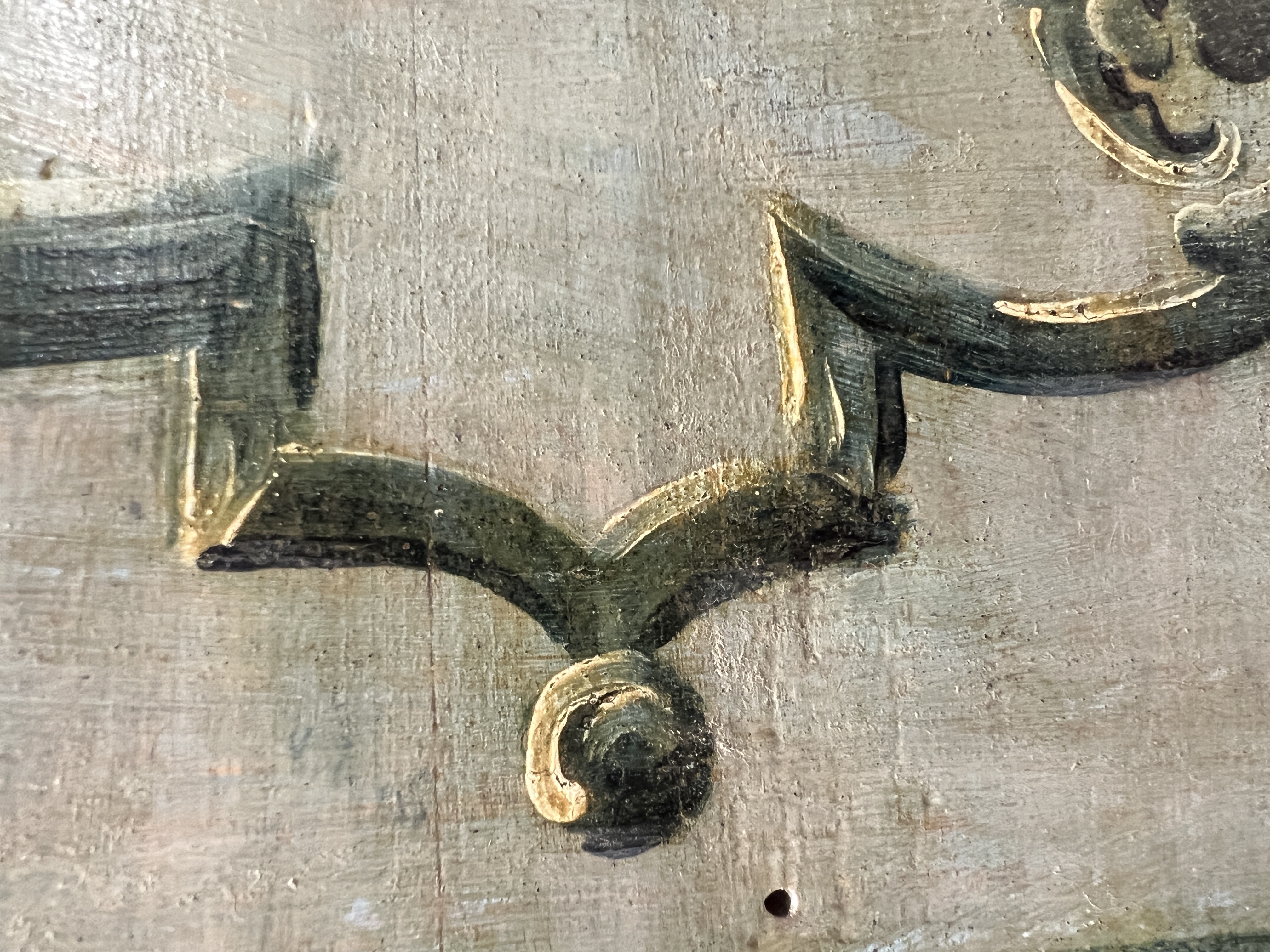 | 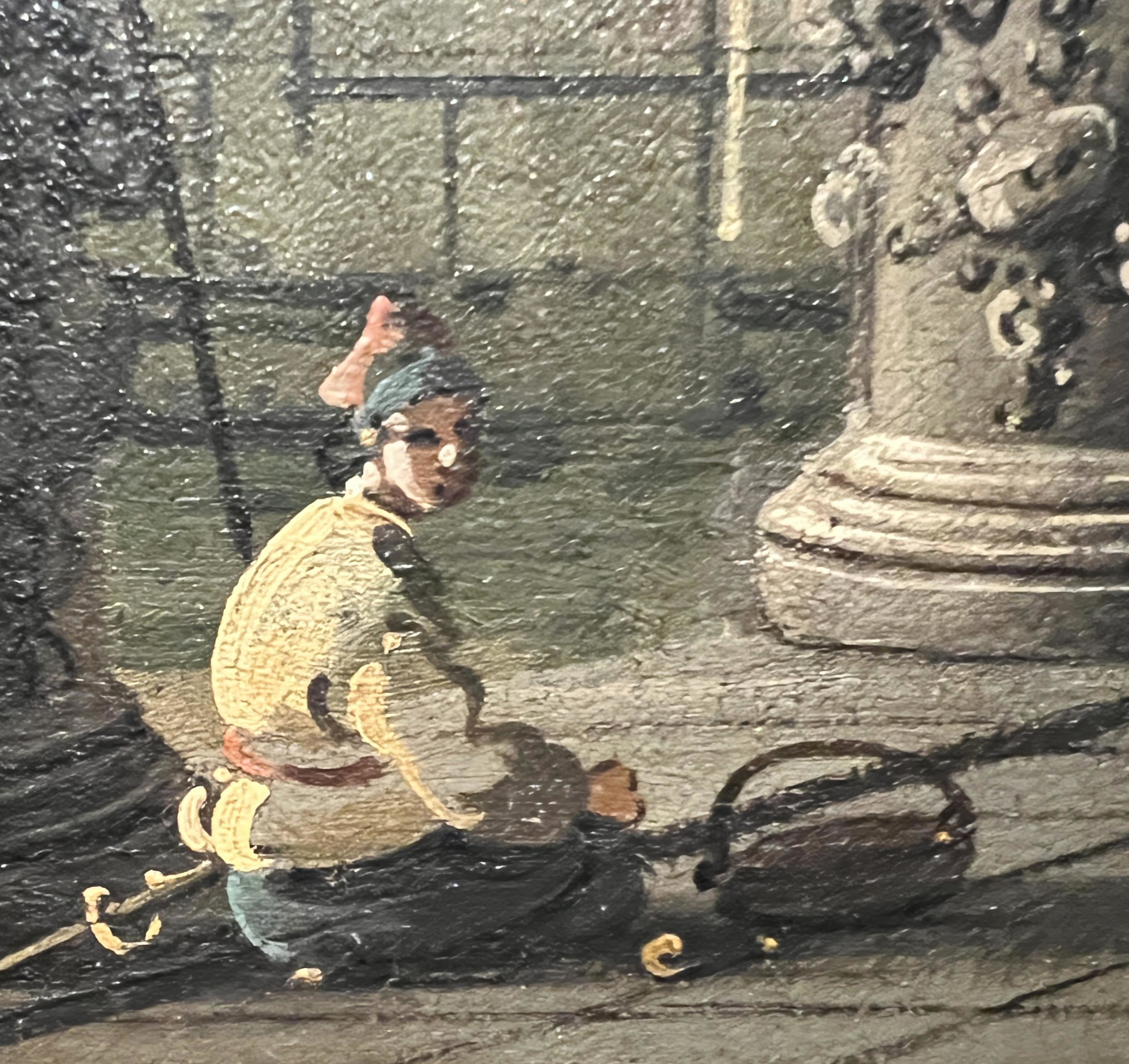 |
Figure M01034.5 – Box Pattern | Figure M01034.6 |
Click images to enlarge. Photo © Rod Bantjes. | Detail from Antonio Canal, 1765, Prospettiva con Portico. |
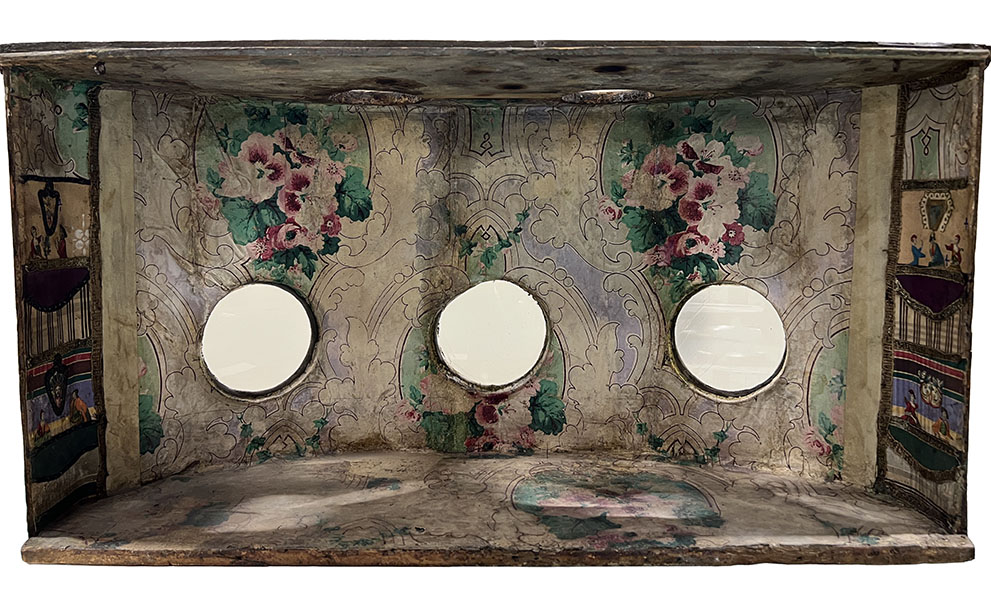
Lenses: The three lenses are each 10 cm in diameter. That is unusually large for mondo niovos but not for 18th-century optical machines. This is the only of the surviving mondo niovos where you can comfortably view through the lenses with both eyes, so it is the only one that can give the binocular effect of 3D enhancement that most optical machines were designed to afford. The depth of the flytower results in the last vues d'optique being much further than the focal length of the lens, in contradiction to 18th-century theory.
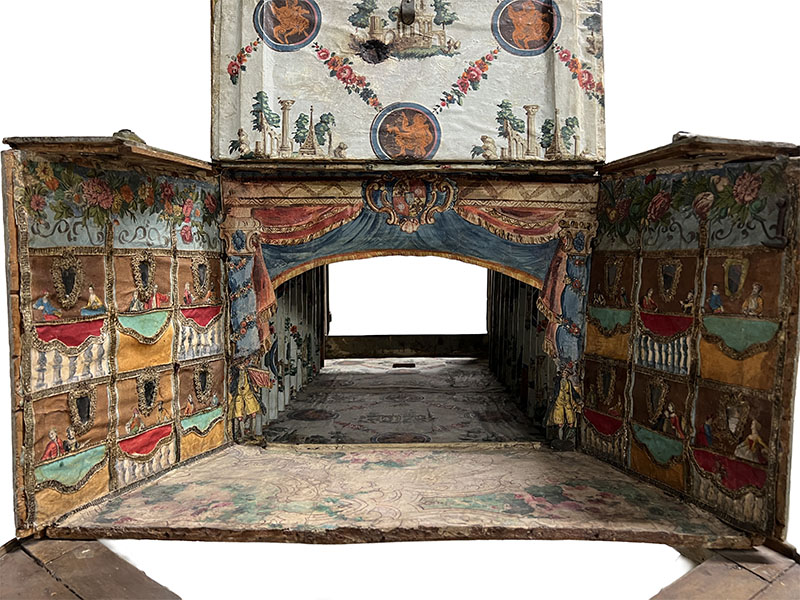
Flytower: The flytower is unusually deep front-to-back (66 cm), twice the average of the boxes we have measured (see Figure MN.6). It held an extraordinary number of prints: 45 as opposed to an average of 21 for the other known boxes. The box seems to be "double" in every way. A previous flat stringer-rail has been replaced by a notched dowel, an improvement since its rounded profile smooths the travel of the strings over it. The sides of the flytower have 12 guide channels, each of which can hold up to four vues d'optique.
Illumination: There are two tubular candle-holders behind the lens-array (Figure M01034.4). The tubes are directional, with a reflector and an open side. To diminish or increase the "house lights" the operator rotates the holder by grasping the ring at the top of the chimney. The chimney design, with its pleated tin cap, is typical of magic lanterns. At some point in the early 20th century, wax candles were replaced by plastic electrified candle-replicas. These are wired with old cloth-covered wire.
Exterior Decoration: Like all mondo niovos the base-colour of the box is green. This one is painted sage-green with dark-green ornament and gold-painted mouldings. The designs are in trompe l'œil relief with highlights and shadow emphasized the way a set-painter would do it, or, incidentally, rather like Canaletto's style (see Figures M01034.5 and 6). The brushwork is confident and persuasive, and therefore probably the work of a professional artist.
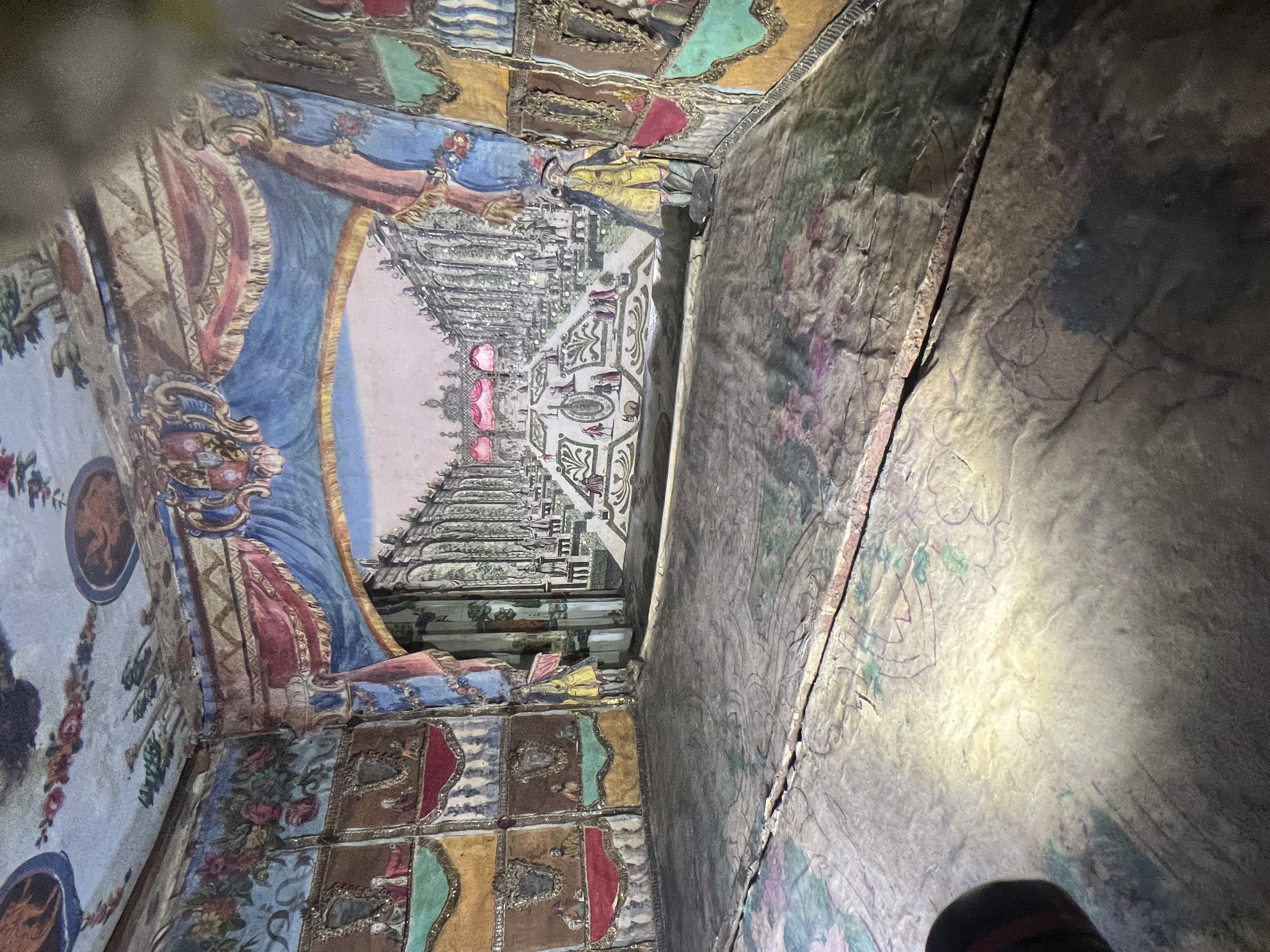 |
Figure M01034.7 – The Auditorium |
The auditorium viewed through the lens. Photo © Ana Mendes. |
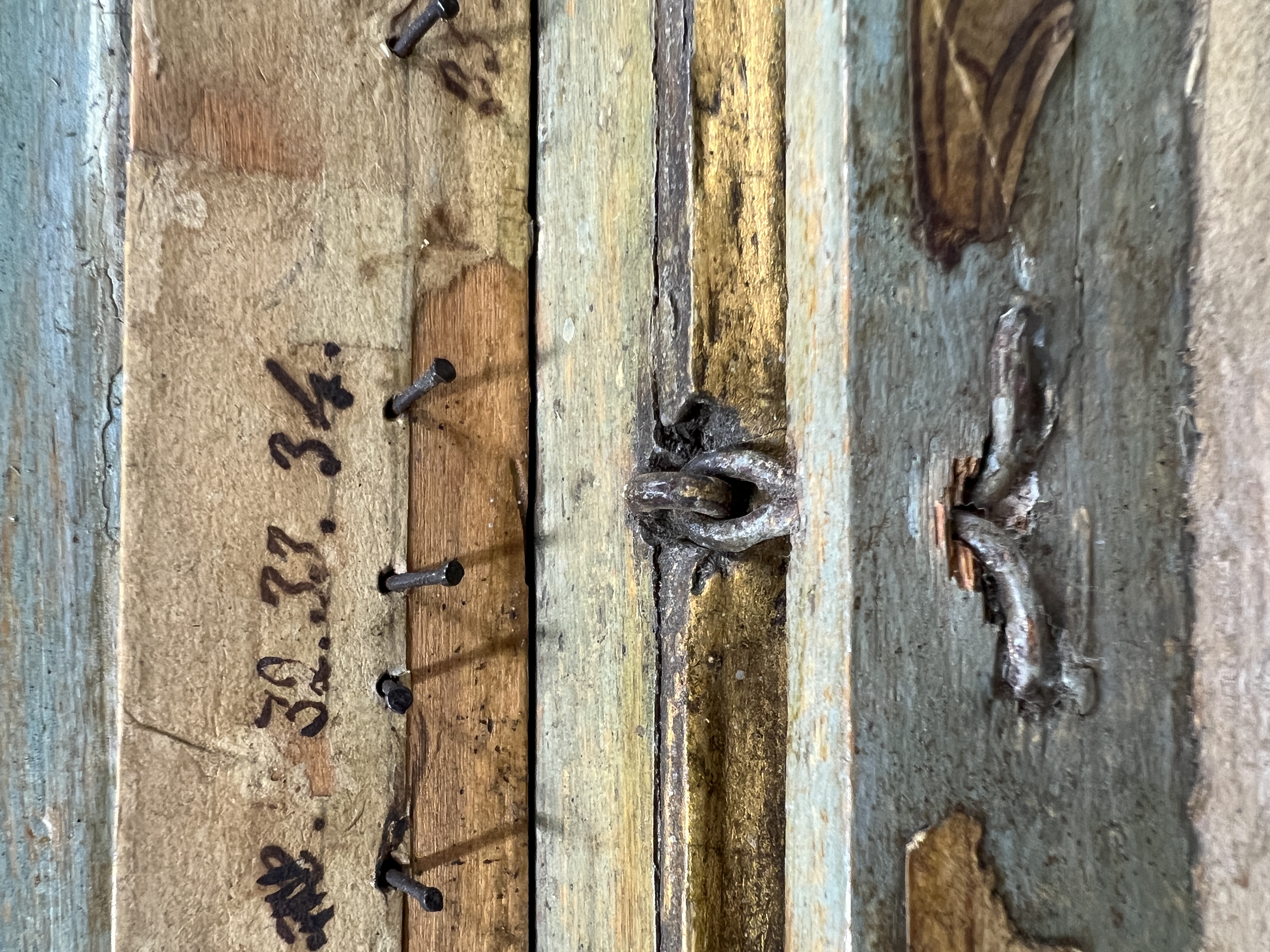 |
Figure M01034.8 |
| Photo © Rod Bantjes.
|
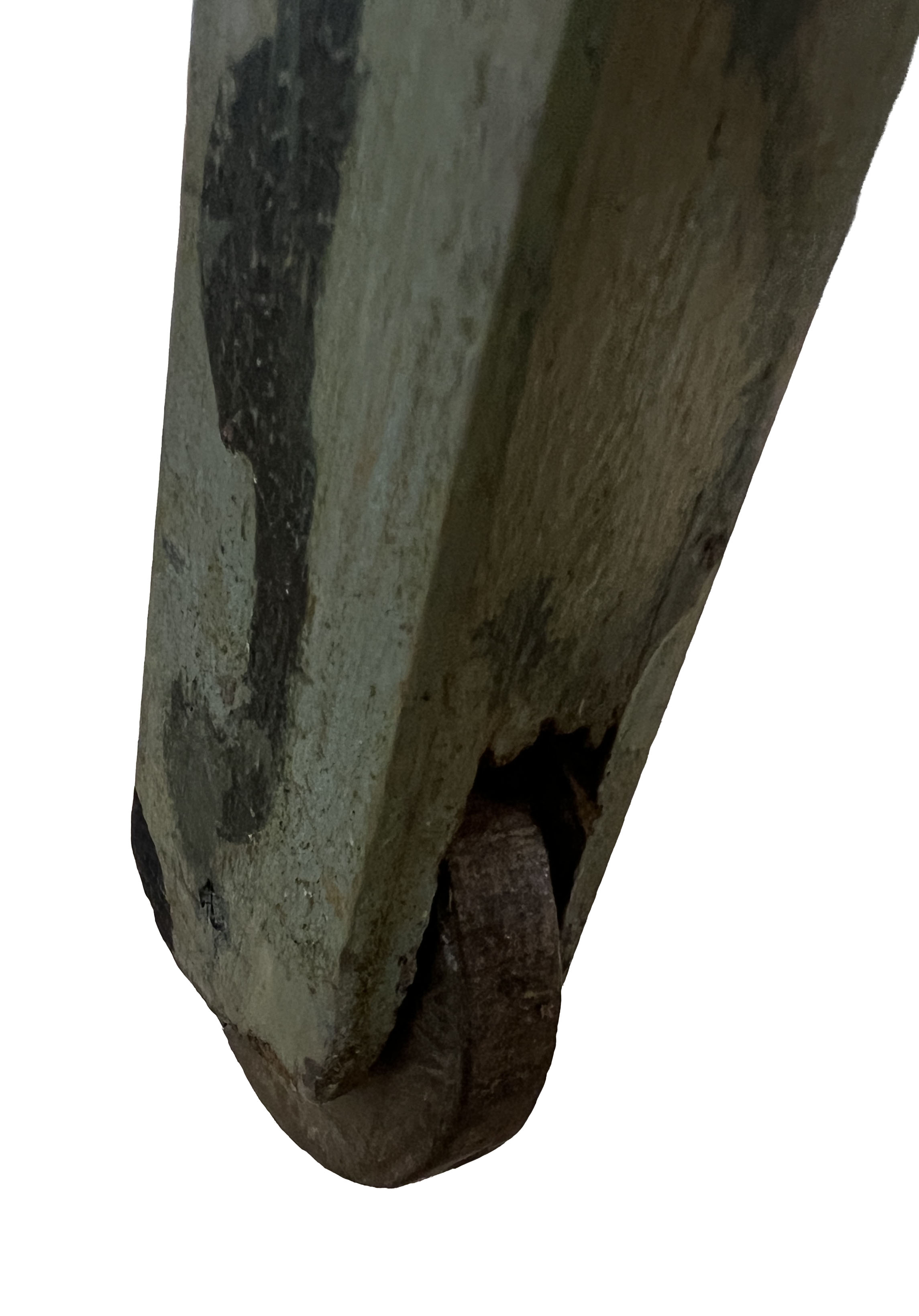 |
Figure M01034.9 |
| Photo © Rod Bantjes. |
Interior - Stage and Auditorium: The highlight of this box is the treatment of the auditorium, also known in theatre circles somewhat vaguely as "the house." (Figure M01034.7 and M01034.11) It is a space that fans out toward the lens-array like the seating area of a theatre. This box makes the implied similarity explicit by depicting theatre boxes filled with spectators along the side-walls. Dividing the house from the stage is a skilfully hand-painted depiction of a proscenium arch and grand drape. At the bases of two side-pillars there are two figures – cutouts from engravings – blowing trumpets with unfurled banners (Figure M01034.2).
Interior - Theatre Boxes: Part of the fun of an 18th-century theatre was watching the other audience-members. Peeping through the lenses of this little theatre would have been a bit like gazing through opera-glasses at the other theatre-goers arrayed in their boxes displaying a variety of dress, attitudes and preoccupations (e.g. Figure M01034.3). The figures – cut out from engravings that probably had little to do with the theatre – are looking at the audience below, reading, conversing, mixing dough and serving cake. The boxes are depicted in relief with pieces of fabric, decorative braid and small mirrors glued to the wall.
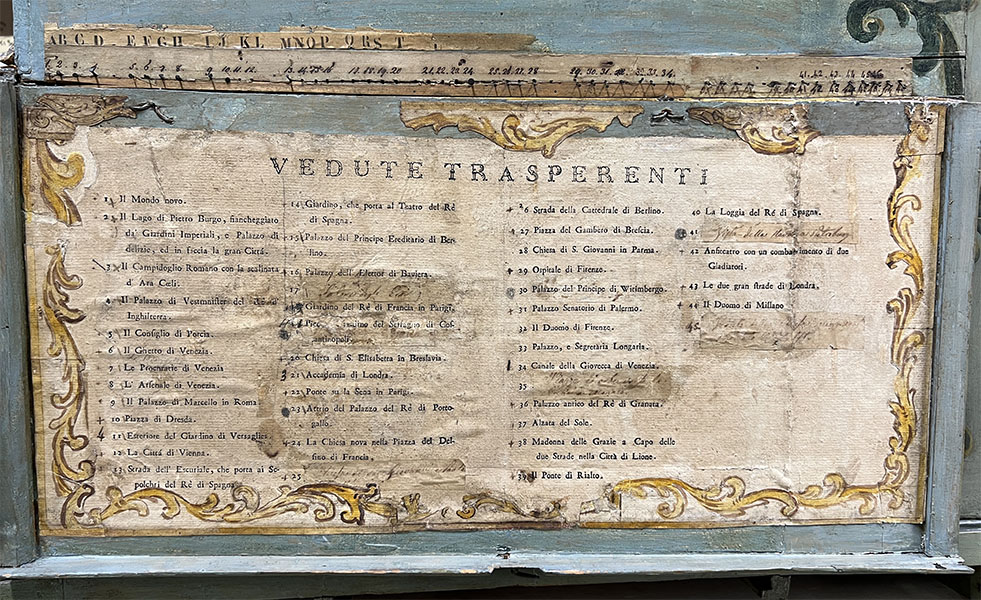
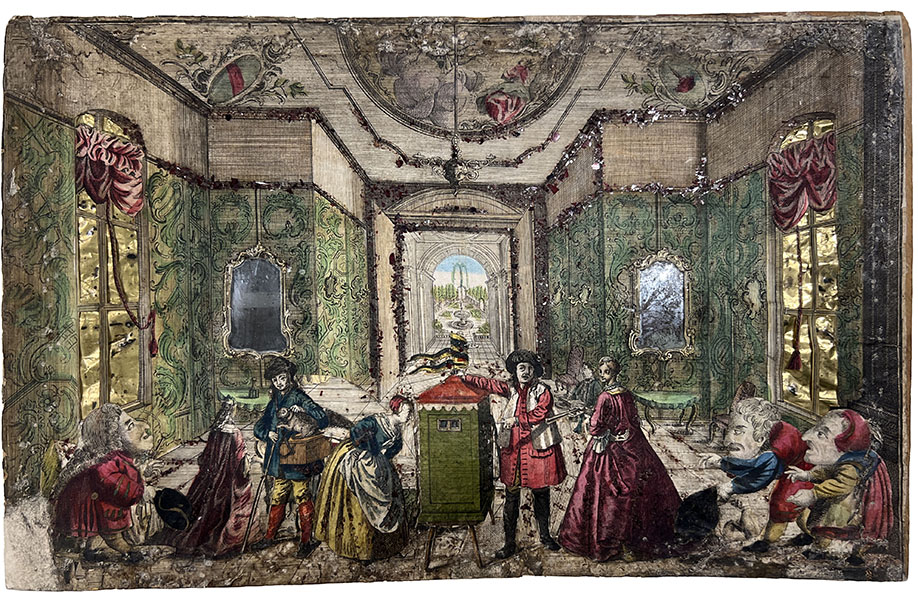
The List of Vues: At the operator's side of the box is a very unusual feature: a numbered list of the vues d'optique is pasted to the inside of a hinged panel (Figure M01034.13). When opened, the panel reveals the pull-strings and securing hooks which have numbers corresponding to the vues that they activate. The panel folds up to hide the mechanism when not in use. We only examined one of the vues d'optique that came with the box – but it was a spectacular delight, in keeping with the interior of the box. It has the same textured applique, and elements cut from other engravings. It also has gold leaf and thin silvered metal for depictions of windows and mirrors respectively (Figure M01034.14). At the centre is a showman showing his optical machine indoors. Oddly, it is of a very different design from this mondo niovo in which it was once shown.
Portability: This is one of the heavier mondo niovos although not too much heavier than François Binétruy's box in the La Cinémathèque française collection which we know was carried on the back. This box has a stand (93 cm high) built with slender supports that rests on four wooden casters (See figure Figure M01034.9). These wheels are far too small to be effective on cobbles or rough outdoor surfaces.
Construction Details: The oldest hardware (the hinges for the top of the flytower) is blacksmith-forged iron with rivets – indicative of very early manufacture. One or two slot-head screws (for hooks) are likely later additions. Other hinges are simple twisted wire (see Figure Figure M01034.8). There are no brass components. These indicators of low-quality construction are in contrast with the high-quality decoration.
Public or Private Show-Box?: This box was meant for display, but it may have been for indoor display for the friends and guests of a wealthy family. A number of features weigh in favour of this conclusion. The casters are best suited to a tiled floor rather than the rough surfaces of 18th-century streets. The indexed list of vues d'optique suggests that the operator used it on an occasional basis and did not have it memorized. The list is also printed – at a cost that would probably have been out of reach for a street performer. Additions to the list are made with a very fine hand, more typical of a well-educated owner. The hinged flap, to cover the strings, may have made it seem more decorative and less machinic when not in use. The large number of vues would have been impressive to sophisticated guests, but might not have made sense commercially – fewer would be cheaper and no doubt customers at that time could still be satisfied with the standard 20-image performance. The quality of the decoration, inside and out, and, if Figure M01034.14 is any indicator, the quality of the prints sets it a cut above the ordinary and closer in status to the Dolfini Teatro Rotondo and Friggeri Tower, both of which we know to have been privately displayed in aristocratic households.
Period of Use: The box dates from the mid-18th century but must have been used at least until the early 20th since the candles were replaced with electric substitutes. Mondo niovos appear to have been much-loved and enjoyed long lives. There are other examples that have been re-fitted for use in the 20th century (e.g. MNC-M01032). This box has a sticker indicating that it was once #505 in the fine-art dealer Ferruccio Asta's inventory. So, by the 1930s or 40s (when Asta was active) it could no longer have been in use as a public show-box and was now recognized as a collectible work of art – a status that most European show-boxes never achieved.
Additional Photos
 |  |  |  |  |
M01034.10 | M01034.11 | M01034.12 | M01034.13 | M01034.14 |
Endnotes:
[*] We would like to thank Raffaella Isoardi and Valentina Malvicino for making our research possible and assisting us in every way, as well as Antoine ... for assistance in the archives.
[xxx] The name means "new world" in Italian, perhaps because it introduced people to new worlds, including the distant Americas. The spelling with an "i" is Venetian and we use it (as opposed to Mondo nuovo or mondo novo) because this style seems to be uniquely Venetian.