Rod Bantjes, “FB-POL-34_Polyorama_3_Optics.html,” created 3 April, 2026; last modified, 4 April, 2026. (https://people.stfx.ca/rbantjes/).
Polyorama Mondo Niovo
François Binétruy Collection,[xxx] #FB-POL-34
France, ca. 1845
Dimensions: H=52 cm, W=55 cm, D=73.5
Lens: ⌀=8.3 cm, ƒ=62.5 cm
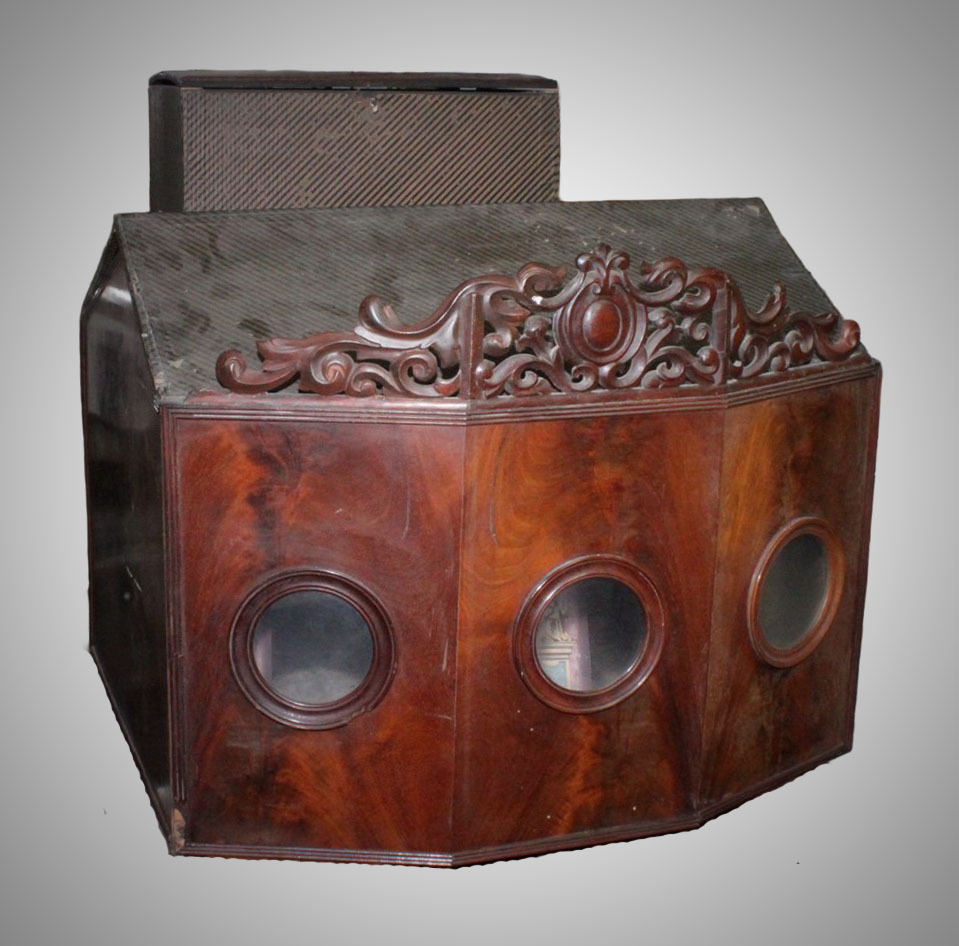 |
Figure FB-POL-34.1 –Polyorama Mondo Niovo |
| Photo © Ana Mendes. |
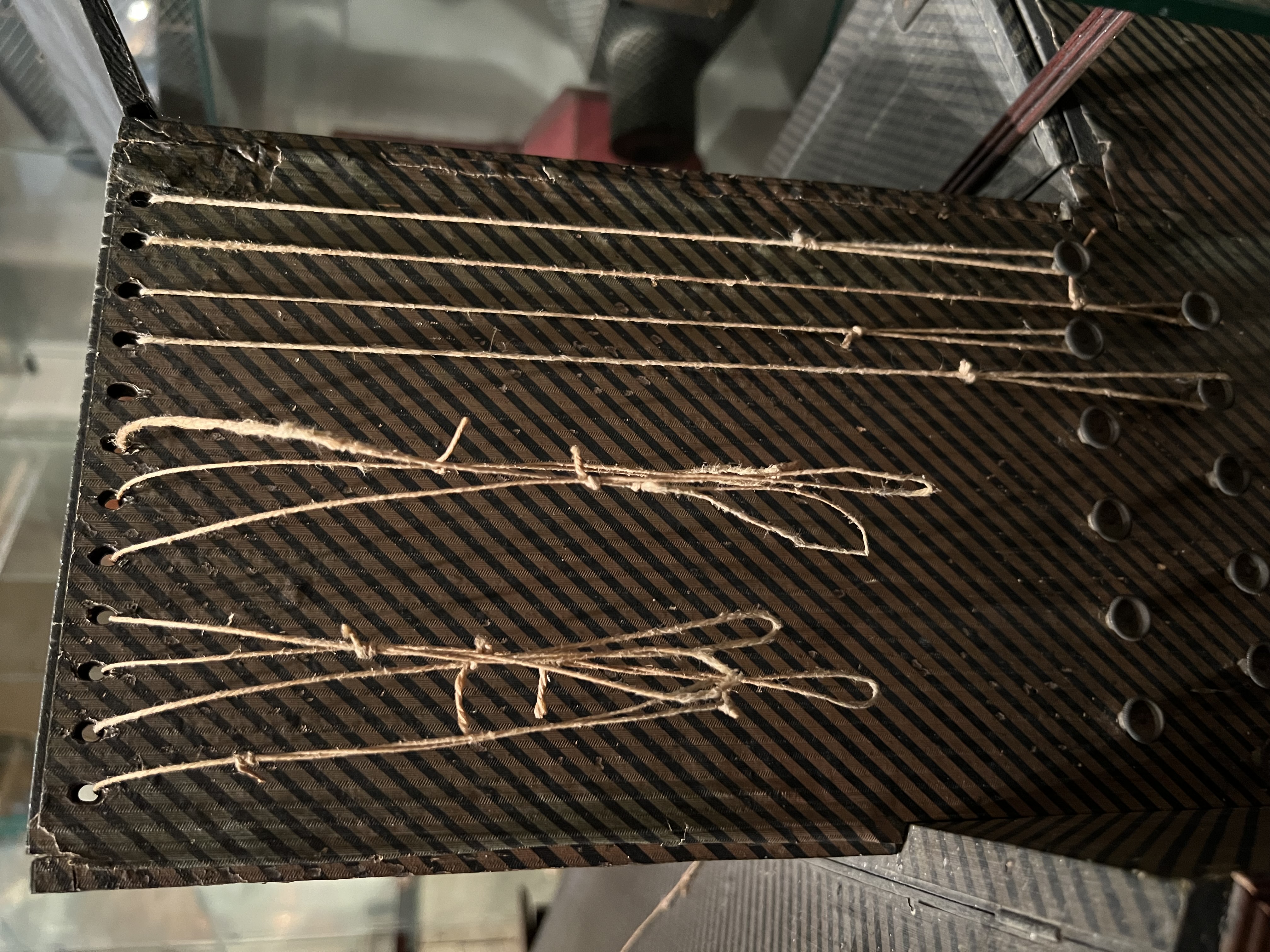 |
Figure FB-POL-34.2 –Flytower from the SideThis view is from the left side of the box looking toward the lens-array. You can see the hinged front-flap to the left of the photo, and the hinged back-flap to the right. Photo © Ana Mendes. |
This is a multiple-lens viewing box for enhancing the 3D effect of paper dioramas. It is a member of the genus of Multiple-Lens Polyoramas in the Optical Machine Taxonomy.
Mondo Niovo Morphology: This box is a 19th-century French take on the 18th-century Italian Mondo Niovo. It has the basic morphology of the Mondo Niovo which I will describe from front to back: a curved lens array; an auditorium with front-illumination flap; a flytower and a rear light-box. The main morphological difference is the shape of the auditorium: This one is not flared out towards the lens-array and has an unusual gabled roof with the ridge-line transverse to the direction in which the "audience" faces. At 74 cm in length, the box is also smaller than a Mondo Niovo, the smallest of which is 82 cm with an average length of 1 metre.
Lenses: The three lenses are plano-convex with the flat surface on the inside. At 8.3 cm diameter each, they are wide enough to view through with both eyes. Refraction through such lenses changes the angle of convergence of the eyes in such a way as to enhance the depth effect of images viewed through them. Many optical machines of this period, including most of those by Henri Lefort, used lenses too small for this binocular effect. This was also true for most Mondo Niovos. The focal length of the lenses is 63 cm and the furthest image is 58 cm from the lens-array. The closest is 41 cm which is far closer than 18th-century theorists such as Harris (1775) recommend.[xxx]
Image Format: This box is for Henri Lefort's largest 26 x 33 cm plaques dioramique. These are layered, translucent images affixed to rigid wooden frames. They reveal new and surprising effects when back-illuminated. The size of the images affects the size of the box. Mondo Niovos were designed for vues d'optique. The fact that these plaques dioramique are much smaller than vues d'optique (33 cm wide vs 44 cm) accounts for the smaller size of this box.
Flytower: Mondo Niovo flytowers typically have 4-5 vue d'optique images per guide-slot. This one has one slot per plaque dioramique – 12 in total. This flytower holds a smaller number of views than the average of 21 for Mondo Niovos. The views are raised and lowered by strings that go straight up and over a stringer-bar, then across to holes in the side of the box. When raised, they are secured to metal buttons on the side of the box (Figure FB-POL-34.2). The stringer bars in Mondo Niovos have grooves or keyholes to keep the strings separate. The stringer-bar in this flytower is a bare wire (Figure FB-POL-34.4). The maker has relied on the channels to keep the views and their strings from colliding and getting tangled.
The Auditorium: Mondo Niovos treat the space between the lens-array and the "stage" on which the images drop as though it were the auditorium of a baroque theatre. This idea is most clearly indicated in a box in the Museo del Cinema Collection in Turin where theatre boxes full of audience members have been depicted along the walls of the auditorium (see MNC-M01034). The decoration on the walls of this box, featuring a colonnade and statues, is more like a theatre foyer (Figure FB-POL-34.3). The raised stage is clearly indicated, plus a proscenium frame and grand drape. A unique feature of this box is a coulisse of the colonnade placed close to the lens-array. The double framing by coulisse and proscenium /grand/drape would, by means of binocular parallax, heighten the apparent distance of the depicted scene in the view on stage. The theatrical framing marks the scene, however "immersive" it might seem, as a fiction.
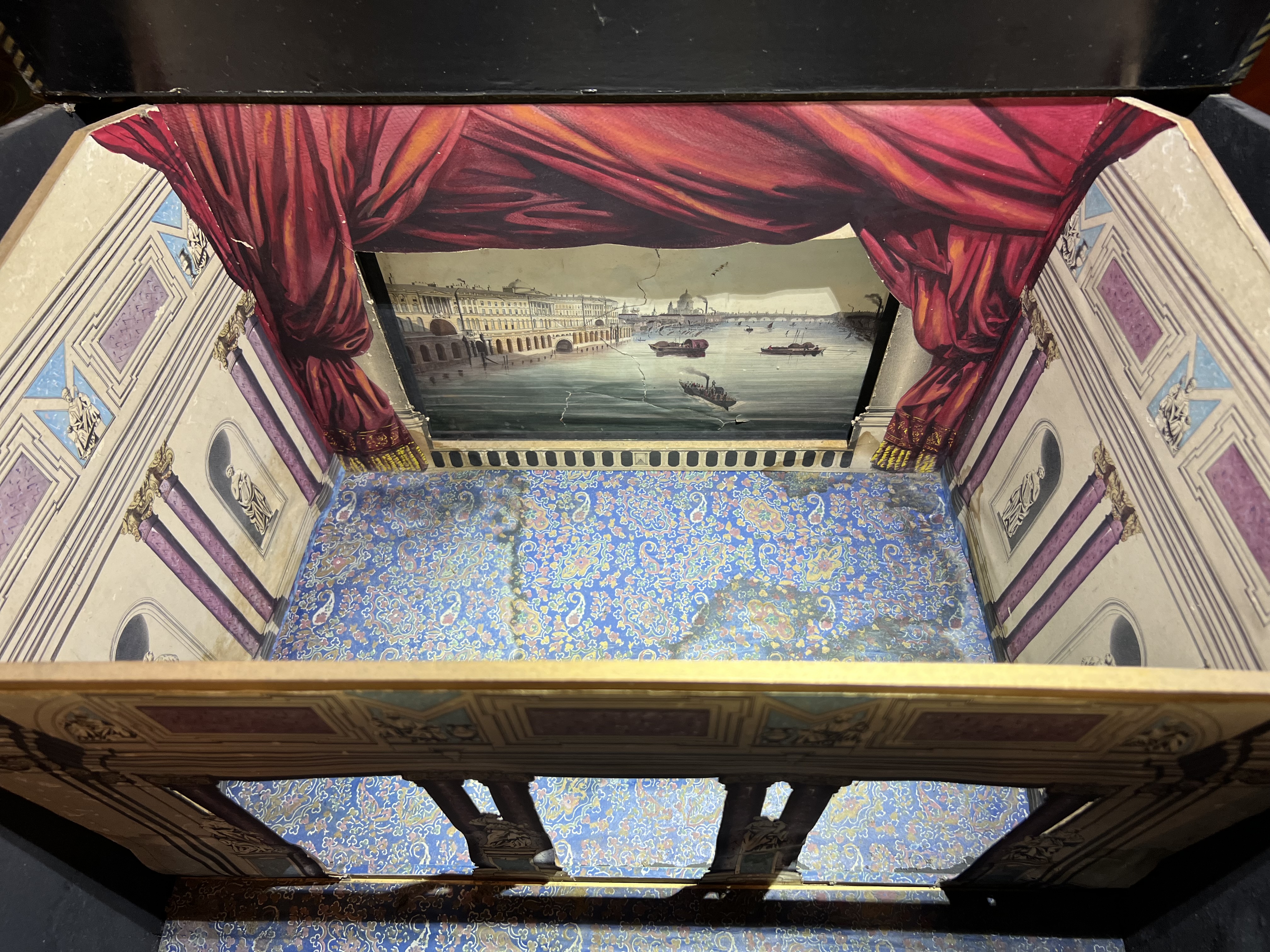 |
Figure FB-POL-34.3 – Auditorium |
| Photo © Ana Mendes. |
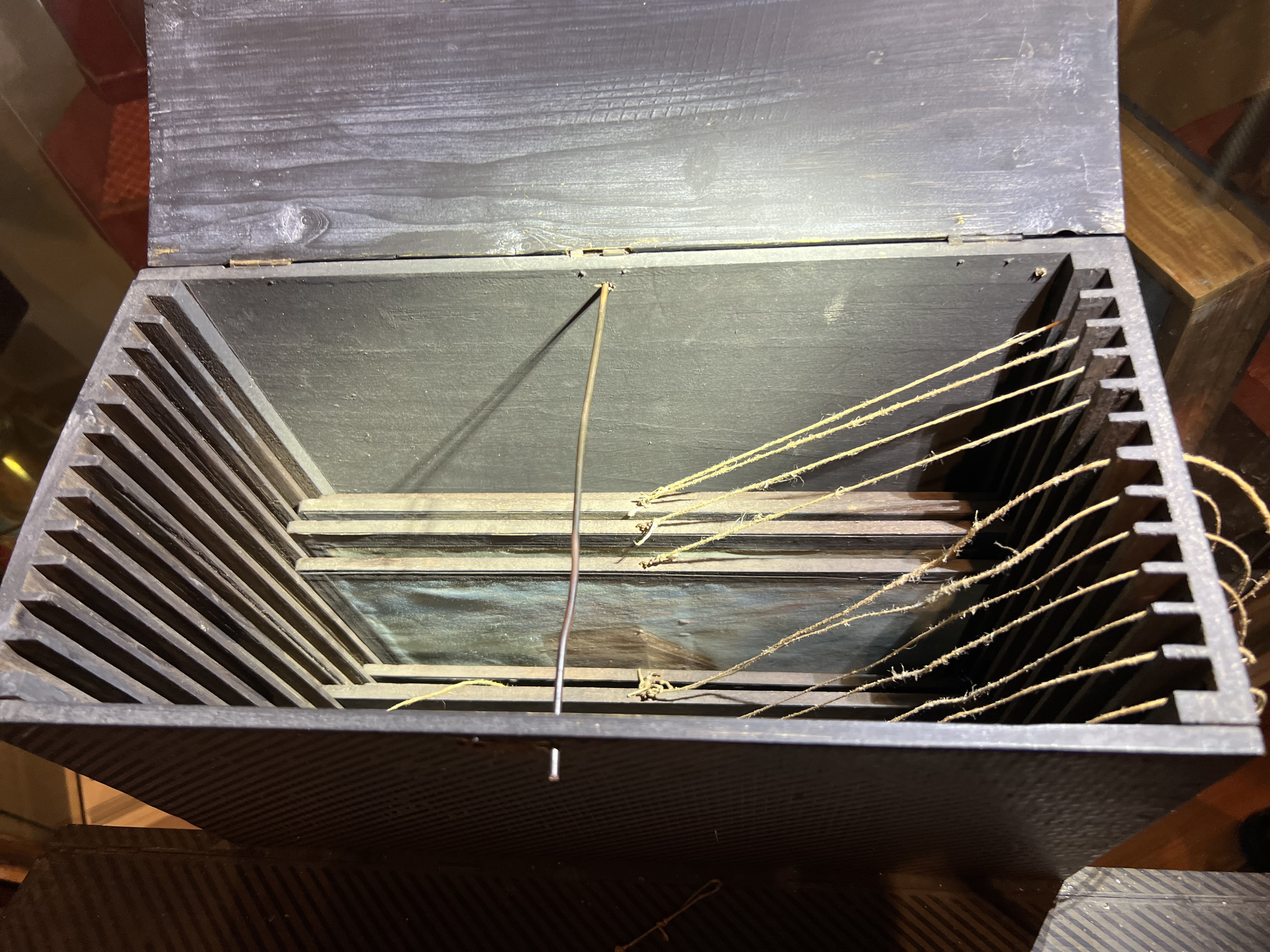 |
Figure FB-POL-34.4 –Flytower from the TopThe strings are incorrectly strung here. They need to go up and over the wire stringer-bar so that they pull upwards. Photo © Ana Mendes. |
Illumination: The front and back flaps, one on top of the auditorium and one on the rear light-box, are designed to admit natural light or some external light-source onto the views. back-illumination brings out special effects in the paper dioramas. Mondo Niovos also include candle-holders behind the lens-array and within the rear light-box to enhance the illumination and to illuminate at night. There is no evidence of candle-holders in this box. That is a bit perplexing in the case of the light-box, because the only reason for extending it is to provide a platform for the internal candles. All of the known Lefort boxes rely, like this one, only on natural light or external illumination. It may have been that bourgeois households of the mid-19th century were better supplied with artificial lighting (e.g. gaslight, argon lamps) than 18th-century elite households.
Public or Private? Mondo Niovos and multiple-lens optical machines were commonly designed for public performance. However, the varnished hardwood face and papered hind-parts of this device would not be suited for outdoor use. Like some Mondo Niovos this box has evidence of water-damage on the auditorium floor; however that might have many causes other than being caught in a rain-shower while the box was being exhibited on the street. I think it likely that this box, like the Dolfini Teatro Rotondo and the Mondo Niovo #MNC-M01034, was meant for private entertainment of multiple guests or family members. It would have been an article of display that only elite households in the mid-19th century could afford.
Lefort Manufacture? Previously I speculated that Henri Lefort's boxes for paper dioramas may have been inspired by the Italian Mondo Niovo. This box gives weight to that speculation. It is structurally similar to a Mondo Niovo, but designed for one of Lefort's paper diorama formats. The mix of a varnished hardwood front with the remainder of the box covered in patterned paper (Figure FB-POL-34.2) is typical of Lefort's style of design. One of the images that came with this box is of the Thames Tunnel, which opened in 1843. That is the latest definitive date that can be attached to the box. So, it could have been made in the early 1840s before Lefort patented the Polyorama Panoptique in 1849. There is no harm in speculation; it can spur conversation and the search for more and better evidence. I suggest that this box might have been an early attempt by Lefort to modernize the Mondo Niovo for the French market. When it failed to sell in sufficient numbers he sought ways to deliver the same effects in a device that was lighter and cheaper, arriving eventually at his very popular Polyorama Panoptique.
Endnotes:
[xxx] We are grateful to M. Binétruy for allowing us access to his superb private collection of optical devices.
[xxx] Harris, Joseph. A Treatise on Optics. London: B. White, 1775.