Rod Bantjes, “Genus_Pontioscopio.html,” created 24 October, 2026; last modified, 24 October, 2026(https://people.stfx.ca/rbantjes/).
Pontioscopio Genus (ca. 1863 - 1880)
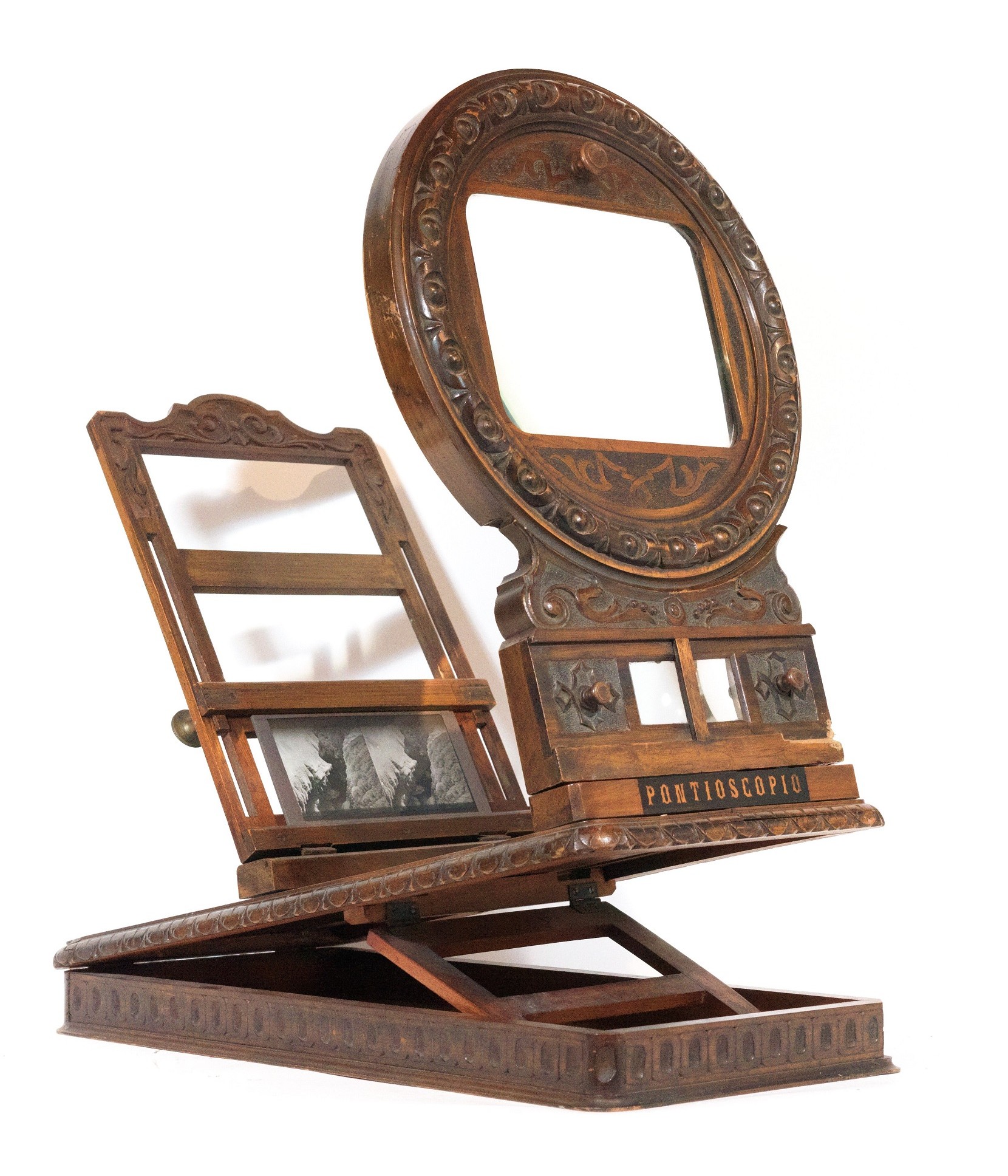 |
Figure GP-1.1 –Rectangular-Lens Pontioscopio |
| Photo © Rod Bantjes. |
Italian photographer and inventor Carlo Ponti (1823–1893) created some of the first graphoscopes but on a uniquely large scale closer to devices of the 18th century like the Dutch Rarekiek. Its super-long focal length changes the optical effect and places it outside the main family of graphoscopes (Graphoscope-Graphoscope). It is in its own family of the more general order “Graphoscope” within the Optical Machine Taxonomy.
Like all the stereo-graphoscopes, it is an inter-media hybrid between the 18th-century optical machine and the 19th-century stereoscope.
The defining features of the Pontioscopio genus are:
| • A large, long-focus lens (ƒ = 70 - 80 cm) | ||
| • A rectangular plinth to which a titling platform is hinged | ||
| • Square stereoscopic lenses adjustable for inter-ocular distance |
Taxonomy: Pontioscopios are similar in morphology to other graphsocopes such as the Integrated Stereo-Graphoscope and Rowsell Graphoscope. The distinctive feature that places the Pontioscopio outside the Graphoscope family is the long focal length (70 - 80 cm) of the monocle biconvex lens. Other graphoscopes average closer to 30 cm with an upper limit of about 40 cm). The greater magnification and distortion of the short-focus graphoscope lens had a unique effect that people seemed to find persuasively enhancing for photographs. The functional difference that focal length makes is the rationale for creating the additional family to locate the Pontioscopio.
Within the family Pontioscopio there is only one genus which we will also call “Pontioscopio”. That genus has two known species: the Rectangular-Lens Pontioscopio (Figure GP-1.1) and the Rowsell Pontioscopio (below).
Originality: By the very name that he has given his device, Ponti seems to be making a claim of uniqueness, if not invention, for it. The close similarity of his original Rectangular-Lens Pontioscopio to the Integrated Stereo-Graphoscope suggests that one is little more than a scaled up (or down) version of the other. Sylvia Paoli writes that during the period between 1868 and 1876 when Ponti was fighting to regain exclusive rights to his Alethoscope from Carlo Naya, Ponti created many variants of his device with inventive names: Amfoteroscopio, Dioramoscopio, Cosmorama Fotografico and Pontioscopio, presumably with the aim of asserting exclusive rights over these.[xxx] If so, the Pontioscopio was invented at least four years after the Rowsell graphoscope (1864).
It is possible that there was ongoing mutual inspiration between graphoscope and Pontioscopio as there often is during periods of design innovation. The Pontioscopio may have taken inspiration from the original Rowsell Graphoscope, and the Integrated Stereo-Graphoscope may in turn have been influenced by the Rectangular-Lens Pontioscopio. The Rowsell Pontioscopio appears to adopt Rowsell’s complex lens-interchange mechanism and lens-frame styling. The Alethoscope is his truly original creation that might better bear his name.
List of Species
Each row in the following table represents a different species:
| Rectangular-Lens Pontioscopio: | 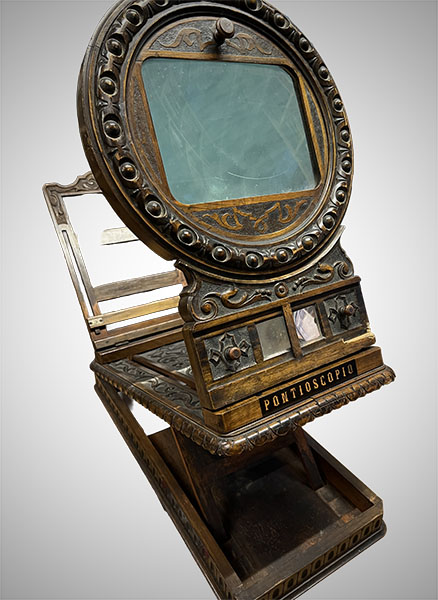 |
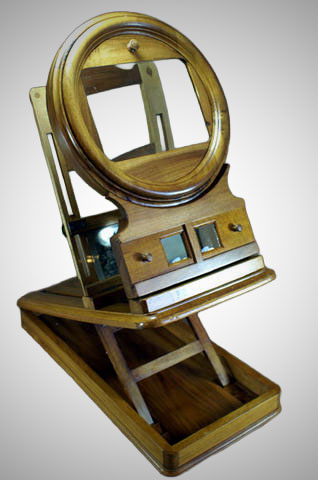 |
| CM-2025-1 | No link yet |
This is the original form of Pontioscopio with the rotating rectangular lens-frame.
The second example (WP-2009-01) lacks the carved ornamentation. The lens is about the same size 15.2 x 20.3 cm, but the device is shorter (55.9 vs 64 cm) and narrower (31.8 vs 34.2 cm). Photo © WorthPoint, 2009.
| Rowsell Pontioscopio: | 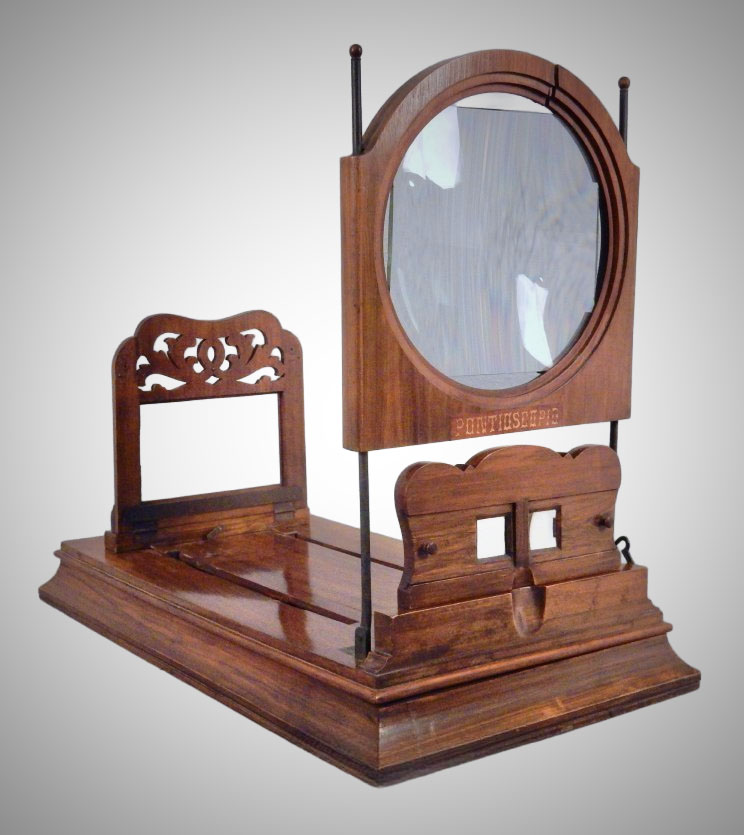 |
| HSJ-2022-2-14 |
The Rowell Pontioscopio is so named because of its similarities in structure to the Rowsell Stereo-Graphoscope. It is however, much larger.
Endnotes:
[xxx] Paoli, Sylvia (2013). “Ponti, Carlo (c. 1822–1893) Optician and photographer”. In Hannavy, John (ed.). Encyclopedia of Nineteenth-Century Photography. Routledge, 1145. The Pontioscopi is actually a different device from the Alethoscope and Megalethoscope. It is a similarly large-scale monocular viewer with a square lens that can be rotated between landscape and portrait orientation, but is is not enclosed like the other devices.