Rod Bantjes, “MNC-M01040_Polyorama.html,” created 2 March, 2026; last modified, 2 March, 2026 (https://people.stfx.ca/rbantjes/).
Polyorama 20?
Museo Nazionale del Cinema Collection, Torino, Italy[*] #MNC-M01040
France, 1849
Dimensions:
Lens: ƒ
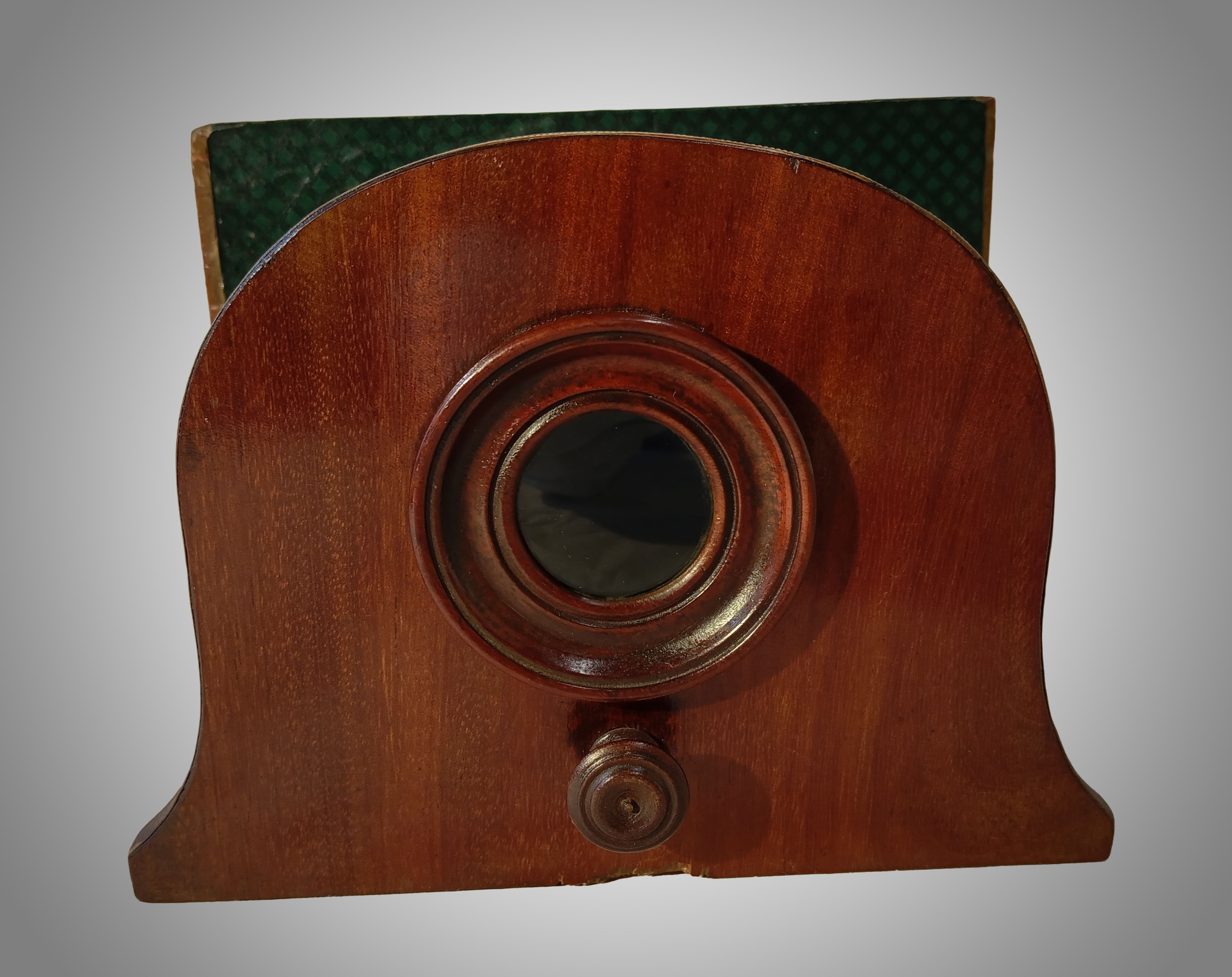 |
Figure MNC-M01040.1 – Polyorama |
| Photo © Ana Mendes. |
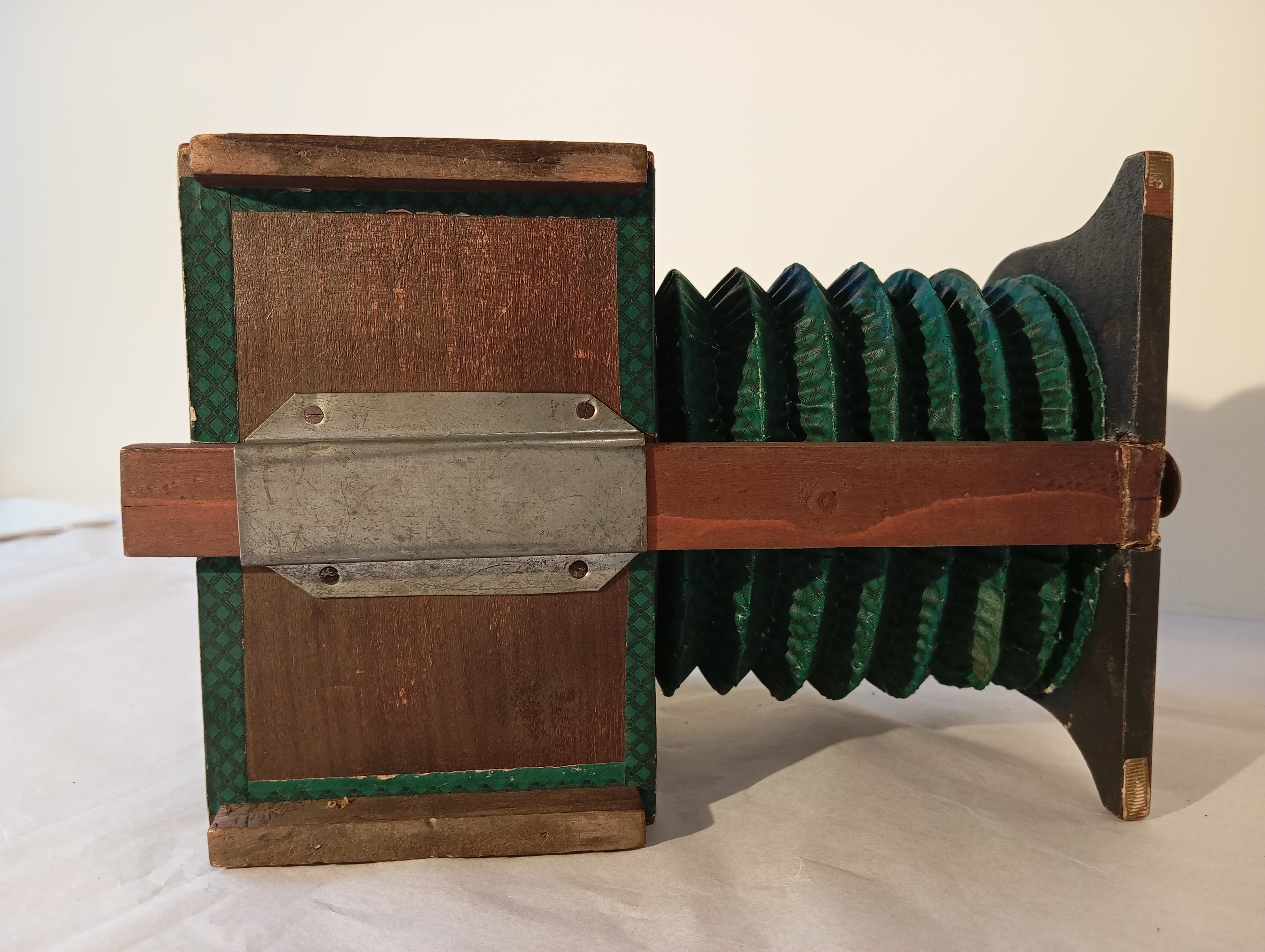 |
Figure MNC-M01040.2 – Bottom View |
| Photo © Ana Mendes. |
This is a viewer for paper dioramas characterized by the soft bellows for adjusting the viewing lens. It is an example of an "optical machine" and is included in the Optical Machine Taxonomy.
It has typical features of Polyoramas Panoptique:
| • synchronized top and back flaps to control the lighting and bring out the transformations in the plaque dioramique; | ||
| • a bellows that allows for adjustment of the lens position (not focus); | ||
| • a stabilizer for the bellows (On larger models, this stick is hinged and when retracted, folds up to close over the back of the box); | ||
| • a small lens for one-eyed viewing (therefore a weak 3D effect); | ||
| • softwood body with green patterned paper (like MNC-M01041 and MNC-M04936 it has the eixample grid pattern); | ||
| • a lens-frame turned in wood with a distinctive pattern: two double ridges separated by a cove or valley (see also MNC-M03371). |
This box, along with MNC-M03371, MNC-M04936 and MNC-M01039 has a top flap with a reflective surface of gold-coloured foil. Lefort seems to have wanted the front-illumination to have a warm, sunset glow. Note that the back flap is silver-foiled.
For more on Polyoramas Panoptique you can read my discussion of the one in the Bill Douglas Cinema Museum in Exeter, UK.
Endnotes:
[*] We would like to thank Raffaella Isoardi and Valentina Malvicino for making our research possible and assisting us in every way, as well as Antoine ... for assistance in the archives.