
Monte Carlo Methods#
Dynamic programming is a method to calculate the optimal policies of a MDP. One issue with is that it requires complete knowledge about the environment, but in some problems we don’t assume complete knowledge and we call them Model-Free problems. To calculate a policy without this knowledge, the agent can only use its experience. The experience comes from the interaction of the agent with the environment.

Important
Although a model is still necessary for interaction, a full transition function is not required to perform Monte Carlo methods.
Monte Carlo Prediction#
The first step in understanding Monte Carlo methods is to evaluate the value of a given policy, denoted as \(v_\pi(s)\).
Key Idea#
The idea is to use episodes (sequences of states and actions from start to a terminal state) to estimate the value function.
Every time a state \(s\) appears in an episode, it’s called a visit.
\(v_\pi(s)\) is calculated as the average return (total accumulated reward) of all visits to state \(s\) across multiple episodes.
Important
The Monte Carlo prediction algorithm is guaranteed to converge to the true value \(v_\pi(s)\) as the number of visits to state \(s\) approaches infinity.
In practice, a finite number of episodes, \(N\), is used to approximate \(v_\pi(s)\). Additionally, instead of averaging returns for every visit to a state, a common approach is to only average the returns from the first visit of each state in an episode. This is called First-Visit Monte Carlo; alternatively, considering every visit is known as Every-Visit Monte Carlo.
Algorithm 5 (Monte Carlo Prediction)
\(\begin{array}{l} \textbf{Inputs}:\ \text{A policy } \pi \text{ to be evaluated}, N\ \text{the number of episodes}\\ \textbf{Output}:\ \text{The value function} V_\pi\\ \textbf{Initialize}: \\ \quad\quad V_\pi(s) \in \mathbb{R}, \text{arbitrarily, for all } s \in S \\ \quad\quad Returns(s) \leftarrow \text{an empty list, for all } s \in S\\ \textbf{Repeat } \text{for } N \text{ episodes:}\\ \quad\quad \text{Generate an episode using } \pi: S_0, A_0, R_1, S_1, R_2, \dots, S_{T-1}, A_{T-1}, R_T\\ \quad\quad G \leftarrow 0\\ \quad\quad \textbf{Repeat } \text{for each step } t = T-1, T-2, \dots, 0:\\ \quad\quad\quad\quad G \leftarrow \gamma G + R_{t+1}\\ \quad\quad\quad\quad \textbf{if } S_t \notin S_0, S_1, \dots, S_{t-1}:\\ \quad\quad\quad\quad\quad\quad \text{append } G \text{ to } Returns(S_t) \\ \quad\quad\quad\quad\quad\quad V_\pi(s_t) \leftarrow avg(Returns(S_t)) \end{array} \)
Activity
Consider the following episode.
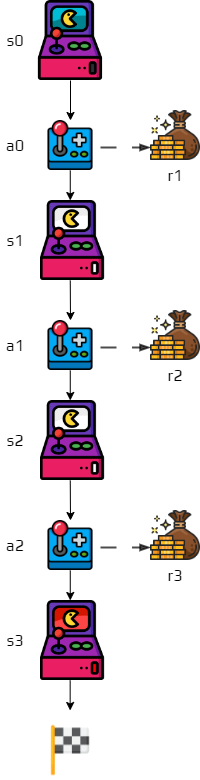
In this episode, one state is visited twice.
Calculate the return \(G\) for this state for both the first and every visit.
Mont Carlo Estimation of Action Values#
Activity
How can you apply Monte Carlo methods when you don’t have a model?
It changes the way the policy is estimated. In this case we apply this method to a state-action pair because, we want to estimate \(q^*(s,a)\). Thus, we will average the returns for each pair state-action.
Activity
Discuss what problems occur with this method.
Due to this problem, all the actions need to be visited to obtain a good estimate. It is similar to the multi-armed bandit problem in which we were trying to balance exploration and exploitation.
Note
Techniques from multi-armed bandit problems, such as \(\epsilon\)-greedy strategies, can be applied to balance exploration and exploitation.
Monte Carlo Learning#
Monte Carlo methods not only estimate the value function but also allow for policy improvement. Once we evaluate a policy, we can improve it iteratively.
On-Policy vs. Off-Policy#
There are two primary approaches to learning with Monte Carlo:
On-policy methods: The agent learns the value of the policy it is currently following.
Off-policy methods: The agent learns the value of a different policy (called the target policy) while following a separate behavior policy for exploration.
On-policy Method#
An on-policy agent uses a soft policy (a policy that has non-zero probabilities for all actions) and gradually shifts toward a deterministic, optimal policy.
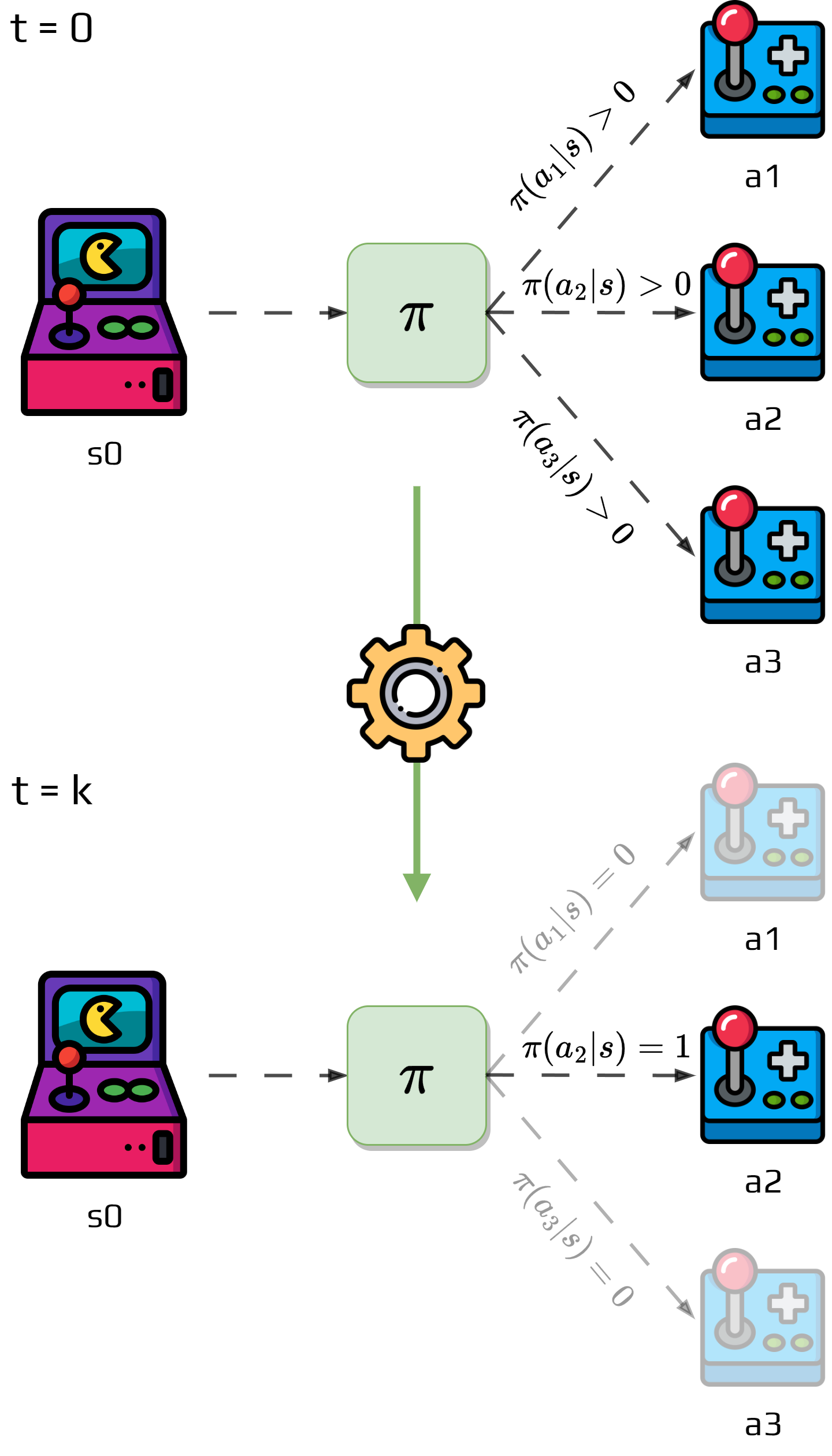
There are many types of soft policies for On-Policy Monte Carlo methods, but the one we will see is the \(\epsilon\)-greedy policy.
Nongreedy actions are given minimal probability of selection \(\frac{\epsilon}{|A|}\).
The greedy action gets the remaining probability \(1 - \epsilon+\frac{\epsilon}{|A|}\).
Algorithm 6 (\(\epsilon\)-greedy policy)
\(\begin{array}{l} \textbf{Inputs}:\\ \quad\quad \text{Small}\ \epsilon > 0 \\ \quad\quad N\ \text{number of episodes} \\ \textbf{Output}:\ \text{A policy} \pi\\ \textbf{Initialize}: \\ \quad\quad \pi \rightarrow \text{an arbitrary}\ \epsilon\text{-soft policy}\\ \quad\quad Q(s,a) \in \mathbb{R}\ \text{(arbitrary), for all}, s\in S, a\in A\\ \quad\quad Returns(s,a) \leftarrow \text{an empty list, for all } s \in S, a\in A\\ \textbf{Repeat } \text{for } N \text{ episodes:}\\ \quad\quad \text{Generate an episode using } \pi: S_0, A_0, R_1, S_1, R_2, \dots, S_{T-1}, A_{T-1}, R_T\\ \quad\quad G \leftarrow 0\\ \quad\quad \textbf{Repeat } \text{for each step } t = T-1, T-2, \dots, 0:\\ \quad\quad\quad\quad G \leftarrow \gamma G + R_{t+1}\\ \quad\quad\quad\quad \textbf{if } S_t \notin S_0, S_1, \dots, S_{t-1}:\\ \quad\quad\quad\quad\quad\quad \text{append } G \text{ to } Returns(S_t, A_t) \\ \quad\quad\quad\quad\quad\quad Q(S_t,A_t) \leftarrow avg(Returns(S_t, A_t))\\ \quad\quad\quad\quad\quad\quad A^* \leftarrow \arg\max_{a} Q(S_t,a)\\ \quad\quad\quad\quad\quad\quad \textbf{for all}\ a \in A:\\ \quad\quad\quad\quad\quad\quad\quad\quad \pi (a|S_t) \leftarrow \begin{cases} 1-\epsilon + \epsilon /|A| & \text{if}\ a=A^*\\ \epsilon /|A| & \text{if}\ a\neq A^*\end{cases}\\ \end{array} \)
This algorithm guarantee that for any \(\epsilon\)-soft policy \(\pi\), any \(\epsilon\)-greedy with respect to \(q_\pi\) is guaranteed to be better than or equal to \(\pi\).
Proof. It is assured by the policy improvement theorem:
Thus, by the policy improvement theorem \(\pi'\geq\pi\).
Note
It achieves the best policy among the \(\epsilon\)-soft policies.
Off-policy methods#
On-policy methods learn action values for a near-optimal policy, because the exploratory part of the method always generate a small number of less optimal actions.
Another approach is to use two policies, one that is learned and that becomes the optimal policy called the target policy, and the other that contains the exploratory component called the behavior policy.
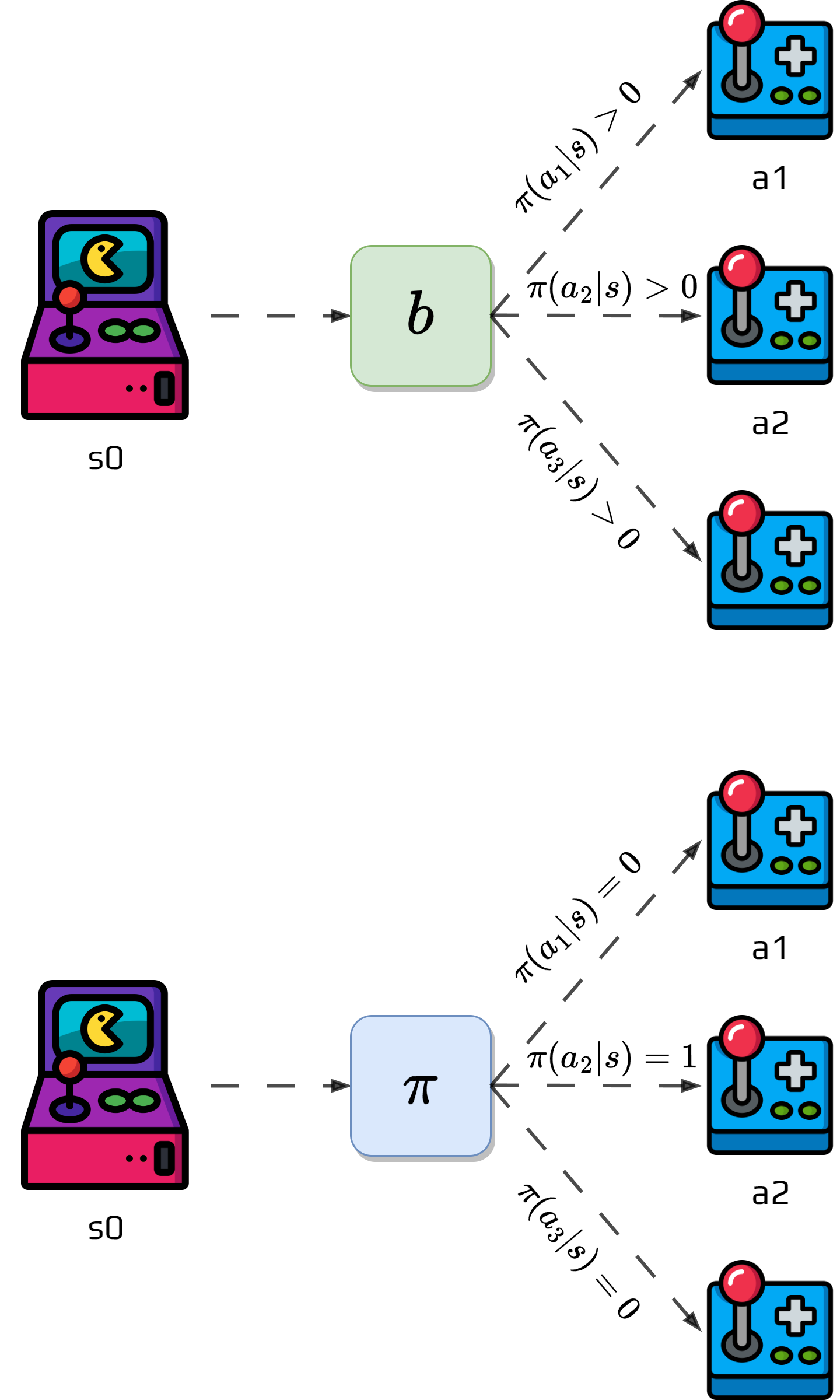
Using two different policies requires to redefine how we estimate the value function of the target policy and how we can improve it.
Prediction problem#
Let’s simplify the issue for a moment and consider the following problem.
The target and behavior policies are fixed and we just try to estimate \(v_\pi\). We don’t have episodes generated by \(\pi\); only episodes generated by the behavior policy \(b\) with \(\pi\neq b\). The only option is to use the episode generated by \(b\) to estimate \(\pi\).
Assumption 1 (Coverage)
Every action taken under \(\pi\) is also taken under \(b\), meaning, \(\pi(a|s)>0\) implies \(b(a|s)>0\).
Activity
Why is this assumption important?
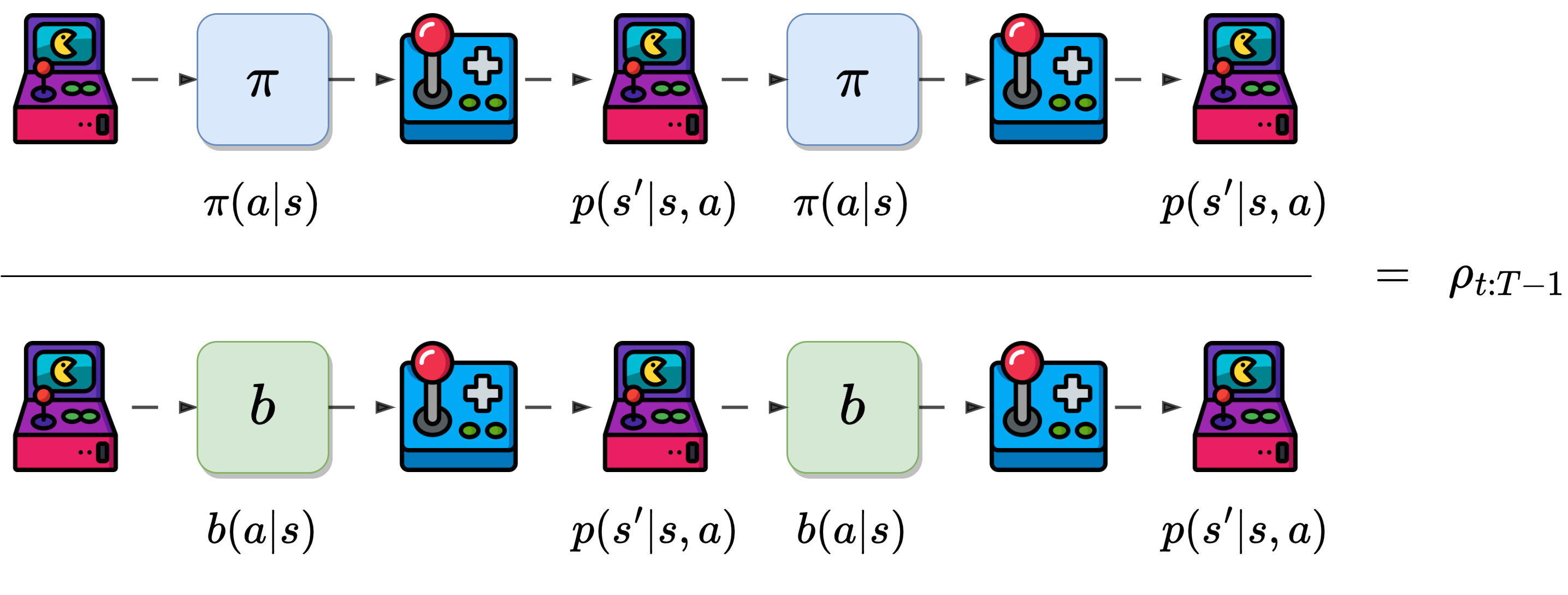
In Off-policy methods, the action values are estimated using importance sampling. Importance sampling takes the returns of the trajectories, and weights them relatively to their probability of occurring in both policies. It is called the importance-sampling ratio.
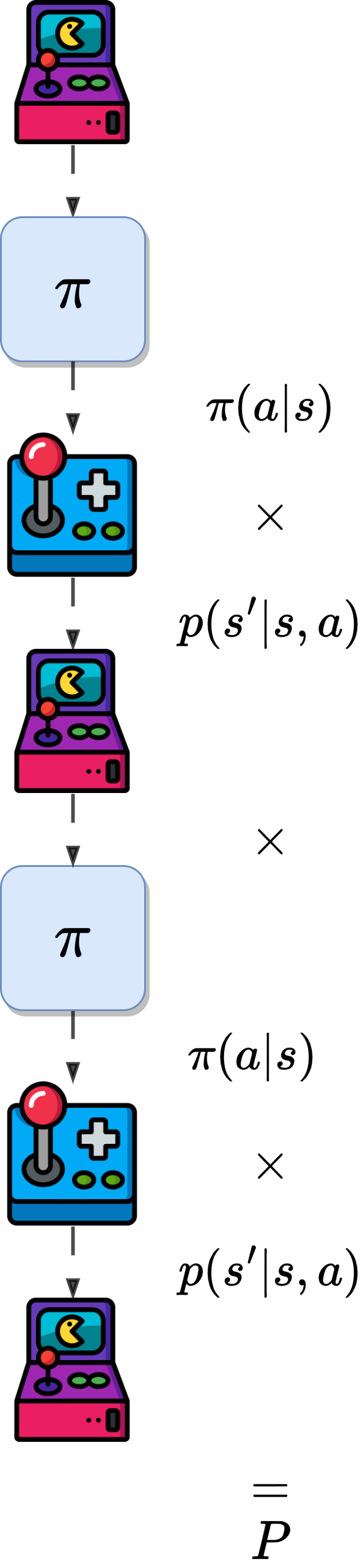
Concretely, giving a starting state \(s_t\); the probability of the subsequent state-action trajectory \(a_t,s_{t+1},a_{t+1},\dots,s_T\) occurring under \(\pi\) is:
The following figure illustrate how the probability can be calculated:
Definition 10 (Importance-sampling Ratio)
Again, it can be illustrated by the following figure:
Important
The importance sampling ratio ends up depending only on the two policies and the sequence not on the MDP.
We wish to estimate the expected returns under the target policy \(\pi\).
We have the returns \(G_t\) under \(b\).
The expectation \(\mathbb{E}[G_t|s_t=s]=v_b(s)\) cannot be averaged to obtain \(v_\pi\).
We use the ratio \(\rho_{t:T-1}\) to transform the returns to have the right expected value:
Concretely:
We define \(\mathcal{T}(s)\), the set of all times steps in which state \(s\) is visited.
We use it to obtain the value function update:
Note
It considers that we have the entire trajectories to update it.
We can modify it to have an incremental implementation. Suppose we have a sequence of returns \(G_1, G_2, \dots, G_{n-1}\), all starting in the same state, and with corresponding random weight \(W_i = \rho_{t_i:T(t_i)-1}\).
We want can rewrite the previous equation:
To obtain an incremental implementation we need to maintain for each state the cumulative sum \(C_n\) of the weights given the first \(n\) returns.
The update rule for \(V_n\) is:
with
Important
We saw this in the multi-armed bandit!
We can now write an algorithm:
Algorithm 7 (Off policy prediction)
\( \begin{array}{l} \textbf{Inputs}:\\ \quad\quad \text{A target policy } \pi \text{ to be evaluated}\\ \quad\quad N\ \text{the number of episodes}\\ \textbf{Output}:\ \text{The value function} V_\pi\\ \textbf{Initialize}: \\ \quad\quad Q(s,a) \in \mathbb{R}, \text{arbitrarily, for all } s \in S, \text{for all}\ a \in A\\ \quad\quad C(s, a) \leftarrow 0\\ \textbf{Repeat}\ \text{for}\ N\ \text{episodes:}\\ \quad\quad b \leftarrow \text{any policy with coverage of}\ \pi\\ \quad\quad \text{Generate an episode using } \pi: S_0, A_0, R_1, S_1, R_2, \dots, S_{T-1}, A_{T-1}, R_T\\ \quad\quad G \leftarrow 0\\ \quad\quad W \leftarrow 1\\ \quad\quad \textbf{Repeat } \text{for each step } t = T-1, T-2, \dots, 0\ \textbf{and}\ W\neq 0:\\ \quad\quad\quad\quad G \leftarrow \gamma G + R_{t+1}\\ \quad\quad\quad\quad C(S_t, A_t) \leftarrow C(S_t,A_t) + W\\ \quad\quad\quad\quad Q(S_t, A_t) \leftarrow Q(S_t,A_t) + \frac{W}{C(S_t,A_t)}\left[G - Q(S_t,A_t)\right]\\ \quad\quad\quad\quad W \leftarrow W \times \frac{\pi (A_t|S_t)}{b(A_t|S_t)}\\ \end{array} \)
Off-policy control#
To calculate the optimal policy using an off-policy method, we consider the policy \(\pi\) to be a greedy policy. After each update of the value function, we assign the best action to the policy.
Algorithm 8 (Off policy control)
\( \begin{array}{l} \textbf{Inputs}:\\ \quad\quad N\ \text{the number of episodes}\\ \textbf{Output}:\ \text{A policy}\ \pi\\ \textbf{Initialize}: \\ \quad\quad Q(s,a) \in \mathbb{R}, \text{arbitrarily, for all } s \in S, \text{for all}\ a \in A\\ \quad\quad C(s, a) \leftarrow 0\\ \quad\quad \pi(s) \leftarrow \arg\max_a Q(s,a)\\ \textbf{Repeat}\ \text{for}\ N\ \text{episodes:}\\ \quad\quad b \leftarrow \text{any policy with coverage of}\ \pi\\ \quad\quad \text{Generate an episode using } \pi: S_0, A_0, R_1, S_1, R_2, \dots, S_{T-1}, A_{T-1}, R_T\\ \quad\quad G \leftarrow 0\\ \quad\quad W \leftarrow 1\\ \quad\quad \textbf{Repeat } \text{for each step } t = T-1, T-2, \dots, 0\ \textbf{and}\ W\neq 0:\\ \quad\quad\quad\quad G \leftarrow \gamma G + R_{t+1}\\ \quad\quad\quad\quad C(S_t, A_t) \leftarrow C(S_t,A_t) + W\\ \quad\quad\quad\quad Q(S_t, A_t) \leftarrow Q(S_t,A_t) + \frac{W}{C(S_t,A_t)}\left[G - Q(S_t,A_t)\right]\\ \quad\quad\quad\quad \pi(S_t) \leftarrow \arg\max_a Q(S_t,a)\\ \quad\quad\quad\quad \textbf{If} A_t \neq \pi(S_t)\ \textbf{Then}\text{ exit inner loop (procceed to next episode)}\\ \quad\quad\quad\quad W \leftarrow W \frac{1}{b(A_t|S_t)}\\ \end{array} \)
Summary#
Here is a comparison of On-Policy and Off-Policy Monte Carlo methods:
On-Policy |
Off-Policy |
|---|---|
Generally simpler |
Requires additional concepts such as importance sampling |
Policy is evaluated and improved simultaneously |
Uses data generated by a different policy (behavior policy) |
Converges faster but explores less broadly |
Greater variance and slower convergence due to importance sampling |
Less powerful but easier to implement |
More powerful and can use any exploratory behavior |
By understanding and applying these Monte Carlo techniques, agents can learn optimal policies in model-free environments through experience, enabling them to adapt to dynamic and complex scenarios.