Rod Bantjes, “RB-03_Graphoscope.html,” created 18 August, 2025; last modified, 18 August, 2025 (https://people.stfx.ca/rbantjes/).
Graphoscope
Rod Bantjes Collection, #RB-03
French ca. 1880
Dimensions (open): H=23 cm, W=13.4 cm, D=21.1 cm; (closed): H=4.1 cm, W=13.4 cm, D=21.1 cm
Lens: ⌀=9 cm, ƒ=23 cm
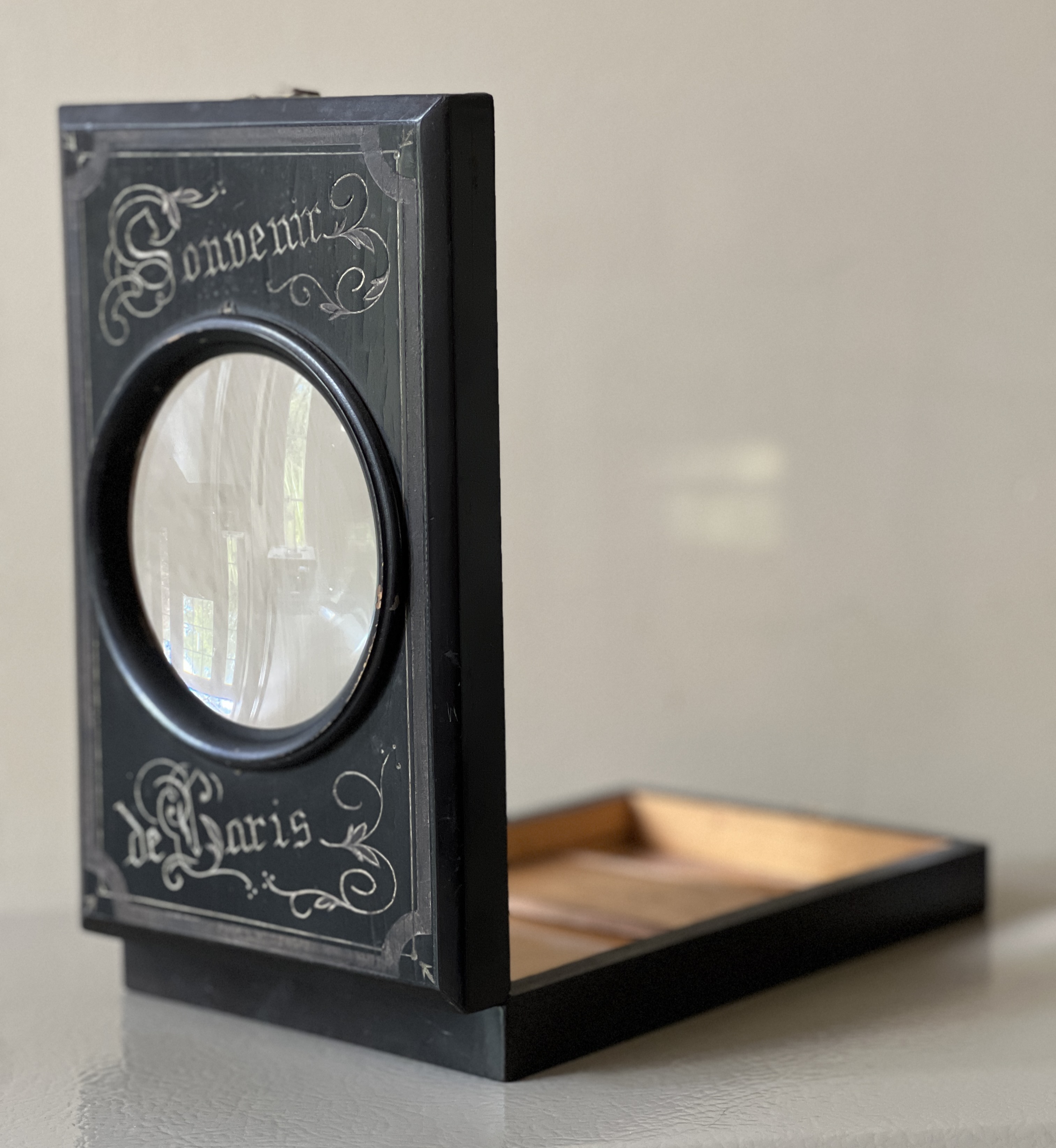 |
Figure RB-03.1 –Graphoscope |
| Photo © Rod Bantjes. |
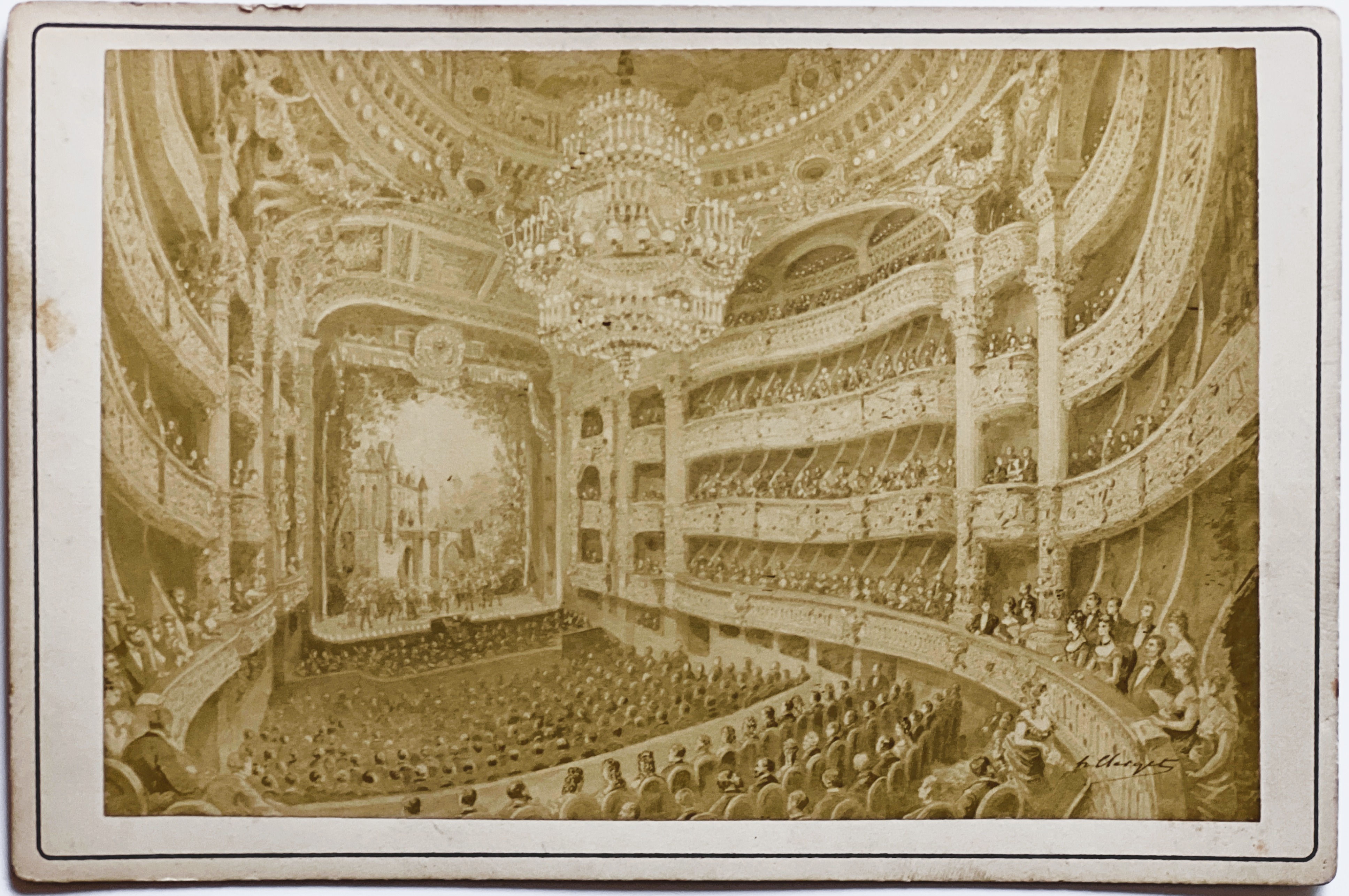 |
Figure RB-03.2 –Salle de l'opera |
| This card came with the graphoscope. It is a photograph of a drawing in a form of wide-angle projection called hybrid projection. Albumen print: 9.5 x 14.3 cm; cardboard backing: 10.9 x 16.4 cm. Photo © Rod Bantjes. |
This is a biconvex lens viewer for late 19th-century photographic formats. It is an example of an "optical machine" and is included in the Optical Machine Taxonomy where it is a member of the genus "Mono-Graphoscope" and the family Graphoscope.
18th-Century Tech:The graphoscope was an 18th-century 3D technology applied to photographic prints. John Rowsell's choice to patent this instrument in 1861 is curious since the far superior 3D technology of the stereoscope had recently been invented. Click here for more discussion on how the graphoscope fits within the context of other media devices.
Drawings in Hybrid Projection:This viewer came with a set of 12 carte de visite-sized images, four of which were photographs of drawings. Figure RB-03.2 is one of these: it depicts the interior of an opera-house rendered in a wide-angle projection known as "hybrid projection." Similar images of opera interiors in hybrid projection were made for another photographic optical machine, the Alethoscope , as well as for the polyorama panoptique, popular in the photographic era (the 1850s on). These images are a return to an 18th-century look.
Features:This example is one of the cheapest versions of the graphoscope. It is made with a light hardwood, perhaps boxwood, with a black laquered finish. The hardware is made from thin stamped metal, in some cases affixed with nails (a mark of cheap construction in the 19th century).
This viewer is missing its image-plate – a card-holder that slides on a track, forward or back to adjust for the size of the image and for the best 3D effect.
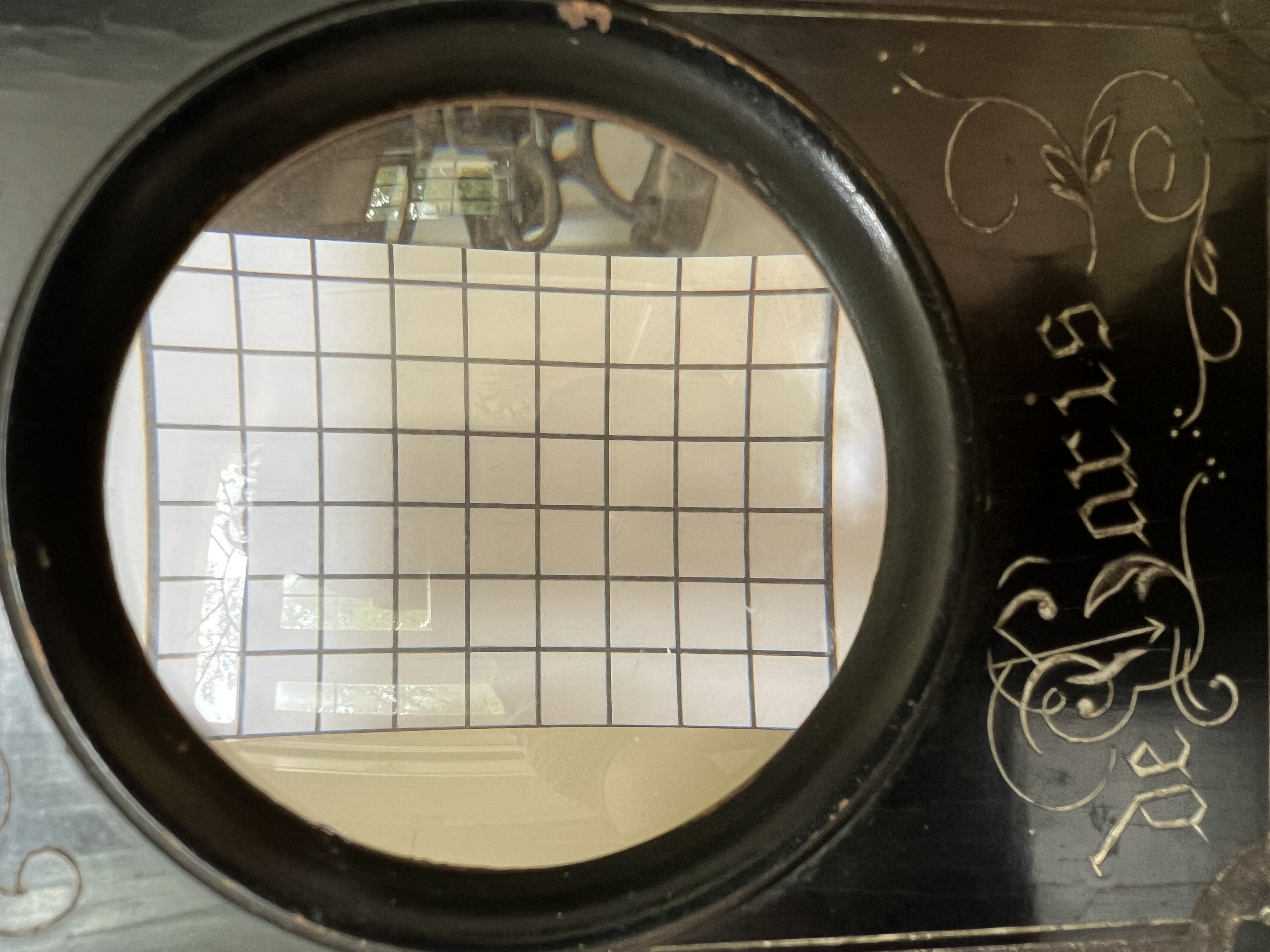 |
Figure RB-03.3 –Lens Distortion |
| Photo © Rod Bantjes. |
Lens Distortion:
Graphoscope lenses have shorter focal lengths (this one is 33 cm) which are more powerful than those in 18th-century optical machines (with typical focal lengths of around 60 cm). They can be brought closer to the surface of the image and they magnify it more. In this way they highlight the imperfections of the surface, which may have been thought more acceptable for photographs with their crisp detail, than for the old copper-plate engravings.
The editor of The British Journal of Photography complained in 1875 that the high magnification of the graphoscope lens made it unsatisfactory for architectural views where the linear grid revealed "a sadly-pincushioned shape" (see Figure RB-03_3).[1] He thought it more suited for subjects like flower arrangements (see below).
Given that this distortion is seen slightly differently by the left and right eyes, it may contribute to a pseudo-disparity effect that enhances the 3D illusion. The editor of Camera Craft recommended an experimental test of this hypothesis that I must try.[2]
Chromatic Aberration and 3D: Most, perhaps all, optical machine lenses suffer from chromatic aberration. What this means is that they bend light at different angles depending on the colour of the light. Some people, including the editor of The British Journal of Photography, thought that this would make objects of different colours appear at different depths in a scene. I am skeptical of the idea that this phenomenon could enhance the 3D effect of an image. The editor was convinced that it could work, but only for specially-chosen scenes. He writes:
| If ...a group of flowers be photographed on a white ground, the most prominent centre flower being coloured a very strong red, some others farther from the centre, and of less importance as respects the composition, being respectively yellow, blue, or violet, the leaves being green, it will be found that, when viewed through a simple magnifying glass of the graphoscope order, in proportion as the colours are more or less frangible so will be the apparent distance from the eye of the objects thus coloured. The red central flower will stand out in bold relief, the green leaves will range farther back, while the blue or violet flowers will retire farthest back of all. Thus the very defect of the common graphoscope objective forms its chief merit when used in the examination of objects of the class of which we have spoken.[3] |
If the editor's opinion were widely shared by photographers for the graphoscope, then we would see many images with this sort of colour composition. It is not something that I have so far observed.
Endnotes:
[1] "A Combination Graphoscope," The British Journal of Photography XXII, no. 768 (1875), 37.
[2] "The Graphoscope," Camera Craft 14 (1907).
[3] "A Combination Graphoscope," 37.