Rod Bantjes, “FB-BO-21_Optical_Theatre.html,” created 6 April, 2026; last modified, 6 April, 2026. (https://people.stfx.ca/rbantjes/).
Optical Theatre
François Binétruy Collection,[xxx] #FB-BO-21
Austrian, ca. 1780
Dimensions: H=37.5 cm, W=50 cm, D=65.6
⌀=16 cm, ƒ=44.4 cm
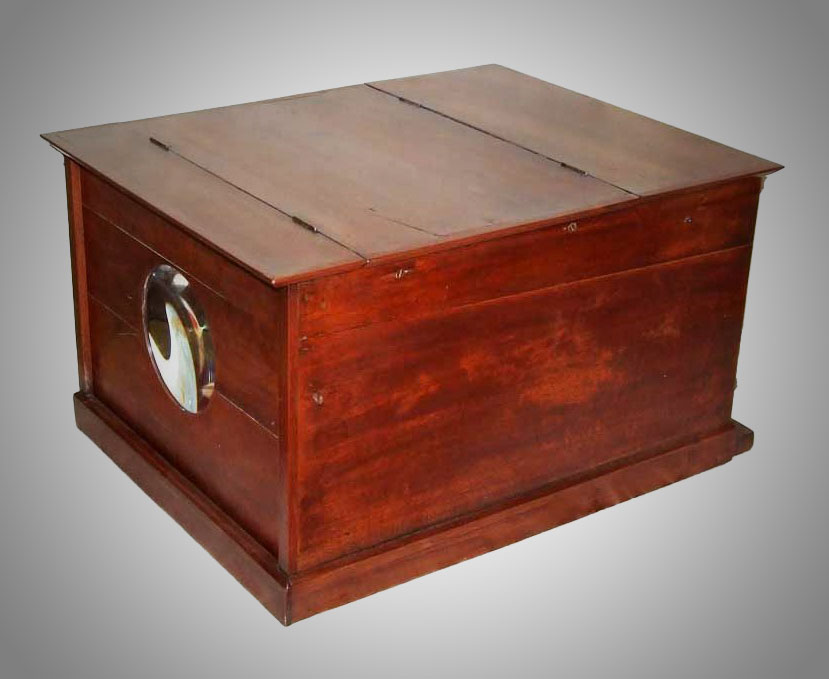 |
Figure FB-BO-21.1 –Optical Theatre |
| Photo © François Binétruy. |
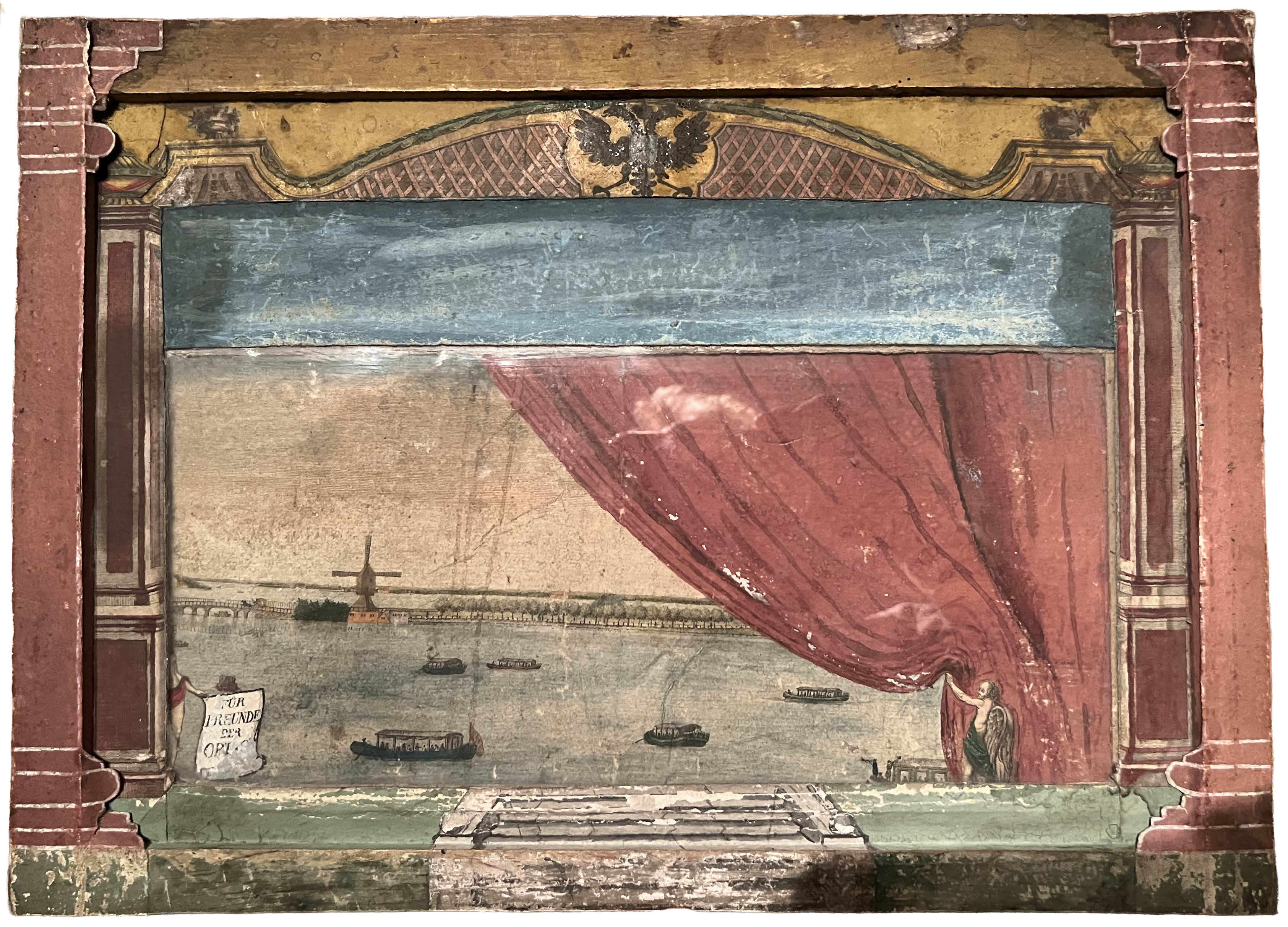 |
Figure FB-BO-21.2 – First Proscenium and Introductory Scene |
This frame is an alternate to the lens-frame at the front of the box. It would be open to the stage and would not frame a vue d'optique as it does here. Photo © Ana Mendes. |
This is an 18th-century single-lens viewing device for enhancing the 3D effect of pierced vues d'optique. It is unique in having de Loutherbourg-style coulisses in front of the vues d'optique backdrop to extend the spatial effect forward. It is an example of an "optical machine " and is included in the Optical Machine Taxonomy.
For those who Love Optics: The introductory sheet that faces the audience when they first look into this "theatre" is a scene across the Elbe River in Germany (Figure FB-BO-21.2). It is a vue d'optique that has been over-painted with two additions: on the right, a winged Greek philosopher draws back a theatrical grand drape to reveal the scene; on the left another classical-inspired figure unrolls a scroll that reads "Für Freunde der Optik" which I am loosely translating as "For those who Love Optics." There are a number of features of this box that would please those well-read in 18th-century optics.
The Lens: The lens is 16 cm in diameter. Optical theorist Joseph Harris (1775) recommends a diameter of at least 10 cm so that the viewer can easily look through with both eyes.[xxx] The prints, or that portion of them visible between the two side-pillars, are about 40 cm wide. For this width, Harris recommends a focal length of 60 to 66 cm. The focal length of this lens, at 44 cm, falls far short. However, the distance between the lens and the image is almost exactly the focal length. Harris recommends this, not because it has anything to do with focusing the image, but because at this distance the lines of sight of the two eyes will be parallel, just as they are when looking at a great distance. This binocular effect was thought to enhance the spatial illusion of the print.
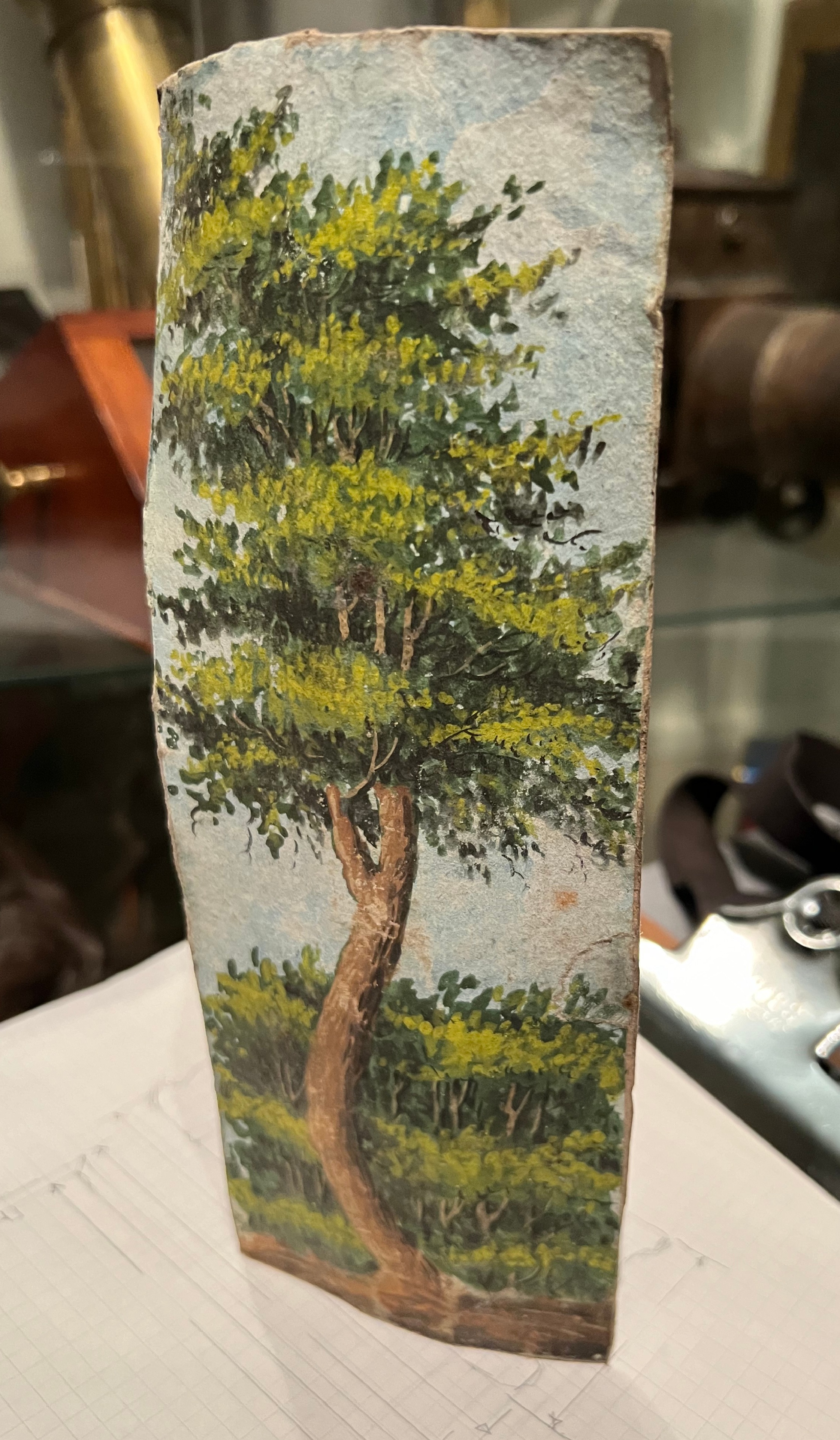 |
Figure FB-BO-21.3 – Stage Flat |
| Photo © François Binétruy. |
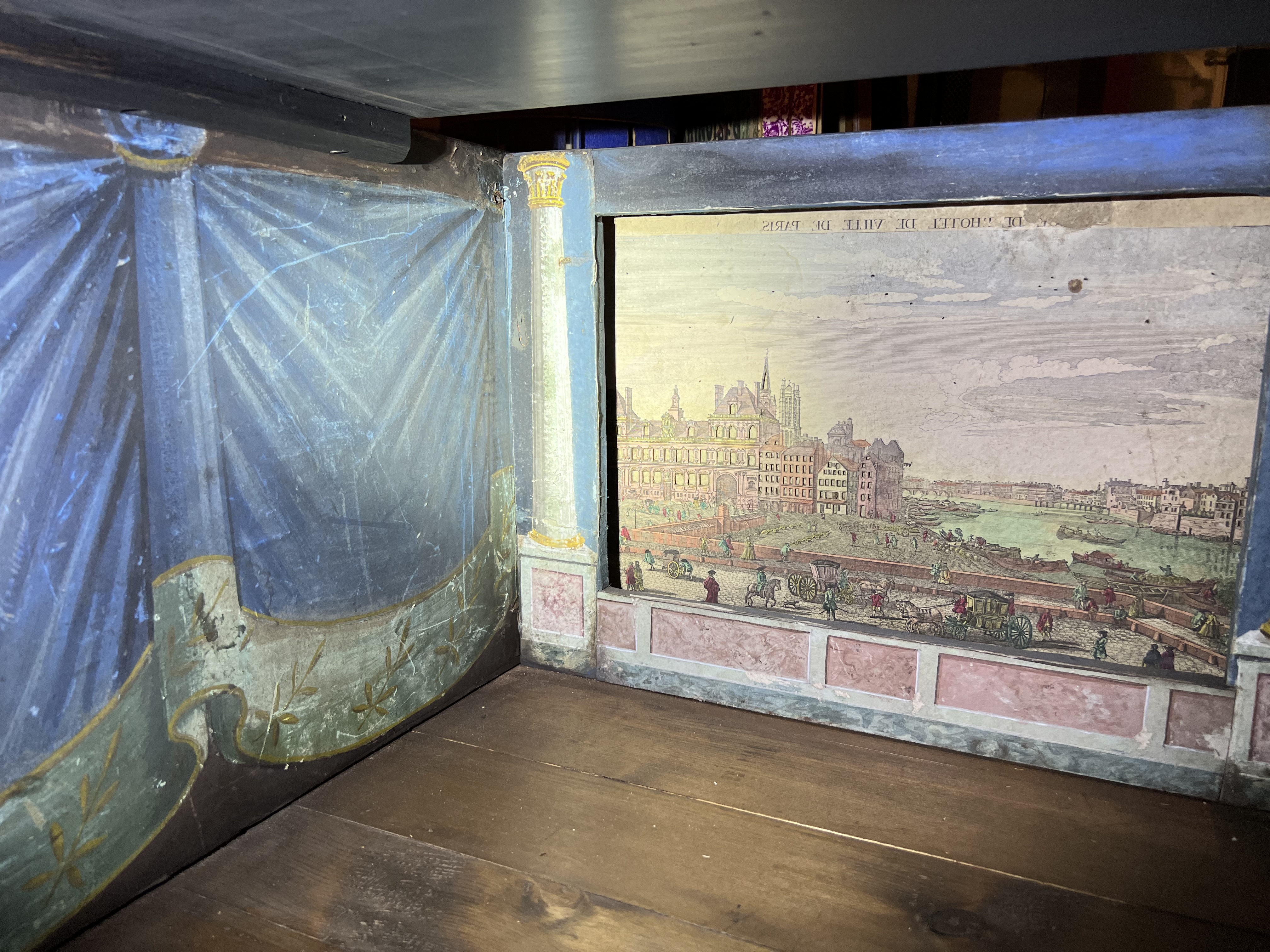 |
Figure FB-BO-21.4 – Second Proscenium |
| Photo © Ana Mendes. |
Coulisses: Eighteenth-century theorists like William Porterfield admired the theatrical coulisse because it exploited three perceptual indexes of spatial depth: focus of the eyes; binocular convergence and the principle of visual overlap.[xxx] This box uses a double coulisse-frame that can be positioned at the front of the box (in place of the lens – Figure FB-BO-21.2). There is a second coulisse-frame that serves as a proscenium behind which the vues d'optique are exhibited (Figure FB-BO-21.4). Finally, and most unusually for optical boxes, there is a collection of stage-flats on stands that can be positioned on the floor of the box framing or overlapping the stage-scene (Figure FB-BO-21.3). These include four trees, a groundrow depicting an open balustrade and two stands that appear to have lost their images.
Faux Terrain: The second, or inner proscenium (Figure FB-BO-21.4) is modelled in relief. This is close to, but not quite the kind of 3D modelling that was, in the 19th century, known as faux terrain. It appears first in optical machines, in the mid-19th century (e.g. FB-POL-35, WN-RB02), then in panoramas in the late 19th century. Here it appears in embryo.
De Loutherbourg Influence: The set designer Philippe de Loutherbourg, during his tenure at the Drury Lane Theatre from 1771 onward, famously "naturalized" sets by breaking up coulisses into stand-alone components and by adding faux terrain, just as this optical theatre does. Previously, baroque theatres had used coulisse-frames in successive ranks, like in a kulissentheater. It is likely that the scenography of this box was inspired by de Loutherbourg's innovations. For this reason I date it to the late 1770s or 1780.
Theatre Two Ways: The interior of the box can be exhibited with or without the lens. The entire front-face, including the lens, lifts out and, in place of it, the first proscenium can be slotted in (Figure FB-BO-21.2). The only other box with a similar feature is the mondo niovo #MNC-M01034 with a removable lens-array. In that case I speculated that the intent was open-display of the decorative interior. In the case of this optical theatre I think it is even more likely that the lens-off form was for display, perhaps to enhance the decor of an elite drawing-room or study. The lensed version was instead for individual immersive experience that transports the user to an imagined other world.
The House: In theatres, the space in front of the proscenium arch is called the "house." Mostly it is filled with seating for the audience, although it can encompass a fore-stage and an open "pit" for standing audience members. Optical machines often invoke theatre architecture, and their treatment of this space between the lens array and the proscenium arch is always rather ambiguous. Mondo niovo #MNC-M01034 treats it as an auditorium despite the fact that the actual audience is always outside it on the other side of the lenses. Other boxes, such as FB-POL-34 treat it more like a theatre foyer. In this box its walls are decorated with drapery, the intent of which is unclear (Figure FB-BO-21.4). As the surface on which the coulisses stand, it functions like a fore-stage. When the lens is off and the first proscenium is erected, it becomes the stage itself.
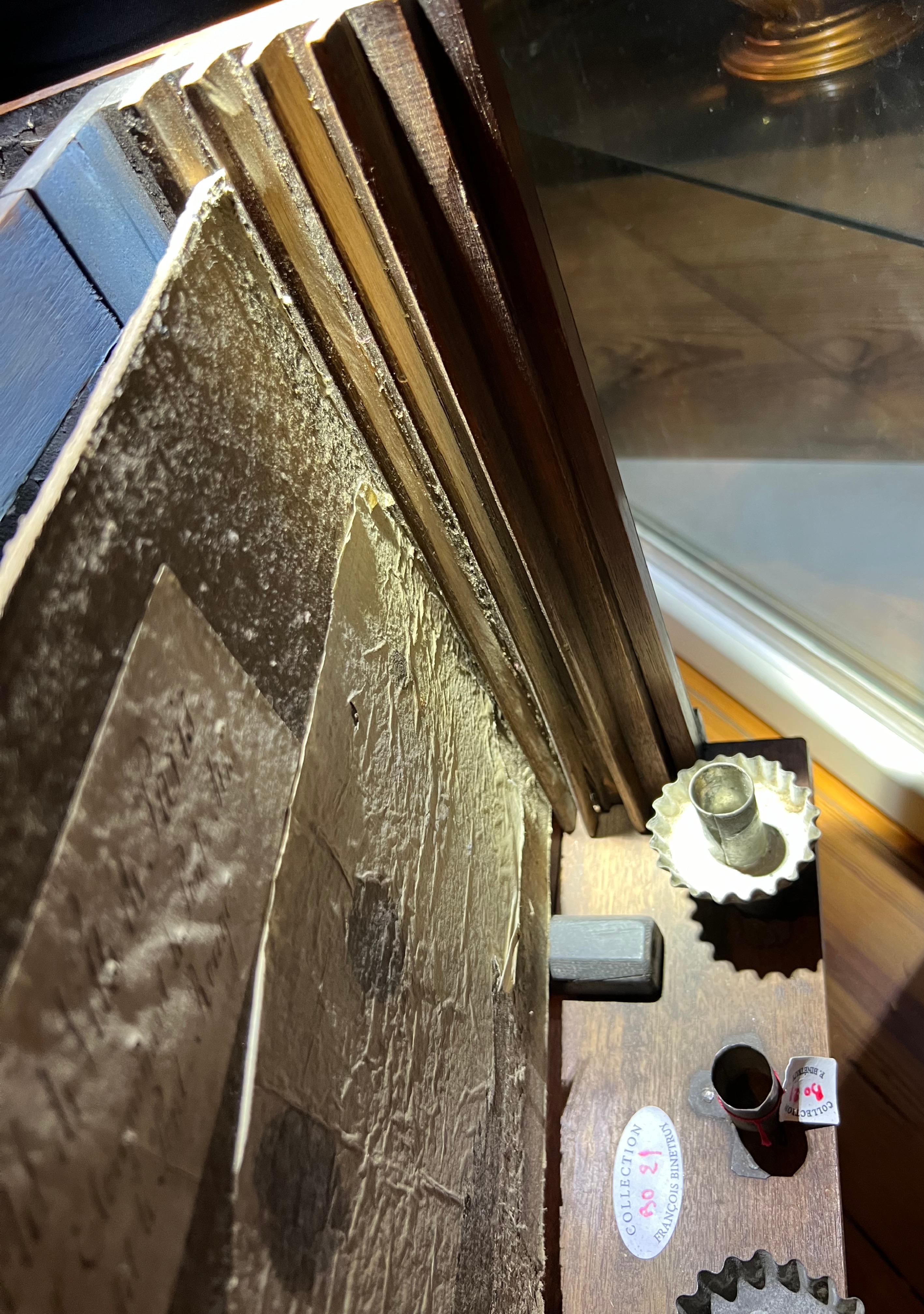 |
Figure FB-BO-21.5 – Image-Slots and Candle-Holders |
| Photo © Ana Mendes. |
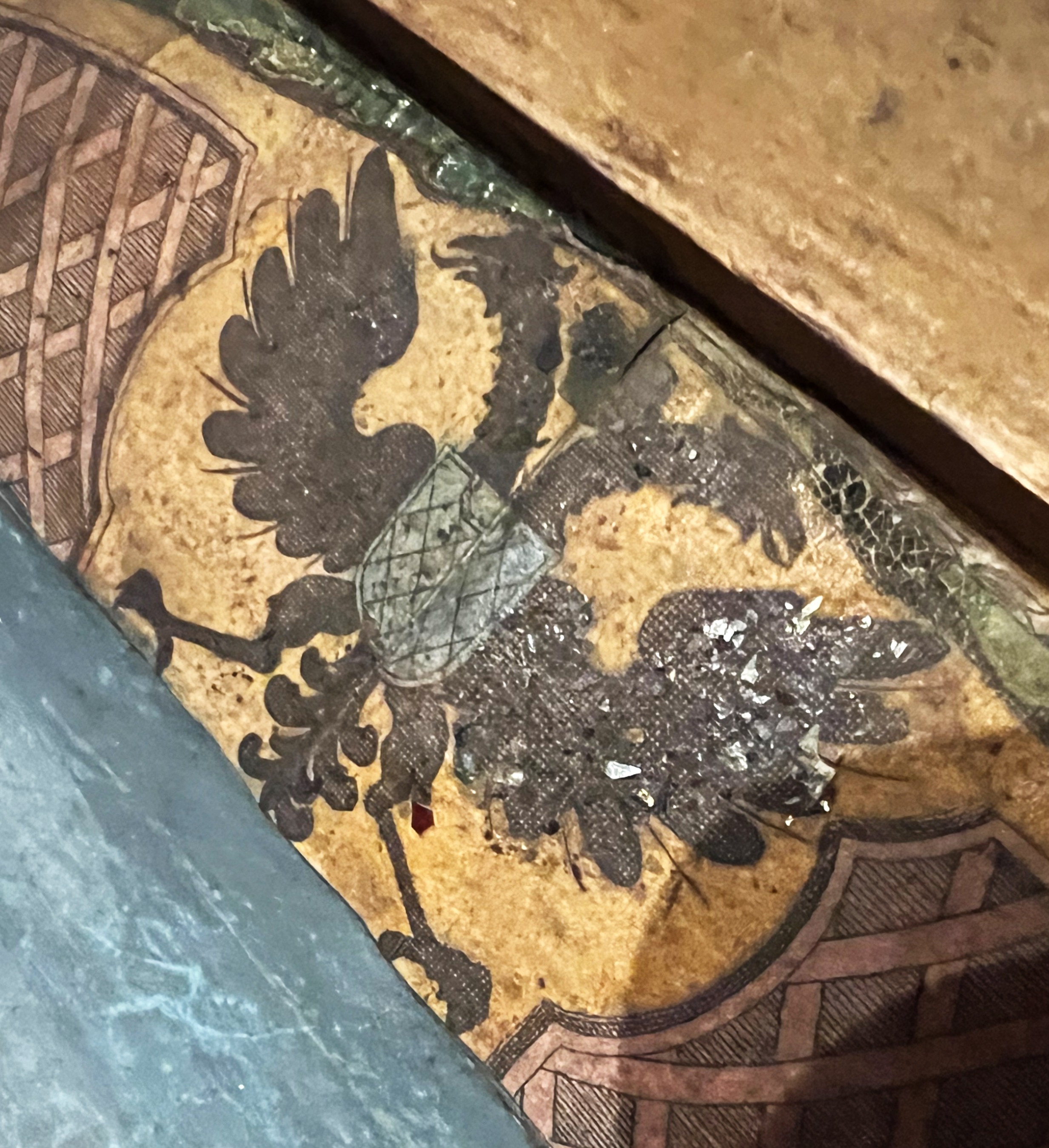 |
Figure FB-BO-21.6 – Imperial Symbol |
| Photo © Ana Mendes. |
Illumination - Flaps: You can see in figure FB-BO-21.4 that in the vue d'optique the depiction of the "Hotel de Ville de Paris" has pierced windows backed with translucent paper (Figure FB-BO-21.5). When the front lights are dimmed and the back-light increased, the scene transitions from day to night and the windows of the hotel light up. On top of the box are two hinged flaps, front and back. Typically these provide variable front and back illumination. However, the front flap is unusually narrow and is best suited for changing the two front sections. The back flap is atypical in that it exposes both the front and back of the views simultaneously. Still, it is probably the most effective means of casting light on the front of the view. In other boxes the under-surfaces of flaps are often covered in a light or reflective surface, but these are matte-black so that they cannot have been intended to reflect light in upon the views.
Illumination - Candles: Mondo niovos have candles behind the lens array for front-illumination, but there is no evidence of candle holders here, and the top flap is too narrow to safely exhaust a candle-flame. There are three candle-holders in the back and evidence of two more (Figure FB-BO-21.5). The best illuminated mondo niovo #MNC-M01033 has provision for six candles at the back, but that is balanced by two at the front plus a wide front flap. So, we can conclude that this box, at least when the lens is in place, has powerful back-illumination and relatively weak front illumination. The preference seems to be for the magic of night scenes.
Performance: The box has three image-slots that allow vues d'optique, affixed to stiff cardboard backings, to be lifted and lowered by hand into the viewing area. I am guessing that all performances began with the introductory view (Figure FB-BO-21.2). That could be raised to reveal a second view, which in turn could be raised to reveal a third (the raised curtain in the introductory scene suggests that raising may have been the preferred scene-change action). Judging from other multiple-slot viewers, three is an unusually small number. If more views were displayed by alternately raising and then lowering them into place, then two slots would suffice.
Provenance: The opening scene depicting the Elbe River in Germany with added text in German (FB-BO-21.2), plus the split eagle symbol associated with the Austrian empire (Figure FB-BO-21.6) together suggest German or Austrian manufacture. The peculiarities of design of this box suggest that it was, like many 18th-century optical machines, a one-off production, perhaps made to order by a prosperous "lover of optics."
Endnotes:
[xxx] We are grateful to M. Binétruy for allowing us access to his superb private collection of optical devices.
[xxx] Harris, Joseph. A Treatise on Optics. London: B. White, 1775.
[xxx] Porterfield, William. A Treatise on the Eye, the Manner and Phænomena of Vision. Edinburgh: G. Hamilton and J. Balfour, 1759.