Rod Bantjes, “IC-26-02_Cloth_Neomonoscope.html,” created 5 October, 2026; last modified, 5 October, 2026 (https://people.stfx.ca/rbantjes/).
Cloth Neomonoscope
Collection of DM (L‘iconomécanophile) #IC-26-02
English, ca. 1860
Dimensions (closed): H=2 cm, W=8.5 cm, D=11.8 cm; (open): H=23.6 cm, W=8.5 cm, D=11.8 cm
Lens: ⌀= 3.3 cm, ƒ= cm
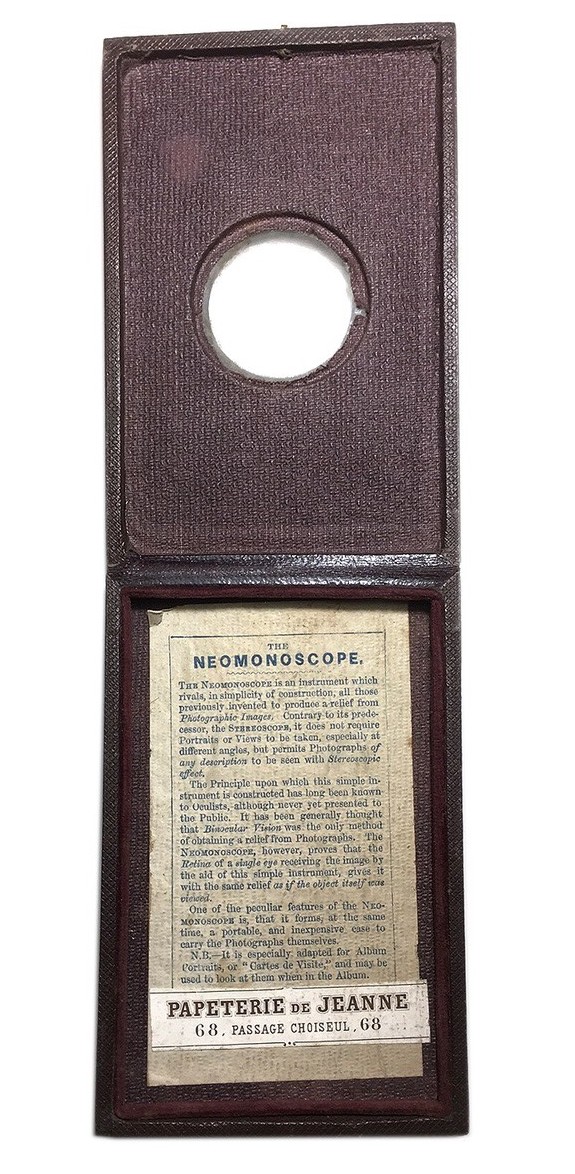 |
Figure IC-26-02.1 –Cloth Neomonoscope |
| Collection of DM (L‘iconomécanophile) Photo © DM |
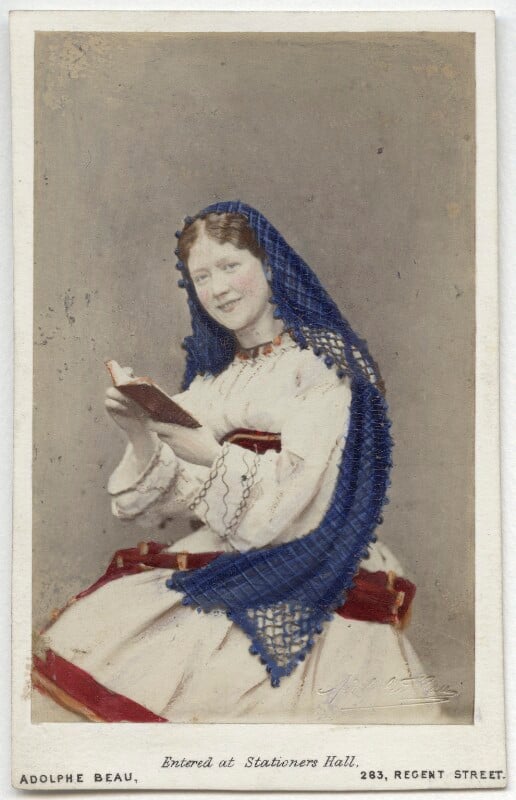 |
Figure IC-26-02.2 – Carte de Visite |
Adolphe Paul Auguste Beau, 1863, Kate Terry as Blanche de Nevers in 'The Duke’s Motto', hand-coloured albumen carte-de-visite, 8.8 x 5.6 cm (image size), © National Portrait Gallery, London. Creative Commons license 3.0
This is an example of the kind of image Beau designed his viewer for. |
This neonomoscope is a folding optical machine designed for viewing photographs in the carte de visite format (see Figure IC-26-02.2). It is included in the Optical Machine Taxonomy as a member of the genus CDV-Mono-Graphoscope in the family CDV Graphoscope.
Priority: Paul Adolphe Auguste Beau (1828 - 1910) received a provisional English patent for his neonomoscope in 1860. That makes it the first of the optical machines designed especially for photographs. It was followed by the Megalethoscope (ca. 1861), Graphoscope (1863) and Cosmoscope (ca. 1880).
3D Illusion: Beau was a London photographer who specialized in portraits of stage actors. You can see an example of his work in Figure IC-26-02.2. When viewed through the lens of the neomonoscope, the figure of the actress Kate Terry was supposed to appear fully volumetric. In his advertisement pasted to the base of the device he tells us that the neomonoscope is the first device since the Stereoscope to “produce a relief from Photographic Images.”
The Lens: The diameter of Beau’s lens is ca. 3 cm, only big enough for viewing with one eye. The spatial illusion of the optical machine is best achieved with a binocular lens that affects binocular convergence. He makes bold claims for what is at best a nearly imperceptible monocular effect: “The NEOMONOSCOPE..., proves that the Retina of a single eye receiving the image by the aid of this simple instrument, gives it with the same relief as if the object itself was viewed.” Assessments at the time were more muted. A contributor to Notes and Queries in 1862 reported that, when “a photographic portrait on a card” was viewed through the neomonoscope, the figure “appears somewhat in relief, and with some degree of stereoscopic effect.”
First Photographic Optical Machine: Beau also makes the extraordinary claim that “The Principle upon which this simple instrument is constructed has long been known to Oculists, although never yet presented to the Public.” He is forgetting the whole panoply of monocular viewers for lithographs and paper dioramas presented to the public in the decade previous (e.g. Polyoramas Panoptique). A generous interpretation is that his claim applies only to photographic viewers. He omitted it on other neomonoscopes, so perhaps this was an early example, when it still was the only device to use a biconvex lens to enhance the 3D effect of photographs.
Viewing: When set up for viewing it looks like a small mono-graphoscope with the plate or “lid” holding the lens standing upright. The instructions pasted to a different example of the device than the one illustrated here read, “The ‘carte de visite’ to be viewed should be placed standing between the Velvet Band and the front of the NEOMONOSCOPE so that it be just opposite the Lid of the Instrument, when open.” This is the simplest form of image-holder – a slot in the upholstery in what in our Figure IC-26-02.1 is at the bottom of the image. The same design was also used in the Reflectoscope. Unlike most Graphoscopes the image-position is not adjustable, so instead one tilts the lens-lid, or in Beau’s words, one “regulates according to sight by slightly moving the Glass forward.”
Viewing Albums: When opened flat as in Figure IC-26-02.1 it was meant to be used to view cartes de visite collected in albums (something that could have been achieved with a simple magnifying glass).
Variants in the Patent:
Beau’s 1860 patent description does not correspond to the known examples of surviving neomonoscopes. The following is the abridged version of the patent, so perhaps the full text includes a description of the variant discussed on this page. If not, then we cannot confidently date the Cloth Neomonoscope to 1860. Beau’s own claims (above) suggest that either he never introduced this patent version to the public or that the Cloth Neomonoscope was prior to 1860.
| My Invention consists in constructing a neomonoscope or apparatus with one glass or several glasses superposed for the purpose of obtaining a similar effect to that derived from viewing pictures in or through a stereoscope. The monoscope is a pyramidal or conical-shaped case, with a part of one of the sides removed to admit light, fitted with a flap or not as desired. The glass is fitted in the top of the apparatus, and in some cases flaps for forming, when raised, a dark chamber between the eye and the glass, are added. The bottom of the apparatus is made to slide to admit of its being entirely removed, in order to view transparent objects or others apart from the apparatus itself. The sides of the apparatus are either made rigid or to fold. I sometimes add a pocket which forms part of the sides or bottom of the apparatus to contain photographic or other representations.[1] |
From this description it sounds like a small, folding Trapezguckkasten without a diagonal mirror. One views down through the lens to the enclose image. Like the Alethoscope, it is designed to accept transparent views, whether photographs on glass or paper dioramas is unclear.[xxx] To make this work, the base would have to be turned to the light and the device held horizontally like a Lorgnette Pittoresque. This device may never have been built or commercialized. If it had been, and one were to show up for examination, then it would probably have to be categorized as a different family of optical machine from the Cloth Neomonoscope.
Beau’s patent mentions variations of the design. Three such variations appear in Casella’s Instrument Catalogue of 1871:[2]
1556. NEOMONOSCOPE, covered with plain cloth . . . 1 shilling 1557. NEOMONOSCOPE, in mahogany polished, with large lens . . 2 shillings 6 pence 1558. NEOMONOSCOPE superior, in ebony, and gilt or red; large lens . 5 shillings 6 pence |
I assume that #1556 is the the one described on this page: covered in plain cloth and worth only a shilling. I suspect that a device I am calling a Mini-Mono-Graphoscope may be #1557. It is made of mahogany and does have a slightly larger lens than #1556. It lacks the “Neomonoscope” label and the text that Beau seems so fond of attaching to his devices.
Endnotes:
[xxx] text of footnote
[1] British Patent no.823, 30th March, 1860, "A Neomonoscope or Apparatus for Viewing Photographic Pictures." cited in Patents for Inventions: Abridgements of Specifications Related to Photography, London: George Eyre and William Spottiswoode, 1872, 8.
[xxx] Timbs, John, The Yearbook of Facts in Science and Art (London: W. Kent and Co., 1861), 199.
[2] Cassella, L., Catalogue Of ...Instruments (London: D. Lane, 1871)..